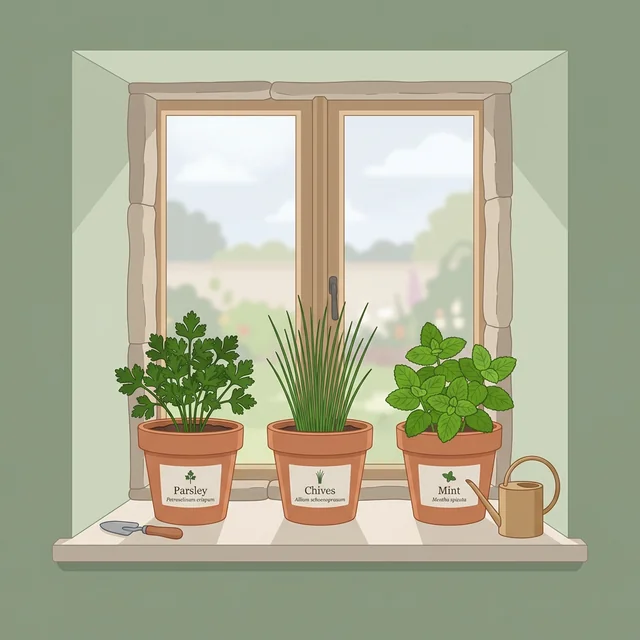
What different low-light windowsill situations usually support
| Windowsill situation | Herbs that usually fit | Main watch-out | Best next move |
|---|---|---|---|
| Bright sill with little or no direct sun | Parsley, chives, mint, sometimes basil | Basil may stay loose and slower | Keep herbs tight to the brightest part of the glass |
| Cool sill with seasonal light drop | Parsley and chives | Wet soil lingers longer in winter | Reduce the crop list or add a small grow light |
| Narrow sill that cannot hold many pots | Two or three compact herbs | Crowding blocks light and airflow | Use fewer, larger containers instead of many tiny ones |
| Weak sill with a grow light assist | Most common culinary herbs | Fixture distance becomes critical | Treat the sill and light as one station |
Low-light windowsill herb gardening works only when expectations are honest. Many homes have a sill that feels bright, decorative, and vaguely plant-friendly, but herbs care about what reaches the leaves, not about how cheerful the room feels to people. If you want the broader cluster path first, start with Small-Space Herb Gardening: Start Here for Apartments, Balconies, and Indoor Setups. If the whole setup still needs structure, pair this guide with How to Set Up a Small-Space Herb Garden That Actually Works.
The goal here is not to force a sunny-balcony herb list onto a weak sill. The goal is to build one small windowsill station that still feels worth maintaining in a home where direct sun is limited.
Quick Setup Logic
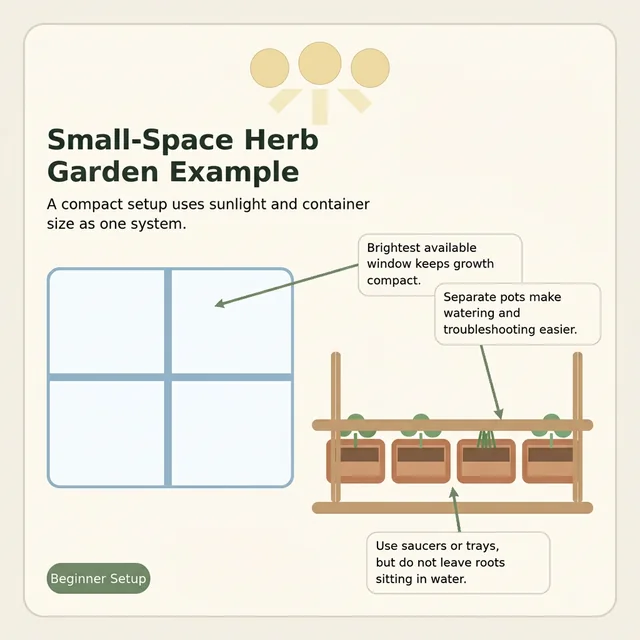
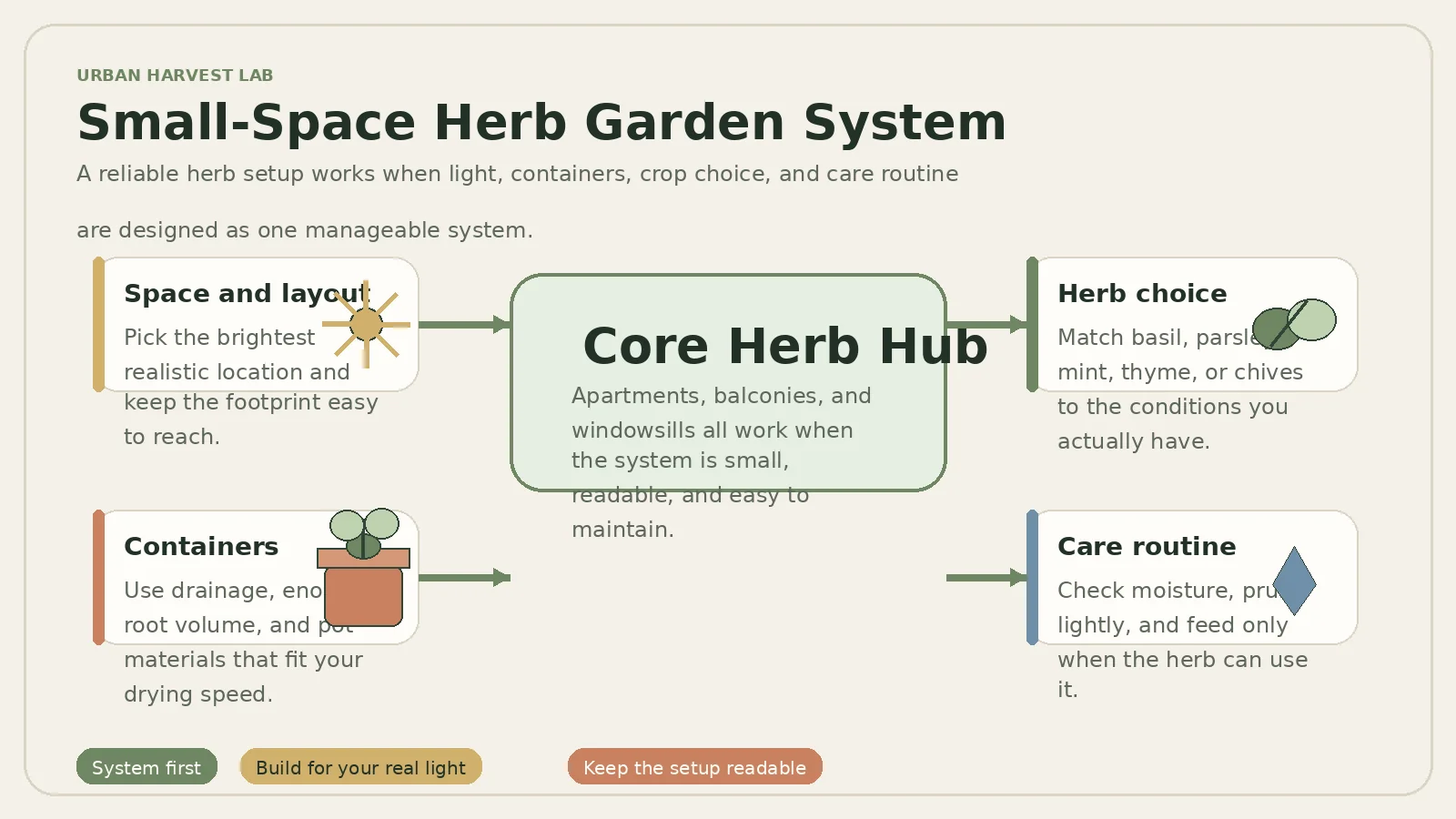
The easiest low-light windowsill herb garden usually means two to four herbs, medium containers with drainage, and every pot placed as close to the brightest part of the glass as the sill safely allows. That setup sounds simple because it should be simple. Low-light homes punish clutter faster than sunny ones.
The key rule is to keep the station readable. If you cannot quickly see which pot is stretching, staying wet too long, or leaning hardest toward the window, the setup is already too noisy for the amount of light available.
Judge the windowsill honestly before choosing herbs
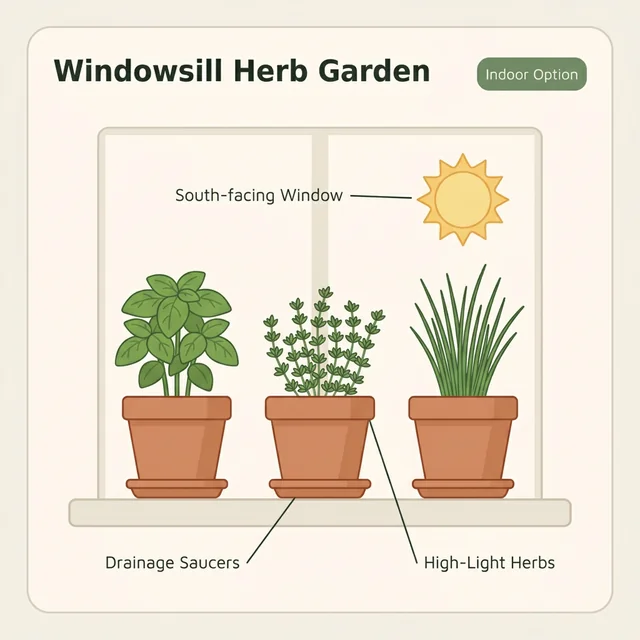
The biggest mistake in low-light homes is treating a bright room and a bright windowsill like the same thing. They are not. Herbs want the strongest usable edge of the actual window, not a nearby shelf that happens to get ambient brightness.
The glass line matters
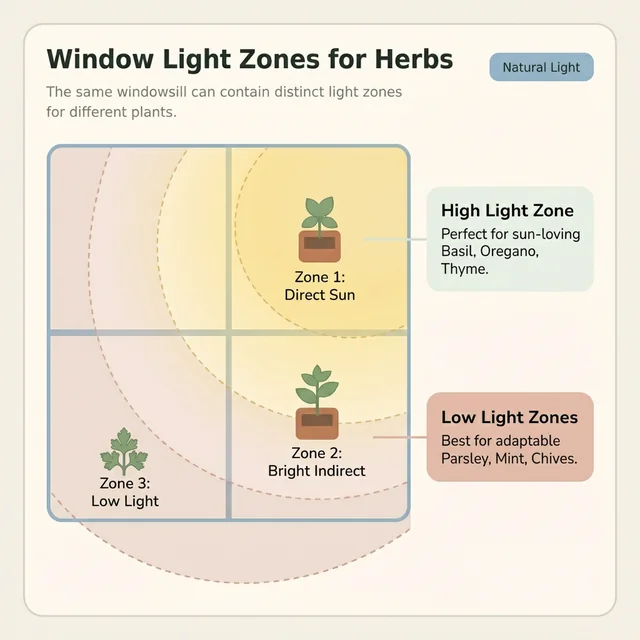
Usable light falls off quickly as you move away from the window. A pot pressed close to the brightest part of the sill can perform meaningfully better than the same pot set even a short distance deeper into the room. Curtains, insect screens, nearby buildings, and overhangs also change the result.
If you are not sure how weak the sill really is, review How Much Light Do Herbs Need? Realistic Sun and Grow Light Rules and Can Herbs Grow Indoors Without Direct Sunlight? What to Expect in Real Homes. Those two guides help you decide whether the problem is the crop choice, the placement, or the fact that the window never reaches a useful light threshold for demanding herbs.
Low light is not no light
Some low-light homes still have one decent sill that can support forgiving herbs. Others only offer short-term holding conditions. The point of diagnosis is not to declare the home good or bad. It is to identify what kind of herb station the window can realistically support.
Choose herbs that match the window, not the ideal recipe list
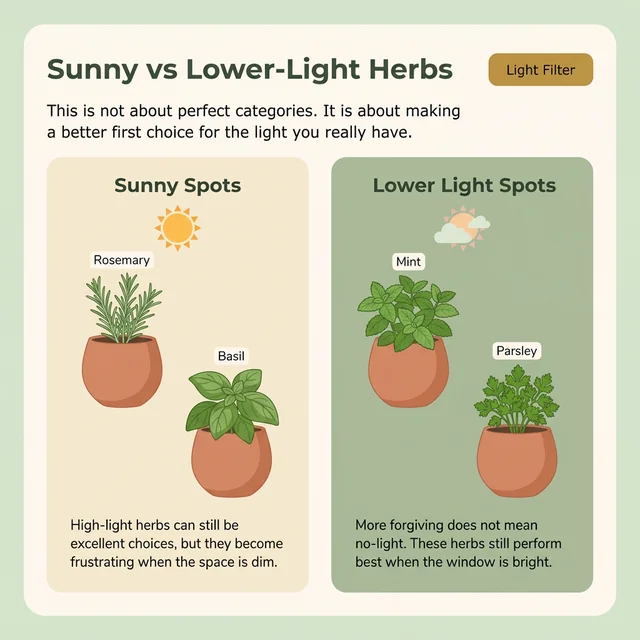
Lower-light windowsills work best when you choose herbs that still stay worthwhile there. Parsley, chives, and mint are usually the first choices because they remain more forgiving when the light is decent rather than ideal. Basil can still be satisfying, but only when the sill is brighter than many beginners assume or when you are willing to add supplemental light.
This is where Best Herbs for Small Spaces: What Grows Well in Apartments, Balconies, and Windowsills becomes useful. It helps you stop treating all herbs as one interchangeable category and start matching crops to the real window instead.
What usually disappoints first
Basil is often the first herb to tell the truth about a weak windowsill. It stretches, pales, and regrows slowly after harvest. Rosemary, oregano, and thyme can also become less satisfying indoors when the sill is soft and airflow is limited. That does not mean they are impossible. It means they are not the safest first bet in a low-light home.
A better first lineup
A practical beginner lineup for a lower-light sill is parsley, chives, and mint in its own pot, with space for a fourth herb only if the station still feels easy to read. Fewer pots usually outperform a crowded sill because each plant gets more light and the watering routine stays clearer.
Keep the whole station small and close to the glass
Low-light herb setups become harder when the footprint spreads out. One windowsill with three sensible pots is easier to manage than several small containers scattered between the sill, a shelf, and a counter.
Fewer pots, better root volume
Beginners often try to solve space limits with tiny pots. That usually backfires. Very small pots dry oddly, crowd roots quickly, and create stress swings that are hard to interpret. Low-light homes already make watering harder because the plants use water more slowly. Tiny pots add volatility on top of that.
A better rule is fewer containers with enough mix to buffer drying. Medium pots with drainage are usually more stable and more readable than a row of tiny decorative herb pots.
One herb per pot is still the cleanest system
On a weak sill, one herb per pot helps because it separates problems cleanly. If parsley stays fine and basil stretches, the diagnosis is obvious. In mixed containers, the stronger herb often masks the weaker one until the whole planter becomes confusing.
Watering is slower in low light, so observation matters more
Windowsill herbs in lower light usually dry more slowly than balcony herbs or herbs under a strong grow light. That is why people often overwater them. The top of the potting mix looks dry, but the lower root zone can still be holding moisture for much longer than expected.
Check below the surface before watering. Feel the weight of the pot. Learn which containers stay damp longest and which herbs actually use water at a steady rate in that window. This is also why proper containers matter even on a sill. If you need the broader logic, Indoor Herb Garden Setup for Apartments Without Outdoor Space and How to Set Up a Small-Space Herb Garden That Actually Works are the best upstream guides.
When a small grow light is the cleaner fix
There is a point where a low-light windowsill stops needing more patience and starts needing more light. If herbs stretch repeatedly, remain pale, regrow poorly after harvest, or keep the pots wet for too long, the best answer is often not another care tweak. It is either changing the crop list or adding a small grow light.
That does not mean every weak sill needs equipment. It means a grow light becomes rational when you have already used the brightest available spot and still cannot get reliable growth from the herbs you want. If you are already committed to an indoor station, that choice often becomes simpler than ongoing disappointment.
Common mistakes
The first common mistake is trusting room brightness instead of the actual sill.
The second is crowding the window with too many tiny pots. More pots usually means less usable light per plant and a harder watering routine.
The third is insisting on basil as the anchor herb when the window keeps proving it is below target.
The fourth is treating the setup like a decorative row rather than a working herb station. In low-light homes, layout is not cosmetic. It is part of the growing system.
FAQ
Can herbs really grow on a windowsill with no direct sun?
Some can remain productive enough to be worthwhile, especially parsley, chives, and mint, if the sill is still bright and the pots stay right at the glass. High-light herbs usually become more difficult.
Should I rotate windowsill herbs?
Yes, especially if one side of the plant consistently leans toward the glass. Rotation helps keep growth more even, though it does not replace insufficient light.
Is a kitchen windowsill always better than a shelf nearby?
Usually yes. Even a strong-looking room loses useful light quickly away from the window, so the sill usually wins if it is practical to use.
What tells me the windowsill is too weak?
Long stems, pale leaves, slow regrowth, and pots that stay wet too long are the clearest signs. At that point, simplify the crop list or add light.
Related Guides
Use these next if you are deciding whether to refine the sill, change the herb list, or add support light:
- Small-Space Herb Gardening: Start Here for Apartments, Balconies, and Indoor Setups
- How to Set Up a Small-Space Herb Garden That Actually Works
- Best Herbs for Small Spaces: What Grows Well in Apartments, Balconies, and Windowsills
- How Much Light Do Herbs Need? Realistic Sun and Grow Light Rules
- Can Herbs Grow Indoors Without Direct Sunlight? What to Expect in Real Homes
If you are planning a windowsill herb garden in a low-light home, also read
These guides connect windowsill decisions back to realistic herb choice, light limits, and the small-space setup path.
- Small-Space Herb Gardening: Start Here for Apartments, Balconies, and Indoor Setups
- How to Set Up a Small-Space Herb Garden That Actually Works
- Best Herbs for Small Spaces: What Grows Well in Apartments, Balconies, and Windowsills
- How Much Light Do Herbs Need? Realistic Sun and Grow Light Rules
- Can Herbs Grow Indoors Without Direct Sunlight? What to Expect in Real Homes
Common questions
What herbs are easiest on a low-light windowsill?
Parsley, chives, and mint are usually the safest starting point. Basil can work only if the sill is much brighter than it looks or if you add supplemental light.
Is a north-facing windowsill enough for herbs?
Sometimes for forgiving herbs, but often not for strong basil growth or steady harvests. The usable answer depends on how bright the window really is and whether the plants sit right at the glass.
Do low-light windowsills need tiny pots?
No. Tiny pots create unstable moisture swings. Medium containers with drainage are usually easier to manage, even on a narrow sill.
When should I add a grow light to a windowsill setup?
Add one when the best sill still gives you stretched growth, slow regrowth, pale leaves, or pots that stay wet for too long because the plants are not using water actively.
Related guides

Indoor Herb Garden Setup for Apartments Without Outdoor Space
A practical apartment herb guide for people growing entirely indoors, with realistic advice on light, layout, containers, and everyday maintenance.
How to Set Up a Small-Space Herb Garden That Actually Works
A calm, practical guide to starting a herb garden on a balcony, windowsill, or bright indoor corner without overbuying or overcomplicating the setup.
Small-Space Herb Gardening: Start Here for Apartments, Balconies, and Indoor Setups
A navigation hub for apartment, balcony, and indoor herb gardening that connects the core setup, herb selection, light, container, and care guides in the right order.