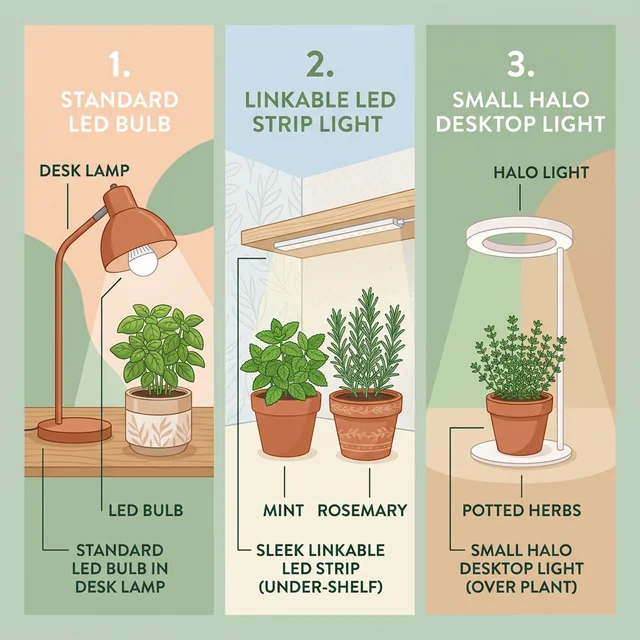
The three most functional grow light styles for apartments
| Light style | Best used for | Top advantage | Main limitation |
|---|---|---|---|
| Standard LED Screw-in Bulb | Pendant lights or desk lamps | Fits existing aesthetic fixtures | Coverage is focused on only 1-2 pots |
| Linkable LED Strips (T5/T8) | Bookshelves or under kitchen cabinets | Super even coverage across multiple plants | Requires mounting hardware or tape |
| Halo / Desktop Stand Lights | Single pots or highly constrained spaces | Plug-and-play with built-in timers | Very low output; won't support large basil crops heavily |
Editorial note: Retailer links are untracked shopping references; Urban Harvest Lab does not currently receive a commission from them. These products were selected from published features and form factor, not a documented hands-on or laboratory comparison. Verify current specifications, availability, and instructions before purchase.
Buying a grow light for indoor herbs is often aggressively overcomplicated. If you search for grow lights online, you are immediately bombarded by massive, purple-glowing panels meant for commercial greenhouses or heavy-fruiting crops. Most apartment herb growers do not need that, and they certainly do not want it in their living room.
If you are just trying to keep your basil from getting leggy and your thyme alive through the winter, the right tool is usually a simple, full-spectrum white LED that fits into your existing apartment aesthetic.
Before spending money, it is critical to diagnose your space honestly. If you haven’t yet, read How Much Light Do Herbs Need? Realistic Sun and Grow Light Rules and Can Herbs Grow Indoors Without Direct Sunlight? What to Expect in Real Homes. Once you know your window is truly insufficient, adding a supplemental light becomes the single best investment you can make. If the whole concept of layout is loose, review Small-Space Herb Gardening: Start Here for Apartments, Balconies, and Indoor Setups first.
Quick answer: the best grow light for herbs
For many indoor herb setups, a white LED sold for plant use is practical because it is comfortable in a living space. Fixture output and coverage matter more than a universal color temperature or distance. Use the manufacturer’s map or measurements at canopy level, start with an appropriate photoperiod and dark period, and adjust from plant response.
Here is a breakdown of the best, most practical grow lights for herbs—categorized by how real people actually build their setups.
1. Best Fit for Open Counters: Full-Spectrum LED Bulbs
For most apartment dwellers, the cleanest setup is to buy a powerful LED grow bulb and screw it into a standard desk lamp, architectural pendant, or clamp light. This gives you high-quality light without making your home look like a science experiment.
Product example: SANSI 24W LED Grow Light Bulb
Check the SANSI 24W Bulb on Amazon
This 24 W listing is an example of the bulb form factor, not a tested winner.
- Why it may fit: A white appearance can be easier to live with, and a directional bulb can suit a compact cluster when the lamp holder is rated for the bulb’s power, weight and heat.
- How to use it: Follow the current manufacturer instructions and use an appropriately rated, stable fixture. Measure or compare light across the actual canopy before deciding how many pots it covers.
- What to verify: true input power, beam or coverage data, clearance, base type, voltage, warranty and certification for your market.
2. Best for Bookshelves and Cabinets: Linkable LED Strips
If your plan is to convert a bookshelf into a thriving indoor garden, a single bulb will only illuminate the center ring. You need linear light. Indoor Herb Garden Setup for Apartments Without Outdoor Space heavily advocates for strip lights when you have a dedicated shelf because they eliminate dark corners.
Product example: Barrina T5 Full Spectrum Grow Light Strips
Check Barrina T5 Strip Lights on Amazon
Linear fixtures can distribute light more evenly over a rectangular shelf than one central bulb, but the number of strips and distance must come from the exact model’s output and footprint.
- Why it may fit: linked bars can reduce dark corners and allow each shelf to have its own layout.
- How to use it: use the supplied or manufacturer-approved mounting hardware and obey link and circuit limits. There is no exact 6-to-10-inch rule across Barrina variants.
- The aesthetic: Look for the versions with black aluminum housings and yellow/white “sunlight” spectrum. They essentially vanish under a dark shelf.
3. Best for Absolute Beginners: Halo Desktop Lights
Sometimes you only have one pot of stretching mint on a desk, and you do not want to buy a lamp fixture or tape strips to your rental cabinets. In this case, a plug-and-play halo light is the easiest fix.
Product example: Aokrean Halo Grow Light with Auto Timer
Check the Aokrean Halo Grow Light on Amazon
These are small rings or small square panels attached to an acrylic stake that you shove directly into the potting mix.
- Why it may fit: An integrated stand and timer reduce setup parts for one small canopy.
- The limitation: Compact halo lights are often low-output, but verify the exact model. A timer does not prove sufficient intensity, and no unmeasured fixture can guarantee that an herb will thrive.
What Actually Matters When You Buy
Ignore the marketing hype and focus on these three constraints when shopping:
Form factor dictates success
A powerful light is ineffective if it cannot be mounted safely over the crop. An adjustable bulb may fit open counter space; linear strips may fit a rack. Choose only after measuring the footprint and checking the mounting surface and electrical instructions.
Spectrum color matters for your sanity
White light can make plant inspection and shared-room use more comfortable. Correlated color temperature does not by itself measure plant-light quantity or electrical efficiency, so compare published output, coverage and input power rather than choosing from spectrum color alone.
You still need a timer
Plants need darkness to process energy and rest. Leaving your grow lights on 24/7 is a fast track to stressed, strange-looking herbs. For a full breakdown on timing strategy, read How Many Hours Should Grow Lights Run for Herbs?. If your light doesn’t come with a built-in timeline, automate the 14-hour cycle with one of the best grow light timers or a cheap smart plug.
The Bottom Line
A grow light can fix a measured light deficit. Buy the form factor that can safely cover the space, then log placement, hours and new growth. Price alone does not predict canopy output, and a close fixture can still overheat or bleach foliage if its instructions are ignored.
Selection method and review limits
The three linked products illustrate bulb, linear-strip and halo formats. They were not ranked from controlled PPFD maps, energy measurements, plant trials or long-term failure data. No “top pick” should override current manufacturer documentation, verified customer support, return terms or measurements in your setup. Product pages and ASINs can change; confirm that the listing still describes the named model.
Sources
- University of Minnesota Extension: Lighting for Indoor Plants and Starting Seeds
- Utah State University Extension: Starting Vegetable Seeds Indoors—Materials
- Barrina: current T5 grow-light example and manufacturer specifications
Related Guides to Perfect Your Setup
- Small-Space Herb Gardening: Start Here for Apartments, Balconies, and Indoor Setups
- How Much Light Do Herbs Need? Realistic Sun and Grow Light Rules
- Can Herbs Grow Indoors Without Direct Sunlight? What to Expect in Real Homes
- Indoor Herb Garden Setup for Apartments Without Outdoor Space
- How Many Hours Should Grow Lights Run for Herbs?
If you are upgrading your indoor herb station, also read
These foundational guides connect your equipment choices back to reality, ensuring your new lights actually solve your problems.
- Small-space herb gardening: start here for apartments, balconies, and indoor setups
- Indoor herb garden setup for apartments without outdoor space
- How much light do herbs need? 6+ hours of sun
- Can herbs grow indoors without direct sunlight? Yes, but bright windows matter
- How many hours should grow lights run for herbs? 12-16
- PPFD and DLI for indoor herbs: a practical measuring guide
- Grow light electricity cost: calculate the real monthly bill
Common questions
Can I just use a regular LED light bulb for my herbs?
You can, if it is exceptionally bright and placed very close, but a dedicated full-spectrum LED grow bulb is vastly more efficient and provides the right wavelengths for dense, healthy growth.
Are purple (blurple) grow lights better than white ones?
Not necessarily for kitchen herbs. Modern full-spectrum white LEDs are highly efficient, pleasant to live with in an apartment, and excellent for vegetative growth like basil and mint.
How many watts do I need for a small herb station?
A true 15W to 24W LED grow bulb (often advertised as 150W-300W equivalent) is usually enough for a cluster of two or three herb pots if kept within 12 inches of the leaves.
Related guides
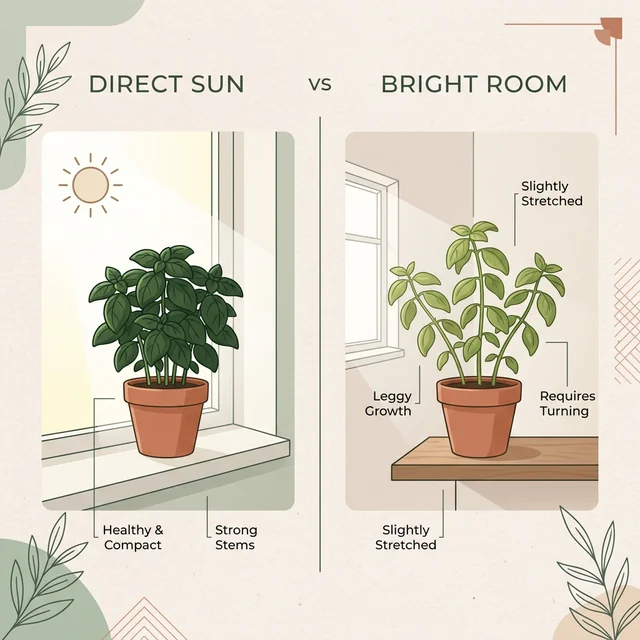
Can herbs grow indoors without direct sunlight? Yes, but bright windows matter
A realistic answer to a common indoor-herb question, with clear expectations for growth, herb choice, and when a grow light becomes the cleaner solution.
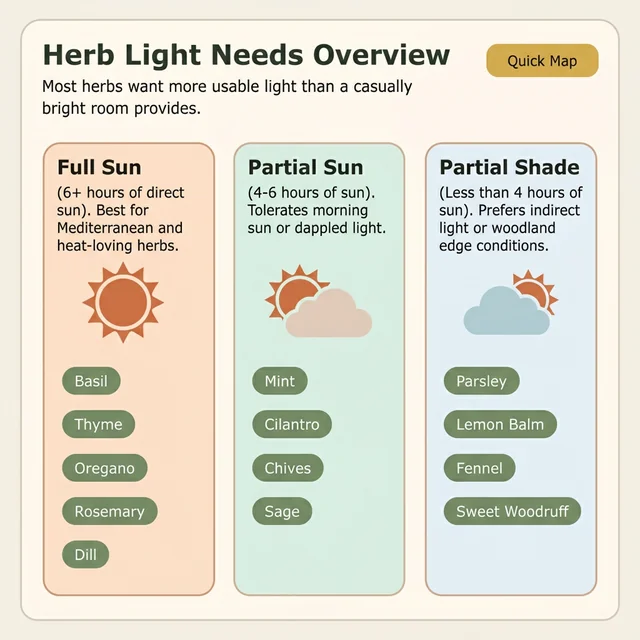
How much light do herbs need? 6+ hours of sun
A practical guide to how much light herbs need, including a quick answer for direct sun, indoor windows, and grow light setups that actually support growth.
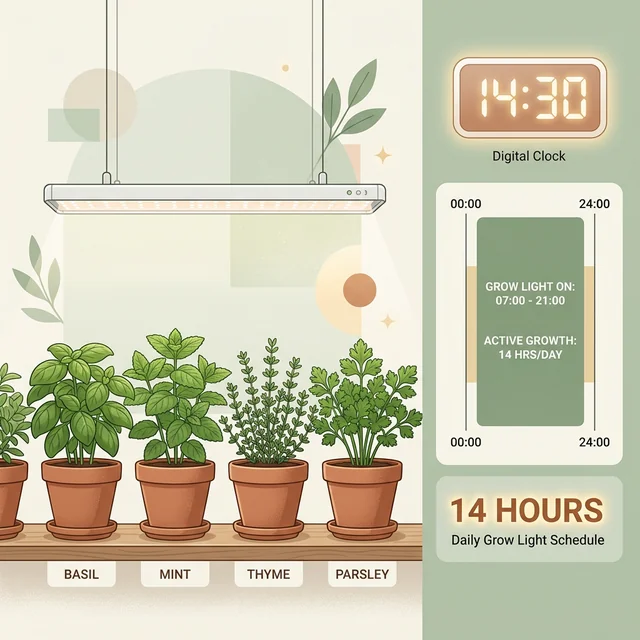
How many hours should grow lights run for herbs? 12-16
Most herb grow lights should run about 12 to 16 hours per day, but intensity, distance, and a stable dark period matter as much as the timer itself.