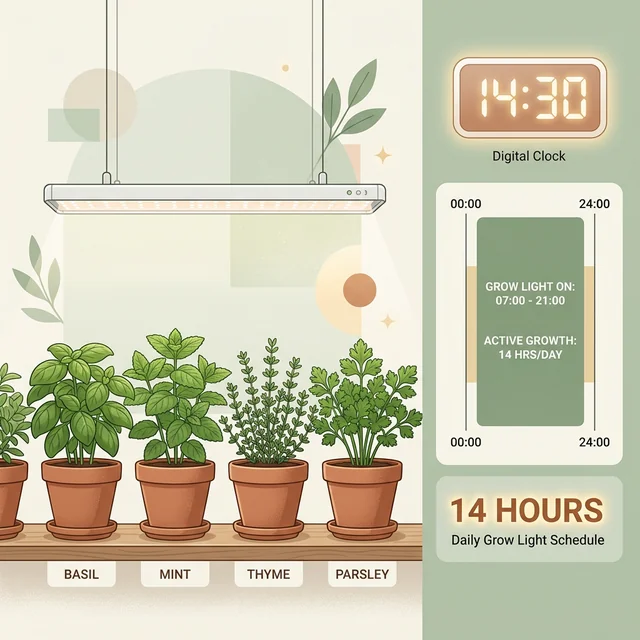
Typical daily lighting ranges for common indoor herb scenarios
| Scenario | Hours per day | What to watch |
|---|---|---|
| Freshly rooted seedlings | 14 to 16 | Avoid heat stress and keep fixtures close enough to prevent stretch |
| Established leafy herbs | 12 to 14 | Look for compact growth and strong color |
| Low-output fixture | 14 to 16 | Longer runtime can help, but intensity may still be the limit |
| High-output fixture close to canopy | 10 to 12 | Watch for leaf curl, bleaching, or dryness |
For most indoor herbs, grow lights should run about 12 to 16 hours per day. That is the practical timer range for basil, parsley, mint, chives, and similar kitchen crops in normal home setups. It does not mean longer is always better. The useful question is how much light the plant is receiving over the whole day, given the strength of the fixture, how far it sits from the leaves, and whether the plant still gets a reliable dark period. If you are still deciding whether your apartment herbs need artificial light at all, see How Much Light Do Herbs Need? Realistic Sun and Grow Light Rules, Can Herbs Grow Indoors Without Direct Sunlight? What to Expect in Real Homes, and Indoor Herb Garden Setup for Apartments Without Outdoor Space.
If a timer is already set but herbs still look weak, do not assume the schedule is the missing piece. In many apartments, the real bottleneck is fixture strength or placement, not the difference between 12 and 14 hours. That is also why fixture choice pairs naturally with Best Grow Lights for Herbs: hours matter, but they only work when the light is suitable for the footprint.
Quick answer: 12 to 16 hours works for most herbs
For most indoor herb setups, 12 to 16 hours per day is a sensible working range. Basil, parsley, dill, cilantro, and chives usually do well in that window when the fixture is appropriately sized and positioned.
Weak fixtures often push growers toward longer schedules. That can help a little, but only to a point. If the light is too dim, extra hours do not fully compensate, and a timer cannot solve a coverage problem by itself.
Match the timer to the actual setup
Grow-light runtime only makes sense in context. A compact apartment herb shelf, a weak windowsill that needs supplemental light, and a brighter indoor station all use the timer differently. (If the fixture itself is the open question, Best grow lights for apartments and windowsills covers options sized to small homes.) That is why it helps to read How Much Light Do Herbs Need? Realistic Sun and Grow Light Rules first to establish the baseline, then Small-Space Herb Gardening: Start Here for Apartments, Balconies, and Indoor Setups for the broader workflow.
If the home is bright but still below target, a fixed timer can stabilize the day. If the setup is already weak because the fixture is too far away or too small for the footprint, a longer schedule helps less than most beginners hope. A realistic timer usually supports a realistic light plan rather than rescuing a poor one.
Why runtime is only part of the answer
Grow light articles often ignore distance. A decent LED placed too high can behave like a poor light. If herbs are stretching, leaning, or producing oversized gaps between leaves, start by reviewing fixture placement. A dedicated guide on grow light distance for seedlings explains the geometry more directly.
Watch plant signals, not just the timer
Healthy herbs under indoor light tend to show:
- compact new growth
- good leaf color
- steady regrowth after harvest
- no obvious bleaching or curled tips
If you see pale, stressed growth, the answer may be less intensity or more distance rather than more runtime.
Do herbs need a dark period?
Yes. Herbs usually respond better to a consistent day-night rhythm than to constant light. In practice, that means choosing a repeatable timer window and leaving a block of darkness every 24 hours.
The exact clock time matters less than consistency. Many growers run lights during the day because it matches normal routines and makes it easier to notice heat, dry pots, or fixture problems. If nighttime hours fit the room better, that can still work as long as the schedule stays stable.
Where product recommendations fit
When this topic includes fixture recommendations, the goal should be matching light output to shelf size, crop type, and noise or heat tolerance. It should not be pushing oversized fixtures into beginner setups that only need herbs on one shelf. If you are still comparing fixtures rather than timers, Best Grow Lights for Herbs is the more useful next step. If your light has no built-in scheduling and you just need to automate the day, Best grow light timers covers simple plug-in options.
Linked comparison pages may include untracked retailer references, but Urban Harvest Lab does not currently receive commissions from them. No particular fixture was tested here. Duration recommendations are starting ranges synthesized from extension guidance; they are not a substitute for measured intensity or crop-specific research.
Related Guides
- Small Space Herb Gardening
- How Much Light Herbs Need
- Indoor Herb Garden Apartment Setup
- Can Herbs Grow Indoors Without Direct Sunlight
Sources
If you are planning indoor lighting for herbs, also read
These guides connect light duration to indoor apartment setups, low-light expectations, fixture choice, and typical herb stress signals.
- Small-space herb gardening: start here for apartments, balconies, and indoor setups
- How much light do herbs need? 6+ hours of sun
- Indoor herb garden setup for apartments without outdoor space
- Can herbs grow indoors without direct sunlight? Yes, but bright windows matter
- Best grow lights for herbs: what actually matters before you buy
- PPFD and DLI for indoor herbs: a practical measuring guide
- Grow light electricity cost: calculate the real monthly bill
Common questions
Is 24-hour light good for herbs?
No. Herbs generally benefit from a daily dark period, and constant light can increase stress without improving useful growth.
Why are herbs stretching even with long light hours?
Stretching usually points to insufficient light intensity or excessive fixture distance rather than too few total hours.
Do seedlings and established herbs need the same grow light schedule?
Not always. Seedlings and weak fixtures often do better closer to 14 to 16 hours, while established herbs under a stronger fixture may stay compact with 12 to 14 hours.
Should grow lights run at night or during the day?
Either can work if the schedule is consistent, but many home growers prefer daytime hours so heat, plant checks, and daily routines stay easier to manage.
Related guides
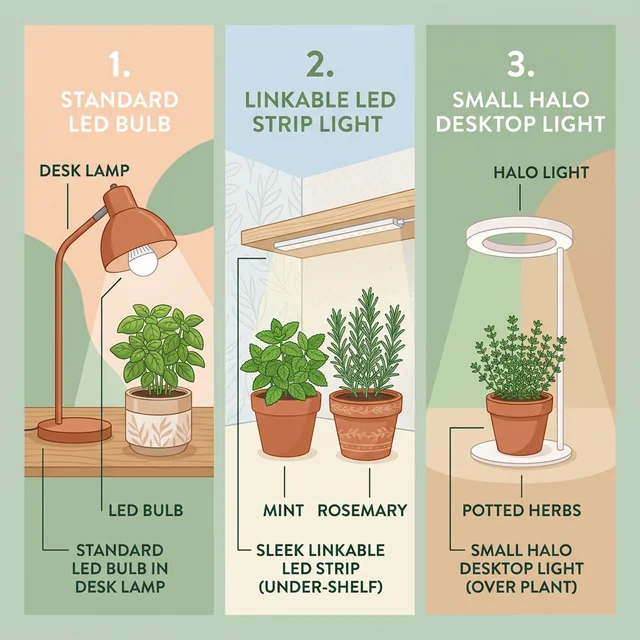
Best grow lights for herbs: what actually matters before you buy
Most indoor herbs don't need a massive, expensive grow tent light. Here is how to choose the right LED bulbs, strips, or halos for your real apartment setup.
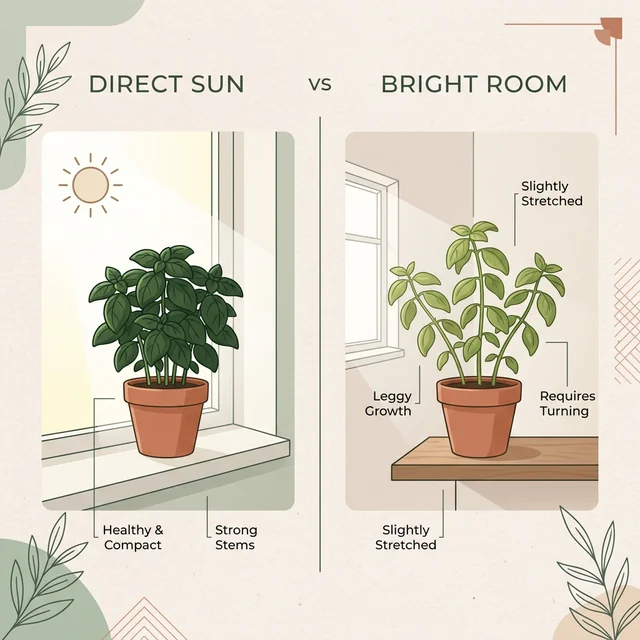
Can herbs grow indoors without direct sunlight? Yes, but bright windows matter
A realistic answer to a common indoor-herb question, with clear expectations for growth, herb choice, and when a grow light becomes the cleaner solution.
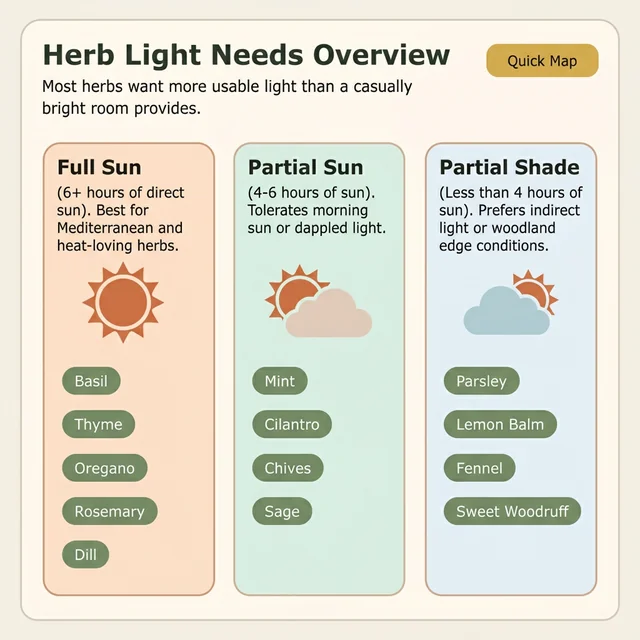
How much light do herbs need? 6+ hours of sun
A practical guide to how much light herbs need, including a quick answer for direct sun, indoor windows, and grow light setups that actually support growth.