Choosing herbs for a small space is not mainly about finding the single easiest plant. It is about finding herbs that stay productive under the conditions you actually have: the light from your window, the drying speed of your containers, the heat on your balcony, and the amount of attention you can give them during an ordinary week.
That distinction matters because many herbs can survive in a compact home, but not all of them thrive there. Some need more direct sun than beginners expect. Some dry too fast in small containers. Some stay manageable and rewarding even when conditions are less than ideal. If you are still building the system itself, start first with How to Set Up a Small-Space Herb Garden That Actually Works, then use this guide to choose the herbs most likely to perform well in that setup.
Quick Selection Logic
If you want the short answer, start by dividing herbs into three practical groups instead of thinking in terms of favorites.
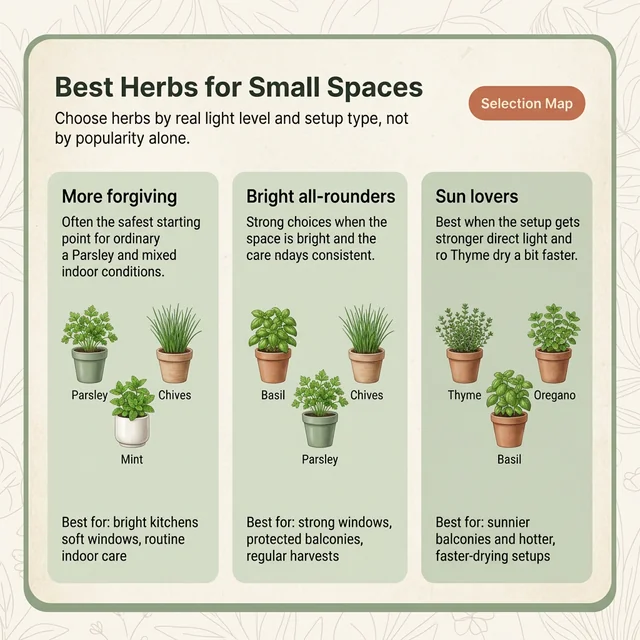
First, there are dependable all-rounders that work in many small-space gardens: parsley, chives, and mint. These are useful in the kitchen, respond well to container culture, and tend to be more forgiving when light or watering is not perfect.
Second, there are strong performers for brighter spaces: basil, thyme, and oregano. These herbs can be excellent choices for balconies and bright windows, but they reward honest light conditions. They are not difficult in principle. They are simply less forgiving if the location is dim or inconsistent.
Third, there are herbs that many beginners want before they are ready for them. Rosemary can work in a compact home, but it often disappoints indoors when light and airflow are weak. Dill and fennel are possible in containers, yet they are often awkward in very small layouts because of their size, root needs, or tendency to bolt under stress.
The practical rule is simple: pick herbs that fit your environment first, then fit your preferences second. A healthy parsley plant you harvest weekly is more valuable than a struggling rosemary plant that matches an idealized kitchen garden image.
Core Recommendations
The most reliable herbs for small spaces are the ones that combine compact growth, useful harvests, and reasonable tolerance for normal beginner mistakes. That does not mean they are identical. It means they are more likely to stay productive in apartments, on balconies, and on windowsills without demanding a highly controlled growing environment.
Reliable all-rounders
Parsley is one of the best starting herbs for small spaces because it stays useful, adapts well to containers, and tolerates moderate light better than basil. It still prefers bright conditions, but it remains worthwhile in homes where the light is good rather than ideal. If moisture stays reasonably even, parsley can produce steadily for a long stretch.
Chives are another strong beginner option. They remain compact, regrow after cutting, and fit easily into small pots. Chives also give clear feedback. In a healthy setup, they keep sending up new growth. If the environment is poor, they usually show it without collapsing immediately, which makes them easier to correct than fussier crops.
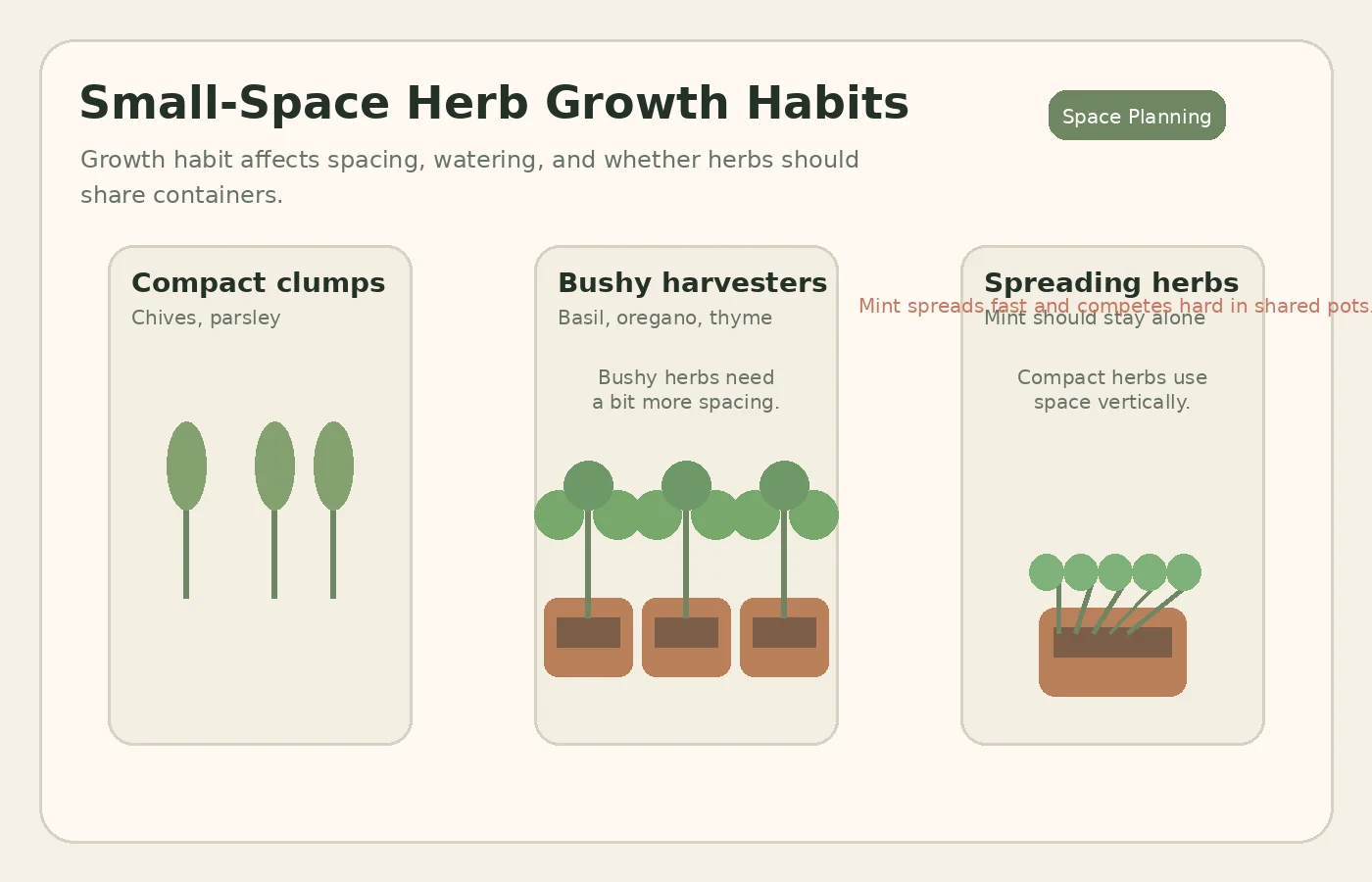
Mint is productive and forgiving in one sense, but it comes with one important warning: keep it in its own container. In a small-space garden, mint can quickly outcompete slower herbs if it shares root room. Managed on its own, however, it is often one of the easiest ways to build confidence because it grows vigorously and gives you frequent harvests.
Best choices for bright locations
Basil earns its reputation because it is generous, flavorful, and satisfying to harvest, but it is only truly easy when the light is strong enough. In bright windows or sunny balconies, basil is often one of the most rewarding small-space herbs. In dimmer rooms, it becomes leggy, weak, and frustrating. Many people call basil difficult when the real problem is simply that they are trying to grow a high-light herb in a low-light setting.
Thyme is excellent for sunny, drier spaces. Its compact habit makes it particularly useful in balconies and brighter windows where container soil dries more quickly. Thyme usually prefers more restraint than parsley or basil in the watering routine, which is why it pairs better with other Mediterranean herbs than with thirstier leafy herbs.
Oregano is similarly well suited to strong light and relatively leaner watering conditions. It can spread attractively in containers without becoming as unruly as mint, and it is resilient enough to handle the heat and airflow of many balcony setups. For cooks who want one hardy, flavorful herb in a bright space, oregano is often underrated.
Better choices when conditions are less ideal
If your home has bright indirect light, shorter winter days, or a windowsill that is useful but not intense, the smartest approach is to choose herbs that stay worthwhile without perfect sun. Parsley and chives remain near the top of that list. Mint can also tolerate somewhat less light than basil, though flavor intensity and growth speed may still improve in brighter spots.
Cilantro can work in small spaces during cooler periods, especially if you are willing to replant more regularly. It is not as stable a long-term recommendation as parsley or chives, but it can fit well into a rotation when the environment is not too hot. The important thing is not to treat every herb as if it responds the same way to the same window.
Herbs to choose later, not first
Rosemary deserves special caution in beginner small-space guides. People understandably want it because it is useful, fragrant, and associated with Mediterranean container gardens. But rosemary typically wants stronger sun, good airflow, and careful watering discipline. In cramped indoor setups with inconsistent light, it often becomes a slow frustration rather than a confidence-building first herb.
Dill and fennel are not bad herbs. They are simply less efficient choices for very small systems. Their form, size, or growth pattern can feel awkward compared with herbs that stay compact and crop repeatedly. In the early stages of a small-space herb garden, it is usually better to choose plants that keep rewarding you quickly and clearly.
Choose herbs that reward repeated harvesting
One reason parsley, chives, basil, mint, thyme, and oregano perform so well in compact gardens is that they fit the way most people actually harvest from a kitchen herb setup. You are usually taking small amounts often, not waiting months for one large crop. Herbs that recover well from repeated cutting are simply more satisfying in limited space because the same pot keeps giving back.
This matters practically as well as psychologically. A herb that responds to light harvesting with fresh growth teaches you that the system is working. It becomes easier to notice when the plant is healthy, when the environment is off, and when your care routine needs adjusting. In contrast, herbs that stay slow, awkward, or oversized can make a small-space garden feel unproductive even when the setup is not truly failing.
Environment-Based Guidance
The same herb can behave very differently depending on where it is grown. That is why selection should be based less on generic “easy herb” lists and more on the environment you actually have.
Best herbs for apartments without outdoor space
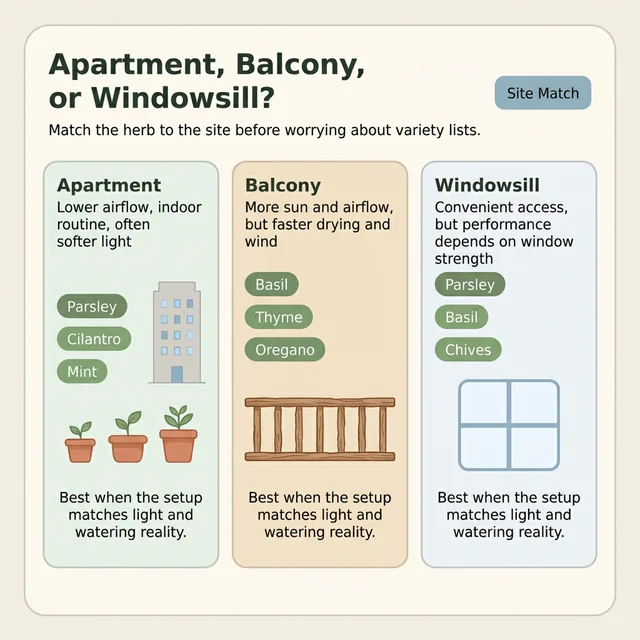
For apartments with no balcony or patio, the usual constraints are limited light, less airflow, and a stronger need for the setup to stay neat and manageable indoors. In those conditions, parsley, chives, and mint are often the strongest starting group. Basil can join them if the window is truly bright, but it should not be forced into a dim corner just because it is popular.
Indoor growers also benefit from choosing herbs that stay understandable in containers. Chives and parsley tend to be easier to read than rosemary. If growth slows, the likely causes are easier to diagnose. If the plants are stretching, you can usually connect the problem back to light rather than assuming a mysterious nutrient deficiency.
Best herbs for balconies
Balconies widen the menu because they often provide stronger direct light and better airflow. That makes basil, thyme, oregano, rosemary, parsley, chives, and mint all plausible, but placement still matters. A sunny, protected balcony can support Mediterranean herbs very well. A balcony with strong wind or hot reflected heat may dry containers so fast that softer herbs need more protection.
The common beginner mistake is assuming “outdoors” automatically means “ideal.” In reality, balconies create their own microclimates. Some are cooler and shaded. Some are bright but brutally drying. In the hottest setups, thyme and oregano often handle the edge better than parsley or basil, while mint may need relief from the harshest exposure.
Best herbs for windowsills
Windowsills are practical because they keep the garden close to your daily routine. That makes harvesting, checking moisture, and noticing problems much easier. But windowsills vary enormously. A bright sill can support basil, parsley, chives, thyme, and mint. A weaker sill is often better reserved for parsley, chives, and mint, with expectations kept realistic.
It also helps to think beyond raw light. Cold glass in winter, overheating glass in summer, and tight spacing all affect performance. Windowsill growing works best when the plants are not jammed together and when you use the brightest portion of the sill rather than the darkest edge.
Use sun level honestly
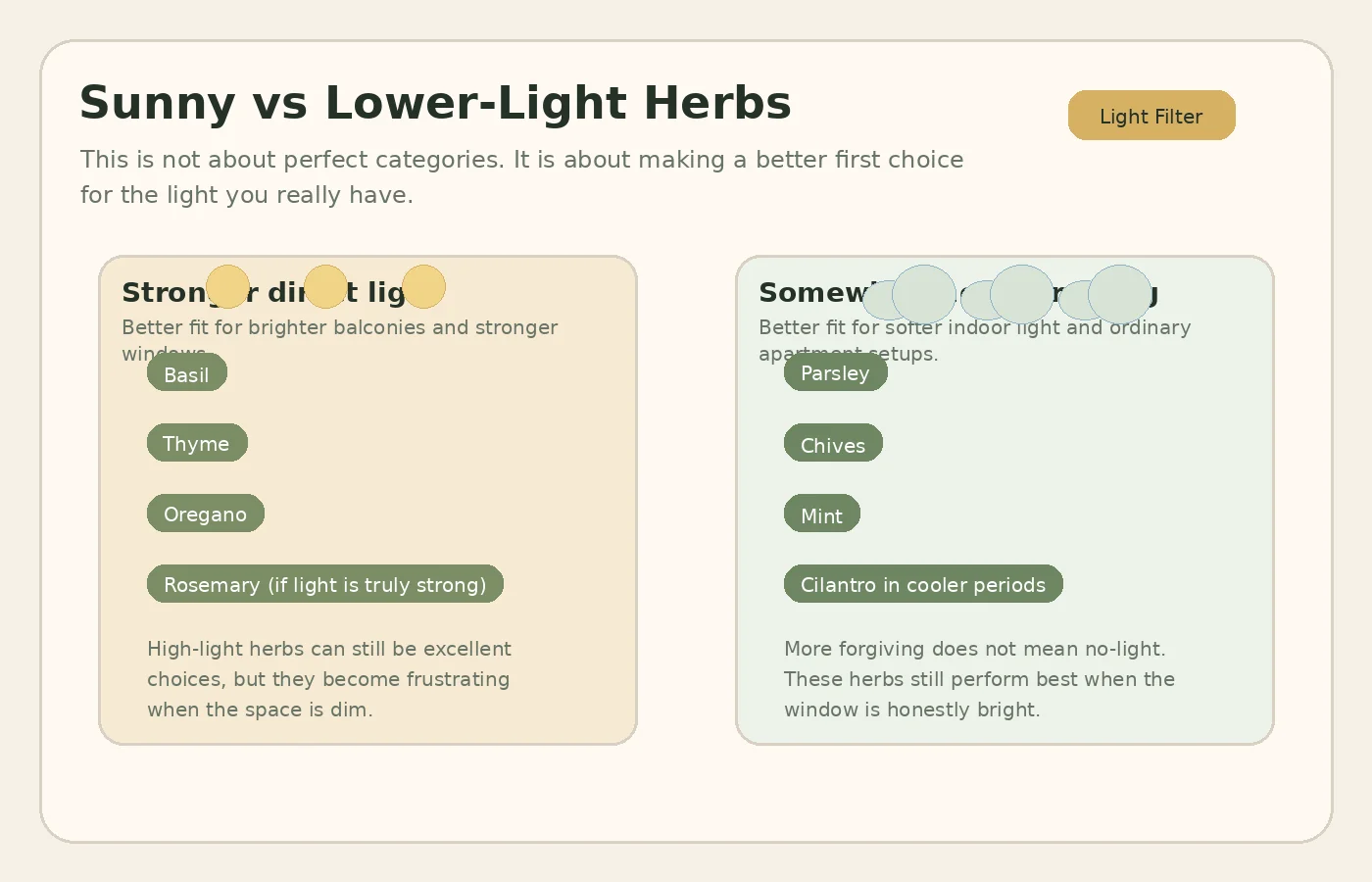
Gardeners in small homes often overestimate available light. A room can feel bright to you and still be weak for basil. This is one reason herb selection goes wrong. The answer is not to judge yourself harshly or buy every new tool. The answer is to make a more honest crop choice.
If you have stronger direct light, lean toward basil, thyme, and oregano. If the light is bright but softer or shorter in duration, parsley, chives, and mint are usually safer bets. The right herb is the one that fits the site without forcing constant rescue work.
Common Mistakes
One common mistake is choosing herbs based only on what you like to eat. That sounds sensible, but it can backfire if your favorite herb is a poor match for the space. Taste matters, yet environment has to come first.
Another mistake is overvaluing novelty. A beginner often learns more from growing three dependable herbs well than from trying nine different ones at once. More variety does not automatically create a better garden. It usually creates a less readable one.
A third mistake is mixing herbs with very different moisture preferences into one small planter. Basil and parsley generally want more even moisture than thyme or oregano. When those plants share a cramped container, one side of the mix is often slightly wrong all the time.
The last major mistake is assuming failure means you are bad at herbs. In small-space gardening, plant performance is often a straightforward environmental response. If a herb is struggling, it usually means the match between crop, light, container, and care routine needs adjusting.
FAQ
What is the easiest herb to grow in a small apartment?
There is no single winner for every apartment, but parsley and chives are among the safest first choices because they stay useful, behave well in containers, and do not demand the strongest possible light to remain worthwhile.
Is basil a good herb for beginners in small spaces?
Yes, but only if the light is strong enough. Basil is rewarding in bright windows and sunny balconies. In weaker light, it often becomes leggy and disappointing, which can make beginners think they are doing everything wrong when the site is simply too dim.
Which herbs grow best on a sunny balcony?
Basil, thyme, oregano, parsley, chives, and sometimes rosemary can all perform well on a sunny balcony. The deciding factor is not just sun but also how hot, windy, and fast-drying that balcony becomes during warm weather.
What herbs are best for a kitchen windowsill?
Parsley, chives, mint, and basil are common windowsill candidates, but the best choice depends on how much direct light the sill actually receives. Basil needs more intensity than many people expect, while parsley and chives are usually more flexible.
Should I grow mint with other herbs in one pot?
Usually no. Mint is better kept in its own container because it spreads aggressively and can outcompete slower herbs in shared root space.
Related Guides
If you are choosing herbs before building the system itself, start here:
If this topic is relevant to you, also read:
Use these related guides to move into setup decisions, troubleshooting, or the next logical beginner step.
Related guides
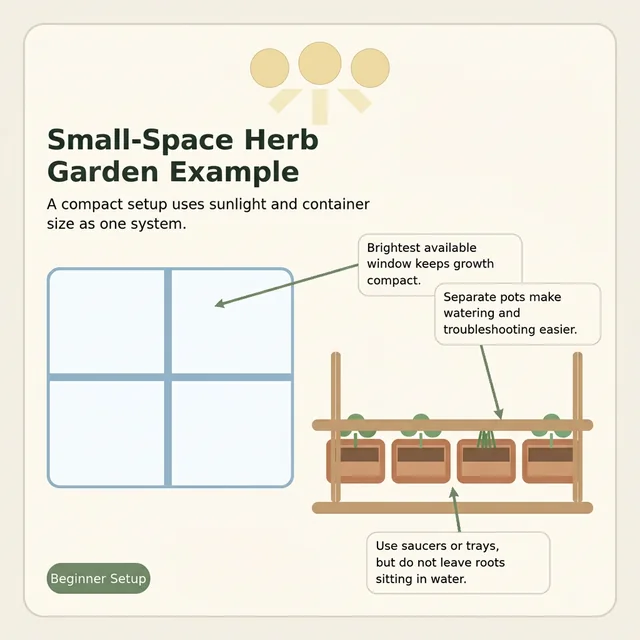
How to Set Up a Small-Space Herb Garden That Actually Works
A calm, practical guide to starting a herb garden on a balcony, windowsill, or bright indoor corner without overbuying or overcomplicating the setup.
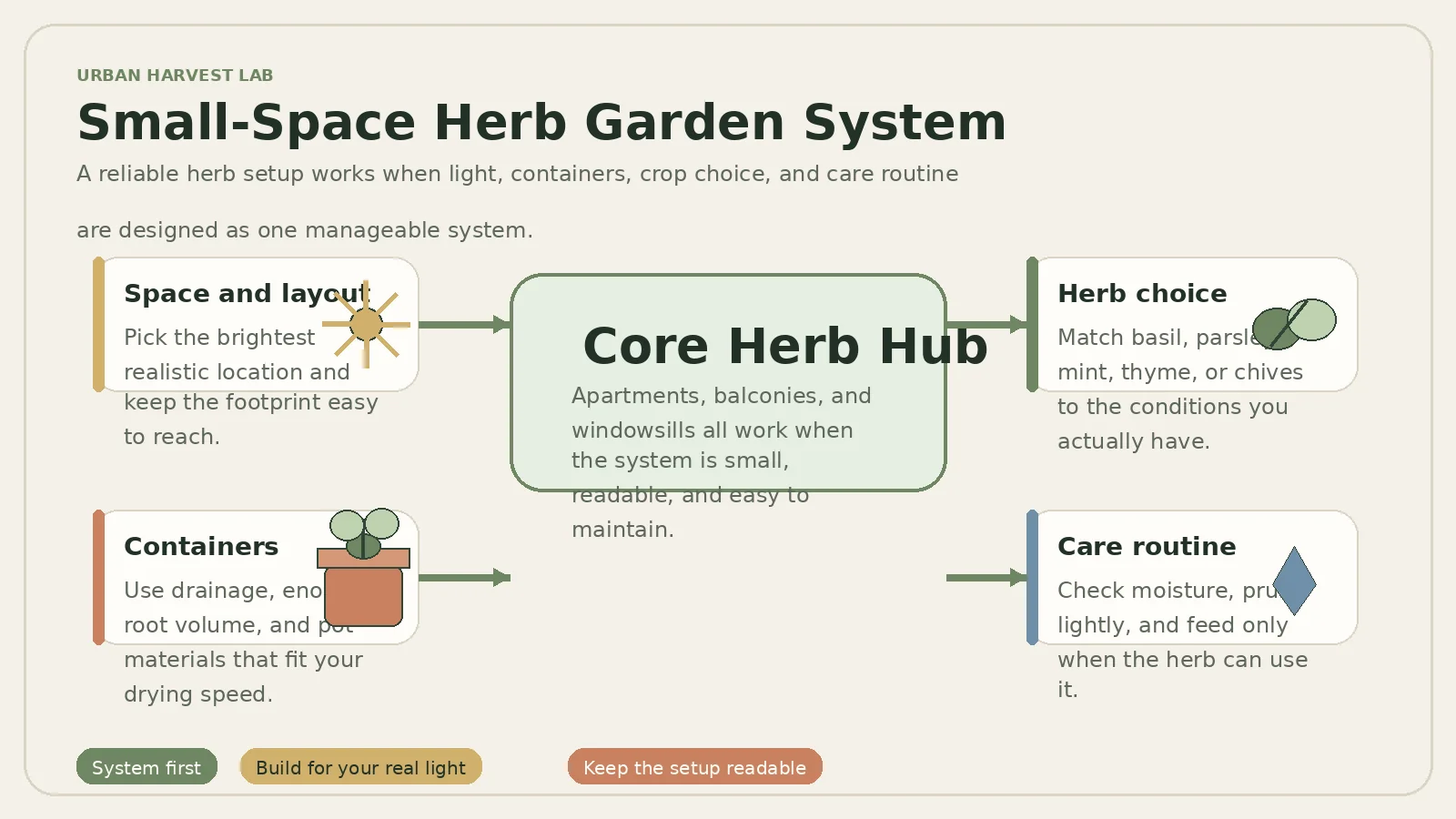
Small-Space Herb Gardening: Start Here for Apartments, Balconies, and Indoor Setups
A navigation hub for apartment, balcony, and indoor herb gardening that connects the core setup, herb selection, light, container, and care guides in the right order.
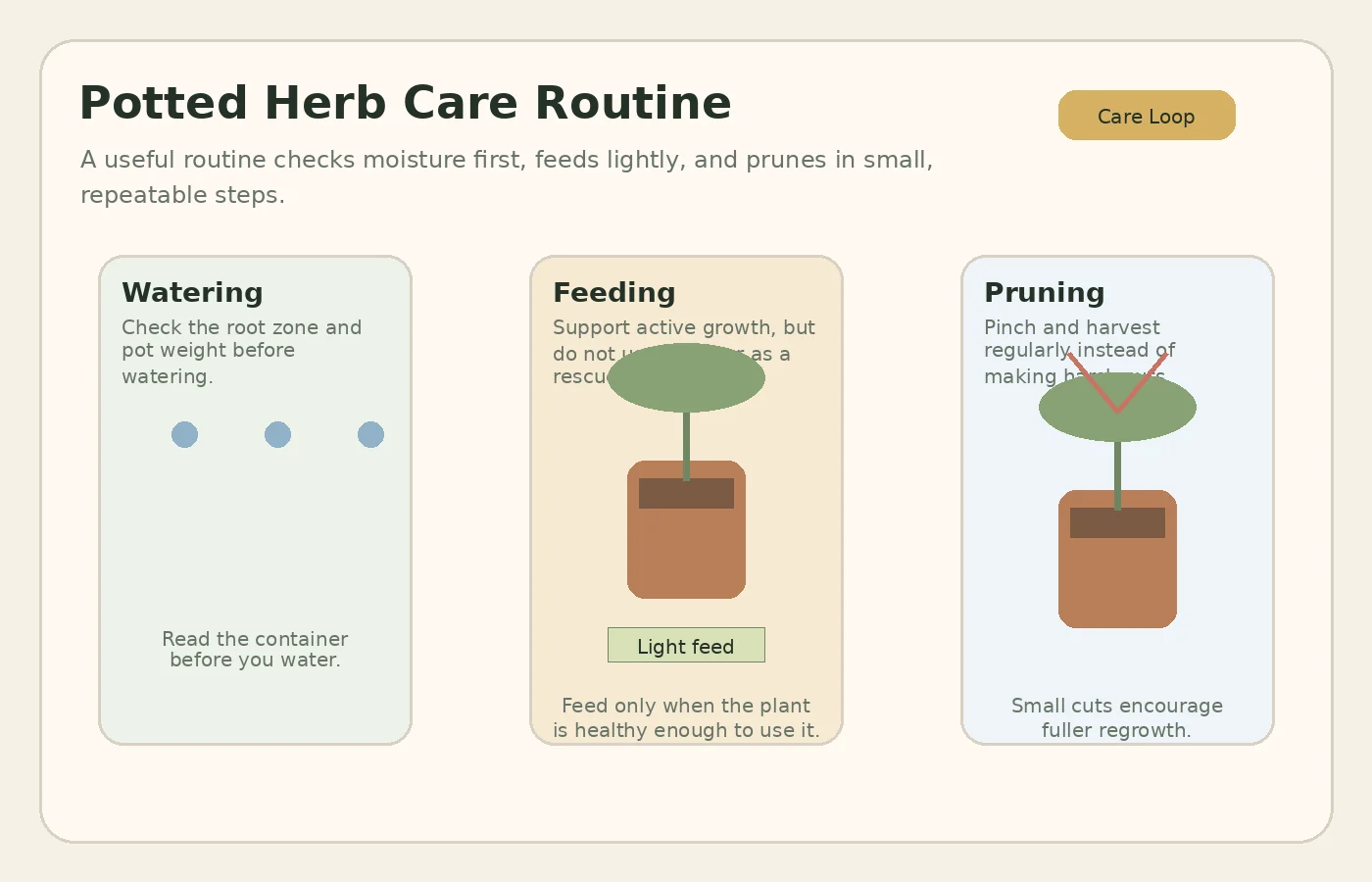
Potted Herb Care: Watering, Feeding, and Pruning Without Guesswork
A calm, science-based guide to keeping basil, parsley, mint, thyme, chives, and other potted herbs healthy without turning the routine into guesswork.