Practical container choices for common herb-growing situations
| Container type | Best for | Main advantage | Main caution |
|---|---|---|---|
| Medium single pot | Basil, parsley, mint, chives | Easy to read and manage one herb at a time | Takes more space than one shared planter |
| Long window box | Several small herbs with similar needs | Efficient footprint for balconies and rails | Mixed herbs can be harder to water evenly |
| Terracotta pot | Sunny, fast-drying spaces | Extra airflow around roots | Can dry too quickly in heat or wind |
| Plastic nursery-style pot | Indoor setups and beginners | Retains moisture better and weighs less | Poor designs may overheat or look less attractive |
Choosing herb containers sounds simple until the plants start struggling. Many beginners assume almost any pot will do because herbs are smaller than tomatoes or peppers. Then the real problems show up: basil drying out twice as fast as expected, parsley staying wet too long in a sealed decorative pot, thyme sitting in a planter mix that never quite drains cleanly, or mint taking over a shared box because the root zone is cramped and unbalanced.
That is why container choice is not a decorative afterthought. It shapes watering frequency, root oxygen, temperature swings, and how readable the whole system feels when something starts going wrong. If you are still putting the whole garden together, begin with How to Set Up a Small-Space Herb Garden That Actually Works. If you are deciding which herbs you want to place into those pots, pair this guide with Best Herbs for Small Spaces: What Grows Well in Apartments, Balconies, and Windowsills.
Quick Answer
The best herb container is usually a medium-sized pot with real drainage holes, enough potting mix to buffer drying, and a material that fits your environment rather than just your style preferences. In practice, that means most herbs do better in functional containers than in tiny decorative ones.
If you want a simple rule set:
- Choose containers large enough that the root zone stays stable for more than a single hot afternoon.
- Prioritize drainage holes before shape, color, or material.
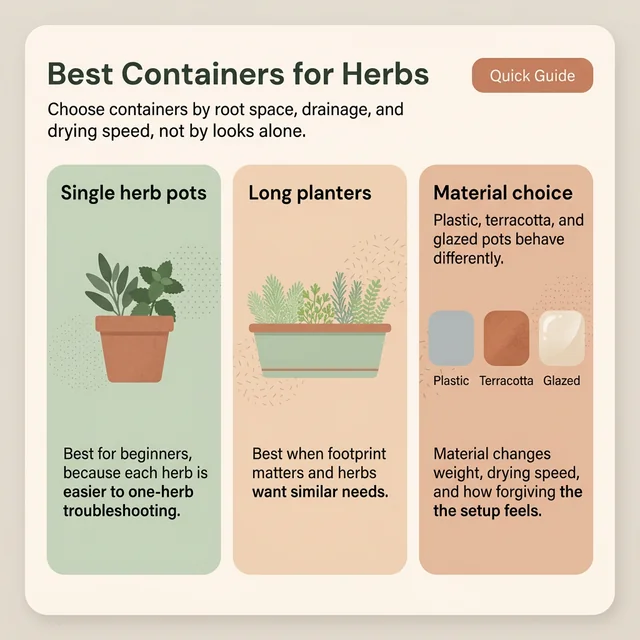
- Use one herb per pot unless you have a good reason to mix crops with similar needs.
- Match the material to the site. Plastic often helps indoors or in windy balconies. Terracotta can work well in sunnier, wetter, or cooler setups where extra drying is useful.
That is not the romantic answer many people hope for, but it is the one that makes herb gardening easier.
Why Container Choice Matters More Than Beginners Expect
In a ground bed, roots can keep exploring. In a container, everything depends on the small volume of media you provide. That limited space has to store moisture, allow air movement, hold nutrients, and support growth during temperature swings. If the container is too small or poorly drained, the herb feels the consequences quickly.
This is why a weak container choice often shows up as several symptoms at once. A pot that is too small dries fast, pushes you into more frequent watering, and becomes harder to interpret. People often think they have a watering problem when the upstream issue is actually container design.
Pot Size Basics
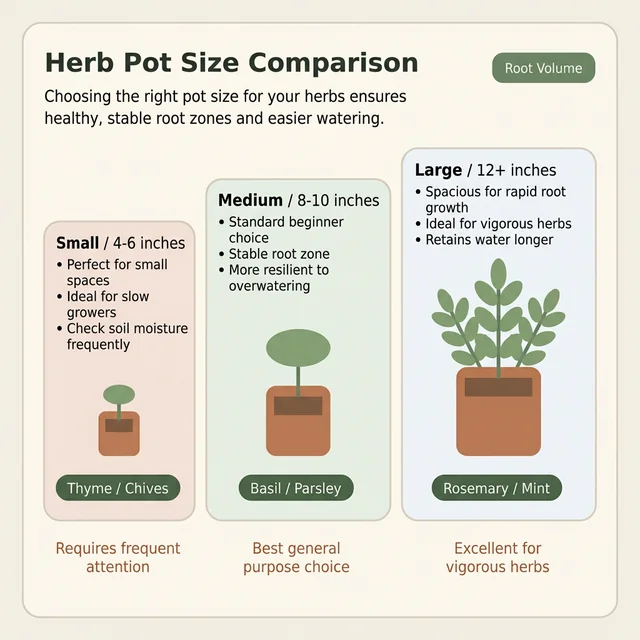
Herbs do not need enormous containers, but many need more volume than the tiny pots sold for kitchen display. A larger root zone does three useful things: it holds moisture longer, gives roots more room to explore, and slows temperature swings. That combination makes care noticeably easier.
For most small-space growers, the practical goal is not maximum size. It is enough size to avoid constant stress. A pot that goes from soaked to bone dry in a single warm day may technically hold an herb, but it does not create a forgiving system.
Small pots have one real advantage and several drawbacks
The advantage of small pots is obvious: they fit anywhere. The drawbacks matter more over time. Small containers dry quickly, crowd roots early, and make nutrient and moisture swings more dramatic. Basil and parsley are much more satisfying when the pot supports steadier regrowth instead of constant stop-start stress.
A practical size rule
A good beginner rule is to avoid containers so small that you have to guess about watering every day from the first week onward. If the pot feels like it only exists for presentation, it is probably undersized for long-term herb production.
Different herbs also want different room:
- Basil and parsley usually benefit from moderate root space because they grow leafy top growth that depends on steady moisture.
- Mint often wants enough room to stay vigorous, but it should still be isolated because it spreads aggressively.
- Thyme and oregano can tolerate somewhat tighter pots than basil, especially in bright conditions, but they still perform better when the root zone is not cramped.
- Chives stay compact, yet they are easier to keep productive when the pot is not shallow and crowded.
One Herb Per Pot or Shared Planter?
Beginners often assume shared planters are automatically more efficient. Sometimes they are. But they also make the system harder to manage because several herbs may have different growth speed, root behavior, and watering needs inside the same container.
One herb per pot is often the simplest default because it creates clearer feedback. If basil wilts, you know the basil pot needs attention. If thyme stays wet too long, you can move only that container or adjust only that watering pattern. The system becomes easier to observe and easier to correct.
Shared planters can still work when herbs have similar needs and the container is large enough. Thyme and oregano may coexist better than mint and parsley. A window box can be useful for a tidy balcony rail or a windowsill layout where footprint matters. The mistake is assuming all herbs belong together just because they are all culinary herbs.
When shared planters make sense
Shared containers make the most sense when:
- the herbs have similar moisture preferences
- the planter has enough width and depth to avoid instant crowding
- the grower understands how fast that planter dries in the actual environment
If those conditions are not true, separate pots are usually the safer choice, especially for a first herb system.
Drainage Rules That Actually Matter
Drainage holes are not a detail. They are the basic engineering of container growing. Roots need both moisture and oxygen. If water cannot move through the container and out the bottom, oxygen around the roots declines, and the plant eventually starts showing stress even if the surface still looks normal.
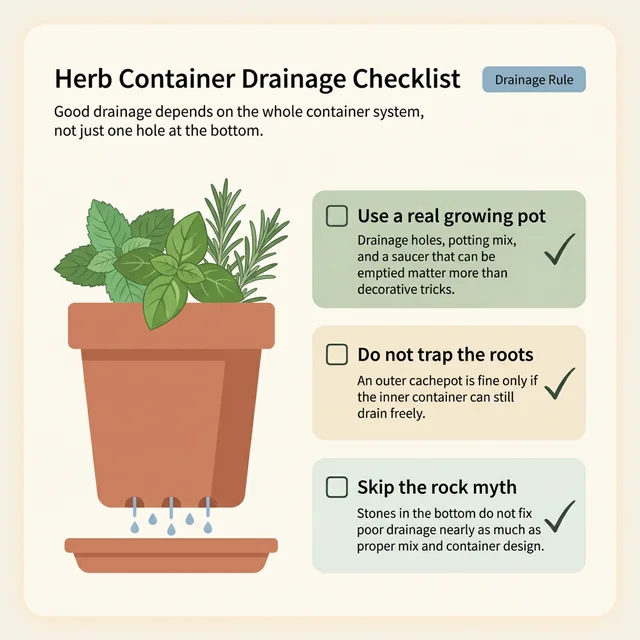
This is why a container without drainage holes is almost always the wrong primary pot for herbs. Decorative outer pots can still be used, but the growing container inside should drain freely and should not sit in a reservoir of stagnant water for long periods.
What good drainage really means
Good drainage is more than “there is a hole somewhere.” It means the system allows excess water to leave efficiently, the potting mix is structured enough for air movement, and the saucer or outer pot is not trapping the root ball in water.
This is where beginners often overfocus on tricks like adding stones to the bottom of the pot. In most cases, the more important choices are:
- using a container with usable drainage holes
- filling it with proper potting mix rather than heavy garden soil
- watering thoroughly enough that water moves through the whole profile
- emptying excess standing water when needed
Once these basics are right, the container behaves more predictably.
Warning signs the container is staying too wet
If a herb pot stays wet for too long, the plant may show slow growth, limp leaves despite damp soil, yellowing, or a generally stalled look. That does not always mean you watered too often. It may mean the container is draining poorly, the mix is too dense, the light is too weak, or the pot is simply oversized for that environment.
This is why container choice cannot be separated from light and site. If a windowsill is weak, a very large moisture-retentive pot may stay wet too long. If a balcony is hot and windy, that same pot may become exactly the buffer you need. A useful light baseline from How Much Light Do Herbs Need? Realistic Sun and Grow Light Rules helps make that call more accurately.
Material Guide: Plastic, Terracotta, Ceramic, and More
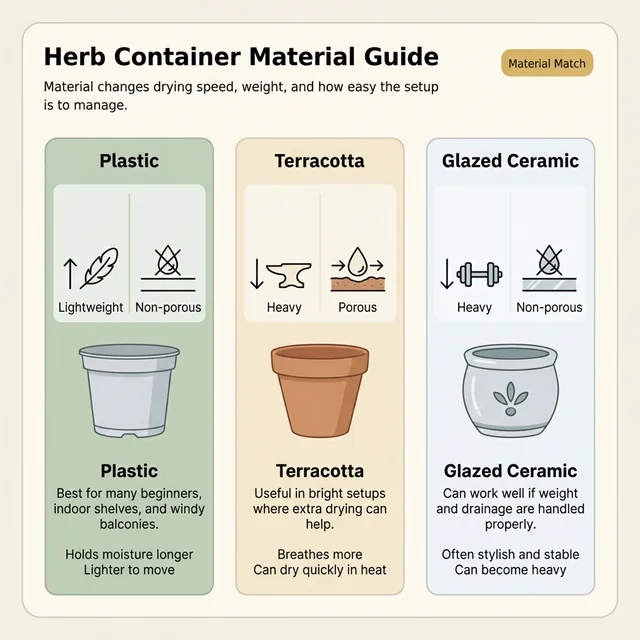
Container material changes how fast the root zone dries, how heavy the pot becomes, and how practical the system feels in real use. No single material is best in every context. The right choice depends on the environment and the grower’s routine.
Plastic
Plastic containers are often the most practical option for beginners. They are lightweight, affordable, and usually retain moisture better than terracotta. That can be especially useful indoors, on shelves, or on balconies where wind and heat increase drying. Plastic also makes it easier to move pots for light adjustments or seasonal changes.
The downside is that cheap plastic containers can overheat in strong sun or feel less durable and attractive. But functionally, they are often the easiest way to build a stable herb setup.
Terracotta
Terracotta is popular for good reason. It looks good, allows some moisture exchange through the pot walls, and can help roots avoid sitting overly wet in certain conditions. This can be useful for herbs like thyme or oregano in bright, drier environments.
The tradeoff is speed of drying. In hot, windy, or very sunny spaces, terracotta can make watering much more frequent. For growers who are away long hours or who already struggle with under-watering, that may not be a helpful trade.
Glazed ceramic and decorative pots
Glazed ceramic can work well if the container has real drainage holes and the total weight is manageable. These pots often hold moisture more like plastic than terracotta. The main caution is that many decorative containers prioritize appearance over drainage or become surprisingly heavy once filled with wet mix.
If you use a decorative cachepot, treat it as an outer shell, not the main growing container, unless it drains properly. Otherwise, style starts dictating root health.
Metal, fabric, and less common options
Metal containers are usually poor default choices for herbs because they can heat quickly and create harsh temperature swings. Fabric containers offer airflow and drainage, but in very small herb systems they often dry faster than beginners want. Both can work in specific cases, but neither is the easiest place to start.
Environment-Based Guidance
Container choice should change depending on where the herbs live. The same pot can behave very differently on a sunny balcony than on a dim windowsill.
For balconies
Balconies often get stronger sun, better airflow, and more wind. That usually means containers dry faster. Plastic or glazed pots often make sense here because they help buffer moisture loss. Terracotta can still work, especially for thyme and oregano, but many growers underestimate how quickly it dries in heat.
Larger containers also become more useful outdoors because they reduce the severity of hot-day swings. If the balcony is extremely sunny and exposed, slightly more volume can make the whole system far easier to manage.
For windowsills
Windowsills are often more protected, but they can vary a lot in light strength and temperature swings near the glass. On a bright but not intensely hot sill, both plastic and glazed containers are often practical because they retain moisture without the rapid drying of terracotta. If the window is weak, avoid oversized pots that may stay wet too long for the amount of light available.
For indoor shelves and grow-light setups
Indoors, portability and predictability matter. Plastic is often the easiest choice because it is light, easy to move, and usually forgiving about moisture. Grow-light setups also tend to work well with simple nursery-style pots inside trays or saucers, especially when you want to group herbs and manage watering cleanly.
Common Mistakes
One of the most common mistakes is choosing the container for looks and trying to solve the consequences later. A beautiful pot without drainage creates weeks of avoidable trouble.
Another mistake is assuming herbs belong in tiny pots because they are small plants. In practice, undersized pots create more work, not less.
A third mistake is planting aggressive and non-aggressive herbs together in one cramped container. Mint is the classic example. It is often better treated as a separate system.
The fourth mistake is ignoring the environment. A terracotta pot that works beautifully on a mild windowsill may become exhausting on a hot, windy balcony. A large moisture-retentive pot that helps outdoors may stay too wet in low indoor light.
FAQ
What is the best pot size for herbs?
There is no single universal size, but most herbs do better in containers large enough to buffer drying and give roots room to grow for more than a short initial phase. Basil, parsley, and mint usually benefit from more volume than tiny decorative pots provide.
Do herbs really need drainage holes?
Yes, in almost every case. Without drainage holes, it becomes much harder to manage root oxygen and excess moisture. Decorative outer pots are fine, but the inner growing container should drain.
Is terracotta better than plastic for herbs?
Not universally. Terracotta can help in bright, fast-draining conditions and for herbs that dislike staying too wet. Plastic is often better for beginners, indoor growers, and any setup where moisture retention and portability matter more.
Can I plant several herbs in one container?
Yes, but it works best when the herbs have similar needs and the planter is large enough. For beginners, one herb per pot is usually easier to manage and troubleshoot.
Why do my herbs keep drying out so fast?
The container may be too small, the material may be drying too quickly for the site, the light and wind may be stronger than expected, or the root mass may have outgrown the pot. Often it is a container issue before it is a watering-skill issue.
Related Guides
Use these next if you are connecting containers to the rest of the herb-growing system:
- How to Set Up a Small-Space Herb Garden That Actually Works
- Best Herbs for Small Spaces: What Grows Well in Apartments, Balconies, and Windowsills
- How Much Light Do Herbs Need? Realistic Sun and Grow Light Rules
- Herb Pot Size Guide: Basil, Parsley, Mint, Thyme, and Chives
- Potting Mix vs. Raised Bed Soil for Herb Containers
If this topic is relevant to you, also read:
Use these related guides to move into setup decisions, troubleshooting, or the next logical beginner step.
Related guides
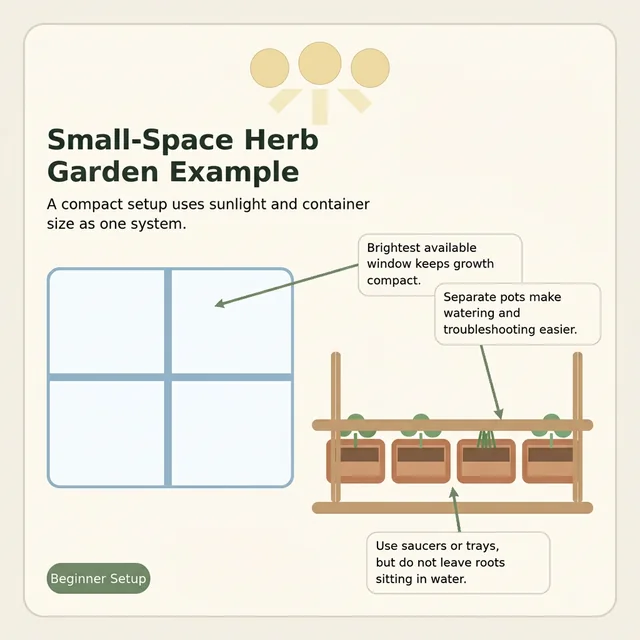
How to Set Up a Small-Space Herb Garden That Actually Works
A calm, practical guide to starting a herb garden on a balcony, windowsill, or bright indoor corner without overbuying or overcomplicating the setup.
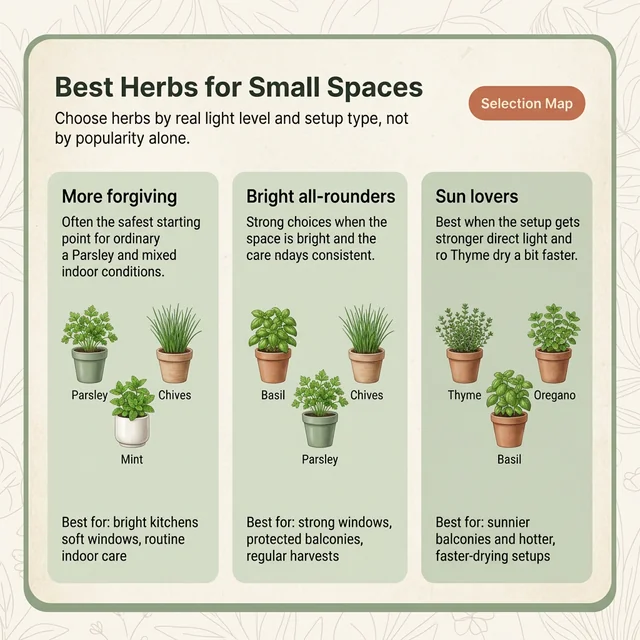
Best Herbs for Small Spaces: What Grows Well in Apartments, Balconies, and Windowsills
A practical guide to the herbs that actually perform well in compact homes, with selection logic for bright windows, balconies, and more forgiving low-space setups.
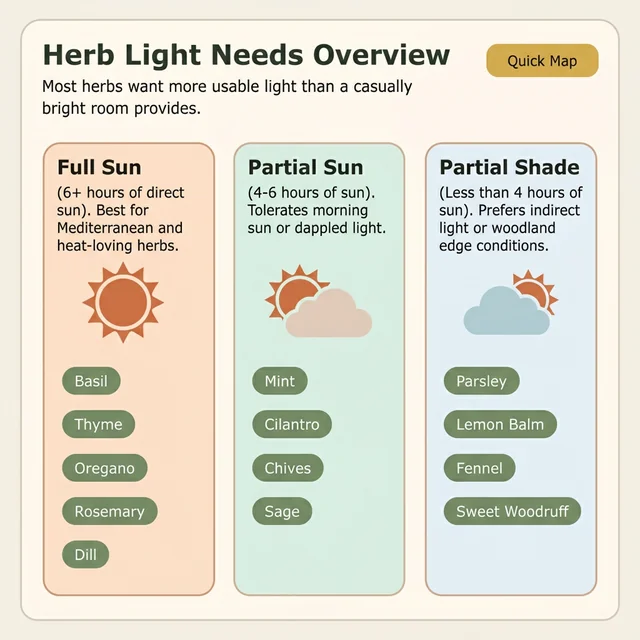
How Much Light Do Herbs Need? Realistic Sun and Grow Light Rules
A practical guide to herb light needs for real homes, with clear rules for sunny windows, balconies, dimmer apartments, and beginner grow light setups.