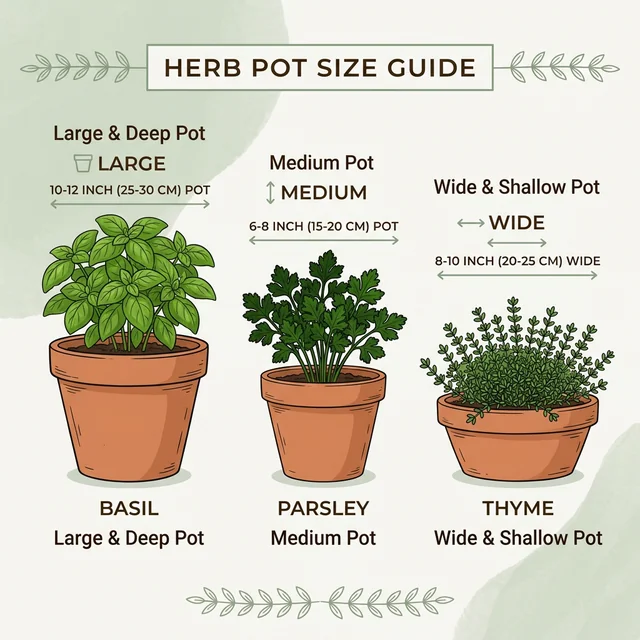
Ideal container dimensions for common culinary herbs
| Herb | Minimum Pot Diameter | Ideal Pot Shape | Root Depth |
|---|---|---|---|
| Basil | 8-10 inches | Deep pot with 1-2 gallon volume | Dense and fast-growing |
| Parsley | 8-10 inches | Standard medium depth | Deep taproot |
| Mint | 10-12 inches | Wide and self-contained | Spreading runners |
| Thyme | 6-8 inches | Wide and shallow | Shallow and creeping |
| Chives | 6-8 inches | Standard round or square | Shallow bulbs |
Most common kitchen herbs need more container space than the decorative pots they are often sold in. As a quick rule, one basil can start in an 8- to 10-inch pot with roughly 1 to 2 gallons of mix, vigorous mint benefits from about 10 to 12 inches of width, parsley needs roughly 8 to 10 inches with useful depth, and a young thyme or chive plant can start in the 6- to 8-inch range if drainage is good. These are practical starting sizes, not biological cliff edges. The goal is enough root volume that watering, growth, and recovery stay manageable.
That is why herb pot size only makes sense inside a larger container system. Before you buy soil or seeds, review Best Containers for Herbs: Pot Size, Drainage, and Material Guide to understand how drainage and materials change the margin for error.
If you are still organizing the whole setup, zoom out with Small-Space Herb Gardening: Start Here for Apartments, Balconies, and Indoor Setups. If you are choosing crops for a compact shelf or windowsill, Best Herbs for Small Spaces: What Grows Well in Apartments, Balconies, and Windowsills helps you decide which herbs are worth sizing a pot for in the first place, and Best herb planters for small spaces covers space-saving planters that still hit these size ranges. If your bigger problem is that containers keep swinging from soggy to bone dry, see How Often Should You Water Potted Herbs? (Stop Guessing) because watering difficulty is often a pot-size problem in disguise.
Sunny balcony growers should also keep exposure in mind, because pot size and drying speed change fast outdoors. Use Best herbs for a sunny balcony (full sun, heat & wind proof) if your containers sit in strong afternoon sun.
Here is the sizing breakdown for the herbs you are most likely trying to grow. Basil, thyme and parsley are summarized in one chart because each has a dedicated guide; mint and chives are covered in full below.
Basil, thyme and parsley at a glance
These three herbs have their own detailed guides, so this chart gives only the starting size and the one thing that decides it.
| Herb | Starting pot for one plant | What decides the size | Full guide |
|---|---|---|---|
| Basil | 8 to 10 in wide, roughly 1 to 2 gallons of mix | A dense, thirsty root system that can dry a small pot within hours in heat | Basil pot size |
| Thyme | At least 6 in wide and 4 in deep (RHS minimum); 6 to 8 in wide for an established plant | Fast drainage and a gritty mix matter more than extra depth | Thyme pot size |
| Parsley | About 8 to 10 in deep and wide | A long taproot that needs vertical room | Parsley pot size |
Mint: The Aggressive Runner
Mint is an incredible survivor, which is exactly the problem. Under the soil, mint sends out aggressive runners (rhizomes) that shoot across the pot to sprout new stems.
- The Mixed Container Mistake: Mint spreads through underground stems and competes strongly in a shared planter. A separate pot keeps its spread and watering easier to control.
- The Ideal Pot: Give mint a medium-to-large container around 10 to 12 inches wide so it can produce a useful canopy, and divide or refresh it when the root mass becomes congested. Width is usually more useful than extreme depth. → Browse wide 12-inch planters on Amazon.
Chives: The Tight Clump
Chives grow from tiny, shallow bulbs that multiply in tight clusters. They don’t have deep roots, and they don’t send out invasive runners like mint.
- The Space Requirement: Chives are highly forgiving when it comes to space. They will happily fill whatever container you put them in, eventually forming a dense, grassy clump.
- The Ideal Pot: A standard 6-inch or 8-inch pot is perfect. You don’t need excessive depth or extreme width. They are the easiest herb to fit into an awkward or tight spot on your shelf, which is why they are often recommended in Best Herbs for Small Spaces: What Grows Well in Apartments, Balconies, and Windowsills. → Browse 6-8 inch pots on Amazon.
Why Pups and Seedlings Can’t Stay in Nursery Pots
When you buy an herb from a supermarket or garden center, it often arrives in a 3- to 4-inch nursery pot intended for production and transport. Treat that as a cue to inspect, not an instruction to repot blindly.
Slide out the root ball when the plant is hydrated enough to hold together. Circling roots, a dense wall of roots, or a pot that dries within hours support moving up one size. A recently rooted seedling with loose, uncolonized mix can remain until its roots hold the plug. Use how to repot herbs without shock rather than moving every plant on arrival day.
Pots that hit these sizes
Whatever herb you are potting, make sure the container has real drainage holes. A few reliable options by size:
- Small herbs (thyme, chives), 6-8 in: browse 6-8 inch pots with drainage on Amazon.
- Thirsty herbs (basil, mint, parsley), 10-12 in: browse 10-12 inch pots on Amazon.
- Hate daily watering? A self-watering pot buffers the moisture for basil and mint.
Pot size for a single herb
Need the size for just one herb? Use these dedicated guides:
- Basil pot size
- Parsley pot size
- Mint pot size
- Thyme pot size
- Rosemary pot size
- Chives pot size
- Cilantro pot size
Related Guides
- Small Space Herb Gardening
- Best Containers Herbs
- How Often to Water Potted Herbs
- Repot Herbs Without Shock
Sources and further reading
- University of Georgia Extension: Container Gardening—Thinking Outside the Box lists one to two gallons as a useful range for annual herbs such as basil and emphasizes drainage.
- Royal Horticultural Society: How to Grow Thyme gives a minimum of about 6 inches wide by 4 inches deep for one thyme plant.
- University of Wisconsin Extension: Container Gardening places basil, mint, parsley, and thyme across container classes rather than presenting one universal size.
If you are matching herbs to container size, also read
These guides connect pot size decisions with container choice, herb selection, sunny balcony exposure, and the wider small-space workflow.
- Small-space herb gardening: start here for apartments, balconies, and indoor setups
- Best containers for herbs: drainage, pot size, and materials that work
- How often to water potted herbs: a by-herb chart
- Best herbs for small spaces: what grows well in apartments, balconies, and windowsills
- How to repot herbs without slowing growth
Common questions
Why is my basil struggling in a 4-inch pot?
Basil has a massive root system and drinks a lot of water. A 4-inch pot dries out far too quickly to support a mature basil plant, leading to daily wilting and stress.
Can I plant all my herbs in one large planter?
It is usually a bad idea. Herbs have drastically different water and root space needs. Separate pots allow you to control the environment for each specific plant.
Does thyme need a deep pot?
No. Thyme has shallow roots that spread sideways, so depth beyond about 6 inches adds little. Depth is not harmful by itself; the risk is a large volume of moisture-retentive mix that stays wet around a small plant. The RHS minimum for one plant is about 6 inches wide and 4 inches deep.
What pot size is best for parsley?
Parsley usually does best in a pot around 8 to 10 inches deep and wide because its taproot needs more depth than many beginners expect.
Is a bigger herb pot always better?
Not automatically. More volume helps basil, mint, and parsley, but the container still needs good drainage and has to make sense for the herb, the light, and how fast the mix dries in your home.
Can basil and parsley share the same planter?
They can share a planter if it is wide enough and drains well, but separate pots are usually easier to manage because basil grows faster and often dries the mix sooner.
Related guides
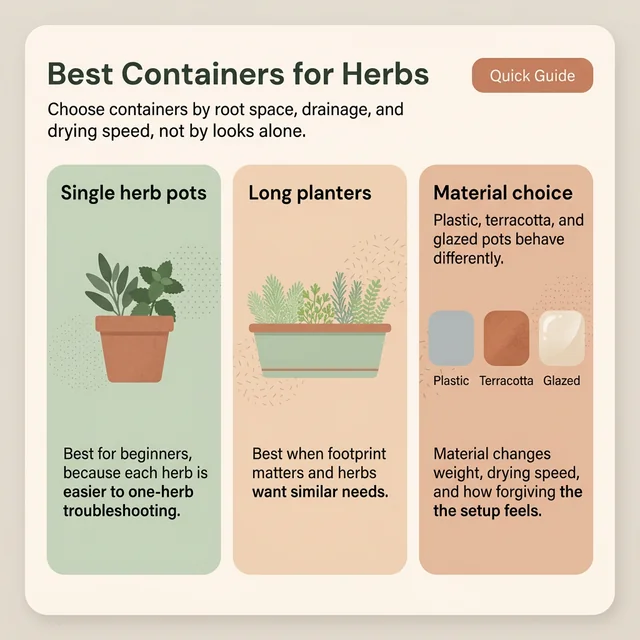
Best containers for herbs: drainage, pot size, and materials that work
A practical guide to herb containers that explains which pots work best, why drainage matters, and how material changes the way containers dry.
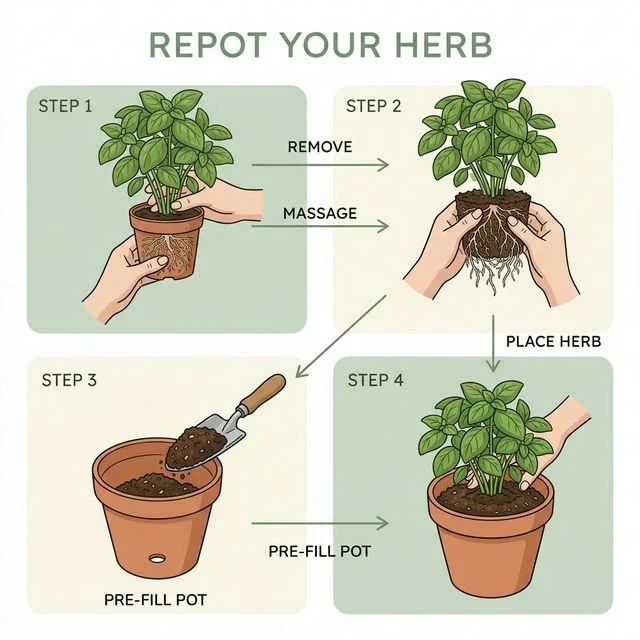
How to repot herbs without slowing growth
Moving an herb to a bigger pot should trigger a massive growth spurt. If your plants wilt and drop leaves after repotting, you are suffering from transplant shock. Here is how to upgrade your container without stressing the roots.
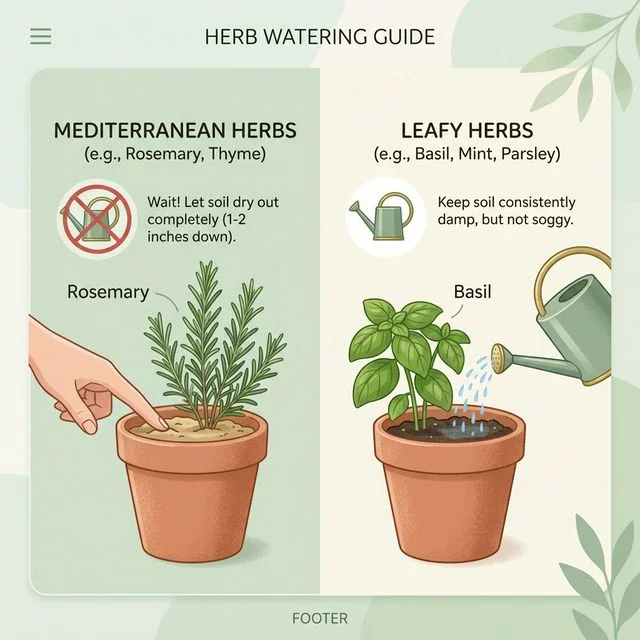
How often to water potted herbs: a by-herb chart
Most potted herbs should be checked often but watered only when the root zone is actually drying. Judge the pot instead of following a rigid calendar.