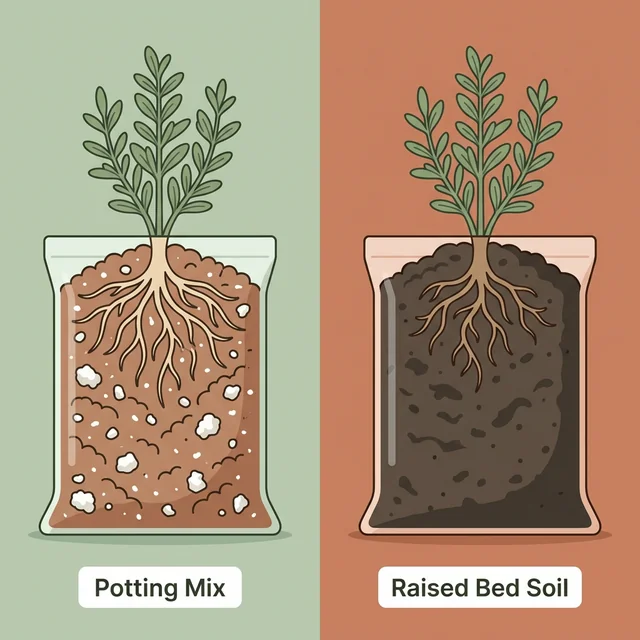
Potting Mix vs. Raised Bed Soil: What happens in a container
| Feature | Potting Mix | Raised Bed / Garden Soil |
|---|---|---|
| Texture | Light, fluffy, and springy | Heavy, dense, and clumpy |
| Drainage | Excellent; water flows through quickly | Poor; water pools on top or creates mud |
| Airflow | High; roots can breathe easily | Zero; roots suffocate in the mud |
| Compression | Resists compacting over time | Turns into a solid brick after a few waterings |
| Verdict for Pots | The only acceptable choice | Never use in a container |
One of the most devastating mistakes a beginner can make is walking into a garden center, seeing a massive $5 bag labeled “Raised Bed Garden Soil,” and using it to fill their indoor herb pots. Within a month, the herbs will turn yellow, wilt despite being wet, and die from root rot.
If this has happened to you, it is not your fault. The terminology used by soil companies is incredibly confusing. However, understanding the difference between the dirt outside and the media used inside a pot is the threshold between constant failure and effortless success.
If you are just beginning to design your apartment setup, remember that soil is just one part of the triad. You also need the right pot and the right watering routine. Make sure you read through Small-Space Herb Gardening: Start Here for Apartments, Balconies, and Indoor Setups to see how the whole system connects.
Here is why “soil” is actually terrible for potted herbs.
The Physics of a Container
In the ground, water has nowhere to go but down. Gravity pulls excess water deep into the earth, aided by earthworms, microscopic channels, and massive root networks.
A container, however, is a closed system with an artificial floor. When you put dirt into a container, gravity cannot pull the water far enough away from the roots. The water gets “stuck” at the bottom of the pot due to a physics concept called the perched water table.
Why Heavy Soil Fails
If you fill a container with heavy “raised bed soil” or “topsoil,” that perched water table basically climbs to the top of the pot. The heavy soil acts like a dense sponge. It holds all the water, immediately collapses under its own weight, and squeezes all the oxygen out.
Roots need oxygen just as much as they need water. When they are encased in dense, wet, airless mud, they drown. This is the root cause of almost every issue discussed in Common Problems With Potted Herbs: How to Diagnose Yellow Leaves, Wilting, and Weak Growth.
Potting Mix: Engineered for Pots
“Potting mix” is the solution to the closed-container physics problem. In fact, most high-quality potting mixes contain absolutely zero real “dirt.”
They are usually a precise, lightweight blend of three functional ingredients:
- Peat Moss or Coco Coir: To hold moisture like a sponge without rotting.
- Perlite or Pumice: Those little white rocks that look like Styrofoam. These create physical air pockets so the roots can breathe even when the mix is wet.
- Pine Bark or Vermiculite: To add structure and prevent the mix from compressing over time.
Because potting mix is so light and fluffy, gravity can easily pull the excess water down and out through the drainage holes. The perlite ensures that even when the peat moss is fully saturated, there are still pockets of oxygen available to the roots.
The Rule for Herb Containers
If you are growing herbs in a container—whether that container is a tiny window box or a massive half-barrel on a balcony—you must use potting mix. Period.
You can read more about how this connects to the physical pot itself in Best Containers for Herbs: Pot Size, Drainage, and Material Guide, but if you fail the soil test, the best pot in the world will not save you.
How to Check Your Current Soil
If you suspect you used the wrong bag of soil, there are three clear warning signs:
- The Concrete Test: When the soil dries out, does it pull away from the sides of the pot and turn into a solid, impenetrable brick? That is heavy garden soil. Good potting mix stays slightly springy even when dry.
- The Pooling Test: When you pour water onto the soil, does it sit on the surface for a long time before slowly sinking in? That is dense soil lacking perlite and airflow.
- The Weight Test: Is the pot excessively heavy to lift, even when dry? Potting mix is remarkably lightweight compared to real dirt. If you recently established your container sizes using the Herb Pot Size Guide: Basil, Parsley, Mint, Thyme, and Chives, you should notice that a large pot filled with mix is still quite manageable to carry.
Fixing the Problem
If you realize you have planted your precious rosemary or basil in heavy raised bed soil, the only real fix is to repot it.
Gently remove the plant from the pot. Do your best to knock the heavy, muddy clay off the roots without tearing them. Rinse the roots if necessary. Then, thoroughly wash out the container, fill it with a fresh bag of high-quality indoor potting mix, and replant the herb.
To prevent future shock, review the watering techniques laid out in Potted Herb Care: Watering, Feeding, and Pruning Without Guesswork. Watering fluffy potting mix requires a slightly different cadence than dealing with dense outdoor dirt, but it is infinitely more forgiving and is the only path to a successful apartment garden.
Related Guides
Read these if your herbs are struggling with water
These guides will help you understand how soil, pot size, and watering habits work together to keep roots healthy.
- Best containers for herbs: drainage, pot size, and materials that work
- Herb pot size chart: basil, mint, parsley, thyme & chives
- Potted herb care: watering, feeding, and pruning without guesswork
- Common potted herb problems: yellow leaves, wilting, and weak growth
- Small-space herb gardening: start here for apartments, balconies, and indoor setups
Common questions
Is "garden soil" the same as potting mix?
No. Garden soil is terrible for pots. It is extremely heavy and assumes worms and deep ground drainage will do the work. In a pot, it turns into a dense, airless brick.
Why does the water sit on top of my soil and take forever to drain?
Your soil has likely compacted because it is either too heavy (raised bed soil) or because the peat moss in the potting mix has completely dried out and become hydrophobic.
Can I mix raised bed soil with perlite to use in a pot?
You can try, but it is rarely worth the effort. It is much safer and cleaner to just start with a high-quality, lightweight indoor potting mix.
Related guides
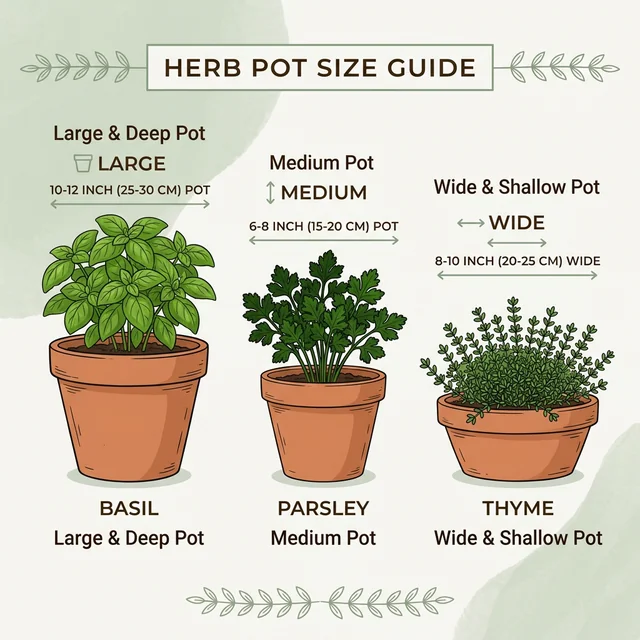
Herb pot size chart: basil, mint, parsley, thyme & chives
A practical herb pot size guide for the most common kitchen herbs, with simple size ranges that make container growing easier to read and maintain.
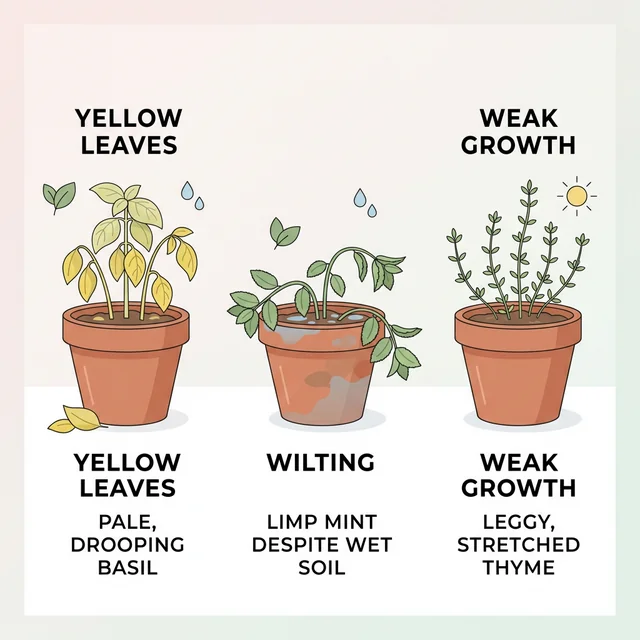
Common potted herb problems: yellow leaves, wilting, and weak growth
Common potted herb problems usually show up as yellow leaves, wilting, or weak growth, but the useful diagnosis starts with light, drainage, and root stress.
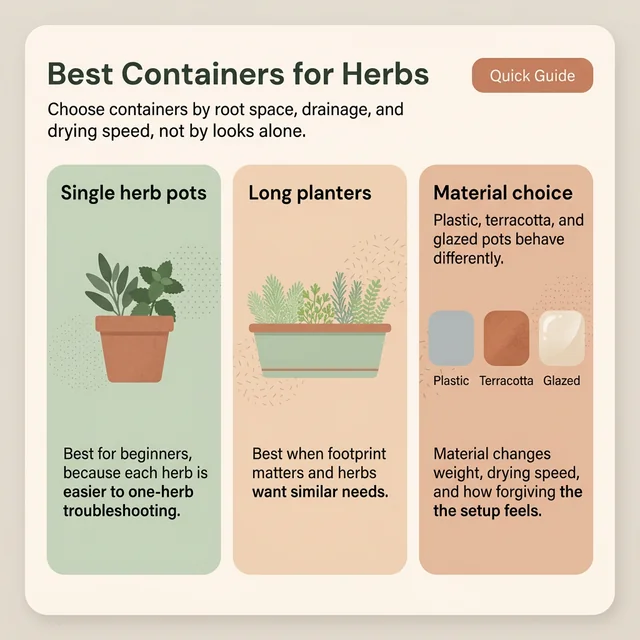
Best containers for herbs: drainage, pot size, and materials that work
A practical guide to herb containers that explains which pots work best, why drainage matters, and how material changes the way containers dry.