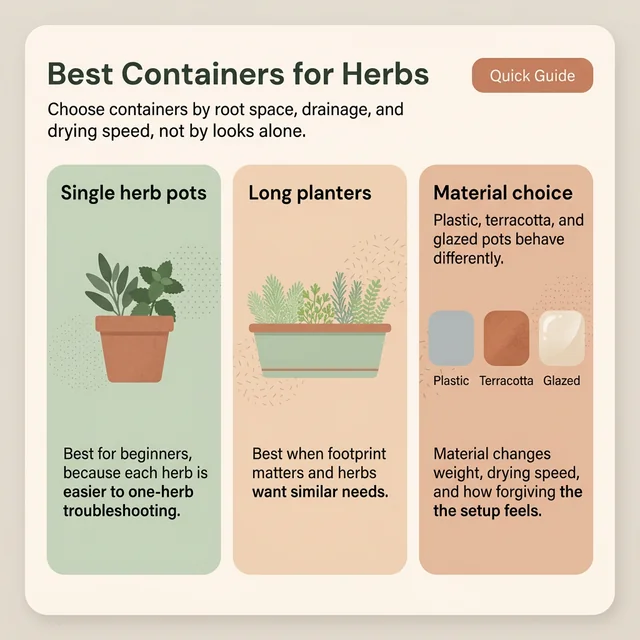
Practical container choices for common herb-growing situations
| Container type | Best for | Main advantage | Main caution |
|---|---|---|---|
| Medium single pot | Basil, parsley, mint, chives | Easy to read and manage one herb at a time | Takes more space than one shared planter |
| Long window box | Several small herbs with similar needs | Efficient footprint for balconies and rails | Mixed herbs can be harder to water evenly |
| Terracotta pot | Sunny, fast-drying spaces | Extra airflow around roots | Can dry too quickly in heat or wind |
| Plastic nursery-style pot | Indoor setups and beginners | Retains moisture better and weighs less | Poor designs may overheat or look less attractive |
The best containers for herbs are the ones that balance three things at once: enough root volume, real drainage, and a material that matches how quickly your site dries. In practice, that usually means avoiding tiny decorative pots, choosing containers with open drainage holes, and deciding between plastic, terracotta, or glazed ceramic based on light, heat, wind, and how often you can realistically check moisture.
If you need the herb-by-herb sizing ranges first, use Best Herb Pot Sizes for Basil, Mint, Parsley, Thyme, and Chives. If the bigger problem is day-to-day watering, see How Often Should You Water Potted Herbs? (Stop Guessing). Container choice and watering behavior are the same system viewed from two angles.
Before you compare materials, make sure the soil side of the system is also correct. Potting Mix vs Raised Bed Soil: Fix Container Yellowing explains why even a good pot becomes hard to manage when the medium is too dense for containers. If you are still laying out the whole garden, How to Set Up a Small-Space Herb Garden That Actually Works gives the wider plan. For a tighter material comparison, Plastic vs Terracotta Pots for Herbs is the best follow-up once you already know the size range you need.
The Herb Container Cheat Sheet
Use the following quick reference chart to identify the best container type for your specific growing situation.
| Container type | Best for | Main advantage | Main caution |
|---|---|---|---|
| Medium single pot | Basil, parsley, mint, chives | Easy to read and manage one herb at a time | Takes more space than one shared planter |
| Long window box | Several small herbs with similar needs | Efficient footprint for balconies and rails | Mixed herbs can be harder to water evenly |
| Terracotta pot | Sunny, fast-drying spaces | Extra airflow around roots | Can dry too quickly in heat or wind |
| Plastic nursery-style pot | Indoor setups and beginners | Retains moisture better and weighs less | Poor designs may overheat or look less attractive |
Practical Tip: When standing in the garden center, always prioritize function over form. A cheap, ugly plastic pot with massive drainage holes will grow drastically better herbs than a beautiful, expensive ceramic glazed pot that has no holes at the bottom.
How to know if your container is the problem (visual symptoms)
Before you assume you have a watering or pest problem, your plants will often tell you if their container is failing them. Here is how to diagnose container issues visually:
- Wilting by mid-afternoon every day: If your plant constantly collapses but recovers when watered, your pot is too small. It lacks the soil volume to hold a full day’s worth of water.
- Pale, yellowing leaves and a foul smell: If the bottom leaves are dropping and the soil smells swampy, your pot lacks drainage. Water is pooling at the bottom and drowning the roots.
- White crust on the outside of the pot: If you use terracotta and see a heavy white crust forming, your pot is breathing heavily and accumulating salt. This is normal, but it means you must water more frequently to prevent severe dry-outs.
Why Container Choice Matters More Than Beginners Expect
In a ground bed, roots can keep exploring to find water. In a container, everything depends on the small volume of media you provide. That limited space has to store moisture, allow air movement, hold nutrients, and support growth during massive temperature swings. If the container is too small or poorly drained, the herb feels the consequences quickly.
This is why a weak container choice often shows up as several symptoms at once. A pot that is too small dries fast, pushes you into more frequent watering, and becomes harder to interpret. People often think they have a watering problem when the hidden issue is actually container design.
Pot Size Basics
Herbs do not need enormous containers, but many need more volume than the tiny pots sold for kitchen display. A larger root zone does three useful things: it holds moisture longer, gives roots more room to explore, and slows temperature swings. That combination makes care noticeably easier.
A practical size rule
A good beginner rule is to avoid containers so small that you have to guess about watering every day from the first week onward. If the pot feels like it only exists for presentation, it is probably undersized for long-term herb production.
Different herbs also want different room:
- Basil and parsley usually benefit from moderate to large root space because they grow leafy top growth that depends on steady moisture.
- Mint often wants enough room to stay vigorous, but it must be isolated in its own pot because it spreads aggressively.
- Thyme and oregano can tolerate somewhat tighter pots than basil, especially in bright conditions, but perform better when not cramped.
One Herb Per Pot or Shared Planter?
Beginners often assume shared planters are automatically more efficient. Sometimes they are. But they also make the system harder to manage because several herbs may have different growth speeds, root behaviors, and watering needs.
One herb per pot is the simplest default. It creates clearer feedback. If basil wilts, you know the basil pot needs attention. If thyme stays wet too long, you can move only that container. The system becomes easier to observe and easier to correct.
Shared containers make the most sense when:
- The herbs have identical moisture preferences (e.g., Rosemary and Thyme).
- The planter has enough width and depth to avoid instant root crowding.
- The grower understands exactly how fast that specific planter dries out.
Drainage Rules That Actually Matter
Drainage holes are not a detail. They are the basic engineering of container growing. Roots need both moisture and oxygen. If water cannot move through the container and out the bottom, oxygen around the roots declines, and the plant essentially drowns in compacted, poor soil.
This is why a container without drainage holes is always the wrong primary pot. Decorative outer pots can be used, but the growing container inside should drain freely and should never sit in a reservoir of stagnant runoff.
Material Guide: Plastic, Terracotta, and Ceramic
Container material changes how fast the root zone dries, how heavy the pot becomes, and how practical the system feels.
Plastic
Plastic containers are the most practical option for beginners. They are lightweight, affordable, and retain moisture significantly better than terracotta. That is especially useful indoors, on shelves, or on balconies where wind and heat increase drying. If you are reading How to Set Up a Small-Space Herb Garden, plastic is a great baseline.
Terracotta
Terracotta is popular because it looks good and allows moisture to evaporate through the pot walls. This extra airflow can help roots avoid sitting overly wet, which is fantastic for Mediterranean herbs like thyme or oregano. The tradeoff is speed: in hot, windy spaces, terracotta can force you to water twice a day.
Glazed ceramic
Glazed ceramic works well if it has real drainage holes. These pots hold moisture like plastic, but they are heavy and prioritize aesthetics. If you use a decorative cachepot without holes, treat it as an outer shell, not the main growing container.
Common container mistakes in herb gardening
Avoid these frequent pitfalls to keep your container garden running smoothly without daily stress:
- Using pots without drainage holes: This is a guaranteed death sentence for herbs. Never plant directly into a decorative cachepot without a plastic nursery pot inside.
- Adding rocks to the bottom for “drainage”: This is a myth that actually raises the water table closer to the roots, causing rot. Use consistent soil from top to bottom.
- Using tiny decorative pots: Those cute 3-inch tin pails sold in supermarkets are for transport, not growing. They will dry out in hours on a sunny windowsill.
- Planting mint in a shared planter: Mint is aggressively invasive. If planted in a window box with thyme or basil, the mint roots will strangle the other plants within a month.
Quick decision guide
When you are checking your herbs wondering how to improve their setup, use these short, actionable bullet points:
- Plant is dropping yellow leaves but soil is wet → Drill more holes in the pot or repot immediately.
- Soil dries out within 12 hours → Move the plant into a container twice the size.
- Growing on a hot, windy balcony → Choose plastic or glazed ceramic to retain moisture.
- Growing in a cool, damp basement under lights → Choose breathable terracotta to prevent rotting.
FAQ
What is the best pot size for herbs?
Most herbs do better in containers large enough to buffer drying for at least 48 hours. Standard 6-inch to 10-inch pots are excellent starting points for individual plants like basil or parsley.
Do herbs really need drainage holes?
Yes. Absolutely. Without drainage holes, it becomes mathematically impossible to manage root oxygen and prevent rotting.
Why do my herbs keep drying out so fast?
The container is likely too small or the material (like unsealed terracotta) is drying too quickly for your specific site. Often, what feels like a failure of watering skill is actually just a pot that lacks necessary volume.
Are self-watering pots good for herbs?
They can be useful for thirsty herbs or growers who miss watering windows, but they still need an airy potting mix and a container size that fits the herb. Self-watering pots for herbs work best when you still pay attention to drainage and root behavior.
Related Guides
If you are choosing herb containers, also read
These guides connect container choice with exact pot sizing, watering behavior, container soil, and small-space setup decisions.
Common questions
What type of container is best for herbs?
The best herb container is one with real drainage holes, enough root volume for the crop, and a material that matches how quickly your site dries. Plastic is often the easiest baseline for beginners.
Are terracotta pots good for herbs?
Yes, especially for herbs that like faster drying, but terracotta can become demanding in hot or windy spaces because it loses moisture through the pot walls.
How big should herb containers be?
Many common herbs do best somewhere between 6 and 12 inches wide depending on the crop. Basil and mint usually want more volume than thyme or chives, which is why a herb-specific size guide helps.
Can herbs grow in containers without drainage holes?
Not well as a long-term primary setup. You can place a draining nursery pot inside a decorative cachepot, but the actual growing container should still let excess water escape.
Is plastic or terracotta better for herb containers?
Neither is always better. Plastic is usually easier for beginners because it holds moisture longer, while terracotta can work well in damp setups or for herbs that prefer faster drying.
Related guides
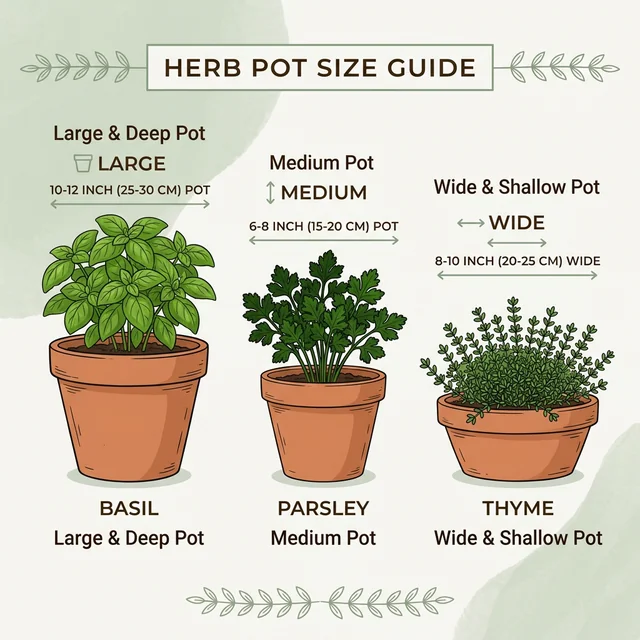
Herb pot size chart: basil, mint, parsley, thyme & chives
A practical herb pot size guide for the most common kitchen herbs, with simple size ranges that make container growing easier to read and maintain.
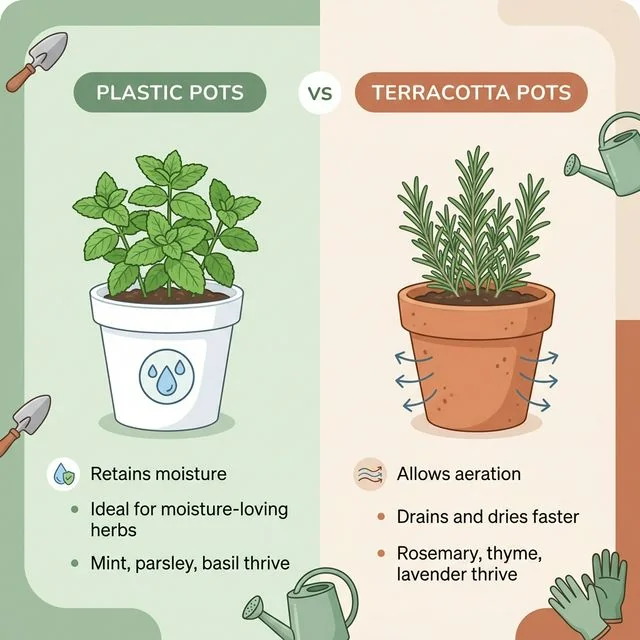
Plastic vs. terracotta pots for herbs: which makes care easier?
The material of your pot dictates how fast your soil dries out. If you put a thirsty mint plant in unglazed terracotta, you will be watering every single day. If you put rot-prone rosemary in a plastic pot, you must be extremely careful.
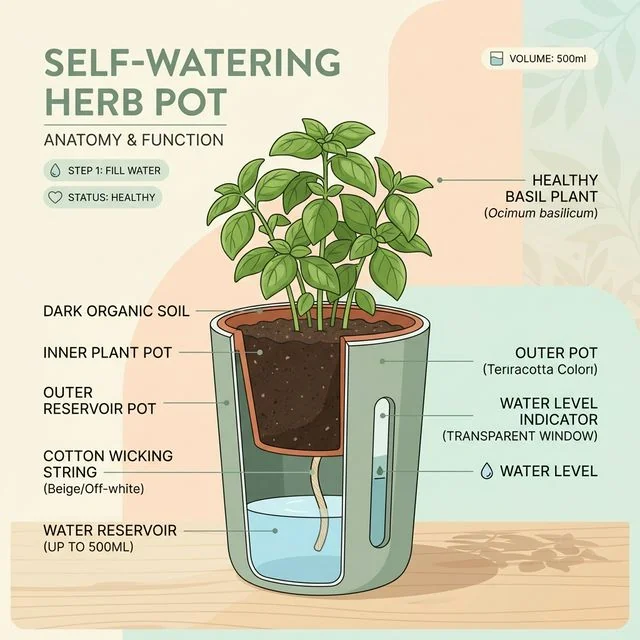
Self-watering pots for herbs: worth it or more trouble?
Self-watering pots sound like the holy grail for busy gardeners. While they are fantastic for moisture-loving herbs like mint, they can quickly turn into a swamp of rotting roots for drought-tolerant plants like rosemary.