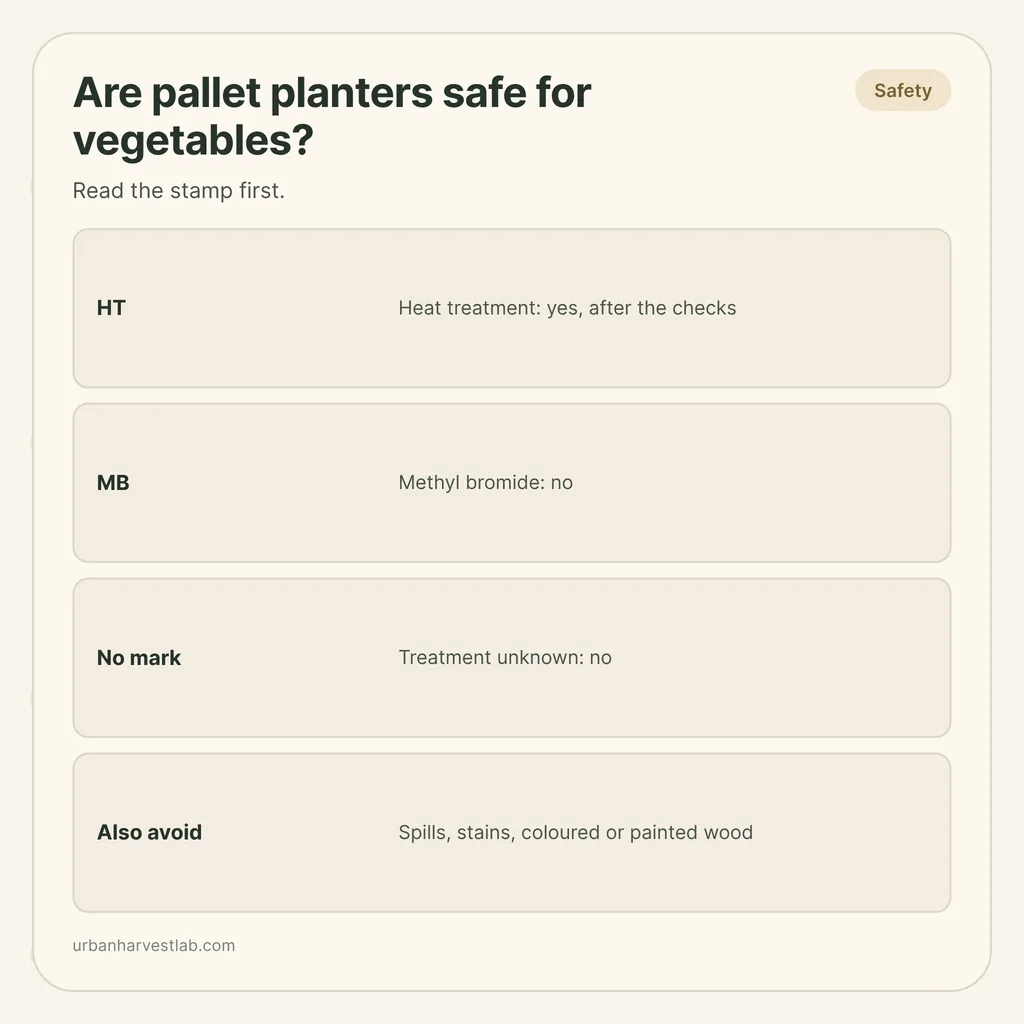
A pallet is a reasonable edible planter only if it carries the IPPC mark with the treatment code HT and has no stains, spills or coloured finish. Pallets stamped MB, pallets with no mark, and pallets that look tinted or painted should stay out of a vegetable garden. Even a good stamp only describes how the wood was treated against pests, not where the pallet spent its life. For the wider rule on anything that will hold soil and food, see food-safe containers.
What the stamp is
Shipping pallets that cross borders are marked under ISPM 15, the International Standard for Phytosanitary Measures published by the International Plant Protection Convention (IPPC). Its scope is stated plainly: it covers the movement of wood packaging made from raw wood in international trade, to reduce the spread of quarantine pests. Kentucky State University’s urban agriculture programme tells growers to look for the IPPC logo first. Without it, the university says it is best to avoid the pallet because you will not have clear information about how it has been treated.
ISPM 15 requires the mark to carry four parts: the symbol, a country code, a producer or treatment-provider code, and a treatment code. The country code is the two-letter ISO code, such as US, CA or MX. Kentucky State notes that the numbers after it identify the supplier of that pallet.
Reading the treatment code
| Code | What it means | Edible planter? |
|---|---|---|
| HT | Heat treatment | Yes, after the checks below |
| MB | Methyl bromide fumigation | No |
| No mark, or unreadable | Treatment unknown | No |
HT. ISPM 15 requires a minimum of 56 °C for a minimum of 30 continuous minutes throughout the entire profile of the wood, core included. USDA APHIS describes the same benchmark for its heat-treatment programme. Kentucky State says that if heat treatment is the only treatment code, the wood is otherwise untreated and safe to use. The University of Saskatchewan agrees: HT pallets are suitable for growing produce.
MB. Kentucky State considers methyl bromide wood unsafe for use in the garden or as compost bins. Saskatchewan tells gardeners not to use pallets stamped MB because they are not suitable for food production. The US EPA describes methyl bromide as an odorless, colorless gas, so you cannot smell your way to a clean pallet, and says it is most dangerous at the fumigation site. The reason to refuse MB wood for a vegetable bed comes from the two garden sources above, not from that EPA line.
Other codes. ISPM 15 lists two more treatment codes, DH for dielectric heating and SF for sulphuryl fluoride. The garden guidance from Kentucky State and Saskatchewan addresses HT and MB. For a pallet marked DH or SF, those two sources give no ruling, so the cautious route is to pick a different pallet.
When a good stamp is not enough
ISPM 15 says its measures are not intended to provide ongoing protection from contaminating pests or other organisms. A treated pallet is also not re-treated during its service life: the standard says an unaltered, marked unit does not require re-treatment or reapplication of the mark. So the stamp tells you about the wood on the day it was treated, and nothing about the freight that sat on it afterwards. Three checks cover what the stamp misses:
- Spills and stains. Kentucky State says that if there are spills or stains on the pallet, you may not want to use it.
- Colour. Kentucky State says coloured pallets should be avoided because they are often used to ship toxic chemicals. Saskatchewan adds that wood tinted green, stained or painted is very likely chemically treated.
- A missing or doubtful mark. Saskatchewan notes that some pallet wood is heated in a kiln without the HT stamp, and still advises that unmarked or suspicious pallets should not be used for food. They are fine for ornamentals.
Repairs matter too. ISPM 15 says that when a marked pallet is repaired, each added component must be individually marked. A pallet with boards that look newer than the rest and carry no mark of their own has been patched, and nothing on it says how those boards were treated.
The cautious view, and the alternative
The University of Washington’s Elisabeth C. Miller Library answers a gardener asking about pallets and vegetables with a firmer line. Beyond chemical treatment, it raises the possibility of the wood having absorbed dangerous bacteria, and concludes that it is wise not to use wooden pallets for growing food. That is more conservative than the Kentucky State and Saskatchewan guidance. It is a fair position if you cannot trace where a pallet came from. Miller Library’s page also notes that many pre-2010 pallets are still around, from the period when methyl bromide fumigation was in wider use.
Kentucky State’s own fallback is simple: if you are unsure about reusing a pallet, new pallets can be purchased. A planter built from boards you bought is the same look with no unknowns. Elevated planter box on a balcony covers depth, height and weight for that route.
If you use an HT pallet
Saskatchewan’s pallet garden sheet describes a build for a pallet leaned against a wall. Two details apply:
- Back and bottom covering. It uses landscape fabric or burlap on the back and bottom to stabilise the soil-less potting mix and plants. That is a retention step, and the sheet does not present it as a safety barrier.
- A waterproof layer behind the pallet. It suggests a heavy-gauge plastic to stop media and moisture leaking or staining the wall. If you are weighing a liner inside the planter, should you line a wooden planter goes through the options.
Pallet gardens are not very deep and can dry out quickly, Saskatchewan notes, and they are too small for root vegetables like carrots, beets and potatoes. It lists thyme, basil, parsley, rosemary, oregano, lavender, cilantro, mint, chives and sage as herbs that work well in them.
Sources
- Garden wood safety guide, Kentucky State University
- Pallet gardens, University of Saskatchewan Gardening at USask
- Safety of wooden pallets for vegetable gardens, University of Washington Elisabeth C. Miller Library
- ISPM 15, Regulation of wood packaging material in international trade, IPPC / FAO
- Methyl bromide, US Environmental Protection Agency
- Wood packaging treatment programs, USDA APHIS
Wood, liners and safe containers
What to check before food touches a salvaged or built container.
Common questions
Are pallets safe for vegetable planters?
Only some are. Kentucky State University and the University of Saskatchewan both accept a pallet stamped HT (heat treated) and both say not to use MB (methyl bromide) pallets. Unmarked, stained, spilled-on or coloured pallets should be left out. The University of Washington Miller Library takes the most cautious view and thinks it wise not to use wooden pallets for growing food.
What does HT mean on a pallet?
Heat treatment. ISPM 15 sets the requirement at a minimum of 56 C for a minimum of 30 continuous minutes throughout the whole profile of the wood, including its core. Kentucky State University says that if HT is the only treatment code, the wood is otherwise untreated and safe to use.
What does MB mean on a pallet?
Methyl bromide fumigation. Kentucky State University considers MB wood unsafe for use in the garden or as compost bins, and the University of Saskatchewan says MB pallets are not suitable for food production.
Is a pallet with no stamp safe?
Treat it as unknown. Kentucky State University says to avoid a pallet without the IPPC logo because you will not have clear information about how it was treated, and the University of Saskatchewan says not to use unmarked or suspicious pallets for food. They are fine for ornamental plants.
Related guides
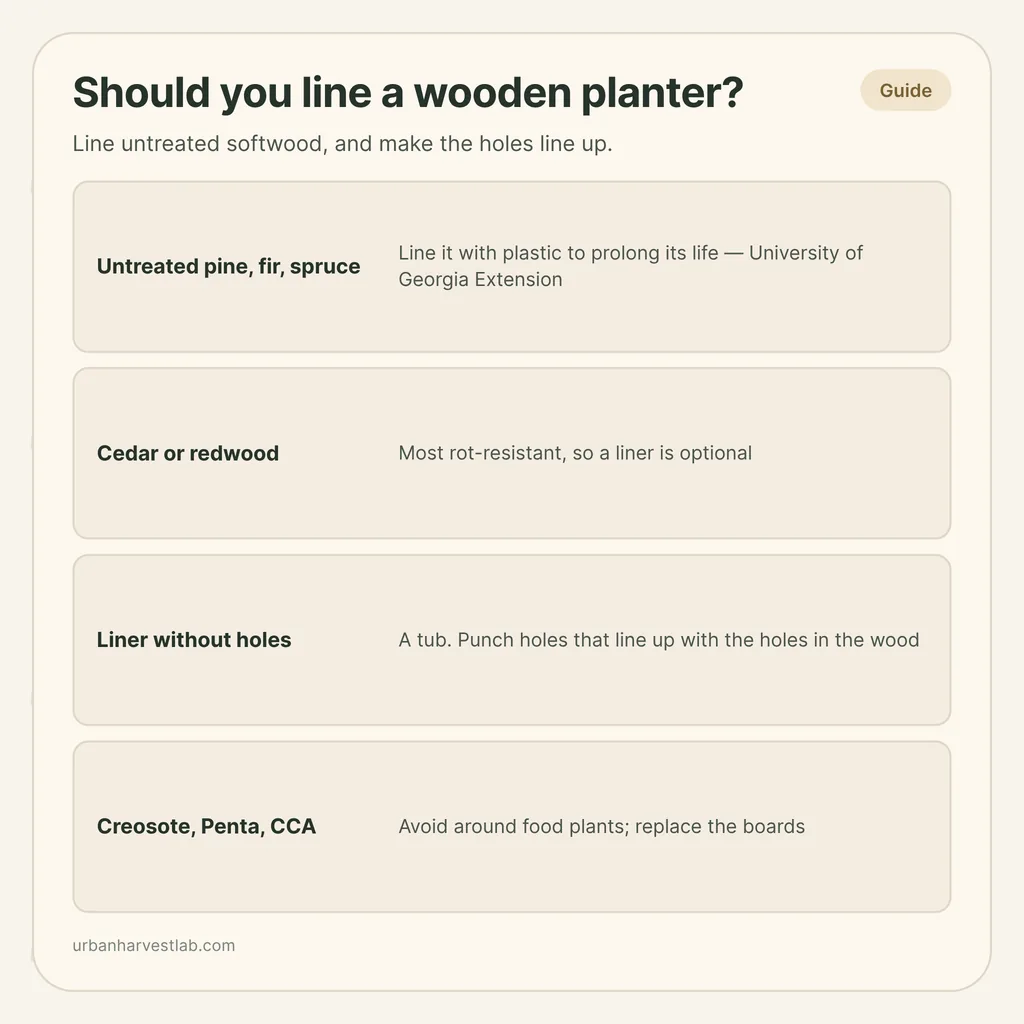
Should you line a wooden planter? Plastic, fabric, or nothing
A liner can stretch the life of a pine box or put a barrier between food roots and questionable lumber. Done badly, it turns the box into a bathtub. Here is how to decide, and how to fit one.

Elevated planter box on a balcony: how deep, how high, how heavy
A planter box on legs is a depth decision first and a weight decision second. Here is how to size one for what you want to grow and for the floor it will stand on.
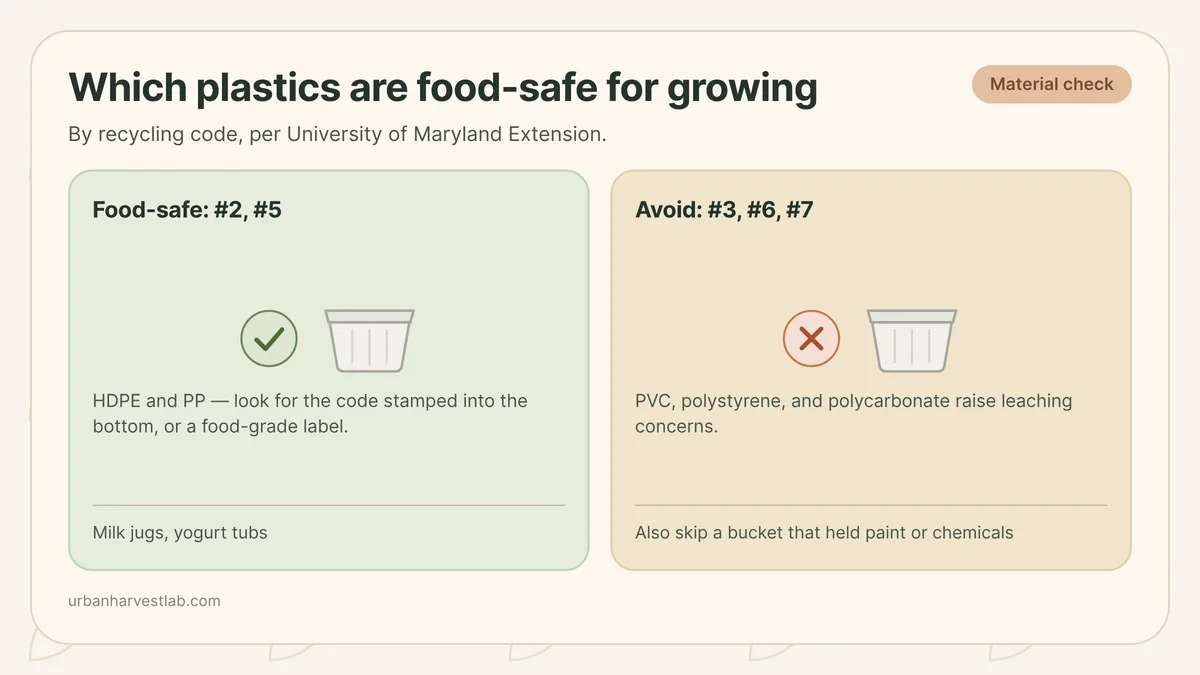
Food-safe containers for growing vegetables and herbs
A container's recycling code and its history both decide whether it's safe to grow food in -- and the two questions have different answers.