Which wood, and does it want a liner?
| Your box | Rot risk | Liner for the wood | Liner for food safety |
|---|---|---|---|
| Untreated pine, fir or spruce | Highest: 4-8 years unpainted, per Maryland's salad-table figures | Yes, perforated plastic | Not an issue |
| Cedar or redwood | Lower: Virginia Tech calls them the most rot-resistant | Optional | Not an issue |
| New residential treated lumber (copper azole, ACQ) | Lowest of the common options | Not needed for rot | Your call; Maryland lists a liner if the wood worries you |
| Old, salvaged or unknown lumber | Unknown | Does not fix the main problem | Replace the boards; a barrier is a fallback |
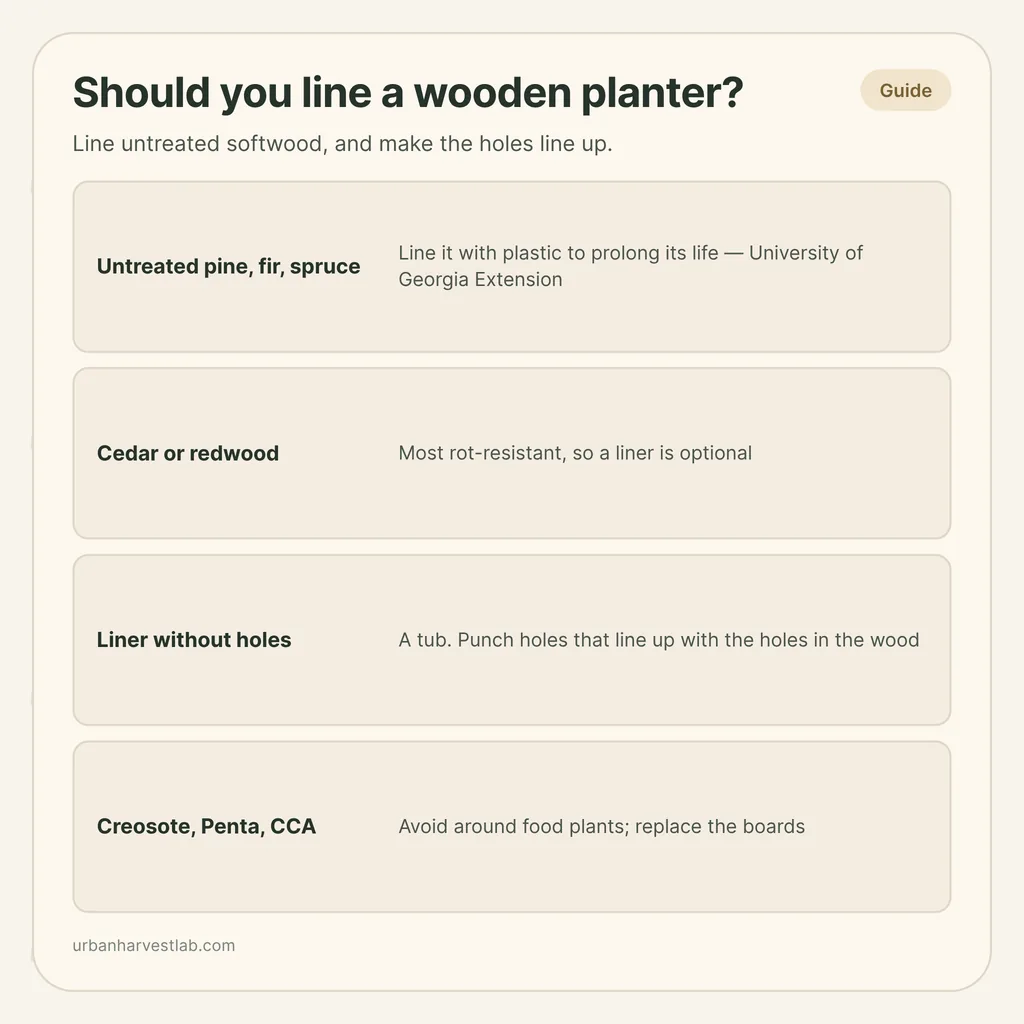
Line a wooden planter if it is untreated pine, fir or spruce, or if you cannot say what the lumber was treated with. Use plastic with drainage holes punched through it, and make sure the holes line up with the holes in the wood. Cedar and redwood box owners can skip it. A liner without holes does harm, because it turns the box into a tub that holds the water you give it.
The lining decision depends on what you are protecting: the wood from the soil, or the soil from the wood. Those are different jobs and they call for different liners. Pot choice in general is covered in best containers for herbs, and food-safe containers covers material safety.
Job one: keeping the wood alive
Wet soil sitting against a board is how a planter dies. Oregon State University Extension notes that raised beds often stay wet year-round from irrigation and rain, which speeds up decay. In its six-year trial, untreated Douglas-fir boxes showed brown rot in the lower portions of the 2 x 12 boards, and the inside of the lower half was severely decayed, with over half the cross-section gone. The treated boxes were mostly intact.
Maryland Extension gives lifespans for a wooden salad-table build: untreated spruce, pine or fir lasts 4 to 8 years, the same wood painted or stained 8 to 12, Western red cedar 12 to 15, and micronized copper azole-treated lumber 15 to 20. Read them as the order of the options rather than a promise for any one box.
A liner is the lever you control after the box exists. University of Georgia Extension is direct: to help prolong the life of wooden containers, line them with plastic. It gives no number for how much longer. University of Illinois Extension adds that a container lined with plastic is resistant to water loss, so expect the mix to hold moisture a little longer.
So the rot-protection case is strongest for cheap softwood. If you are about to spend an afternoon building a pine box, lining it is the cheapest insurance. If the box is cedar, Virginia Tech Extension calls redwood and cedar the most rot-resistant choices, and Illinois Extension suggests picking naturally decay-resistant wood such as cedar or redwood; the liner adds less.
Job two: keeping the soil away from the wood
This is the food-safety half, and the sources split into three groups.
Avoid outright. Virginia Tech Extension says wood around plants should not be treated with creosote or pentachlorophenol (Penta), which may be toxic to plants and harmful to people. Maryland Extension advises avoiding CCA, creosote and Penta lumber. CCA, the arsenic-containing preservative, has not been available for residential use since 2004, per Maryland, and Oregon State warns that salvaged lumber over 20 years old may bring CCA into your garden. In practice, treat salvaged boards that old, such as fence posts or decking, as possible CCA.
Current treated lumber. Maryland Extension describes micronized copper azole, the most widely available residential preservative, as low in toxicity. In Oregon State’s trial of beds built from copper azole-treated lumber, soil copper rose only within 1 inch of the board, and across four seasons the vegetables and herbs showed no increase in copper. Oregon State adds that you should use lumber approved for residential use and rated for ground contact. Illinois Extension is more careful: use caution with treated lumber when growing food. Virginia Tech names ACQ and copper azole as the safer waterborne options.
Two caveats before you take comfort from the Oregon result. It measured garden beds about 4 feet wide by 10 feet long, per Oregon State, not a window box where the wall is close to every root. And it tested one preservative in one region.
If you want a barrier anyway. Maryland lists three routes for anyone uneasy about treated wood: paint or stain it, put a heavy plastic liner between the wood and the soil, or use a non-wood material. Iowa State University Extension describes lining treated wood on the inside with woven geotextile, which lets water drain while keeping soil and roots away from chemicals in the wood.
What a liner does not do is rescue bad lumber. Iowa State says a barrier can separate soil and roots from CCA or creosote lumber, and suggests a soil test to check for toxic chemicals. Still, Maryland and Virginia Tech both say to avoid those woods, and for a box of lettuce and herbs, new boards cost less than the doubt. The same question across plastics, buckets and barrels is in the food-safe containers page.
Plastic or fabric?
The two materials do different things, so match them to the job.
| Perforated plastic | Woven geotextile | |
|---|---|---|
| Main job | Keep moisture off the wood | Separate soil from treated wood while water passes through |
| Source | University of Georgia, Virginia Tech, Maryland Extension | Iowa State University Extension |
| Water | Leaves only through the holes you make | Drains through the fabric |
| Watch for | Holes missing or misaligned | Water passes through, so moisture still reaches the wood |
Plastic: Virginia Tech gives plastic-lined containers with drainage holes punched in the liner as its example. Maryland says a plastic liner should allow soil drainage. Choose plastic that is food-grade where it touches the mix; the recycling-code rules are in the food-safe containers page above. A thin sheet gets torn by staples and trowels, so Maryland’s word “heavy” is worth following.
Fabric: Iowa State specifies woven geotextile, so check what a fabric is before relying on it. If you cannot confirm it, plastic with generous holes is the simpler pick.
Fitting a liner so it helps
- Drill the wood first. The box needs holes in the base regardless. Virginia Tech Extension says to be sure there are holes in the bottom of any container so roots do not stand in water. The drainage holes guide covers sizes and technique for wood.
- Fit the liner, then pierce it. Push through the plastic at each hole in the wood, or cut it open there. Virginia Tech describes the holes punched in the liner.
- Skip the gravel. Washington State University Extension states that drainage material added to containers will only hinder water movement. The mix runs to the floor of the box.
- Cover large holes, not small ones. Maryland Extension says to cover large-diameter drain holes with a porous material such as fiberglass window screening, untreated burlap, a paper towel or a coffee filter, since moist mix mostly sticks to itself and stays in smaller holes.
- Trim the top. Keep plastic below the soil line, so it does not sit in sun or hold a puddle at the rim.
- Raise the box if you can. A legged box keeps the base out of standing water on a deck; elevated planter boxes on a balcony covers depth, height and filled weight.
For a shallow box on a rail, window box herbs has the depth and mix details.
When to leave the liner out
Skip it when the box is cedar or redwood and you only want the wood to breathe, when you have already painted or stained the inside, or when the box is a small insert that sits in a decorative sleeve. Leave it out, too, if you cannot make holes in it. A box with no drainage path is worse than an unlined one.
Sources
- University of Georgia Extension: Gardening in Containers Using Tropical Plants
- Virginia Cooperative Extension: Vegetable Gardening in Containers
- University of Illinois Extension: Container material choices
- University of Maryland Extension: The safety of materials used for building raised beds
- University of Maryland Extension: Growing vegetables in containers and salad tables
- Oregon State University Extension: Pressure-treated wood for raised bed construction in Oregon
- Iowa State University Extension: Creating raised bed planters
- Washington State University Extension: Container drainage
Wooden boxes and food safety
Material safety for food containers, how to cut drainage holes, and how high and deep a legged wooden box should be.
Common questions
Should I line a wooden planter box?
Line it if the wood is untreated pine, fir or spruce and you want it to last, or if you cannot tell what the lumber was treated with. University of Georgia Extension advises lining wooden containers with plastic to prolong their life, and Virginia Tech Extension says to punch drainage holes in the liner. Cedar and redwood resist decay on their own, so a liner is optional there.
Should I use plastic or landscape fabric to line a wooden planter?
Perforated plastic is the option extension sources describe for stretching wood life. Iowa State University Extension describes woven geotextile for the other job, separating soil and roots from treated lumber while letting water drain through. Pick plastic to keep moisture off the wood, fabric when water must pass through the wall, and food-grade plastic if it touches your mix.
Do I need drainage holes if the planter is lined?
Yes. Virginia Tech Extension says containers need holes in the bottom so roots do not stand in water, and it specifies holes punched in a liner. Cut or pierce the liner where the holes in the wood are, or the water has nowhere to go.
Is pressure-treated wood safe for vegetables if I add a liner?
Current residential treated lumber uses copper compounds such as micronized copper azole, which University of Maryland Extension calls low in toxicity. Oregon State University found no increase in copper in plants grown in treated beds. Older CCA, creosote and pentachlorophenol lumber is the real concern; Maryland and Virginia Tech both advise avoiding them, liner or no liner.
Related guides
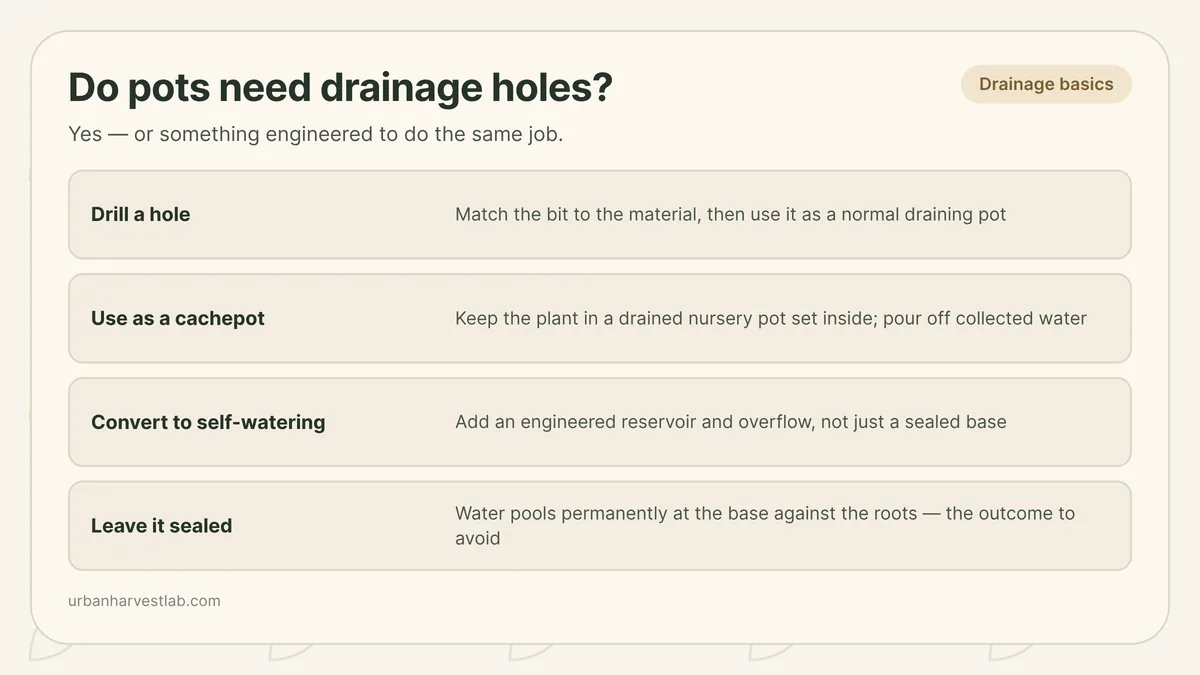
Do pots need drainage holes, and how to add one safely
A pot with no drainage hole is not a design quirk you can water around. Here is why that matters, how to drill one safely by material, and how to use a hole-less pot the right way instead.

Elevated planter box on a balcony: how deep, how high, how heavy
A planter box on legs is a depth decision first and a weight decision second. Here is how to size one for what you want to grow and for the floor it will stand on.
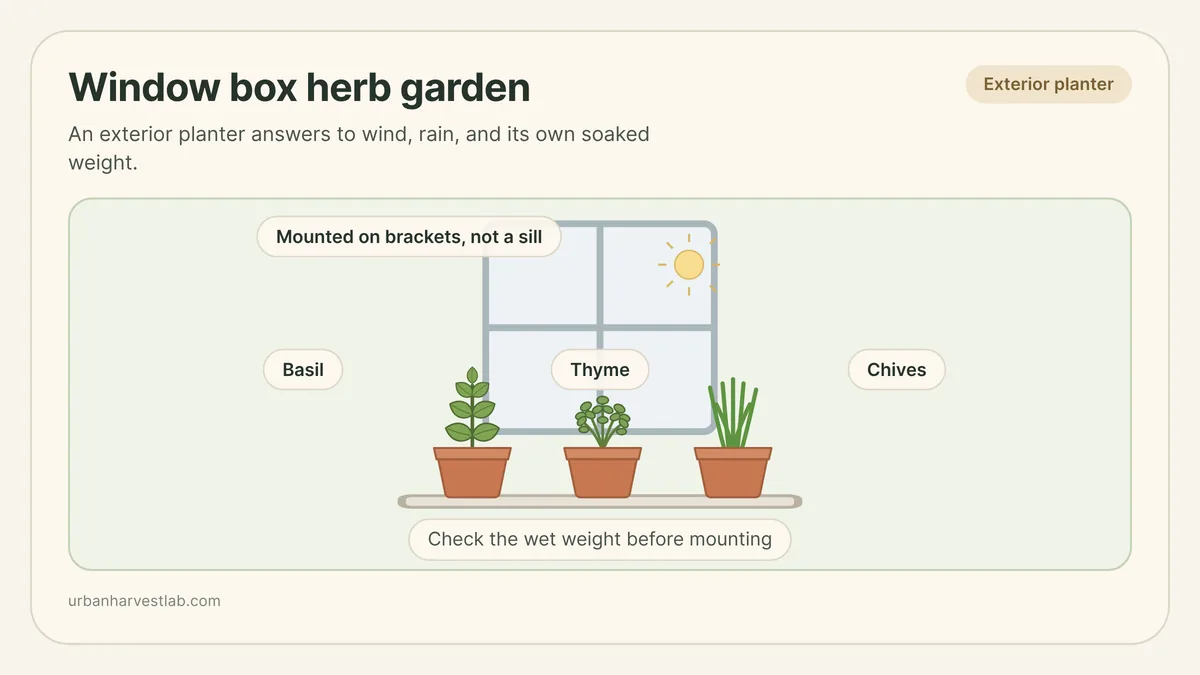
Window box herb garden: depth, mounting, and a workable mix
An exterior window box answers to gravity and weather in a way an indoor sill does not. Here is how to size, mount, and plant one without turning it into a hazard.