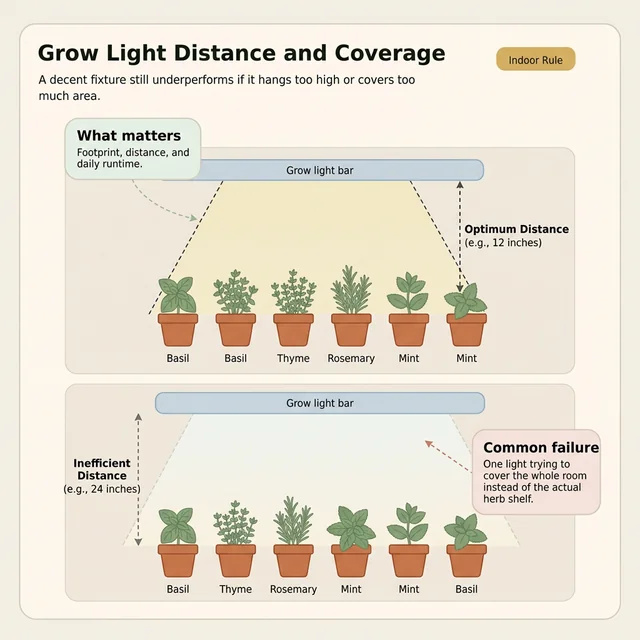
Troubleshoot the system before you change the inputs.
Symptoms
- Seedlings are tall, thin, or leaning hard toward the fixture.
- Internodes are longer than they should be for the crop stage.
- Trays look bright to you but plants still appear weak.
Possible causes
- The light is too far from the canopy.
- Fixture output is too low for the tray size.
- Heat management concerns have pushed the light too high.
Quick fixes
- Lower the fixture or raise the tray while watching for stress.
- Reduce the footprint if one light is covering too much area.
- Reassess runtime only after fixture distance is sensible.
How to establish seedling-light distance
| Evidence available | Starting action | Verification |
|---|---|---|
| Manufacturer PPFD map | Use its seedling distance | Measure the same canopy plane and footprint |
| PPFD sensor | Adjust toward the crop target | Map centre, corners, and edges |
| Relative lux readings only | Use for uniformity, not universal conversion | Keep device and spectrum consistent |
| No measurements | Use manufacturer clearance conservatively | Watch new growth and upgrade measurement |
Seedlings need enough light for compact growth, but “LED” is not an intensity specification. Optics, input power, dimmer setting, footprint, and mounting height can make two fixtures at the same distance perform completely differently. Set distance from evidence, then verify the whole tray.
Quick answer: how far should a grow light be from seedlings?
Start at the fixture manufacturer’s seedling setting and measure from the top of the canopy, not the tray or shelf. Utah State University Extension gives roughly 200–400 µmol/m²/s PPFD as a general seedling-light range; crop, growth stage, temperature, and daily light period still matter. Do not force a weak fixture to reach a number by violating its clearance instructions.
Start close, then adjust
Mount the fixture so height is repeatable, level, and secure. Record the distance, dimmer setting, and timer. Check the centre and at least four corners: a bright centre can hide a weak tray edge. If edge readings are much lower, reduce the planted footprint, add another bar, or reposition fixtures before increasing total hours.
Change only one of height, dimmer, photoperiod, or footprint at a time. Recheck after the canopy grows because the measured plane has moved closer to the light.
What stress looks like
Move the light farther away if you see:
- bleached top leaves
- curled leaf edges
- unusually dry media directly under the lamp
- signs of heat accumulation in enclosed spaces
Those symptoms are not exclusive to light. Dry media, root damage, nutrient concentration, or high air temperature can look similar. Check temperature and roots before concluding that photons are the only cause.
What low intensity looks like
Move the light closer if seedlings are:
- leaning hard toward the fixture
- developing long, weak stems
- producing large internodes early
Legginess can also reflect overcrowding, warm conditions, or crop genetics. Compare the dimmest and brightest tray positions: if only edge seedlings stretch, coverage is more likely than runtime.
Convert measurement into a daily dose
PPFD describes photons arriving each second. DLI combines that intensity with hours:
DLI = PPFD × hours × 0.0036
For example, 250 µmol/m²/s for 14 hours gives 12.6 mol/m²/day. This calculation does not declare that 12.6 is correct for every seedling; it lets you compare two schedules honestly. The practical PPFD and DLI guide for indoor herbs explains how to map a canopy and change one variable at a time.
Keep a three-day adjustment log
Record crop, stage, centre/edge measurement, height, hours, temperature, and one photograph from the same angle. After an adjustment, wait for new growth rather than expecting stretched stems to shorten. The useful result is tighter new internodes, stable leaf colour, and acceptable media drying—not a cosmetically improved old stem.
Raise trays with stable blocks rather than balancing pots individually. Maintain air movement without pointing a strong fan at tender seedlings, and preserve a consistent dark period.
Distance and runtime work together, which is why grow light hours for herbs should be considered alongside fixture placement.
Related Guides
Sources and further reading
If seedlings are stretching under lights, also read
These related guides connect light distance with runtime, fixture choice, and diagnosis-led troubleshooting.
- How many hours should grow lights run for herbs? 12-16
- Best grow lights for herbs: what actually matters before you buy
- Countertop hydroponic herbs for beginners: what to buy and what to ignore
- Hydroponic lettuce growing slowly? Check light, roots, and EC in order
- Why are basil leaves turning yellow indoors?
Common questions
How far should a grow light be from seedlings?
There is no safe universal distance by fixture category. Begin with the manufacturer's seedling recommendation or PPFD map at canopy height, then check several tray points and plant response.
How close should LED grow lights be to seedlings?
As close as the fixture can operate while meeting its intensity target, coverage, heat, and clearance instructions. A low-output bar may sit close; a high-output panel may need much more distance.
Why are seedlings leggy under a grow light?
The most common cause is insufficient light intensity at canopy level, often because the fixture is too far away.
Can a grow light be too close?
Yes. Too much intensity or radiant heat can bleach, curl, or dry the newest leaves.
Related guides
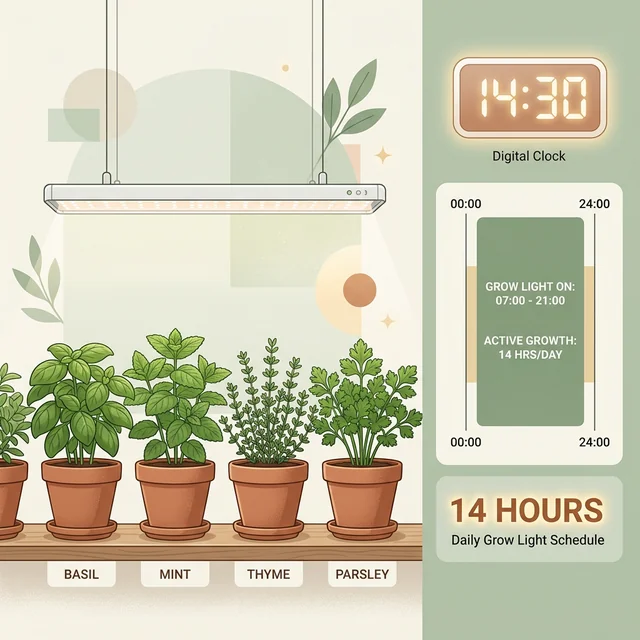
How many hours should grow lights run for herbs? 12-16
Most herb grow lights should run about 12 to 16 hours per day, but intensity, distance, and a stable dark period matter as much as the timer itself.

Grow lights for seedlings: the complete setup
A tray of seedlings under lights needs more than a bulb overhead. It needs the right kind of fixture, a photoperiod on a timer, and a distance that changes every week as the seedlings grow.

Grow light mistakes that stress herbs more than they help
Most grow light problems trace back to a handful of repeatable mistakes, not a mysterious plant failure — and most of them show up as a visible sign you can check today.