Practical light expectations for common small-space herb situations
| Situation | Light level | Herbs most likely to work | Main caution |
|---|---|---|---|
| Sunny balcony or strong south-facing window | High | Basil, thyme, oregano, rosemary, parsley, chives | Heat and fast drying can become the limiting factor |
| Bright window with some direct sun | Moderate to high | Basil, parsley, chives, mint, thyme | Basil may still struggle if the direct sun period is short |
| Bright room with little direct sun | Moderate | Parsley, chives, mint | Expect slower growth and lower productivity from high-light herbs |
| Indoor shelf with a suitable grow light | Variable but controllable | Most culinary herbs if the fixture is strong enough and well placed | Distance and runtime matter as much as fixture label claims |
Herbs do not all need identical light, but they do share one inconvenient truth for beginners: most of them want more usable light than people think. A room can feel bright to you and still be weak for basil. A windowsill can look sunny for an hour and still fall short for a high-light herb. Many disappointing herb setups are not really watering failures or fertilizer failures. They are light mismatches.
That is why light should be treated as a first design decision, not a detail to solve later. Before choosing crops, before buying decorative pots, and before assuming a plant is “difficult,” it helps to understand what herbs are actually asking for. If you are still building the overall system, start with How to Set Up a Small-Space Herb Garden That Actually Works. If you are still deciding which herbs fit your home, pair this guide with Best Herbs for Small Spaces: What Grows Well in Apartments, Balconies, and Windowsills.
Quick Answer
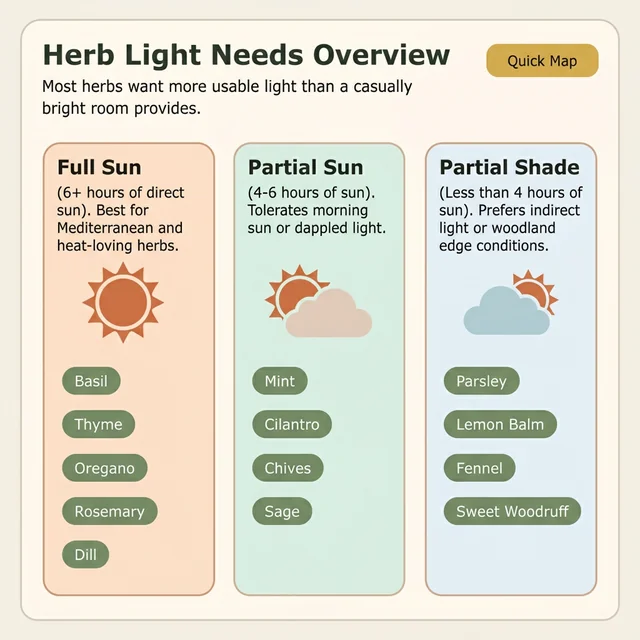
The short version is that most culinary herbs do best with strong direct sun, a genuinely bright location, or a competent grow light setup. In practical terms, basil, thyme, oregano, and rosemary usually want the strongest light. Parsley, chives, and mint can tolerate somewhat less, though they still perform better when the window or fixture is honestly bright.
For many homes, a useful beginner rule looks like this:
- If the space gets several hours of direct sun, you can grow a wider range of herbs with better flavor and tighter growth.
- If the space is bright but only lightly sunny, parsley, chives, and mint are safer bets than basil-heavy plans.
- If the home is dim, herbs may survive, but they often stop being productive unless you add a grow light.
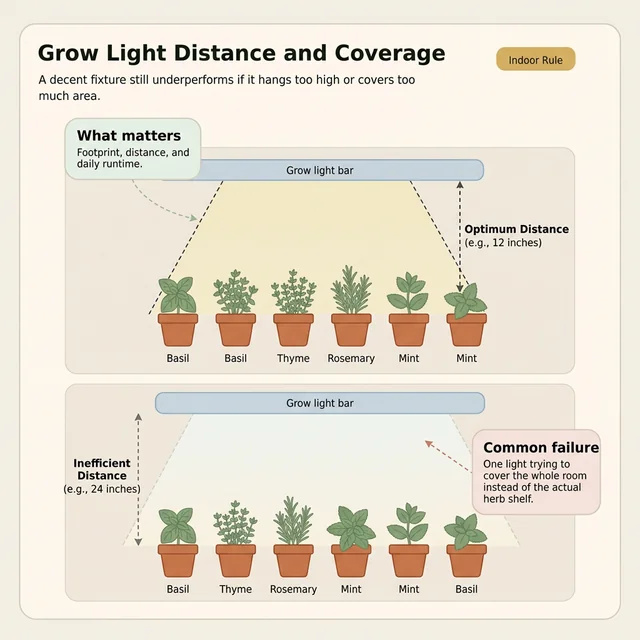
What matters most is not just the number of hours on paper. It is the combination of light intensity, duration, and distance. That is why a bright balcony behaves differently from a weak north-facing sill, and why a grow light hung too high can underperform even when it runs all day.
What “Enough Light” Actually Means
Plants use light to build sugars that support new leaves, stems, aroma compounds, and recovery after harvest. When herbs do not receive enough usable light, they cannot maintain compact, flavorful growth. Instead, they begin stretching toward the light source, widening the space between leaves, producing thinner stems, and often growing more slowly overall.
That response is not a sign of poor character on your part or poor genetics in the plant. It is a straightforward biological response. The herb is trying to find more light. This is why leggy growth is so common on windowsills that seem bright to people but are still weak from the plant’s perspective.
Three variables matter most:
- Intensity: how strong the light is when it reaches the leaves.
- Duration: how long the plant receives that light each day.
- Distance: how far the leaves are from the sun exposure or grow light source.
Beginners usually focus only on duration because it is easy to count hours. But a long day of weak light is not the same as a shorter day of strong light. That is the central idea behind realistic herb-light guidance.
Realistic Sunlight Rules in Real Homes
Direct sun is still the simplest path for many herbs, but not all “sunny” spaces perform the same way. Sun coming through a window is shaped by direction, season, weather, nearby buildings, and how far the plant sits from the glass. On a balcony, the same herb may receive stronger light but also deal with more heat, wind, and drying.
That is why it helps to judge light by outcomes, not just by labels like “bright room.” If a basil plant remains compact, deep green, and quick to regrow after harvest, the light is probably doing its job. If it leans hard toward the window and grows soft, long stems, the location is probably below target.
What counts as a strong natural-light setup
A strong natural-light setup usually means a window or balcony that receives a meaningful block of direct sun rather than only ambient brightness. South-facing and some west-facing positions often get closest to this, though every home is different. Herbs like basil, thyme, oregano, and rosemary generally benefit most from these stronger positions.
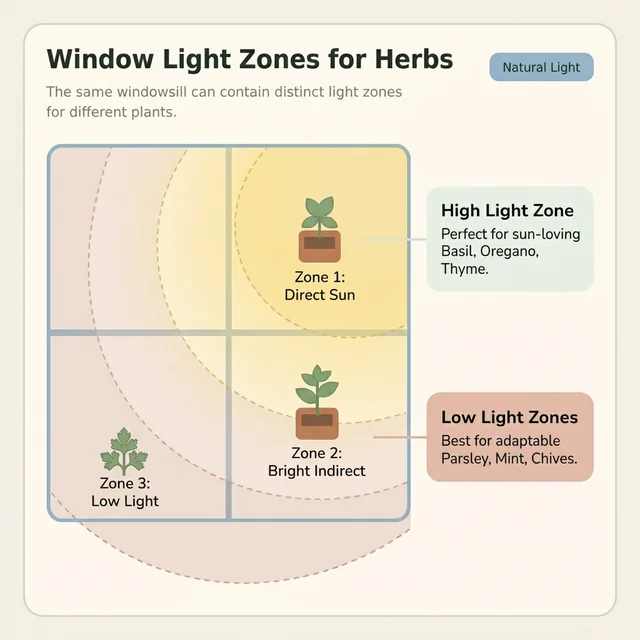
Windowsill growing can still work very well, but you have to use the brightest portion of the sill. A plant pushed to the edge of the frame, shaded by curtains, or set deeper into the room is effectively receiving a different environment than the same plant placed at the glass line of the brightest section.
When a bright room is not enough
This is the point many indoor gardeners underestimate. A room can be pleasant, airy, and visually bright without providing enough energy for high-light herbs. Parsley and chives may stay usable there. Mint may remain alive and acceptable. Basil, however, often becomes the plant that reveals the truth about the space.
This is one reason herb selection should follow light assessment rather than wishful thinking. If your best natural-light spot is good but not exceptional, that is not failure. It simply means you should choose herbs that align with that reality or use supplemental lighting.
Practical Grow Light Rules
Grow lights matter because they make herb growing possible in homes where sunlight is inconsistent, seasonal, or simply inadequate. But beginner grow-light advice often becomes confusing because it gets split into separate arguments about watts, spectrum, runtime, and product claims. For most herb growers, the practical questions are simpler.
Ask:
- Is the fixture strong enough for the growing area?
- Is it close enough to the canopy to be useful?
- Is it running for a stable number of hours each day?
If any one of those is weak, the setup underperforms. A powerful fixture hung too high can disappoint. A modest fixture can still work well if it covers a small footprint and stays close enough. A long schedule cannot fully compensate for poor intensity.
Duration is only part of the answer
Grow-light users often try to fix weak growth by extending the timer first. That can help within reason, but it is not the only lever. A herb under a low-output fixture may still stretch after long lighting days if the light at leaf level remains weak. On the other side, a strong fixture placed close to the canopy may not need extreme runtime to keep herbs compact.
This is why a guide like How Many Hours Should Grow Lights Run for Herbs? works best as a follow-up, not as a replacement for understanding light need itself. Herbs care about the total usable light they receive, not just the timer number.
Placement and coverage matter more than hype
Indoor herb growers lose a lot of performance by treating the entire room as the growing area when only a small shelf or countertop is actually under the fixture. Light falls off with distance. Even a reasonable fixture becomes ineffective if it is trying to cover too large an area or if it hangs far above the leaves for visual convenience.
This is also why “one lamp in the room” is rarely enough for serious indoor herbs. The useful light has to reach the canopy where the leaves are doing the work.
Herb-by-Herb Reality Check
Different herbs tolerate different light conditions, but it helps to think in practical bands rather than in absolute rankings.
High-light herbs
Basil is the classic example. When light is strong, basil is generous and fast. When light is marginal, it becomes leggy, pale, and frustrating. Thyme and oregano also prefer strong light, though their structure often lets them cope with heat and drier containers better than basil does. Rosemary belongs in this brighter group as well and usually becomes disappointing indoors when light and airflow are mediocre.
These herbs are best for sunny balconies, strong windows, or indoor setups with a grow light that is actually appropriate for the footprint.
Medium-to-more-forgiving herbs
Parsley and chives are often the smartest choices when the home is bright but not ideal. They still prefer good light, but they are usually more tolerant of imperfect conditions than basil. Mint also fits this group in a practical sense. It will not always be at peak quality in softer light, but it often remains serviceable and productive enough to justify the space.
The important point is not that these herbs “like shade.” They do not. The point is that they remain more forgiving when your window is good rather than excellent.
Seasonal and situation-dependent herbs
Cilantro can work well in bright conditions, especially during cooler periods, but it tends to be more sensitive to heat and timing. Dill can grow well with enough light, yet it is often an awkward early choice in compact systems because it becomes larger and less tidy than many kitchen gardeners expect. These herbs are not bad candidates. They are simply less universal than parsley, chives, mint, basil, thyme, and oregano.
Signs Your Herbs Need More Light
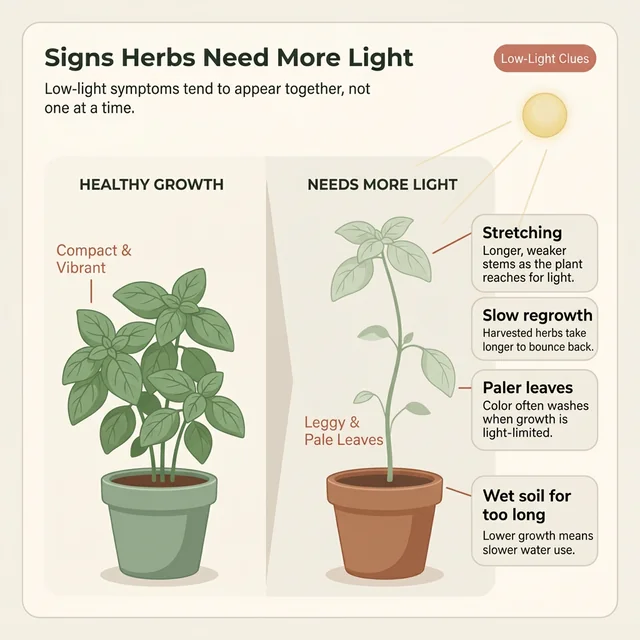
You do not need a meter to notice that a herb is light-limited. Plants give repeated visual clues. The most common are:
- long, weak stems
- wider gaps between leaves
- leaning strongly toward the light source
- smaller harvests and slower regrowth
- lighter green or washed-out color
- potting mix staying wet longer because the plant is using less water
This last point is often overlooked. When growth slows because of low light, the plant also uses less water. That can make the container stay wet longer, which beginners sometimes misread as a watering problem when light is the upstream issue.
What to do first
When you suspect low light, do not immediately add fertilizer. First move the herb to the strongest available natural-light location, reduce the distance to the grow light if one is present, or choose a more forgiving herb for that spot. Nutrients help only after the plant has enough energy to use them well.
Environment-Based Guidance
The same herb can behave well in one home and poorly in another. That is why it helps to choose a rule based on the actual environment instead of chasing a universal answer.
Sunny balconies and strong windows
This is where you can be more ambitious. Basil, thyme, oregano, rosemary, parsley, chives, and mint all become more plausible when the light is strong. In these setups, the constraint often shifts from light to heat and drying. A herb can receive enough light and still struggle if container size and watering do not keep up.
Bright windows with limited direct sun
This is a common real-world setup. It often works best with parsley, chives, mint, and carefully managed basil if the direct sun block is meaningful. If basil repeatedly stretches here, it is usually better to accept the limit and switch the crop than to keep forcing the same result.
Dimmer apartments and interior rooms
Without supplemental lighting, most herbs in these locations become decorative rather than productive. The leaves may persist for a while, but growth slows, flavor weakens, and harvests become sparse. A grow light is usually the cleanest solution if you want reliable indoor herbs away from strong natural sun.
Common Mistakes
One common mistake is confusing “bright to people” with “bright to herbs.” Human eyes adjust quickly. Plants do not.
Another is assuming runtime alone solves everything under grow lights. A longer schedule can help, but it cannot fully rescue a weak fixture placed too far away.
A third mistake is trying to grow basil in the weakest indoor spot because basil is popular and rewarding in theory. Basil is rewarding when the light is strong. In poor light, it is one of the fastest ways to feel like you are failing.
The last big mistake is reading every symptom as a feeding problem. In small-space herb setups, poor light often sits upstream of slow growth, pale leaves, and awkward watering behavior.
FAQ
How many hours of direct sun do herbs usually want?
Many culinary herbs perform best with a substantial block of direct sun, often around six hours or more in practical home conditions. Some herbs tolerate less, but high-light herbs like basil, thyme, oregano, and rosemary are usually happiest when the light is stronger and more sustained.
Can herbs grow in bright indirect light only?
Some can survive and remain somewhat useful, especially parsley, chives, and mint, but many herbs become less productive and less compact without direct sun or supplemental lighting. Bright indirect light is often enough for survival, not always for strong performance.
Do basil and parsley need the same amount of light?
No. Basil usually wants more. Parsley is generally more forgiving when light is decent but not ideal, which is why it is often a safer choice for apartments and softer windows.
When should I add a grow light?
Add one when your best natural-light space still leads to stretching, pale growth, slow regrowth, or disappointing harvests, especially if you want to grow basil or keep herbs productive through darker seasons.
Is a sunny window always enough for herbs?
Not always. Some windows provide only a brief period of direct sun, and seasonal changes can weaken performance significantly. The plant’s growth habit tells you whether the light is truly sufficient.
Related Guides
Use these next if you are building the rest of the herb-light system:
If this topic is relevant to you, also read:
Use these related guides to move into setup decisions, troubleshooting, or the next logical beginner step.
Related guides
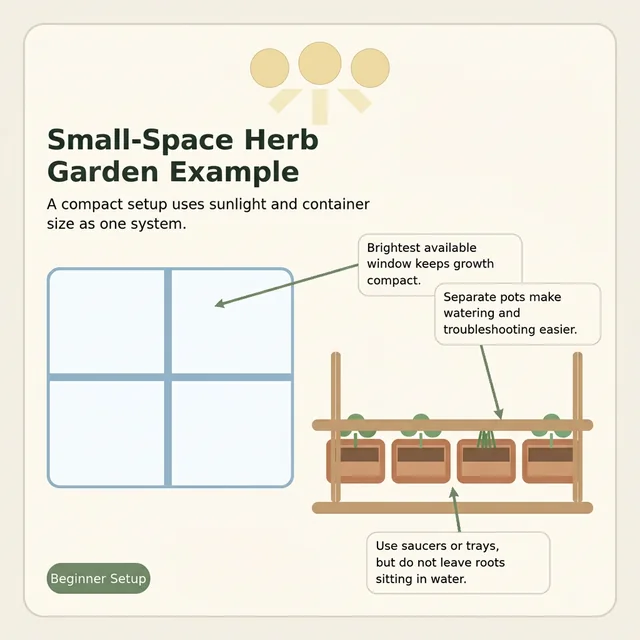
How to Set Up a Small-Space Herb Garden That Actually Works
A calm, practical guide to starting a herb garden on a balcony, windowsill, or bright indoor corner without overbuying or overcomplicating the setup.
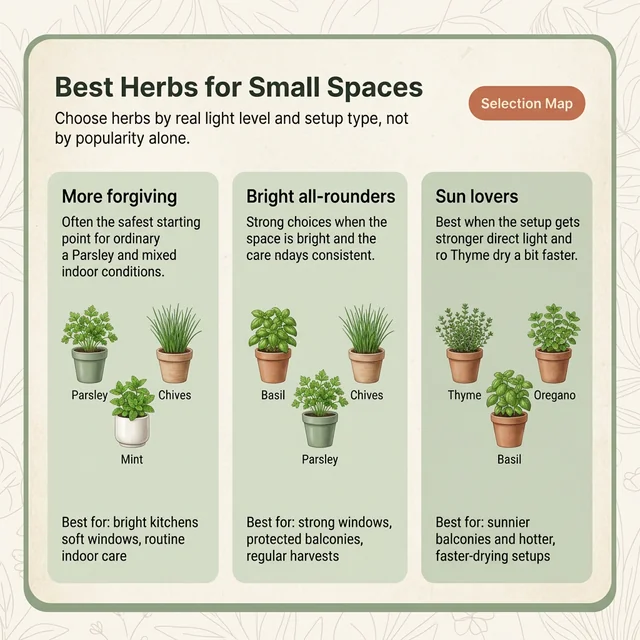
Best Herbs for Small Spaces: What Grows Well in Apartments, Balconies, and Windowsills
A practical guide to the herbs that actually perform well in compact homes, with selection logic for bright windows, balconies, and more forgiving low-space setups.
Best Grow Lights for Herbs: What Actually Matters Before You Buy
The best grow light for herbs is the one that matches your footprint, crop density, and tolerance for heat and visual clutter. This guide focuses on fit before hype.