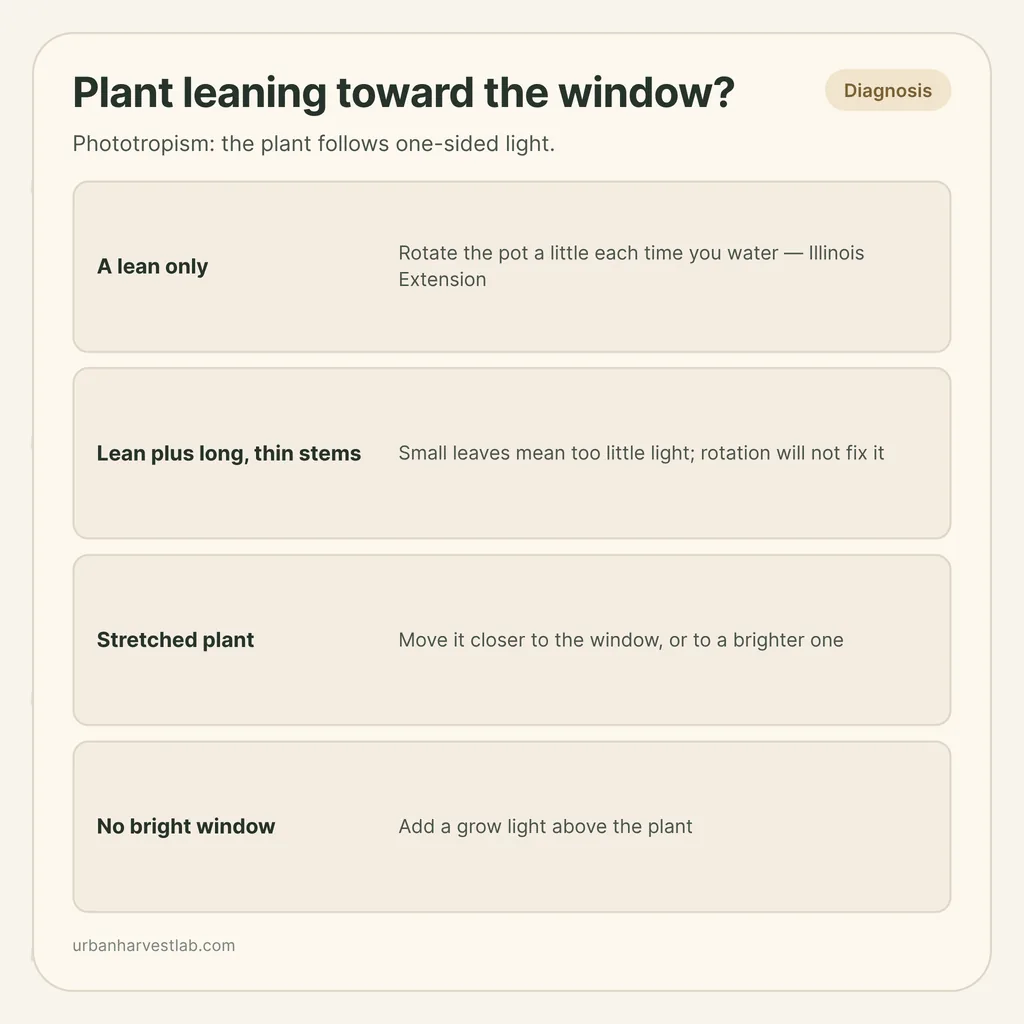
Troubleshoot the system before you change the inputs.
Symptoms
- The whole plant, or the top of it, curves toward the window.
- Leaves on the window side are full while the room side looks thin or bare.
- Stems are long and thin with wide gaps between leaves, and leaves are small.
- Older leaves yellow and drop while the plant stretches toward the glass.
Possible causes
- Phototropism: light from one direction makes cells on the shaded side of the stem elongate faster, as Penn State Extension describes.
- A pot that has not been turned, so one side has had all the light.
- A light level too low for the plant, which University of Maryland Extension says makes indoor plants spindly or leggy and prone to a lean.
- A spot far from the glass, where light drops off quickly with distance.
Quick fixes
- Turn the pot a little each time you water so every side faces the glass in turn.
- If the stems are stretched as well, move the plant closer to the window, or to a brighter one.
- Add a grow light above the plant when no window is bright enough.
- Let new growth come in upright rather than trying to bend the old stem back.
A plant leaning toward the window is following the light, a response called phototropism, and the cure for a plain lean is to rotate the pot. If the stems have also gone long and thin with small leaves, the lean is a symptom of a spot that is too dim, and rotation alone will not fix it. How much light each edible needs is in how much light herbs need.
Why plants lean toward the glass
The RHS says plants grow and bend towards the light, and that when light comes from one side, a seedling will bend in that direction. Penn State Extension gives the mechanism: phototropic bending results from cells on one side of the stem elongating faster than cells on the other side. The side away from the window grows longer, so the tip tilts toward the glass.
So a lean is the plant working, not failing. It becomes a problem when it is uneven (a lopsided plant that falls over in the pot) or when it signals that the window is not giving enough light. Those are different problems with different fixes.
Is it a bend or a stretch?
Check three things.
- Stem length between leaves. The RHS notes that in good light plants stay compact with short gaps between leaves, while in low light they become tall and spindly, or etiolated, as those gaps grow longer than normal.
- Leaf size and colour. The University of Maryland says the same plant grown in brighter light would be more compact, better branched, and have normal-sized leaves. Small leaves on long stems point to light, not a one-sided lean.
- Older leaves. Illinois Extension lists small leaves and long thin stems reaching for more light, with older leaves that yellow and drop, as the sign that a houseplant is short of light.
A compact plant with good leaf size that merely curves toward the glass has a rotation problem. A stretched plant with small leaves has a light problem that happens to come with a lean.
Fix a plain lean: rotate
Illinois Extension advises rotating indoor plants on a regular basis so that all sides benefit from the light coming in the window, and notes that rotating prevents one-sided growth. Neither source gives a fixed interval, so build it into something you already do: turn the pot a little each time you water. Start early, because rotation steers new growth.
This applies to any edible you grow on a sill: basil, mint, chives, parsley, lettuce, peppers, a pot of tomato seedlings.
Fix a stretch: more light, not just a turn
The University of Maryland says light intensity depends on the distance from the source and decreases rapidly with increasing distance. Illinois Extension’s figures show how fast it drops: about 5 feet back from a south window gives roughly what an east or west window does, and 8 feet or more from any light source counts as low light.
- Move the plant closer. Pull it right up to the window before trying anything else.
- Pick the brighter window. The University of Maryland rates north-facing windows as low light at 25 to 100 foot-candles, east- or west-facing windows as medium-bright at 100 to 500, and south-facing windows or some west-facing windows as high light at 500 to 1,000.- Watch the other direction. The University of Maryland warns that too much direct light is as harmful as too little: leaves become pale, turn brown and die. In summer, increase the distance from the window or use a sheer curtain.
- Add a light. When no window is bright enough, a grow light removes the one-sided problem entirely because the light comes from above. The north-facing window herbs guide covers the dimmest sill.
The RHS also notes that shade-adapted plants do not have such a strong phototropic response. If a plant stays upright in a dim room, that does not mean the room is bright enough for it to crop; it may simply be a shade plant.
When it is one of the neighbouring problems
- Basil that is tall and floppy with pale stems: leggy basil indoors separates light from pruning.
- Seedlings in a tray that flop and lean: leggy seedlings covers heat and crowding as well as light.
- Herbs that will not thrive on any sill: growing herbs indoors without direct sunlight.
Sources
- RHS: How plants respond to light and environment
- Penn State Extension: How do plants move?
- University of Maryland Extension: Lighting for indoor plants
- University of Illinois Extension: Houseplants and indoor lighting
- University of Illinois Extension: Make sure houseplants get enough light this winter
More on light and stretching
When the lean comes with stretching, these pages cover how much light edibles need and what to do when the window is not enough.
Common questions
Why is my plant leaning toward the window?
Because the light reaches it from one side. Penn State Extension explains that phototropic bending results from cells on the shaded side elongating faster than cells on the lit side, so the stem curves toward the glass.
How often should I rotate a plant that leans toward the window?
Illinois Extension says to rotate indoor plants on a regular basis so all sides benefit from the window light, without giving a fixed interval. Turning the pot a little every time you water is an easy habit to keep.
Will a leaning plant straighten itself out?
The RHS explains that a seedling lit from above grows straight upwards because the cells in its stem lengthen equally, so once light reaches the plant evenly or from above, new growth comes in upright. Rotation steers the growing tip; it does not undo the curve already in the stem.
Does a leaning plant mean it needs more light?
Not by itself. A healthy, compact plant can lean on a bright sill. If the stems are also long and thin with small leaves, the University of Maryland describes that as too little light, and the plant needs a brighter spot or a grow light.
Related guides
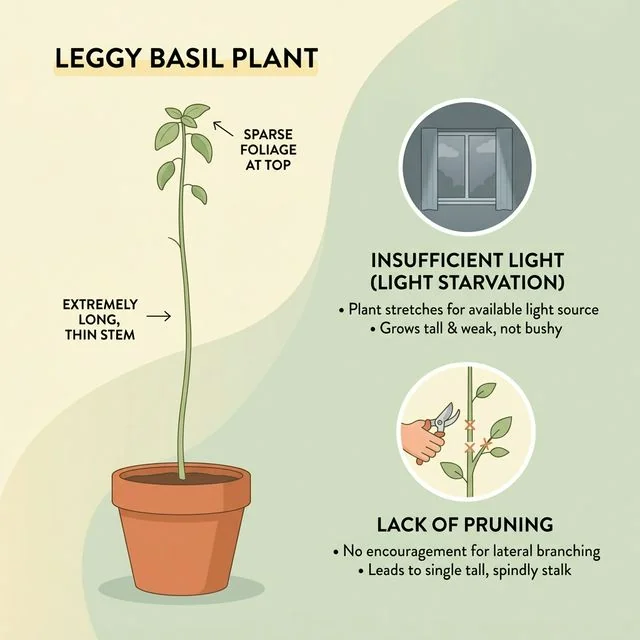
Leggy basil indoors: light problem or pruning problem?
A bushy, compact basil plant is the goal of every gardener. If your plant is growing into a ridiculously tall, flimsy vine with only a few leaves at the top, you have 'leggy' basil. Here is how to diagnose and fix it.
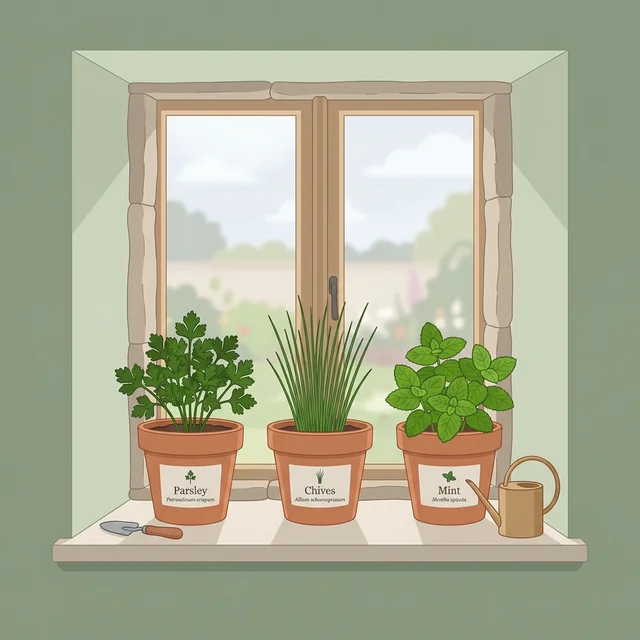
Windowsill herb garden guide for low-light homes
A practical windowsill herb guide for homes that feel bright enough to people but still struggle to keep basil and other herbs compact without extra help.
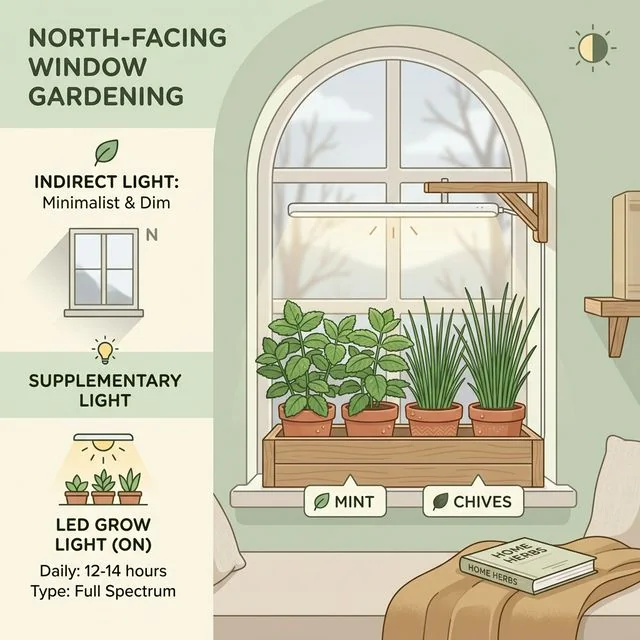
North-facing window herbs: what actually works and when you need a grow light
A north-facing window is widely considered the death sentence of an indoor garden. But with the right selection of shade-tolerant herbs and strategic placement, you can still harvest fresh greens year-round.