
Troubleshoot the system before you change the inputs.
Symptoms
- Stems are long, thin and pale, and the seedlings flop over or lean hard toward the light.
- Leaves sit far apart on the stem, with big gaps between each pair.
- Only the seedlings at the edge of the tray stretch, or every seedling stretches evenly, or the thickest clumps stretch most.
Possible causes
- Not enough light: the fixture is too far away, too weak, or on for too few hours, or a fluorescent tube has dimmed with age.
- The growing area is too warm, which makes seedlings stretch even when the light is adequate.
- Too many seedlings per cell or tray, so they compete for light and shade each other.
- Seeds started too early, so the seedlings outgrow their light and cells before it is time to plant them out.
Quick fixes
- Start at the fixture maker's seedling setting, or the extension range (Iowa State 4 to 6 inches; Illinois 2 to 4 inches for fluorescent tubes), and run it 12 to 16 hours a day.
- Put a thermometer at seedling height. If the shelf is warm, move the tray or cool it before touching the lamp.
- Thin to one seedling per cell and pot up crowded trays.
- Bury leggy tomato stems at transplanting. Pot up everything else at the same depth it grew.
Reading the stretch: which cause fits what you see
| What you see | Likely cause | First fix |
|---|---|---|
| Edge seedlings stretch, centre ones are sturdy | Uneven light coverage | Move the tray under the middle of the fixture or lower the light |
| Every seedling is tall, thin and pale, and the shelf feels warm | Heat, light, or both | Measure the temperature at seedling height before you lower the lamp |
| Seedlings in thick clumps stretch most and lean on each other | Crowding | Thin to one per cell and pot up |
| Seedlings lean one way | Light comes from one side | Rotate the tray, and make the overhead light the main source |
| Stems pinched and water-soaked at the soil line | Damping-off, not legginess | Remove those seedlings and see the seedling failure guide |
Leggy seedlings are stretching because they are short of light, too warm, or crowded, and often more than one of those. A fourth cause is timing: seed started too early. The stretched stem will not shorten, but the plant can keep growing, and tomatoes can be buried deeper to turn the extra length into roots.
Illinois Extension names insufficient light, in both duration and intensity, as the most common cause. That points at the lamp first, but a lamp that is fine on paper can still lose to a warm shelf or a packed tray. Work through the first three causes in order, because the fixes are different, then check the timing.
Cause 1: not enough light
A seedling that cannot find enough light puts its energy into height, trying to lift its leaves toward the source. Iowa State Extension puts it positively: intense light is necessary to prevent spindly or leggy seedlings.
Start with distance. Iowa State says to keep the light source 4 to 6 inches above seedlings growing under lights, and Illinois Extension says fluorescent tubes are typically kept 2 to 4 inches above the tops of the plants. The spread exists because fixtures differ in output and heat, so treat both as starting points. Grow light distance for seedlings shows how to measure what your fixture actually delivers across the tray, which is the number that matters.
Then check the hours. Illinois, Iowa State and UMass Amherst all land on about 12 to 16 hours of light a day after germination. A light on a timer that lost its setting, or a lamp that runs 8 hours, produces stretch under an otherwise good fixture.
Two smaller leaks are worth a look:
- Age. Illinois Extension notes that fluorescent lights lose some of their brightness as they age, and suggests replacing the tubes when they do.
- Position. If only the edge seedlings stretch, the problem is coverage, not runtime. Move the tray toward the middle of the fixture’s footprint. The full setup, from fixture choice to hours, is in the seed-starting grow light guide.
Cause 2: too warm
This is the one that sends people to the wrong fix. UMass Amherst states that plants will stretch and become leggy and weak without enough light, or if the temperature is too warm. Lowering a lamp over a shelf whose real problem is heat changes nothing.
UMass gives numbers for six crops: tomato, pepper, eggplant, cucumber, melon and squash seedlings grow best at 60 °F at night and 70 to 75 °F during the day. Those are the crops UMass measured, so do not stretch them to other plants. For everything else, Iowa State offers a relative rule: once seeds germinate, the best growing temperature is about 10 °F cooler than the best germination temperature. Seeds germinate best in warm soil, and Iowa State puts most between 68 and 86 °F, so the tray that sat on a heat mat to sprout should come off it once the seedlings are up.
Put a thermometer at seedling height, under the light, not on the wall. If it reads well above those figures, move the tray to a cooler spot, take it off the heat mat, or deal with the heat the fixture itself throws, which grow light heat management covers.
Cause 3: crowding
Illinois Extension says crowded seedlings compete for light, which can make them leggy. Each plant shades the next, and the stems race upward.
The cure is arithmetic. Illinois recommends putting only a few seeds in each cell and thinning once they start germinating. Iowa State suggests sowing two or three seeds per container, and UMass thins large-seeded sowings to one or two seedlings per pot. Snip the extras at the soil line with scissors instead of pulling them, so you do not tear the roots of the one you are keeping. If a whole flat has run together, pot individual seedlings into cell packs. Iowa State recommends doing this when the first true leaves appear or when they are large enough to handle.
Cause 4: started too early
Iowa State warns that seedlings planted too early get large and lanky by the time they can be planted outside, and Purdue notes that store-bought transplants get leggy if bought too soon before they can be planted out. Count back from your last frost date before sowing, and do not buy transplants weeks ahead of planting.
What can be saved
Stretch stays. A leggy stem does not shorten when conditions improve, and the next set of leaves tells you whether the fix worked: if the new growth comes in short between the nodes and thick, it did. Iowa State does warn that lanky seedlings do not transplant well, and it gives that warning about seedlings sown too early, which is a reason to correct the setup before potting up and to harden them gradually. Transplant shock in seedlings covers what happens after a weak plant goes out.
Tomatoes are the exception, and a good one. Purdue Extension says most gardeners handle leggy tomato transplants by setting them deeper when they plant them out. Cornell Garden-Based Learning says tomatoes can be planted deeper, up to two-thirds of the plant underground, because they produce additional roots on the buried stem. To do it, follow Purdue: dig a trench large enough for the section of stem you want to bury, and remove any leaves that would otherwise sit below the soil.
There is a trade-off. Purdue points out that the deeper you place the roots, the cooler the soil, and tomato roots like warm soil. In a cold spring, lay the stem in a shallow trench with the top bent upward, instead of drilling it straight down.
Do not extend this to the rest of the tray. Purdue is explicit that other crops do not root as readily and should not be planted deeper. For peppers, eggplant, brassicas and herbs, pot up at the depth they were growing at and correct the cause.
For leggy basil that is already a grown plant, the fix is different: see leggy basil indoors: light or pruning. For microgreens flopping over in the tray, see why microgreens fall over.
Keeping the next tray sturdy
Everything above is the prevention list: thin early, keep the light at the fixture maker’s seedling setting or the extension range and raise it as the plants grow, and take the tray off the heat mat once seedlings emerge. Two additions: sow on the right date for your last frost, and rotate the tray if you are mixing window light with overhead light. Iowa State also notes that ventilation and air circulation help discourage damping-off diseases.
If seedlings are collapsing rather than stretching, that is a different problem: why herb seedlings die separates damping-off from the rest. Purple-tinged leaves on young seedlings have their own causes, in seedlings turning purple.
Sources
- Illinois Extension: What’s wrong with my seedlings? Troubleshooting seed starting problems
- Iowa State Extension: How to successfully start seed indoors
- UMass Amherst CAFE: Starting seeds indoors, caring for your seedlings
- Purdue Extension: Leggy tomatoes
- Cornell Garden-Based Learning: 3.7 Planting the garden
Fix the setup behind the stretch
These guides cover the light distance, the heat and the seed-starting routine that keep seedlings short and sturdy.
Common questions
Why are my seedlings leggy?
Illinois Extension calls insufficient light, in both duration and intensity, the most common cause. Warmth is the second: UMass Amherst says seedlings stretch if the temperature is too warm. Crowding is the third, because seedlings packed together compete for light. Iowa State also warns that seedlings planted too early get large and lanky before they can go outside. Look at all of these before changing anything.
Can leggy seedlings be saved?
Yes, in the sense that they can keep growing. The stretched section stays long, but new growth comes in sturdy once light, temperature and spacing are right. Tomatoes can also be buried up to most of their height at transplanting, because they root along the stem. Peppers and most other crops should not be planted deeper.
How close should the grow light be to stop legginess?
Iowa State Extension says 4 to 6 inches above the plants for seedlings under lights, and Illinois Extension says fluorescent tubes are typically kept 2 to 4 inches above. Fixture output varies a lot, so measure with the method in the grow light distance guide and raise the light as the plants grow.
Related guides

Seedlings turning purple: cold roots, phosphorus, and when it is normal
Purple stems and leaf undersides on seedlings are a stress response, and cold roots are one of the commonest triggers. Often it is a short-lived stress rather than a mix that needs fertilizer. A few checks separate the harmless cases from the ones that need action.
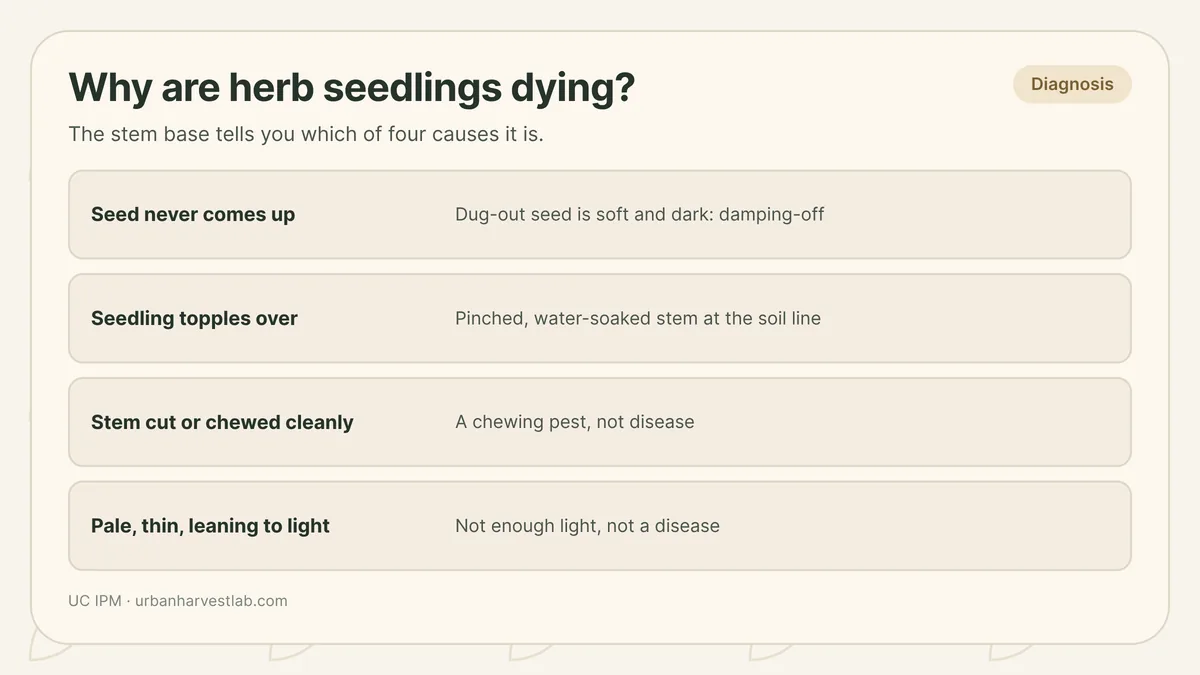
Why are my herb seedlings dying?
A tray of herb seedlings can fail three or four different ways, and they do not all look the same up close. The stem base and the seed itself tell you which one you have.

Brown spots on tomato leaves: early blight, septoria or bacterial spot
Three common diseases cause brown spots on tomato leaves, and each leaves a different mark. Read the spot, then pick the response that fits.