Troubleshoot the system before you change the inputs.
Symptoms
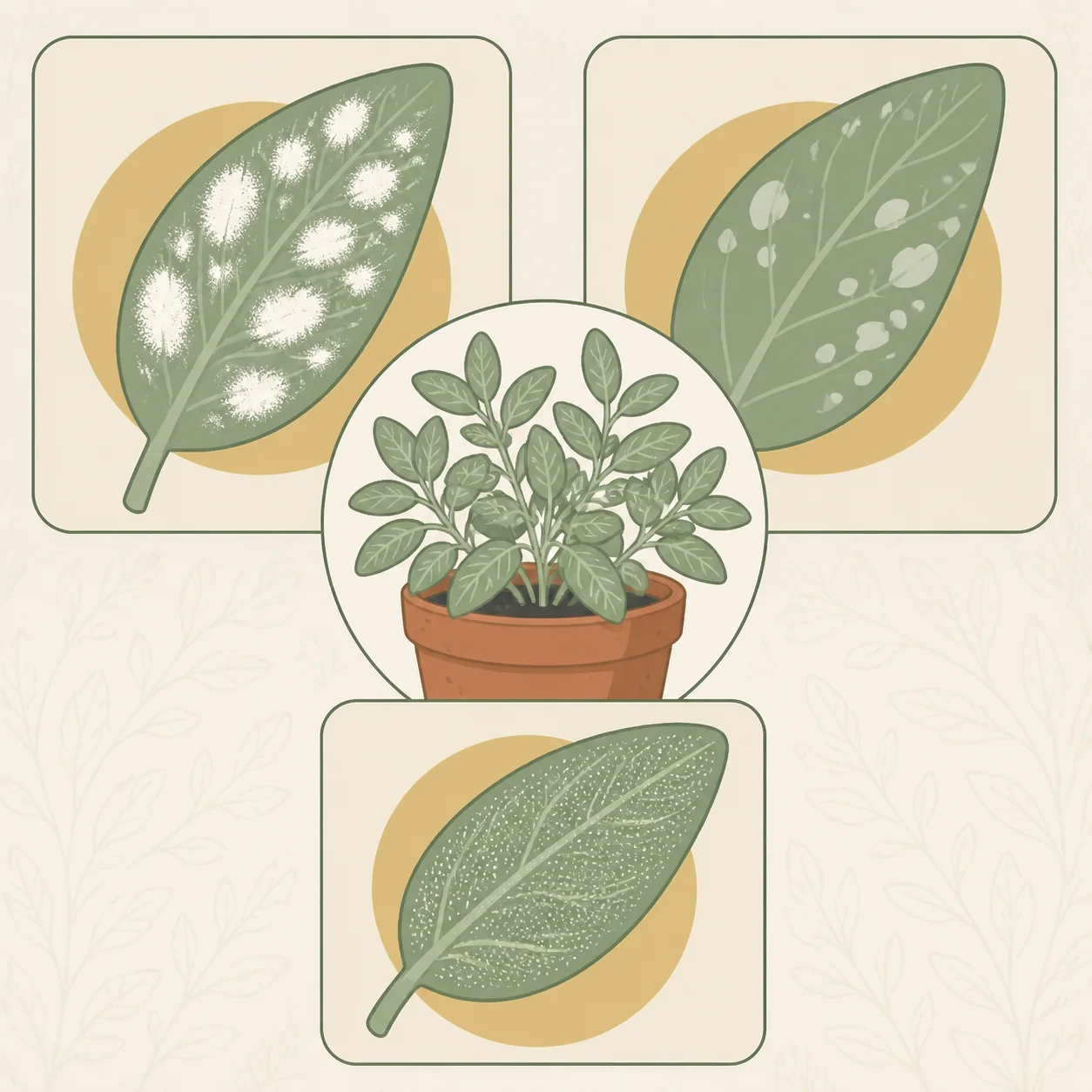
- White or gray powder-like patches that recur or expand on leaves.
- Leaf yellowing, distortion, or early drop as infection advances.
- Several plants of a susceptible herb affected in crowded conditions.
Possible causes
- Spores reached susceptible tissue under favorable humidity and airflow conditions.
- Crowded foliage reduced light and air movement through the canopy.
- A superficial mineral or spray residue is being mistaken for disease.
Quick fixes
- Isolate the pot and compare marked patches over several days.
- Remove severely affected leaves without shaking them through the garden.
- Improve spacing and use only a crop-labeled treatment if necessary.
White marks on herb leaves
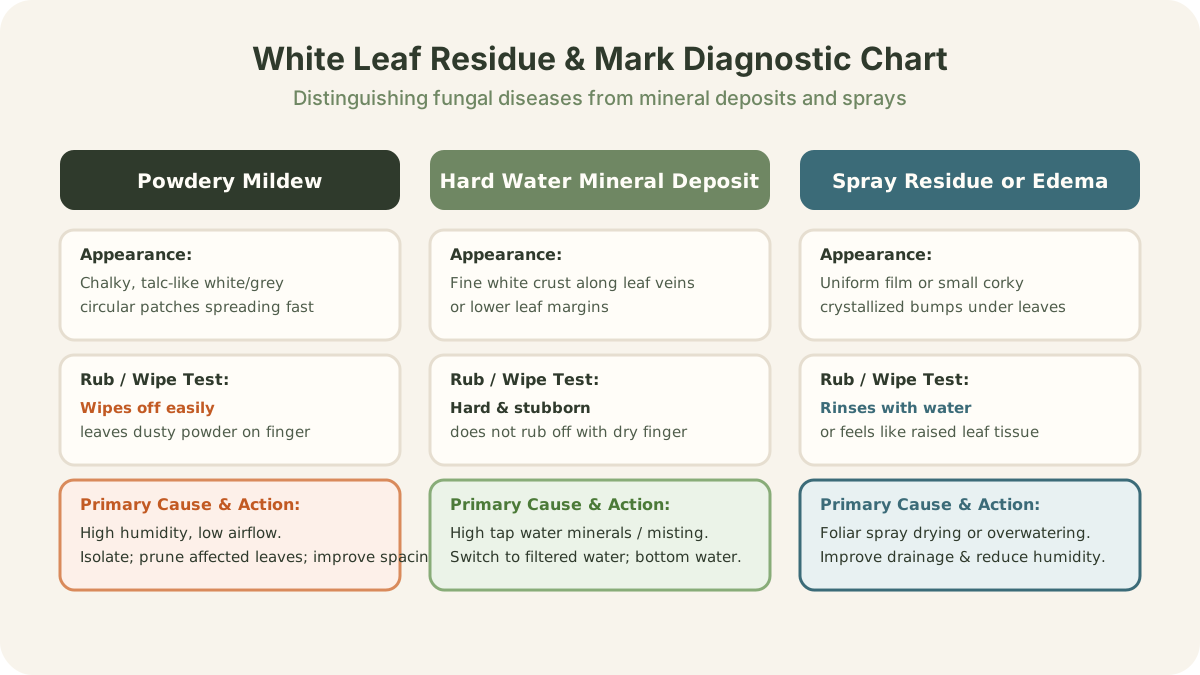
| Pattern | More consistent with | Confirmation |
|---|---|---|
| Irregular powdery patches that expand | Powdery mildew | Mark edge and recheck new growth |
| Round spots after overhead watering | Mineral deposits | Pattern follows droplets and wipes away |
| Uniform film after treatment | Spray residue | Matches application timing |
| Cottony clusters at stem joints | Mealybugs or scale | Inspect for insects and honeydew |
Powdery mildew is a group of fungal diseases that produces white or gray powder-like growth on plant surfaces. On herbs, it can begin as a few pale patches and spread across leaves, causing distortion, yellowing, and early decline.
Do not treat every white mark as disease. The general potted herb diagnosis helps rule out environmental decline before separating powdery growth from residues and choosing a cautious control sequence for edible plants.
Confirm that the white material behaves like mildew
Inspect both leaf surfaces under bright light. Powdery mildew tends to form irregular colonies that expand or appear on new leaves. Mark the edge of one patch with a photograph and compare it after two or three days.
Hard-water deposits often follow the round outline of dried droplets. Spray residue may cover the plant uniformly and match a recent application. Both may wipe away without returning. Mildew can partly wipe off too, so recurrence and spread are more informative than one wipe test.
Cottony material concentrated at leaf joints may be mealybugs rather than fungus. Look for individual insects, sticky honeydew, and clustered waxy bodies before choosing a disease treatment.
Isolate and remove the strongest source
Move the affected container away from susceptible plants. Avoid shaking foliage as you carry it. Remove heavily coated, yellow, or distorted leaves with clean scissors and bag the material.
Do not strip the entire canopy from a weak plant. If most of a cheap annual herb is affected, replacement may be more sensible than keeping a large spore source beside healthy crops. Clean tools between plants.
Remove fallen leaves from the soil surface and shelf. They do not improve the pot and can retain moisture and disease material.
Correct canopy conditions
Space plants so leaves are not pressed together. Prune selectively to open the interior, but preserve enough leaf area for recovery. Improve gentle air movement through the growing area rather than blasting one plant continuously.
Check light. Weak light produces soft, crowded growth and slow drying. Move the plant within its appropriate range or correct the fixture using how much light herbs need. Acclimate plants rather than moving a shaded herb directly into harsh sun.
Water the root zone and avoid routine overhead wetting indoors. Powdery mildews do not all require free water to infect, so “keep every leaf dry” is not a complete explanation; the goal is a stable environment without prolonged humidity pockets and crowded tissue.
Decide whether treatment is justified
For a light infection on a fast-growing herb, sanitation and environment may be enough. Mark remaining patches and inspect new growth. If active spread continues, consult local extension advice and choose a fungicide specifically labeled for powdery mildew on that edible crop and for the location of use.
Read the entire label. Observe application interval, temperature limits, protective equipment, and pre-harvest interval. Oils and other contact materials can injure heat-stressed leaves or react badly with products applied too close together. Do not combine home remedies because their ingredients sound harmless.
Treatment protects clean or lightly infected tissue better than it restores a leaf already covered in mildew. Judge success by reduced spread and healthy new growth, not by old leaves becoming perfect again.
Prevent the next outbreak
At the end of a crop, discard infected debris and clean reusable pots, supports, and nearby surfaces. Do not propagate cuttings from affected growth. Start replacement plants with enough spacing from the beginning.
Choose resistant varieties when seed descriptions provide credible disease-resistance information. Rotate which susceptible herb occupies a chronically humid corner. Outdoors, give pots morning sun where possible and avoid walls that trap still air around dense foliage.
Keep nitrogen feeding moderate. Excessively lush growth can create a dense, susceptible canopy, but starvation is not prevention. Feed according to crop performance and the container medium.
Common mistakes
- Diagnosing a single dried water spot as mildew.
- Spraying before removing heavily affected tissue.
- Increasing airflow while leaving leaves tightly crowded.
- Applying oil in heat or too close to another treatment.
- Ignoring the product’s edible-crop and harvest directions.
- Expecting damaged leaves to return to normal.
Track spread instead of relying on memory
Choose three leaves with small patches and photograph them at the same distance every two days. Include an unaffected young leaf. Note temperature, watering, and treatment. This separates a stable stain from a colony that expands and shows whether new tissue stays clean.
Do not repeatedly rub the same leaf. Mechanical damage obscures the pattern. If identification remains uncertain, a local extension diagnostic service is more useful than applying several incompatible products.
Manage a mixed balcony collection
One affected herb does not mean every nearby species will develop the same disease, but shared crowding can expose susceptible hosts. Increase spacing and inspect similar plants first. Keep irrigation from splashing debris between containers and clean dead leaves from saucers and corners.
If the same position produces disease repeatedly, record sun hours, overnight humidity, and airflow obstructions. Moving a pot or thinning a dense screen may be more durable than recurring treatment.
Plan harvest and recovery
Never harvest visibly diseased leaves merely to avoid waste. After any application, follow the label’s pre-harvest interval even if washing removes visible residue. Keep a dated note beside the pot so another person does not harvest early.
When clean new growth develops, remove badly marked leaves gradually. Continue inspection because favorable conditions can produce another cycle. At crop end, decide whether a perennial merits sanitation or a depleted annual is better replaced.
Avoid incompatible treatment sequences
Applying one remedy after another can burn foliage and make diagnosis harder. Oils, sulfur products, soaps, and other fungicides may have required separation intervals or temperature restrictions. Never combine them unless the labels explicitly permit it.
Write the treatment and date on a tag beside the pot. If control is inadequate, consult the label and local extension guidance before switching active ingredients. More frequent application than allowed does not turn a weak match into effective control.
Reintroduce the pot cautiously
Keep the herb separated until marked patches stop expanding and several new leaves remain clean. Reintroduce it with more space than before and inspect during routine watering. If disease resumes in the same environmental pocket, move the plant or replace it with a less susceptible crop rather than maintaining a permanent spray cycle.
The successful endpoint is not a cosmetically perfect old canopy. It is clean new growth, no ongoing spread, a usable harvest under label rules, and growing conditions that make recurrence less likely.
Sources and further reading
- University of Minnesota Extension: Powdery mildew in the flower garden explains identification and cultural management principles.
- UC Statewide IPM: Powdery Mildew on Vegetables provides integrated disease-management context; product choices must still match the specific herb and location.
Correct the conditions behind repeat disease
Review spacing, light, watering, and general symptom diagnosis before adding treatments.
Common questions
Can I eat herbs with powdery mildew?
Discard visibly affected or degraded leaves. For remaining harvest, follow local food-safety guidance and every harvest restriction on any product applied; when in doubt, replace a small annual herb.
Does powdery mildew mean I overwatered?
Not necessarily. Powdery mildew can develop without free water sitting on leaves. Susceptibility, humidity patterns, crowding, and poor airflow all matter.
Will wiping the leaves cure powdery mildew?
Wiping may help distinguish residue and remove some surface growth, but a true infection can recur. Combine sanitation with environmental correction and labeled control where justified.
Related guides
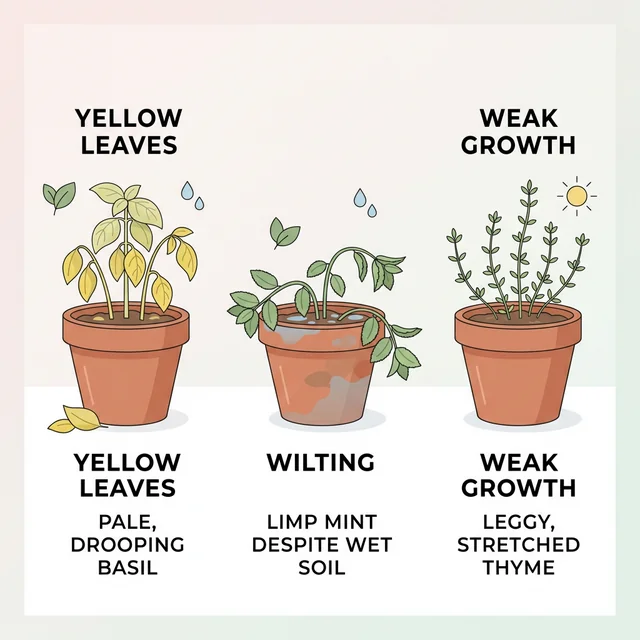
Common potted herb problems: yellow leaves, wilting, and weak growth
Common potted herb problems usually show up as yellow leaves, wilting, or weak growth, but the useful diagnosis starts with light, drainage, and root stress.
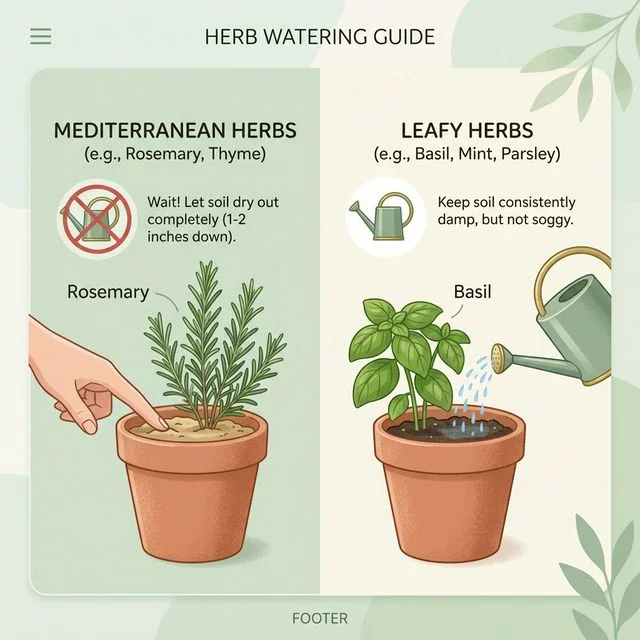
How often to water potted herbs: a by-herb chart
Most potted herbs should be checked often but watered only when the root zone is actually drying. Judge the pot instead of following a rigid calendar.
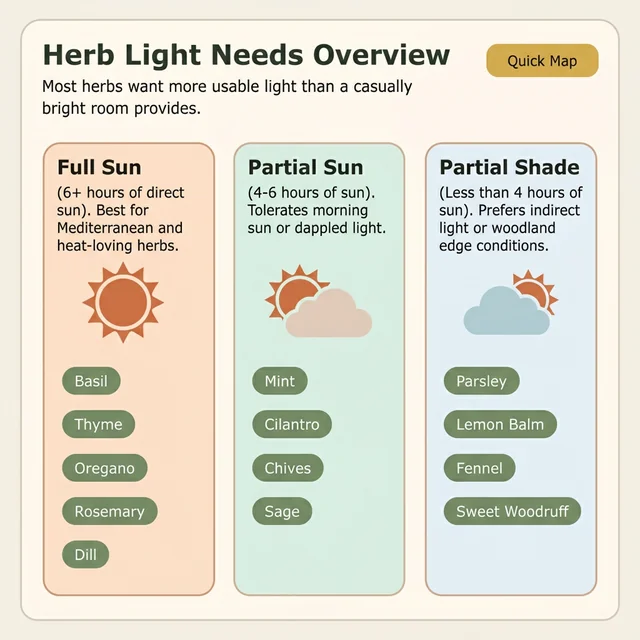
How much light do herbs need? 6+ hours of sun
A practical guide to how much light herbs need, including a quick answer for direct sun, indoor windows, and grow light setups that actually support growth.