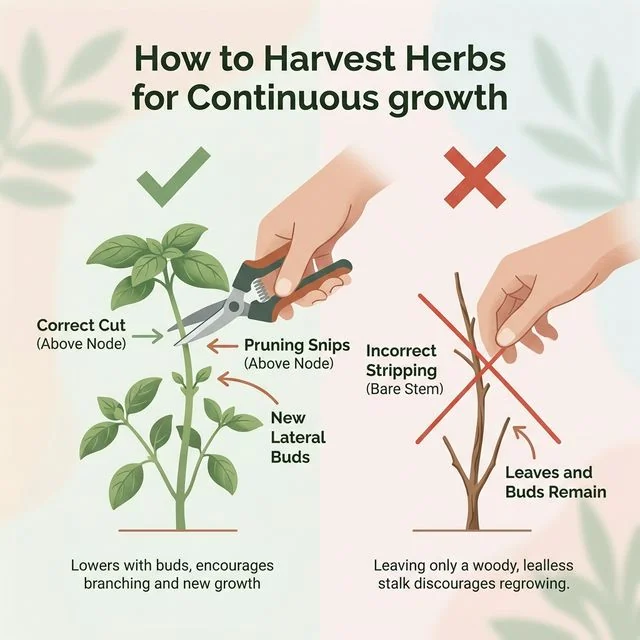
Branching Herbs vs. Crown Herbs
| Growth Habit | Common Herbs | How to Harvest |
|---|---|---|
| Branching (Woody/Stem) | Basil, Mint, Oregano, Thyme, Rosemary, Sage | Cut the stem down to the nearest healthy leaf node. Do not pluck individual leaves. |
| Crown / Basal Rosette | Parsley, Cilantro | Snip the oldest, outermost stems entirely off at the base. New growth pushes up from the center crown. |
| Bulb / Grass | Chives, Garlic Chives, Scallions | Grab a handful and shear them straight across, about 1 to 2 inches above the soil line. |
When a beginner wants to make a Caprese salad, they walk over to their beautiful indoor basil plant, grab a massive green leaf off the side of the main stem, and rip it off.
Three weeks later, they look at their plant and realize it is a tragic, bald, woody stick with three sad leaves clinging to the top. They wonder why the plant is dying.
The plant is dying because they harvested it completely wrong.
Harvesting your indoor garden is not just about gathering food for your kitchen; it is a critical botanical maintenance task. When executed perfectly, a harvest actually triggers a massive explosion of new growth. Here is exactly how to execute a “Cut-and-Come-Again” harvest so your herbs yield endlessly.
The Cardinal Sin: Plucking Single Leaves
You must understand that a stem without leaves is functionally dead.
If you pull all the large solar panels (leaves) off the bottom half of a basil stem to make pesto, that bare stem can no longer photosynthesize. The plant views the bare stem as a waste of energy, abandons it, and it slowly turns brown and woody. Furthermore, removing leaves from the side of the plant does not encourage new lateral branching. The plant will continue growing straight up until it hits the ceiling.
(This is precisely the mechanism that causes Leggy Basil Indoors).
How to Harvest “Branching” Herbs
(Basil, Mint, Oregano, Thyme, Rosemary)
If you grow branching herbs, harvesting is functionally identical to the structural pruning techniques we mapped out in When to Prune Basil, Mint, Parsley, and Chives.
To harvest, you must perform a “Topping” cut.
- Look down the stem you want to harvest. Stop when you find a “Node.” A node is an intersection where two leaves jut out horizontally from the main vertical stem.
- If you look closely into the armpit of that intersection, you will see two microscopic new leaf buds waiting to emerge.
- Take sharp snips and cut the entire main stem off a quarter of an inch above those two tiny dormant buds.
The Magic: You just harvested a massive 6-inch stalk of basil for your kitchen. But more importantly, by cutting the top off the plant, you broke its “apical dominance.” The plant instantly reroutes all its growing energy into those two tiny lateral buds you left behind. In a week, two brand new branches will emerge. You traded one stalk for two. This is how you build a bushy, high-yielding herb.
How to Harvest “Crown” Herbs
(Parsley, Cilantro)
Parsley and Cilantro do not grow like trees with branching woody stems. They grow in a “basal rosette,” meaning all the stems independently push up directly from the center crown down in the dirt.
If you cut the top half of a parsley stem off, it will look ugly and it will never branch out.
Instead, you must harvest whole stems. Look at the plant: the tallest, oldest, and largest stems will be leaning outward on the ultimate exterior of the plant. The youngest, smallest, freshest growth will be clustered tightly in the very center.
- Grab the oldest, outermost stem.
- Follow it all the way down to the dirt.
- Snip it off entirely, about 1 inch above the soil line.
This clears the heavy outer canopy, allowing light to penetrate the center crown and rapidly accelerate the growth of the young new leaves hidden inside.
The 30% Safety Rule
A newly harvested plant is a traumatized plant. It requires immense energy to heal its cuts and push new growth. Where does energy come from? Photosynthesis.
If you cut 90% of a plant’s leaves off to make a massive batch of pesto, you have removed 90% of its solar panels. The plant will likely not have enough residual energy left to survive, and it will die of shock.
Never harvest more than 30% of a plant’s total foliage at one time.
If you need a massive amount of basil for a recipe, you cannot rely on a single 6-inch pot. You need to expand your operation and grow multiple plants (perhaps implementing a Small Space Herb Garden). Stagger your harvests across three different plants, ensuring none of them cross the 30% trauma threshold, and your garden will outlive you.
Not enough growth to harvest?
If your plant isn't pushing enough foliage to harvest, check your light and water baselines to ensure the plant isn't stunted.
Common questions
Should I use scissors or can I just pinch the stem with my fingers?
While you can pinch young, tender stems, it is always safer to use sterilized, sharp gardening snips. Ragged, torn stems invite fungal infections. A clean microscopic cut heals infinitely faster.
If a stem already flowered, is it too late to harvest it?
You can still eat the leaves, but they will likely taste bitter and tough. When an herb flowers (bolts), its chemical composition changes. Always harvest *before* the flower buds fully open for the best culinary flavor.
Does harvesting chives follow the same node rule as basil?
No! Chives are "grass-like" herbs spreading via bulbs, not branching woody herbs. You do not cut them at a node; you simply snip the entire spear off one inch above the dirt line.
Related guides
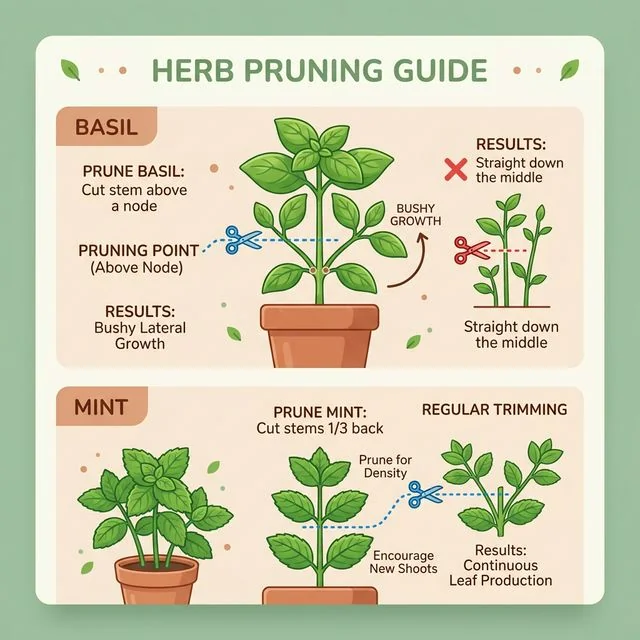
How to prune basil, mint, parsley, and chives without stunting growth
Basil and mint should be cut above a node, parsley should be harvested from the outer stems, and chives should be cut like a small patch of grass.
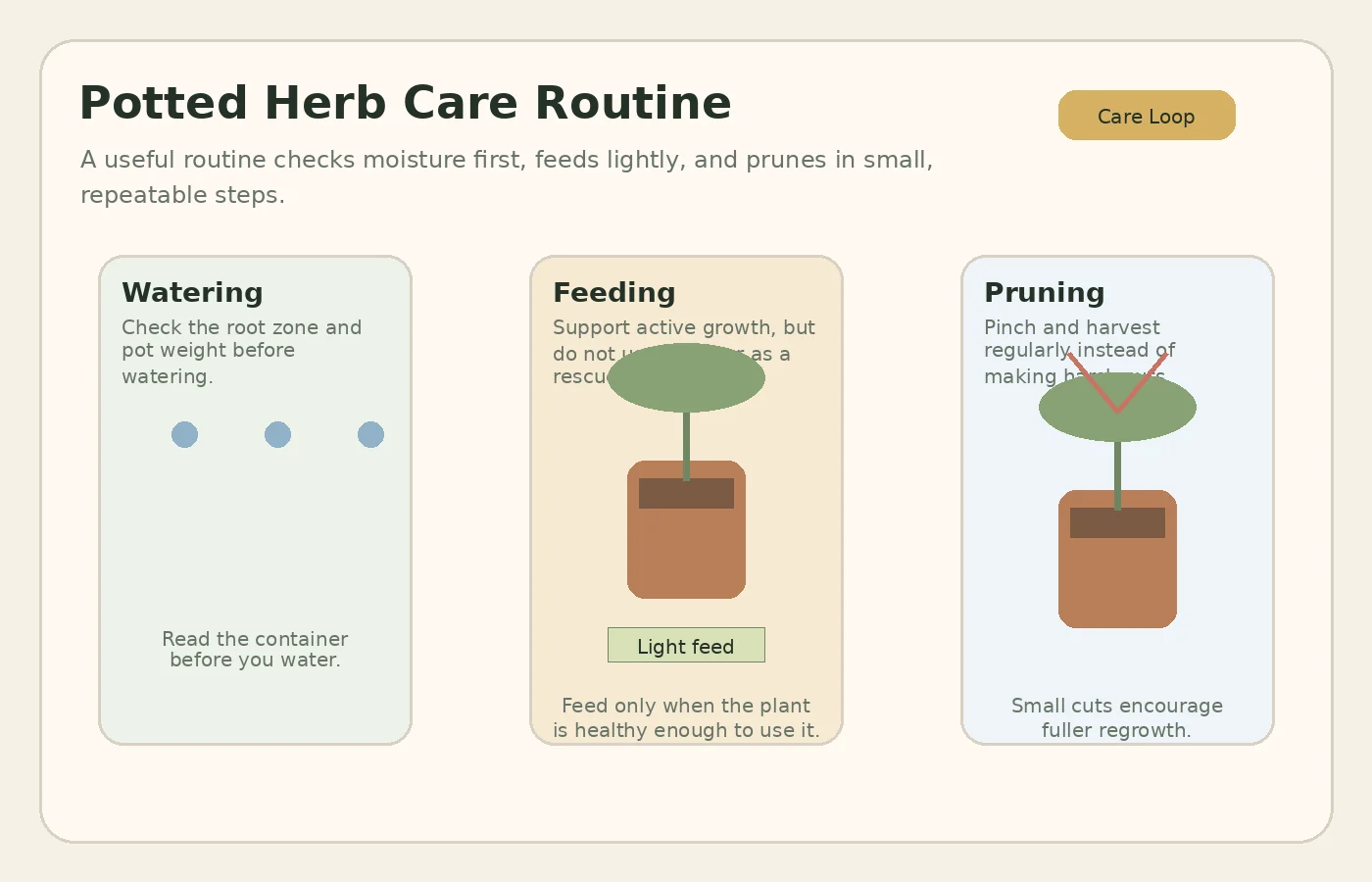
Potted herb care: watering, feeding, and pruning without guesswork
A practical guide to keeping basil, parsley, mint, thyme, and chives healthy by matching watering, feeding, and pruning to the setup.
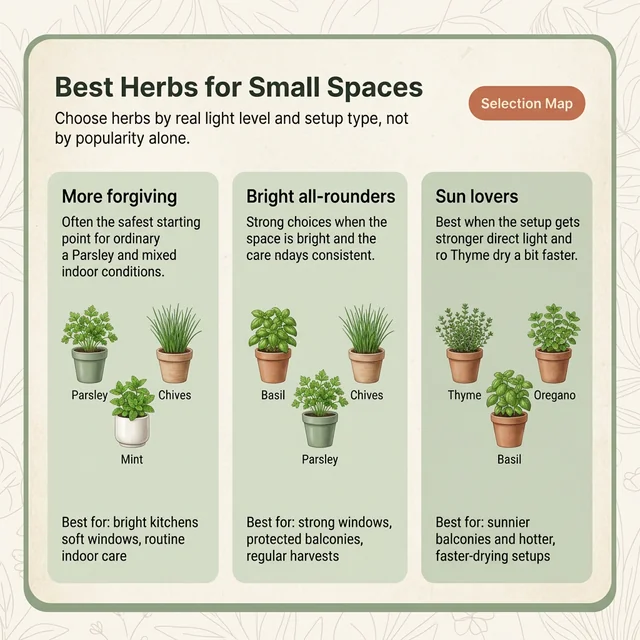
Best herbs for small spaces: what grows well in apartments, balconies, and windowsills
A practical guide to the herbs that actually perform well in compact homes, with selection logic for bright windows, balconies, and more forgiving low-space setups.