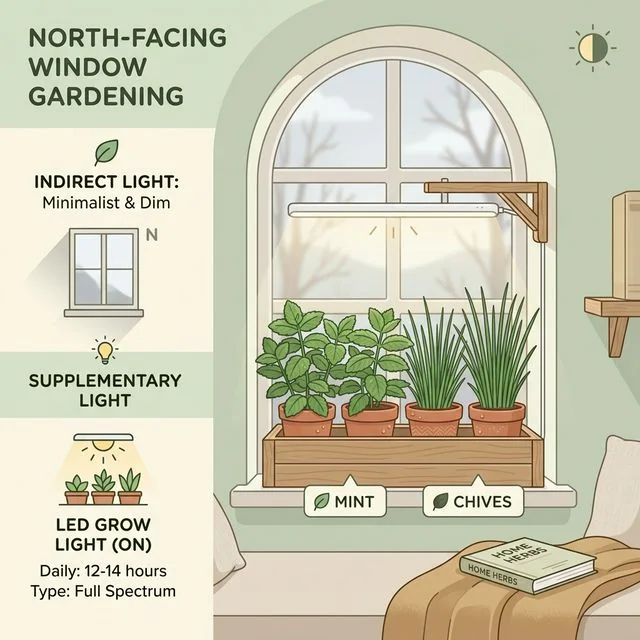
The North-Facing Window Survival List
| Herb | North-Window Viability | Special Care Required |
|---|---|---|
| Mint | Excellent | Must be pinched constantly to encourage bushy growth instead of a single long vine. |
| Chives | Very Good | Will grow slightly thinner than outdoor chives but produces a respectable harvest. |
| Parsley | Good | Requires incredibly careful watering; dark, cool windows mean soil dries out very slowly. |
| Cilantro | Fair | Prone to getting leggy. Will need absolute premium placement directly against the glass. |
| Basil / Rosemary | Do Not Attempt | Zero chance of survival without placing a dedicated grow light directly above them. |
For an urban gardener, moving into a new apartment usually involves pulling up a compass app on your phone. If the largest windows face South, you celebrate. If they face North, your heart sinks.
In the Northern Hemisphere, south-facing windows receive intense, direct rays of the sun for most of the day. North-facing windows receive exactly zero direct sun. They provide a cool, weak, highly diffused “ambient” light.
For houseplants like a Monstera or a Pothos, this ambient light is perfectly acceptable. For culinary herbs—plants that genetically evolved under the blazing Mediterranean sun—a north-facing window is a serious challenge.
But it is not an impossible one. If you understand the physics of light degradation and choose the correct species, you can still build a thriving indoor garden on a dark windowsill.
The Physics of a North-Facing Window
When attempting to grow plants indoors without direct sunlight, as outlined heavily in Can Herbs Grow Indoors Without Direct Sunlight?, you must understand the Inverse Square Law of Light.
Simply put: Light intensity drops off exponentially the further away you move from the source. In a south-facing room flooded with direct beams of sun, a plant might survive sitting on a coffee table three feet away from the window.
In a north-facing room, there is no direct beam. If a plant sits three feet away from a north-facing window, to the plant’s photosynthetic receptors, it is essentially sitting in an unlit closet.
Rule #1 of North-Facing Windows: Your pots must be sitting directly on the windowsill, pushed as close to the glass as thermally safe (do not let the leaves physically touch freezing glass in the winter). If you have sheer curtains, open them. Every single photon of light matters.
The Northern Window Survival Roster
You cannot throw random seeds into a pot on a north windowsill and hope for the best. You must be completely ruthless in your plant selection. Do not attempt to grow Basil, Rosemary, Thyme, Sage, or Oregano. They will stretch, weaken, and die within two months.
Instead, look to the broad-leafed, moisture-loving herbs that naturally grow low to the ground in the shade of larger plants in the wild. For a full breakdown of these plant structures, revisit Best Herbs for Small Spaces: What Grows Well in Apartments, Balconies, and Windowsills.
Here are the four champions of the Northern Window:
- Mint: Mint is famously invasive precisely because it is so resilient. It has incredibly broad leaves capable of capturing weak ambient light. Because north windows are generally cooler, mint actually appreciates the break from intense heat.
- Chives: While chives prefer full sun, they are highly adaptable. Your harvest will not be as thick or vibrant as outdoor chives, but they will reliably push up fresh green spears for your baked potatoes.
- Parsley: Another broad-leaf herb that naturally grows close to the damp forest floor. It thrives in cool temperatures and will tolerate the dim, diffused light of a northern exposure nicely.
- Lemon Balm: A close relative to mint, lemon balm shares its shade tolerance and will produce heavily scented, citrusy leaves even on a cloudy day.
The Watering Trap of Dark Windows
A major hidden danger of a north-facing window has nothing to do with the light—it is the water.
In a south-facing window, the intense heat of the sun constantly bakes the potting soil, evaporating moisture and keeping the root zone aerated.
In a north-facing window, the ambient temperature is much cooler and the sun never directly hits the pot. If you water a parsley plant heavily in a north window, the soil might stay soaking wet for two straight weeks. This is a fast track to fungus gnats and root rot.
You must drastically reduce your watering frequency when growing in low light. The plant is not photosynthesizing as rapidly, therefore it does not need as much water. Do not water on a schedule. Wait until the weight of the pot is extremely light before reaching for the watering can.
When to Accept Defeat (and Buy a Grow Light)
Sometimes, a north-facing window is simply a lost cause. If you live on the first floor of an alleyway, or if an aggressive oak tree blocks your window from the street, no amount of careful watering will save your mint.
If your chives fall over, or if you simply cannot live without fresh, homemade pesto from a massive basil plant, you must cheat the system.
It is incredibly easy today to integrate artificial lighting into a dim apartment without it looking like a science experiment. You can mount a small, aesthetic LED panel directly to the ceiling above your windowsill, completely bypassing the need for the sun.
If you are ready to make the jump, start by reading LED vs. Fluorescent Grow Lights for Herbs: Which is Better? and Grow Light Distance: How Close Should LEDs Sit? to select a fixture that belongs in a stylish living room rather than a commercial warehouse.
Embrace what your apartment offers you. Stick to the shade lovers, watch your watering, and your north-facing window will soon become the greenest corner of your home.
Adding supplemental light to a dark room
If your north window isn't cutting it, these guides will help you integrate an LED light without ruining your apartment's aesthetic.
Common questions
Can I just put my basil right up against the cold glass of a north window?
No. Even an inch away from the glass, the light intensity of a north window is not enough for basil, which requires 6-8 hours of direct, blazing sun. Furthermore, the cold transfer from winter glass will likely shock and stunt the tropical plant.
How can I tell if my north-facing window is too dark even for mint?
Watch how the plant grows. If the mint produces a long, pale stem with inches of bare space between the leaves (called "etiolation" or growing "leggy"), it is desperately reaching for a light source that doesn't exist. You need a grow light immediately.
Should I rotate my pots in a north-facing window?
Yes, always. Because the light is coming weakly from one single direction, the plants will aggressively lean toward the glass. Rotate them 90 degrees every time you water to ensure balanced, upright growth.
Related guides
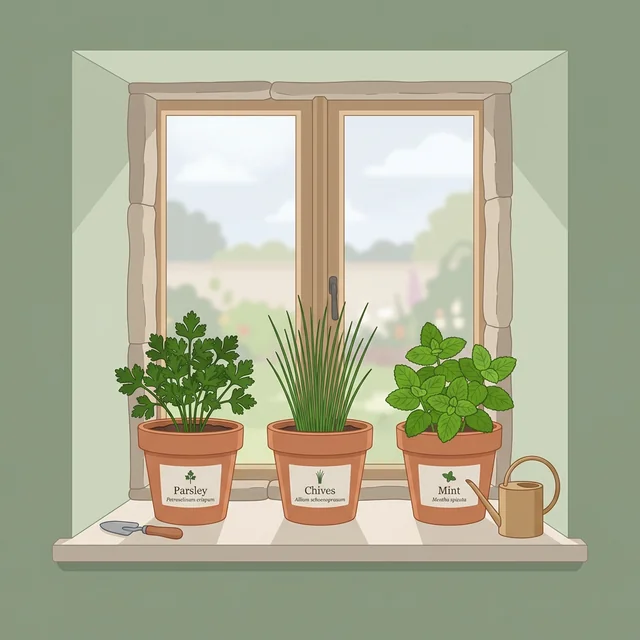
Windowsill Herb Garden Guide for Low-Light Homes
A practical windowsill herb guide for homes that feel bright enough to people but still struggle to keep basil and other herbs compact without extra help.
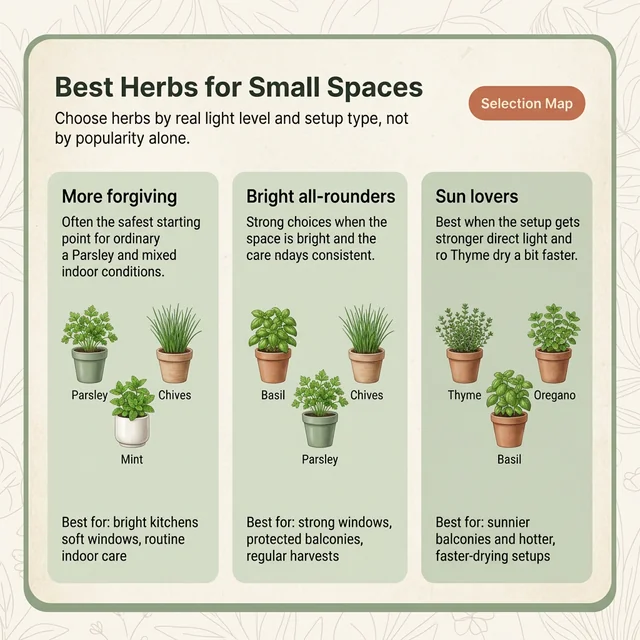
Best Herbs for Small Spaces: What Grows Well in Apartments, Balconies, and Windowsills
A practical guide to the herbs that actually perform well in compact homes, with selection logic for bright windows, balconies, and more forgiving low-space setups.
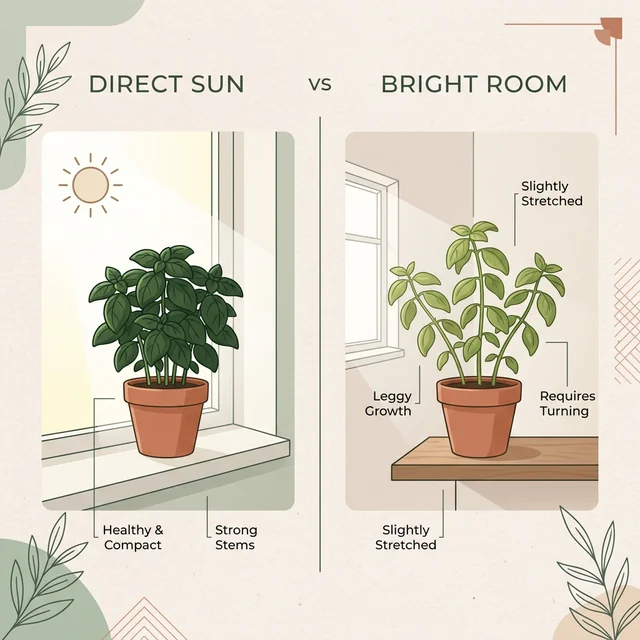
Can Herbs Grow Indoors Without Direct Sunlight? What to Expect in Real Homes
A realistic answer to a common indoor-herb question, with clear expectations for growth, herb choice, and when a grow light becomes the cleaner solution.