The Hydroponic Lettuce Chemistry Chart
| Stage of Growth | Optimal pH Range | Target EC (mS/cm) | PPM (500 scale) |
|---|---|---|---|
| Seedling / Sprout | 5.5 - 6.0 | 0.5 - 0.7 | 250 - 350 ppm |
| Early Vegetative | 5.5 - 6.0 | 0.8 - 1.0 | 400 - 500 ppm |
| Mature / Harvesting | 5.5 - 6.0 | 1.0 - 1.2 | 500 - 600 ppm |
| Late Summer / High Heat | 5.5 - 6.0 | 0.8 - 0.9 (Lower is safer) | 400 - 450 ppm |
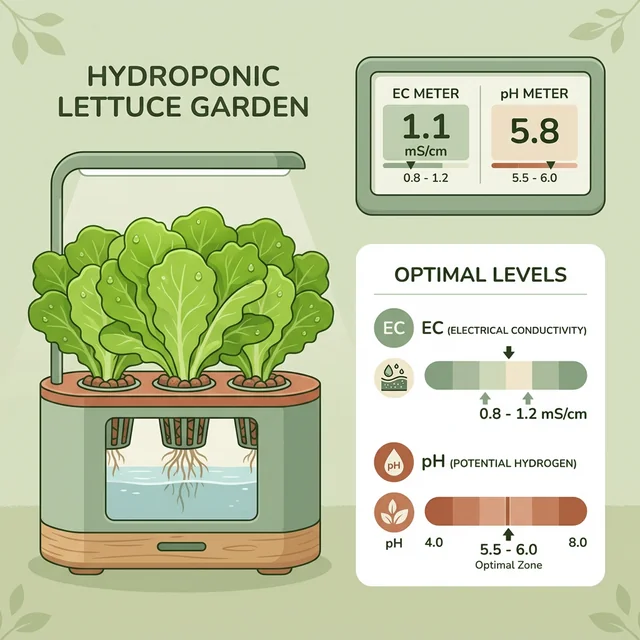
For most hydroponic lettuce, the useful target is simple: keep EC around 0.8 to 1.2 mS/cm and pH around 5.5 to 6.0. If the crop is still young, start lower. If the leaves are burning at the edges or turning pale in the center, check those two readings before changing everything else. Even in a well-built countertop hydroponic setup, lettuce slows down quickly when the reservoir drifts.
In this practical decision-making guide, you will learn:
- The exact EC and pH numbers you need for every growth stage.
- How to instantly identify visual symptoms like burnt tips or pale leaves.
- A quick decision framework to know exactly when and how to adjust your reservoir.
If you are brand new to reservoir management, start with our hydroponic nutrient basics guide first. If the numbers already look reasonable but growth still feels weak, check Hydroponic Lettuce Growing Slowly? Check Light, Roots, and EC in Order and When to Change Hydroponic Nutrient Solution: Top Off vs Full Reset before you raise concentration again.
Quick Answer: Lettuce EC & pH
- EC: 0.8 – 1.2 mS/cm
- pH: 5.5 – 6.0
If your lettuce has tip burn, your EC is often too high. If new leaves turn yellow, your pH has often drifted too high.
The Magic Numbers: Lettuce EC and pH
Use the following quick reference chart to establish a baseline for your crop’s requirements.
| Stage of Growth | Optimal pH Range | Target EC (mS/cm) | PPM (500 scale) |
|---|---|---|---|
| Seedling / Sprout | 5.5 - 6.0 | 0.5 - 0.7 | 250 - 350 ppm |
| Early Vegetative | 5.5 - 6.0 | 0.8 - 1.0 | 400 - 500 ppm |
| Mature / Harvesting | 5.5 - 6.0 | 1.0 - 1.2 | 500 - 600 ppm |
| Late Summer / High Heat | 5.5 - 6.0 | 0.8 - 0.9 (Lower is safer) | 400 - 450 ppm |
To use this chart you need two inexpensive tools: a pH meter and an EC/TDS meter (you cannot judge either number by eye). Our picks and what to look for are in best EC and pH meters for home hydroponics.
Practical Tip: Stability matters more than chasing the perfect reading. A reservoir that stays close to target and gets refreshed on time is usually safer than one that swings up and down because you keep correcting it. If you are unsure whether the solution is still trustworthy, use this top-off vs full reset guide before stacking more nutrients into old water.
Unlike tomatoes, which are “heavy feeders” requiring a stronger solution to produce fruit, lettuce is a light feeder. It only needs to produce leaves. Peppers are the exception among fruiting crops here — Oklahoma State University Extension’s own table puts them at 0.8 to 1.8 mS/cm, overlapping lettuce’s 0.8 to 1.2 range rather than sitting above it. Overfeeding lettuce is the most common beginner mistake.
The pH Range: 5.5 to 6.0
The pH scale measures how acidic or alkaline your water is. For hydroponic lettuce, the absolute sweet spot is 5.5 to 6.0, leaning slightly acidic.
- What happens if it goes too high (above 6.5)? The plant experiences “nutrient lockout.” Even if the water is full of fertilizer, the roots physically cannot absorb iron and manganese at high pH levels. The new leaves will turn pale yellow, a symptom commonly misdiagnosed as needing more fertilizer.
- What happens if it goes too low (below 5.0)? Uptake becomes unbalanced and the roots come under stress. Bring it back into range rather than waiting for symptoms to appear.
The EC Range: 0.8 to 1.2
Electrical Conductivity (EC) measures the total amount of fertilizer salts dissolved in your water. Because lettuce is a light feeder, its EC requirements are wonderfully low.
- Seedlings (0.5 - 0.7 EC): When your lettuce has just sprouted its first true leaves, the roots are delicate. Keep the nutrient concentration very low.
- Mature Plants (0.8 - 1.2 EC): As the lettuce forms a head or dense rosette, it needs more food to power that rapid growth.
- The Heat Exception: If your indoor space is very warm (above 75°F / 24°C), the plant will drink more water to cool itself down. If the EC is high when it drinks heavily, it will accidentally consume too much fertilizer. Always lower your EC slightly in hot conditions.
How to know if your EC or pH is wrong (visual symptoms)
Before you break out the testing meters, your plants will often tell you exactly what is wrong. The symptoms sort into three patterns:
- Yellowizing new leaves: If the center leaves are coming in pale or white while the outer leaves remain green, this is a classic sign of a pH imbalance. Specifically, the pH has drifted too high, locking out iron.
- Dwarfed or slow growth: If your lettuce looks perfectly healthy but just is not getting any bigger week after week, you may have low EC or another bottleneck such as weak light or warm roots. The plant is surviving, but it may not have enough support to push new growth.
- Burnt, crispy tips: If the edges of the leaves look brown and crispy, despite sitting in water, this is almost always caused by high EC. The nutrient salts are too concentrated, causing a localized drought in the plant’s extremities.
Diagnosing Lettuce Nutrient Problems
Because lettuce grows quickly, changes in the reservoir can appear in new growth, but leaf symptoms are not a direct chemical test. If plants are stunted, cross-reference the readings with Why Is My Hydroponic Lettuce Growing So Slowly? and inspect roots, temperature, light, and airflow before assigning one nutrient cause.
Problem 1: Tip Burn (Brown, crispy edges)
If the very edges of your inner lettuce leaves are turning black or crispy brown, you are experiencing tip burn.
- The Cause: This is a calcium deficiency at the edge of the leaf. However, it is rarely caused by a lack of calcium in the water. Instead, it is caused by an EC that is too high or a lack of airflow. High EC prevents water from flowing smoothly into the extremities of the plant.
- The Fix: Lower your EC by adding fresh, plain pH-balanced water to your reservoir, and point a small fan directly at the plants to encourage transpiration.
Problem 2: Yellowing New Leaves
If the oldest, outer leaves are green, but the brand-new leaves emerging from the center are pale yellow or white, you have an iron deficiency.
- The Cause: Your pH has drifted too high (above 6.5). The iron is in the water, but the high pH has made it unavailable to the roots.
- The Fix: Use “pH Down” solution to gently bring the reservoir back down to 5.8. Do not add more fertilizer; the plant just needs access to what is already there.
Problem 3: Wilting and Slime
If your lettuce looks thirsty despite its roots hanging directly in water, pull the plant up and inspect the roots. If they are brown, slimy, and smell foul, you likely have a case of root rot.
- What it can mean: Wilt plus soft, slimy, or foul-smelling roots points to root-zone disease or oxygen stress rather than a simple pH correction. Warm water, weak aeration, sanitation, and stressed roots can interact. Use root rot prevention and diagnosis before adding more nutrient.
- The Fix: Prevention is the best cure. Keep your water moving and cool.
Common EC and pH mistakes in hydroponic lettuce
Avoid these frequent pitfalls to keep your hydroponic garden running smoothly:
- Over-adjusting pH: Adding “pH Down”, overshooting, and then adding “pH Up” creates a toxic soup of unneeded salts. Make small adjustments and wait.
- Ignoring water temperature: Warm water holds significantly less oxygen and makes high EC even more dangerous. Always test your water temperature alongside your EC and pH.
- Not calibrating or verifying meters: A display can look precise while the probe has drifted. Check it against fresh standards before making a large correction. Best pH and EC meters for home hydroponics covers calibration, probe care, and replacement signs.
- Overcorrecting EC: If your EC is 1.4 when the target is 1.2, don’t panic. Gently dilute it over a few days rather than dumping half the reservoir.
Quick decision guide
When you are standing in front of your system wondering what to do next, use these short, actionable bullet points:
- Leaves yellowing in the center → Check and lower your pH (target 5.8).
- Growth has stalled completely → Increase your EC slightly (boost by 0.2).
- Edges are burning and crispy → Lower your EC immediately with fresh water.
- Water is cloudy or smells → Empty and clean the reservoir.
How Often to Test
When you mix a fresh batch of hydroponic nutrients, the chemistry will naturally drift as the plant consumes water and fertilizer at different rates. Knowing when to completely change your nutrient solution is just as important as daily top-offs.
- Check pH twice a week: Lettuce naturally pushes the pH up as it eats nitrogen. You will routinely need to add a few drops of pH Down to keep it in the 5.5 - 6.0 range.
- Check EC once a week: If the EC is rising, the plant is drinking more water than fertilizer. Add plain water. If the EC is falling fast, the plant is eating heavily. Add a slight boost of nutrient solution.
Holding the 0.8 - 1.2 EC range and the 5.5 - 6.0 pH pocket heads off most of what goes wrong in a small indoor system. Keep the water clean and the lights close, and the crop will tell you it is on track long before a meter does.
The two tools you need to hit these numbers
You cannot judge EC or pH by eye, so two inexpensive meters do all the work here:
- A pH meter to keep the reservoir in the 5.5-6.0 window. Browse pH meters for hydroponics on Amazon.
- An EC / TDS meter to keep the concentration at 0.8-1.2. Browse EC / TDS meters on Amazon.
For how to choose accurate, easy-to-calibrate models, see best EC and pH meters for home hydroponics.
Beyond lettuce
Once lettuce is dialled in, the same skills transfer to other crops and systems:
- Hydroponic EC chart by crop for targets beyond lettuce.
- How to mix hydroponic nutrients step by step, and Best hydroponic nutrients for herbs and greens if you still need a beginner-friendly formula.
- Hydroponic basil: EC, pH, and light for the next easy crop.
- NFT vs DWC vs Kratky to choose a system.
Related Guides
- Hydroponic Nutrients Ec Ph Basics
- Hydroponic Lettuce Growing Slowly
- Countertop Hydroponic Herbs Beginner
Sources and further reading
- Oklahoma State University Extension: Electrical Conductivity and pH Guide for Hydroponics provides crop EC and pH context plus a calibrated measurement workflow.
- University of Kentucky: Hydroponic Lettuce Production in Controlled Environments covers lettuce propagation, nutrient-solution management, light, and environmental limits.
- Virginia Cooperative Extension: Hydroponic Production of Edible Crops—DWC Systems explains how EC and pH measurements are used alongside temperature, dissolved oxygen, and system management.
Troubleshooting your hydroponic greens? Read these
If your lettuce looks pale, is growing too slowly, or has crispy edges, these guides will help you diagnose the water chemistry.
Common questions
What should the EC be for hydroponic lettuce?
The optimal Electrical Conductivity (EC) for hydroponic lettuce is between 0.8 and 1.2 mS/cm. Seedlings should start lower (around 0.5), and mature plants can handle up to 1.2.
Why are the edges of my hydroponic lettuce turning brown?
This is called "tip burn," and it is almost always caused by an EC that is too high, inadequate airflow, or a lack of calcium reaching the leaf edges.
How often should I test the pH in a countertop hydroponic system?
You should check the pH at least twice a week. Plants naturally alter the pH of the water as they consume different nutrients.
Is 1.6 EC too high for hydroponic lettuce?
For most lettuce, yes. An EC around 1.6 mS/cm is usually stronger than necessary and can contribute to tip burn, bitter growth, or stalled plants in warm conditions.
Related guides
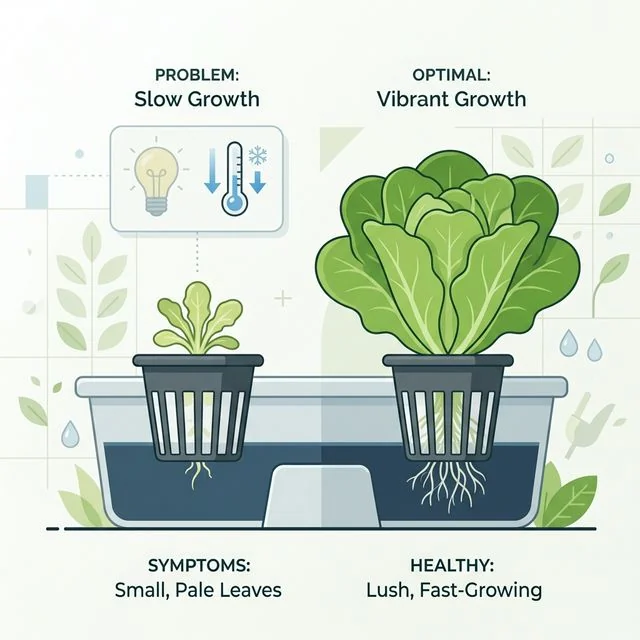
Hydroponic lettuce growing slowly? Check light, roots, and EC in order
Slow hydroponic lettuce is usually a systems problem, not a mystery deficiency. The goal is to find the bottleneck without overcorrecting five variables at once.
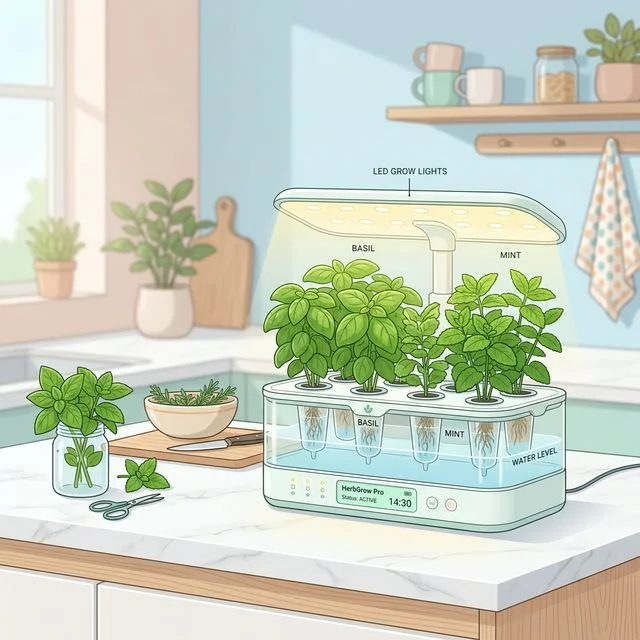
Countertop hydroponic herbs for beginners: what to buy and what to ignore
Countertop hydroponic systems can work very well for herbs, but only if you treat them as small growing systems rather than decorative appliances.
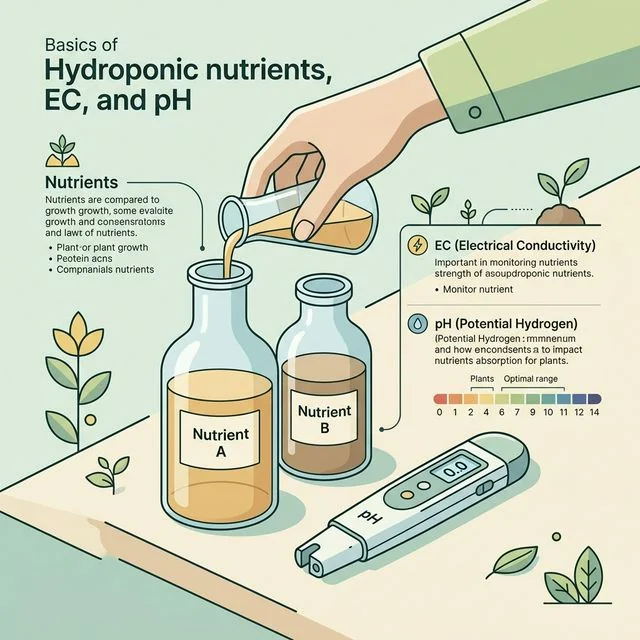
Hydroponic nutrient basics: EC, pH, dilution, and reservoir stability
Most hydroponic problems are not mysterious. They come from concentration drift, pH drift, heat, or neglected maintenance. This guide covers the basics clearly.