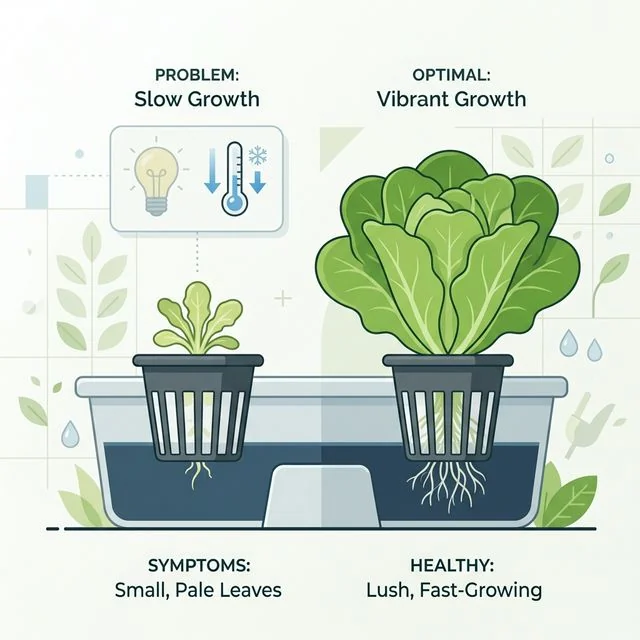
Troubleshoot the system before you change the inputs.
Symptoms
- Leaves stay small and growth feels stalled for several days.
- Plants look light green or thin without obvious burn or rot.
- Outer leaves mature slowly and heads never bulk up.
Possible causes
- Light intensity is too low for the crop density.
- Water temperature or root-zone hygiene is reducing root efficiency.
- EC, spacing, or airflow is out of balance.
Quick fixes
- Check fixture coverage and reduce canopy crowding first.
- Refresh the solution and inspect root health before increasing concentration.
- Stabilize temperature and airflow for several days before making more changes.
Hydroponic lettuce can look fine while still underperforming. That is what makes slow growth frustrating: the plants are alive, but they never seem to accelerate. In most cases, the answer is not a dramatic nutrient deficiency. It is a quiet bottleneck somewhere in the system.
If you want the short version first, start with the basics in this order: light coverage, spacing, root health, water temperature, and only then nutrient concentration. That sequence answers most hydroponic lettuce growing slowly problems faster than changing the formula on day one. If you need the nutrient framework behind that order, use Hydroponic Nutrients for Beginners: EC and pH Without the Confusion as the baseline. If your setup is a compact indoor unit, Countertop Hydroponic Herbs for Beginners: What to Buy and What to Ignore helps explain why crowding and small reservoirs drift so quickly.
Quick Answer
Slow hydroponic lettuce is usually caused by weak light, crowding, warm or stressed roots, or an EC routine that no longer matches the system. The useful move is to check those variables in order instead of changing everything at once.
Start with light and spacing
Lettuce needs enough daily light and enough physical room to build leaf mass. When plants are crowded too early, they shade one another and trap humidity inside the canopy. The solution is often better spacing or more even coverage, not simply more fertilizer.
Check the root zone next
If the roots are stressed, top growth slows down. Warm nutrient solution, stale water, or dirty channels reduce root efficiency long before a total failure is obvious. Refreshing the reservoir and checking for clean, healthy roots is usually more useful than guessing.
Avoid the reflex to raise EC first
More concentration is not always more growth. If light is the true bottleneck, stronger solution can add stress without improving yield. This is why Hydroponic Nutrients for Beginners: EC and pH Without the Confusion should be treated as a systems guide, not a bottle guide.
If the lettuce sits under a weak fixture or an uneven countertop light, correcting the lighting setup usually does more than nudging EC upward. In that case, Best Grow Lights for Herbs: What Actually Matters Before You Buy is the cleaner next step.
Use a diagnosis order
Work in sequence:
- confirm coverage and runtime
- inspect spacing and airflow
- refresh solution and check roots
- only then consider nutrient adjustments
That order protects you from making multiple changes at once and losing the signal.
Compare the crop with milestones, not memory
Record cultivar, sowing and transplant dates, true-leaf count, canopy diameter, root appearance, and one same-angle photograph. Compare with the 45–55 day lettuce timeline while allowing for baby leaf, loose-leaf, butterhead, and romaine harvest goals.
One slow-looking day is not a trend. Measure at a consistent interval and focus on new leaves. If the crop stops changing across several observations, work through the diagnosis order.
Verify measurements before correcting them
Calibrate EC and pH meters, check units, and measure solution temperature. A drifting probe can create unnecessary nutrient and pH additions. Record source-water EC, reservoir volume, top-ups, and every dose.
If roots are firm and new growth is healthy but small, the cultivar or harvest expectation may explain it. If roots are soft or foul-smelling, isolate root-zone troubleshooting before changing light or feed.
Run a controlled recovery test
Split comparable plants when possible. Keep one group unchanged and alter one suspected limiter—coverage, spacing, or reservoir condition—for the other. Observe new growth for several days. A control protects against crediting normal growth to an unnecessary additive.
Related Guides
- Hydroponic Nutrients for Beginners: EC and pH Without the Confusion
- Countertop Hydroponic Herbs for Beginners: What to Buy and What to Ignore
- Best Grow Lights for Herbs: What Actually Matters Before You Buy
Sources and further reading
If you are troubleshooting hydroponic lettuce, also read
These related guides cover nutrients, fixture decisions, and beginner system choices that often explain slow lettuce performance.
- Hydroponic nutrient basics: EC, pH, dilution, and reservoir stability
- Countertop hydroponic herbs for beginners: what to buy and what to ignore
- Best grow lights for herbs: what actually matters before you buy
- How many hours should grow lights run for herbs? 12-16
- Why are basil leaves turning yellow indoors?
Common questions
Why is hydroponic lettuce small even though the leaves look healthy?
Healthy-looking but undersized lettuce often points to insufficient light intensity, crowding, or temperature conditions that are slowing growth.
Should I add more nutrients if lettuce is growing slowly?
Not immediately. Slow growth is often caused by light, spacing, or root-zone issues rather than a need for more concentrated nutrient solution.
What should I check first when hydroponic lettuce stops growing?
Start with light coverage and spacing, then inspect root health and water temperature, and only after that review EC and nutrient routine.
Related guides
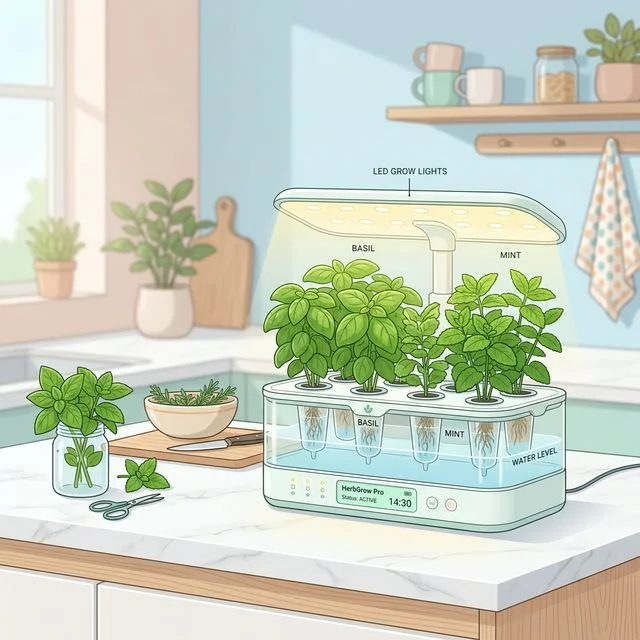
Countertop hydroponic herbs for beginners: what to buy and what to ignore
Countertop hydroponic systems can work very well for herbs, but only if you treat them as small growing systems rather than decorative appliances.
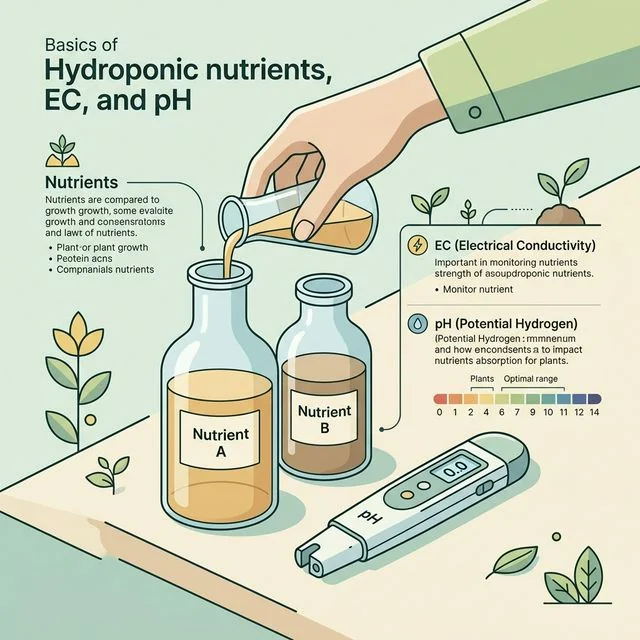
Hydroponic nutrient basics: EC, pH, dilution, and reservoir stability
Most hydroponic problems are not mysterious. They come from concentration drift, pH drift, heat, or neglected maintenance. This guide covers the basics clearly.

Hydroponic nutrient deficiency chart: what each symptom means
Where a symptom starts tells you which nutrient is short. Use the chart to narrow it down, then rule out pH and roots before you add anything to the reservoir.