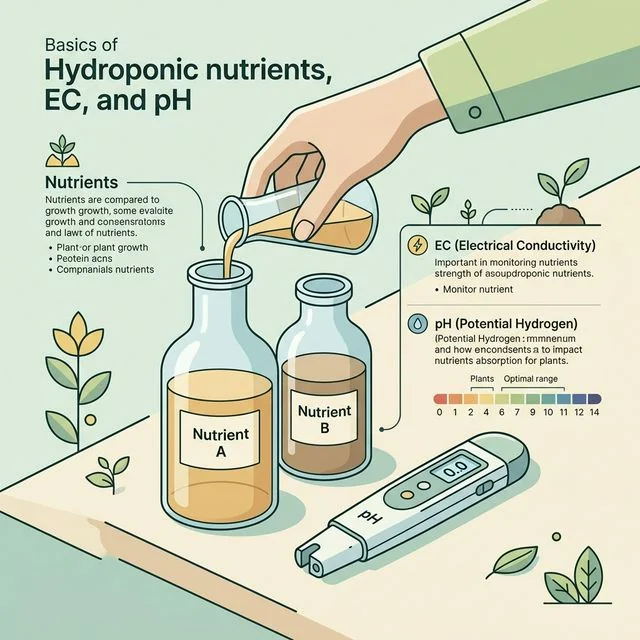
Hydroponics gets harder than it needs to be when the basic measurements are explained poorly. For beginners, the useful version is simple: EC helps you avoid feeding too weakly or too strongly, and pH helps the plant access what is already in solution. If you want crop-specific numbers after this, use it together with Hydroponic Lettuce EC & pH Chart and When to Change Hydroponic Nutrient Solution: Top Off vs Full Reset.
EC and pH here are the beginner foundation, not a universal feeding schedule for every plant. The point is to understand what the readings mean, how dilution works, and how to keep a small reservoir stable enough that the rest of your troubleshooting becomes clearer. If the system is already showing brown roots or stale water, move from nutrient theory to Hydroponic Root Rot: Brown Roots, Slimy Roots, and Prevention before you assume the next bottle or additive will solve it.
What EC actually tells you
EC is a conductivity reading. In practice, it helps you estimate how concentrated the nutrient mix is. A higher number means more dissolved salts. That does not automatically mean better feeding.
If EC rises while the reservoir level drops, the plant is taking up water faster than nutrients and the remaining solution is becoming more concentrated. That usually points to a need for dilution or a full refresh.
Why pH still matters
Even with a good nutrient formula, the root zone can struggle if pH drifts out of the useful range. (If you still need to choose that formula, Best hydroponic nutrients for herbs and greens covers beginner-friendly options.) In many herb-focused hydro systems, a mildly acidic range is usually safest. The exact target matters less than avoiding sharp swings.
This is why stable routines matter more than constant correction. If you keep chasing a perfect number with repeated small additions, you often create more drift, not less.
Dilution and top-offs are part of nutrient control
Many beginners assume a lower water level means it is time to add more fertilizer. Often the opposite is true. In small systems, plants usually remove water faster than dissolved minerals, so the remaining solution becomes stronger as the reservoir drops.
That is why top-offs and full resets belong in the same conversation as EC and pH. If the system keeps concentrating between checks, a plain-water top-off may be the right move. If the readings stay erratic or the reservoir is overdue, use a full change instead of stacking more adjustments on tired solution. The full maintenance logic is covered in When to Change Hydroponic Nutrient Solution: Top Off vs Full Reset, but the core idea belongs here because it is part of nutrient basics, not an advanced tactic.
The beginner mistake: adjusting too often
Some growers chase every small reading change. That creates instability. In small systems, minor drift is normal. The better habit is to:
- top up with water consistently
- inspect roots and water temperature
- refresh solution on a schedule
- make measured adjustments instead of repeated small corrections
For a more detailed reset rhythm, continue with When to Change Hydroponic Nutrient Solution: Top Off vs Full Reset. If you are growing lettuce and need exact stage-by-stage targets, the more specific reference is Hydroponic Lettuce EC & pH Chart.
Meter habits matter more than beginners expect
A reading is only useful if the meter is trustworthy. Dirty probes, old calibration solution, or inconsistent measuring habits can turn a normal reservoir into a fake emergency. If you are still choosing a pen, Best EC and pH meters for home hydroponics covers which ones hold calibration.
You do not need a lab routine. You do need to rinse tools, calibrate them often enough to trust the numbers, and interpret those numbers in the context of water level, plant condition, and temperature.
When symptoms appear
If basil or lettuce starts looking pale, stretched, or weak, do not assume the nutrient bottle is wrong. Check light, temperature, and reservoir hygiene first. Hydroponics is still a whole-system problem, not just a nutrient label problem. When the crop is herbs on a small countertop unit, Countertop Hydroponic Herbs for Beginners gives the broader setup context that these numbers depend on.
If the leaves are stalling while the reservoir seems technically “in range,” compare the symptom against Hydroponic Lettuce Growing Slowly? Check Light, Roots, and EC in Order or the Hydroponic Lettuce EC & pH Chart before raising concentration. If the roots smell swampy or look coated, stop treating it as a pure feeding problem and move directly to Hydroponic Root Rot: Brown Roots, Slimy Roots, and Prevention.
Related Guides
To build hydroponic context around nutrients, also read
These guides connect nutrient basics with crop performance, lighting, and the most common hydroponic troubleshooting patterns.
- Countertop hydroponic herbs for beginners: what to buy and what to ignore
- Hydroponic lettuce EC & pH chart: 0.8-1.2 and 5.5-6.0
- Hydroponic lettuce growing slowly? Check light, roots, and EC in order
- When to change hydroponic nutrient solution: top off vs full reset
- Hydroponic root rot: how to spot it early and stop it
- How many hours should grow lights run for herbs? 12-16
- Why are basil leaves turning yellow indoors?
Common questions
What is EC in hydroponics?
EC means electrical conductivity. It is used as a practical proxy for how concentrated the nutrient solution is.
Why does pH matter if nutrients are already in the water?
Because roots can only absorb nutrients efficiently when the solution stays within a usable pH range.
Should I add more nutrients every time the reservoir level drops?
Usually no. In many small systems, topping off with plain water is safer until your readings show that concentration has actually fallen.
Do I need to calibrate hydroponic meters?
Yes. A pH or EC reading is only useful if the meter is clean, working properly, and calibrated often enough to trust.
What is the difference between topping off and doing a full reservoir reset?
A top-off replaces lost water so concentration does not keep rising. A full reset replaces the whole solution when drift, imbalance, or reservoir age makes the old mix unreliable.
Where should beginners go for actual target numbers after learning the basics?
Use this guide for the framework, then move to crop-specific references like the hydroponic lettuce EC and pH chart when you need working ranges for a specific plant.
Related guides
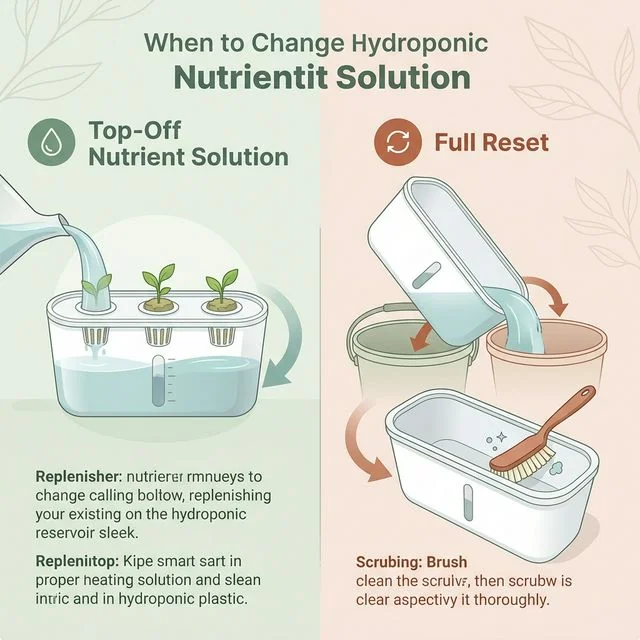
When to change hydroponic nutrient solution: top off vs full reset
A hydroponic reservoir should not be treated like a closed loop forever. This guide shows when a simple top off is enough and when a full reset is the safer move.
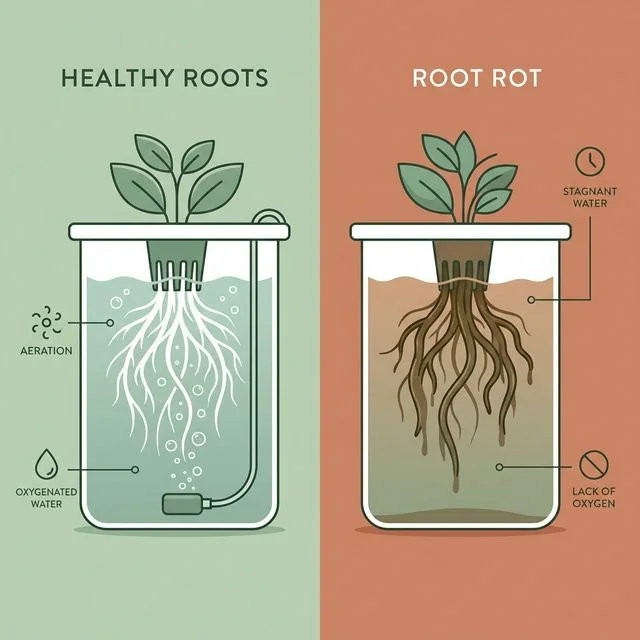
Hydroponic root rot: how to spot it early and stop it
Brown, slimy or swampy-smelling roots mean root rot. Catch it early and fix the conditions behind it — warm water, low oxygen and stagnant flow.
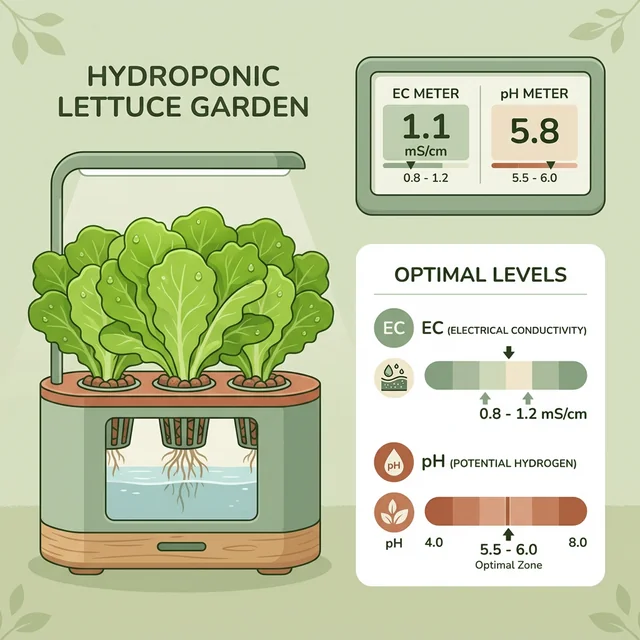
Hydroponic lettuce EC & pH chart: 0.8-1.2 and 5.5-6.0
Lettuce is the easiest crop to grow hydroponically, but it requires specific water chemistry. Use this beginner-friendly EC and pH guide to prevent tip burn and slow growth.