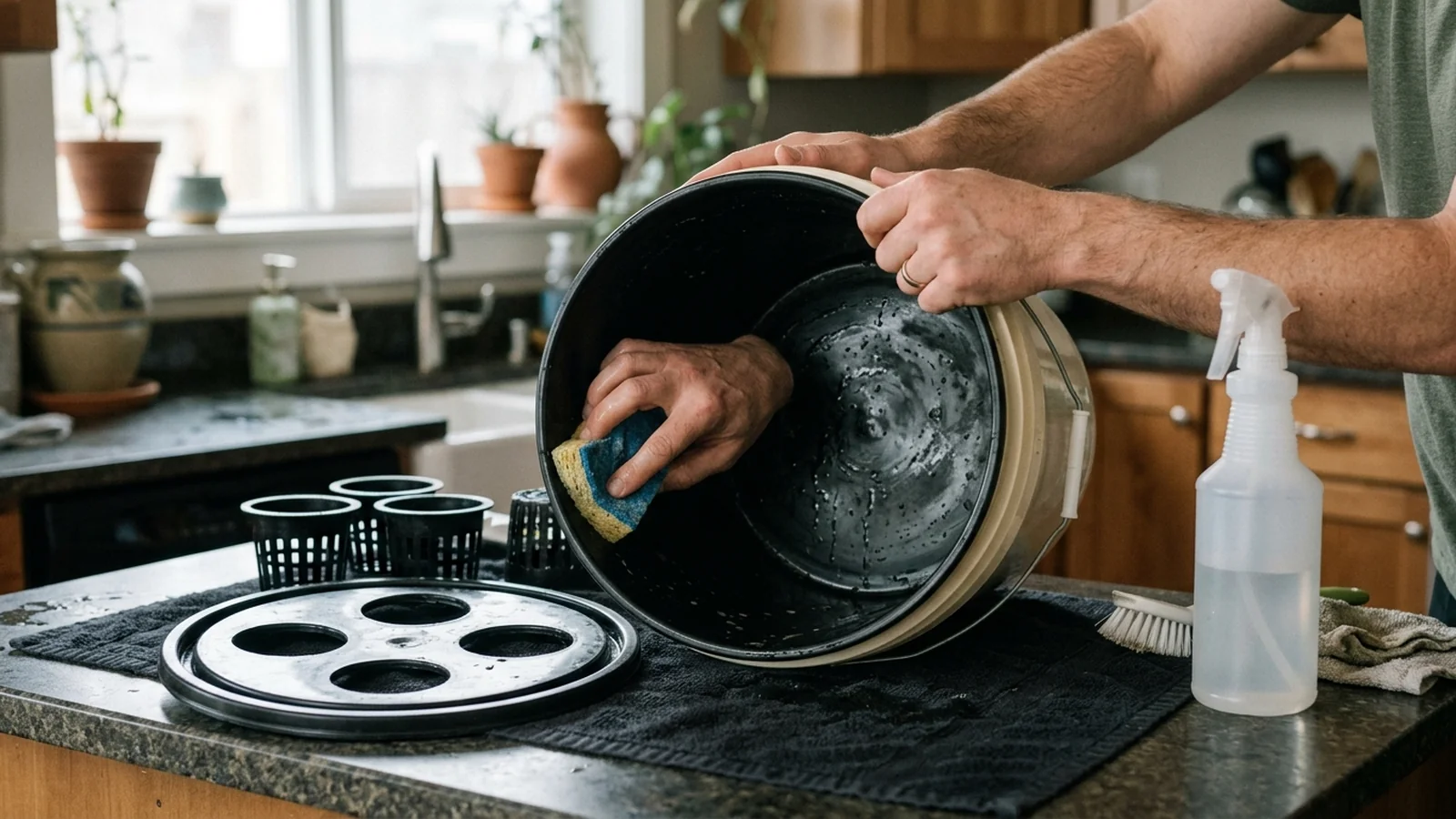
Reservoir sanitizing versus surface sanitizing (University of Minnesota Extension)
| What you're treating | Bleach dose | Contact time | What happens after |
|---|---|---|---|
| Reservoir and plumbing | 150-200 ppm (about 1 Tbsp of 5.25-6% bleach per gallon) | Up to 3 hours, circulated through the system | Drain, then run a plain-water rinse cycle for 2-3 hours before refilling |
| Net pots, boards, totes (surfaces) | Same 150-200 ppm, about 1 Tbsp per gallon | Spray on or dunk the parts | Let air dry — skip the rinse |
Sanitizing between crops means a timed chemical treatment, not a scrub. University of Minnesota Extension’s dose is 150 to 200 ppm bleach — about 1 tablespoon of unscented 5.25-6% sodium hypochlorite per gallon of water — run through the reservoir for up to 3 hours, then followed by a plain-water rinse cycle of 2 to 3 hours. Surfaces such as net pots and totes get the same dose but the opposite ending: air dry instead of rinsing.
The reversal is deliberate: the reservoir gets rinsed because nutrient solution goes back into it, and the surfaces do not because the residual film is what keeps them clean until the next crop.
Sanitizing is a between-crops job, separate from routine cleaning
Cleaning a small hydroponic system covers the physical side: draining old solution, scrubbing mineral scale and biofilm off plastic, taking the pump apart. Sanitizing is the chemical step that follows a clean system, aimed specifically at whatever survived the scrub — bacteria, algae spores, and pathogens like the Pythium water mold that causes root rot. University of Kentucky’s extension service lists sanitizing between crops as a direct management step against Pythium, alongside not introducing diseased plugs and removing affected plants promptly.
Sanitizing between crop cycles also does double duty as a grower’s main defense against carryover insects. University of Minnesota Extension names sanitizing between plantings as the primary insect-management tool available to a home hydroponic system, and calls for cleaning and sanitizing reused growing substrate before it goes back into service, specifically to keep pathogens from building up cycle over cycle.
The order the steps happen in, not just what’s in the bottle
A sanitizer poured over a dirty surface does very little. University of Minnesota Extension’s sequence is not optional and not reorderable: spray off loose debris first, then wash with detergent and warm water using a scrub brush, then rinse with potable water, and only after that apply the sanitizer. Sanitizer applied over organic matter and biofilm does not reach what it is meant to kill — it reacts with the grime instead.
That means the deep-clean routine and the sanitizing step are sequential, not competing. Scrub first. Sanitize second.
The bleach dose, and why the ending differs by surface
The dose itself does not change between the reservoir and the equipment around it: 150 to 200 ppm bleach, roughly 1 tablespoon of unscented 5.25-6% sodium hypochlorite per gallon of water, from University of Minnesota Extension.
What changes is what happens after contact:
- Reservoir and plumbing. Add the solution to the reservoir and run it through the system for up to 3 hours so it reaches every hose and fitting. Then drain it completely and run a rinse cycle — plain municipal water, cycled for an additional 2 to 3 hours — before refilling with nutrient solution.
- Surfaces — net pots, foam or polystyrene boards, totes. University of Minnesota Extension directs the same 150-200 ppm concentration sprayed on or dunked over the parts, then air-dried with no rinse afterward; the residual film is the point, and rinsing it off defeats the purpose.
For scale, Cornell’s CEA program describes its own commercial equivalent: floats, trays, and other equipment washed with a 2% bleach solution between every use. That is a stronger concentration than the home reservoir dose above, and it is a surface wash rather than a reservoir treatment — worth keeping separate rather than borrowing the number for a home system. Cornell’s practice for an actual disease outbreak is more severe still: drain the ponds and tanks, discard the crop, and clean everything with 2% bleach before the next planting.
Hydrogen peroxide and peroxyacetic acid: read the label instead of guessing a dose
Bleach is not the only sanitizer that shows up on hydroponic labels. University of Minnesota Extension names hydrogen-peroxide and peroxyacetic-acid products — ZeroTol 2.0 and Sanidate 5.0 are its examples, both OMRI listed for organic use — as an alternative to bleach. The requirement is that the product’s label states it is safe for food-contact surfaces, and from there the label’s own dosing, personal protective equipment, contact time, and flushing instructions govern.
That is a narrower instruction than it sounds: buy a product labelled for food-contact sanitizing and follow what is printed on it, rather than measuring out a generic hydrogen-peroxide concentration by guesswork. A dose that works for a bathroom or a pool is not the dose a food-contact label specifies, and the reverse is also true.
Skip bleach mid-cycle
The 150-200 ppm dose above is for between crops, with nothing growing in the system. University of Minnesota Extension is specific that bleach should not be used during an active growing cycle, because it can damage plants if any residue is not fully rinsed away — and a chemical treatment that is safe for an empty reservoir is a different question from one running under live roots.
Mid-cycle maintenance is mechanical instead: a high-powered spray to knock debris loose, or a scrub brush and warm water on tanks and pumps. Save the timed bleach or peroxide treatment for the gap between one crop coming out and the next one going in.
Algae is worth heading off before it needs sanitizing
Sanitizing removes algae that has already established. Preventing it in the first place is mostly a light problem rather than a chemical one, and it is worth solving separately — see controlling algae in a hydroponic reservoir for the shading and light-blocking side of that work. University of Minnesota Extension’s own note ties the two together: over-fertilizing promotes algae growth on roots and inside tubing, so keeping nutrient concentration at the target level is itself a form of prevention, alongside shading reservoirs and lines from light.
If root rot has already shown up, sanitizing gets stricter
The routine above is for a healthy crop finishing on schedule. If the system is coming out of a Pythium or root rot event, treat the whole setup as contaminated rather than lightly used — see preventing hydroponic root rot and distinguishing root staining from root rot for how to tell the two apart and what to do once rot is confirmed. A system that grew a diseased crop is exactly the case University of Kentucky Extension has in mind when it lists sanitizing between crops as a Pythium-management step, not an optional courtesy.
Rinse the produce too, not just the system
Sanitizing the hardware and washing what comes out of it are separate steps. University of Minnesota Extension explains why the hardware step matters in the first place: biofilms build up on hard surfaces over time, and they harbor bacteria — some of it potentially pathogenic — that can transfer to the crop through the system water itself. That mechanism is the reason a sanitizing routine exists at all, not just a hygiene habit.
The same guidance carries past the reservoir and into harvest. University of Minnesota Extension directs harvesting with clean hands into totes or buckets that have themselves been cleaned and sanitized, using scissors or knives given the same treatment — a sanitized system undone by a dirty harvest tote defeats the point of everything above it.
From there, the FDA’s guidance on produce safety is plain: wash all produce thoroughly under running water before eating or preparing it, including anything grown at home, and skip soap, detergent, or commercial produce washes — vegetables are porous enough that those residues can be absorbed rather than rinsed away, and their effectiveness is not established. Washing reduces bacteria that may be present; it does not eliminate it, which is why a clean, sanitized system upstream matters as much as the final rinse.
Sources
- University of Minnesota Extension: Small-scale hydroponics — sanitizing doses, contact and rinse times, sequence, mid-cycle limits, algae and insect management, and food-safety practice for harvest.
- Cornell University CEA Program: Hydroponic Lettuce Handbook — commercial bleach concentration and outbreak response.
- University of Kentucky CCD-CP-63: Hydroponic Lettuce Production in Controlled Environments — Pythium management and sanitizing between crops.
- U.S. FDA: Selecting and Serving Produce Safely — produce washing guidance.
Cleaning, roots, and algae
Sanitizing between crops sits next to routine cleaning, root rot, and algae control. These cover the neighboring questions.
Common questions
What is the correct bleach dose to sanitize a hydroponic reservoir?
University of Minnesota Extension gives 150 to 200 ppm — about 1 tablespoon of unscented 5.25-6% sodium hypochlorite bleach per gallon of water. Run it through the reservoir and plumbing for up to 3 hours, then drain it and flush with plain municipal water for another 2 to 3 hours before refilling with nutrient solution.
Do I need to rinse after sanitizing net pots and trays?
No. For surfaces such as net pots, foam boards, and totes, University of Minnesota Extension directs the opposite of the reservoir procedure — spray or dunk the parts in the same 150-200 ppm bleach solution and let them air dry, without a rinse afterward.
Is hydrogen peroxide a substitute for bleach between crops?
Hydrogen peroxide and peroxyacetic-acid products are a documented alternative, but University of Minnesota Extension defers the dose, contact time, and flushing steps to the product label rather than publishing one generic figure. Buy a product labelled safe for food-contact surfaces and follow its instructions rather than reusing a bleach measurement.
Can I sanitize with bleach while plants are still growing in the system?
No. University of Minnesota Extension is specific that bleach is for between crop cycles, not mid-cycle maintenance, because residue that is not fully rinsed can damage plants. Mid-cycle cleaning of tanks and pumps is a high-powered spray, or a scrub brush and warm water, without bleach.
Related guides
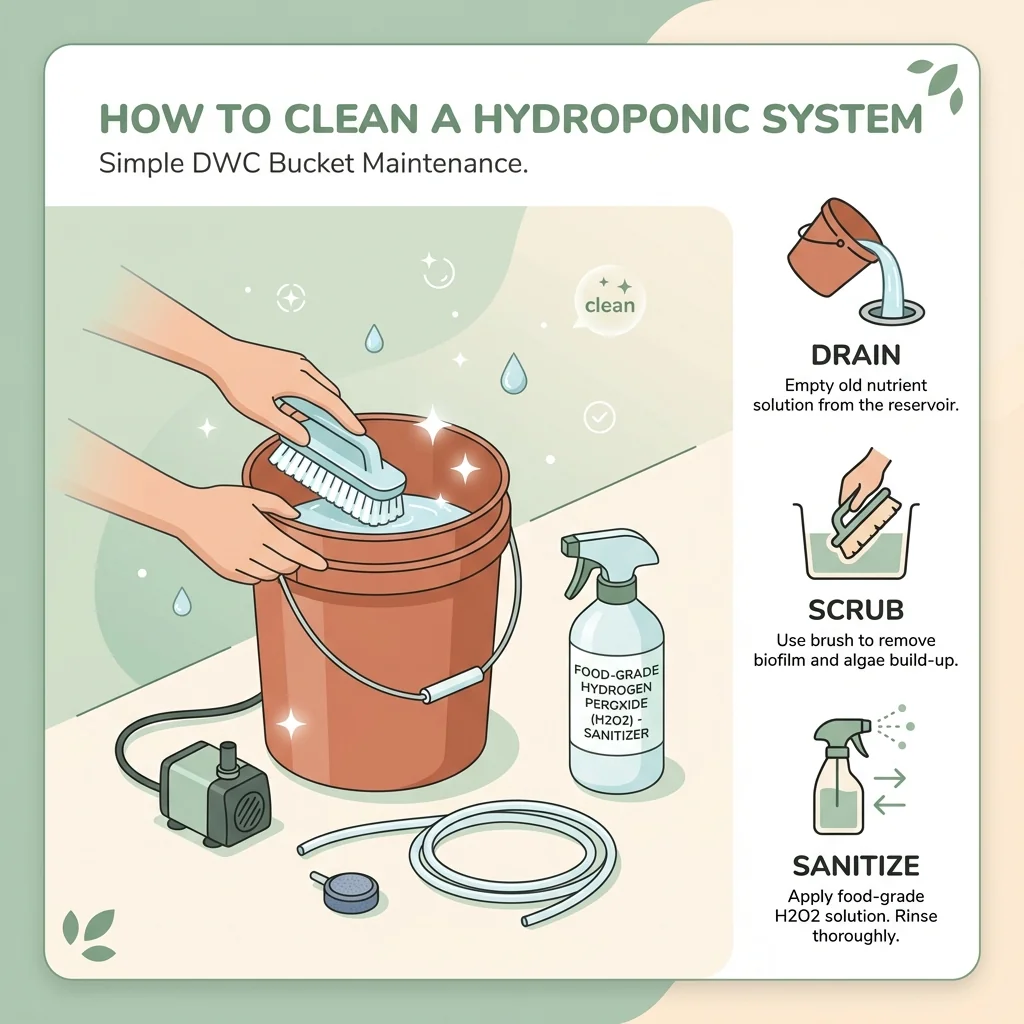
How to clean a small hydroponic system
A small hydroponic setup does not need constant chemical intervention. But between harvest cycles, a rigorous deep-clean is non-negotiable to prevent algae, mineral scaling, and deadly root rot spores from infecting your next crop. Here is the ultimate guide to system hygiene.
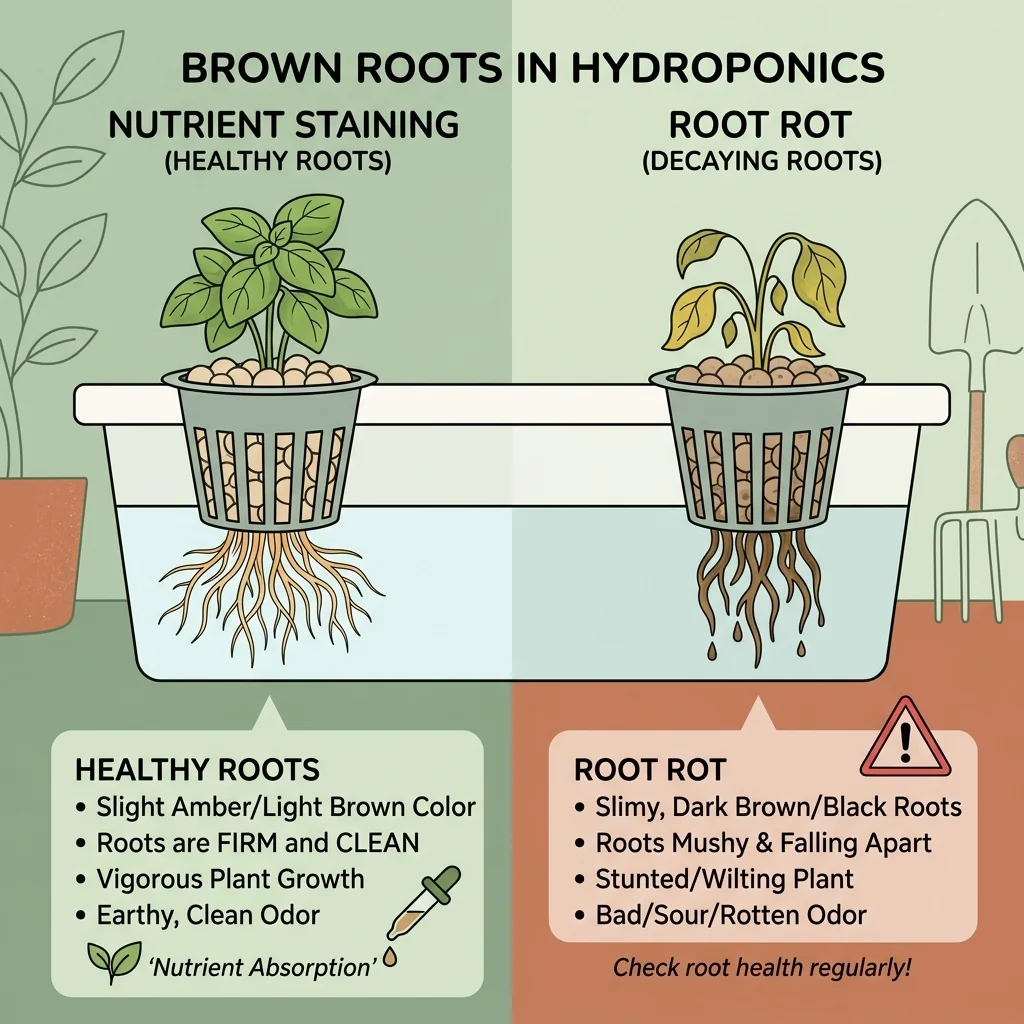
Brown roots in hydroponics: staining vs. root rot
Finding brown roots in your hydroponic reservoir can cause instant panic. But before you dump your nutrients, you need to know: is it a harmless stain or a fatal infection? Here is how to diagnose the difference in seconds.
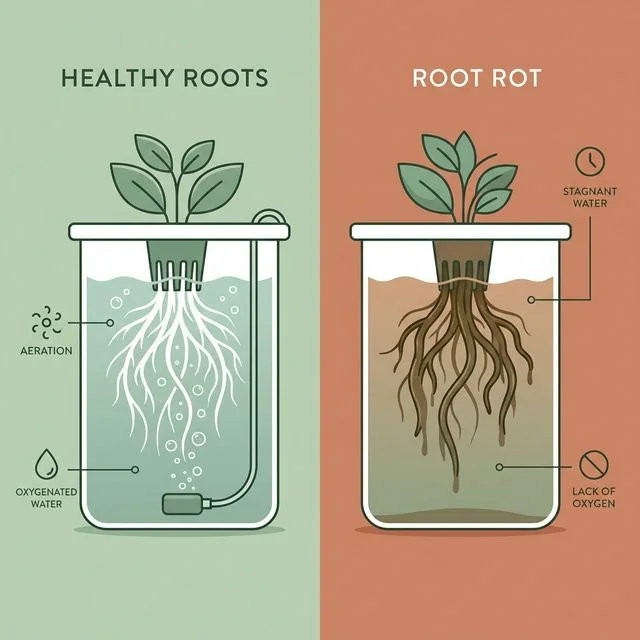
Hydroponic root rot: how to spot it early and stop it
Brown, slimy or swampy-smelling roots mean root rot. Catch it early and fix the conditions behind it — warm water, low oxygen and stagnant flow.