Troubleshoot the system before you change the inputs.
Symptoms
- Leaves yellow, wilt, or lose vigor without a single obvious cause.
- Stems stretch, flop, or regrow slowly after harvest.
- Pots stay wet too long or swing from wet to bone dry too quickly.
Possible causes
- The herbs are receiving less usable light than the grower assumes.
- The root zone is stressed by poor drainage, dense mix, or an awkward container.
- The care routine has drifted away from what the site and herb type actually need.
Quick fixes
- Check light and container behavior before reaching for fertilizer.
- Let the root zone dry to a healthier point if the pot is staying saturated.
- Simplify the setup so each herb is easier to read and water correctly.
Fast symptom-to-cause checks for common potted herb problems
| Symptom | Likely constraint | First thing to check |
|---|---|---|
| Yellow leaves with slow growth | Low light or root stress | Light level and how long the root zone stays wet |
| Wilting while the soil is still wet | Poor drainage or low root oxygen | Container holes, mix structure, and pot size |
| Leggy or floppy stems | Insufficient light | Distance to window or grow light |
| Slow regrowth after harvest | Weak light, cramped roots, or routine drift | Root space, light quality, and watering pattern |
Potted herbs usually decline in patterns, not in random acts of bad luck. Yellow leaves, wilted stems, stalled regrowth, and weak flavor often look like separate issues, but they commonly trace back to the same small group of causes: poor light, stressed roots, mismatched containers, or a care routine that no longer fits the environment. If you want the full cluster roadmap before diagnosing symptoms one by one, start with Small-Space Herb Gardening: Start Here for Apartments, Balconies, and Indoor Setups.
This guide is the broad diagnostic page for potted herbs. Its job is not to guess one dramatic cause. Its job is to help you read the system in the right order so you can isolate the real bottleneck before you change five things at once.
Start with the system, not the symptom
When a herb looks bad, many growers react at the leaf level. Yellow leaves must mean fertilizer. Wilt must mean more water. Weak growth must mean the plant is fussy. In containers, that logic often fails because the symptom is usually downstream of a system problem.
The fastest diagnosis sequence is usually:
- check the light honestly
- inspect how the root zone is drying
- look at the container and drainage behavior
- review the care routine only after the first three make sense
That order matters because light affects water use, water use affects root health, and root health affects whether feeding or pruning will actually help. If the setup is fundamentally off, care tweaks alone rarely fix the problem. Use this guide together with How Much Light Do Herbs Need? Realistic Sun and Grow Light Rules, Best Containers for Herbs: Pot Size, Drainage, and Material Guide, and Potted Herb Care: Watering, Feeding, and Pruning Without Guesswork.
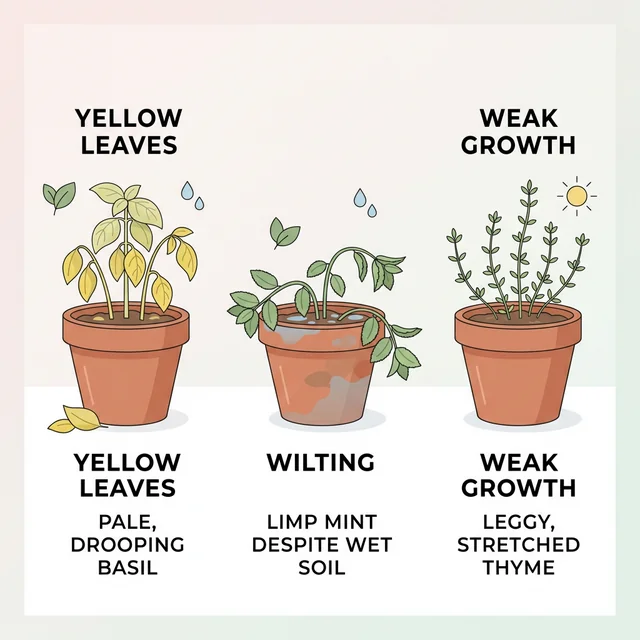
Yellow leaves usually point to low energy or root stress
Yellowing is one of the most common potted herb complaints because it appears in several different failure patterns. Sometimes older leaves fade first while the plant stretches. Sometimes the whole plant looks tired and soft. Sometimes the leaves go pale while the mix stays damp far too long.
Those clues matter more than the color alone. If the herb is pale and stretched, weak light is high on the list. If it is yellow and limp in wet media, root stress is more likely. If the decline followed a sudden temperature swing or a heavy feeding on a stressed plant, the yellowing may be stacked stress rather than a neat deficiency.
This is why yellow leaves should not send you directly to fertilizer. A herb with compromised roots or inadequate light cannot use nutrients efficiently. Basil is especially quick to reveal this pattern, which is why a symptom-specific page like Why Are Basil Leaves Turning Yellow Indoors? is useful after you understand the broader framework.
Wilting in wet soil is a root-zone warning
Wilt does not always mean thirst. In containers, wilted herbs sitting in wet soil often point to roots that are struggling for oxygen. The mix may be too dense. The pot may lack proper drainage. The container may be too large for the available light, causing the lower root zone to stay saturated long after the surface seems dry.
This is one of the most misread potted-herb problems because it feels intuitive to add more water when leaves droop. But if the soil is already wet, extra water deepens the stress instead of relieving it.
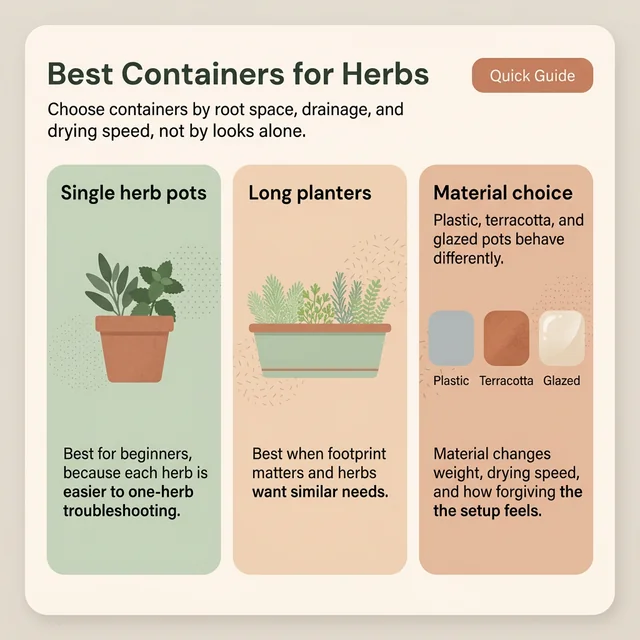
Start by checking whether excess water can actually leave the pot. Then check whether the mix is structured enough for air movement. Decorative containers without drainage, heavy media, and oversized pots in mediocre light all make this symptom more likely. The best container guide for this stage is Best Containers for Herbs: Pot Size, Drainage, and Material Guide, because the fix is often architectural before it is routine-based.
Weak or leggy growth usually starts with light
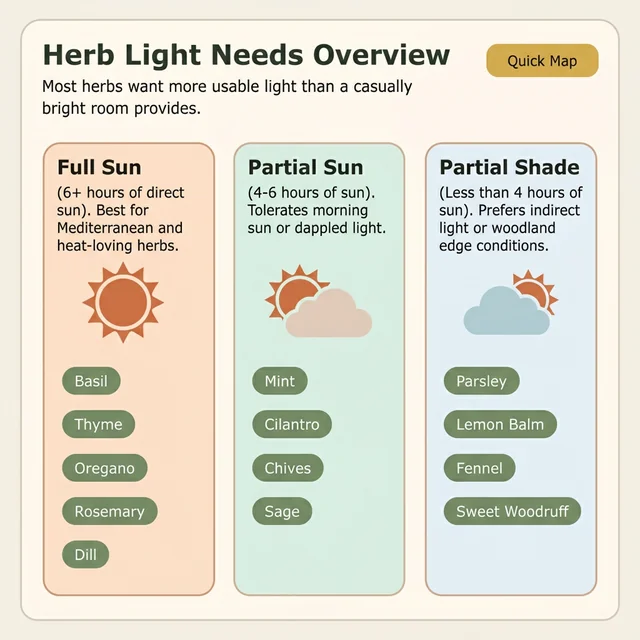
When herbs produce long stems, wider gaps between leaves, floppy growth, or very slow regrowth after harvest, light is usually the first variable to review. Growers often overestimate available sun indoors because the room feels bright to human eyes. Herbs do not respond to brightness the way we do. They respond to usable light reaching the leaves.
Low light also distorts the rest of the system. A light-starved herb uses less water, so the mix stays wet longer. That can make the grower think the watering routine is wrong when the deeper problem is that the plant has too little energy to drive growth and water use.
If weak growth is the main symptom, review How Much Light Do Herbs Need? Realistic Sun and Grow Light Rules before you change feeding. Once light makes sense, the care routine becomes much easier to calibrate.
Diagnose potted herb problems in a fixed order
Most container herbs become easier to troubleshoot when you resist the urge to improvise and instead follow the same checklist every time.
1. Check placement and light
Ask whether the herb is in the strongest realistic location for that crop. Basil, thyme, oregano, and rosemary usually want more light than parsley, chives, or mint. If the plant is stretching, paling out, or regrowing slowly, do not assume the issue is purely nutritional.
2. Check the root zone
Push below the surface and learn whether the lower root zone is staying wet, compacted, or sour. Healthy diagnosis comes from knowing what is happening where the roots are, not from reading only the top half inch of mix.
3. Check the container design
Small decorative pots, poor drainage, and awkward shared planters make symptoms harder to read. A container can create both drought stress and saturation stress depending on how the mix behaves in that specific site.
4. Check the routine
Only after the first three steps make sense should you ask whether watering, feeding, or pruning habits need adjustment. This is where Potted Herb Care: Watering, Feeding, and Pruning Without Guesswork becomes especially useful. A good routine is a response to the setup, not a substitute for it.
One stressed herb does not always mean the whole system is bad
Sometimes one pot declines while the rest of the herb setup looks fine. That usually means the issue is crop-specific or container-specific rather than global. Mint may be rootbound. Basil may be the first herb to complain about weak light. Thyme may be staying too wet in a mix that parsley tolerates better.
This is one reason single-herb pots are often easier to troubleshoot than mixed planters. If every herb shares a single container, one bad response can be harder to isolate. If each herb runs in its own pot, you can test one change without disrupting everything else.
The goal is not perfect uniformity. The goal is clarity. If one herb is failing, make the smallest correction that fits the evidence, then wait long enough to read the result.
Common mistakes that make diagnosis worse
The first mistake is changing too many variables at once. More water, more fertilizer, a harder prune, and a new location may feel productive, but they erase the clues you needed.
The second mistake is assuming every symptom is nutritional. In container herbs, weak light and poor root conditions usually create more trouble than true hunger.
The third mistake is trusting the surface of the potting mix more than the deeper root zone. The top can dry quickly while the lower half remains saturated.
The fourth mistake is trying to force one universal care rule onto herbs with different habits. Basil, mint, thyme, and parsley may all live in pots, but they do not all read the same environment the same way.
FAQ
What is the most common reason potted herbs decline?
Usually a mismatch between the herb and the system. Weak light, poor drainage, cramped roots, or a routine built around the calendar instead of the root zone are more common than dramatic disease problems.
Why do my herbs keep wilting even when I am watering them?
Because the issue may not be simple thirst. If the container drains badly or the roots are stressed, the plant can wilt even while the mix is wet.
Do yellow leaves always mean fertilizer is missing?
No. Yellowing often reflects low light, wet roots, temperature swings, or stacked stress. Fertilizer helps only when the plant is healthy enough to use it.
Should I repot or just water differently?
Repot when the current container is making the problem hard to solve. If roots are crowded, the mix has collapsed, or the pot design keeps creating saturation problems, a better container is often the cleaner fix.
Related Guides
Use these next if you want to move from symptom diagnosis to root-cause correction:
- Small-Space Herb Gardening: Start Here for Apartments, Balconies, and Indoor Setups
- How Much Light Do Herbs Need? Realistic Sun and Grow Light Rules
- Best Containers for Herbs: Pot Size, Drainage, and Material Guide
- Potted Herb Care: Watering, Feeding, and Pruning Without Guesswork
- Why Are Basil Leaves Turning Yellow Indoors?
If your potted herbs are struggling, also read
These guides connect common symptoms back to the setup, light, container, and care decisions that usually cause them.
- Small-Space Herb Gardening: Start Here for Apartments, Balconies, and Indoor Setups
- How Much Light Do Herbs Need? Realistic Sun and Grow Light Rules
- Best Containers for Herbs: Pot Size, Drainage, and Material Guide
- Potted Herb Care: Watering, Feeding, and Pruning Without Guesswork
- Why Are Basil Leaves Turning Yellow Indoors?
Common questions
Why are my potted herbs yellow and droopy at the same time?
That combination often points to root stress. The plant may be sitting too wet, receiving too little light, or growing in a container and mix that stay saturated too long.
Should I fertilize herbs that already look stressed?
Usually not first. Correct light, moisture, and drainage before adding fertilizer, because stressed roots often cannot use extra nutrients well.
Can a bad container cause both overwatering and underwatering symptoms?
Yes. Small or poorly designed pots can swing between staying wet too long in the lower root zone and drying too quickly near the top, which confuses the diagnosis.
When should I repot a struggling herb?
Repot when roots are crowded, the mix has become dense or sour, or the current container does not drain and dry in a manageable way for the light conditions.
Related guides
Why Are Basil Leaves Turning Yellow Indoors?
Yellow basil rarely has a single universal cause. The pattern of yellowing, the growing medium, and the recent care routine usually tell the story.
Best Containers for Herbs: Pot Size, Drainage, and Material Guide
A practical guide to selecting herb containers that make watering easier, reduce root problems, and actually suit apartments, balconies, and windowsills.
How Much Light Do Herbs Need? Realistic Sun and Grow Light Rules
A practical guide to herb light needs for real homes, with clear rules for sunny windows, balconies, dimmer apartments, and beginner grow light setups.