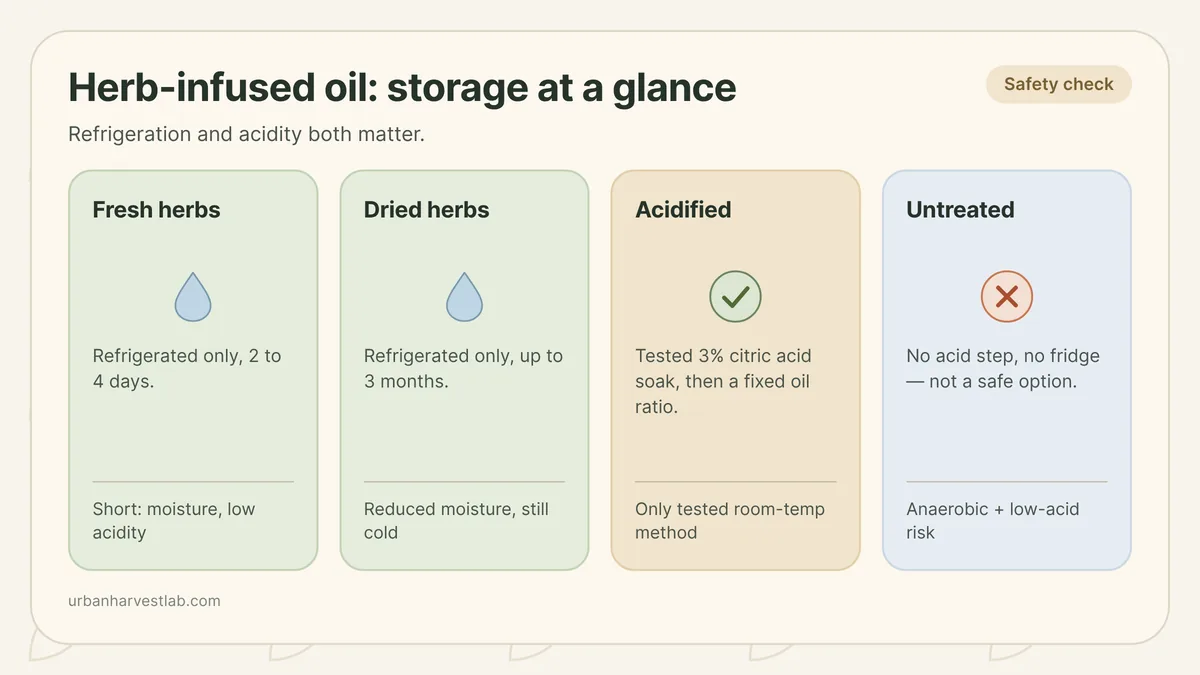
Herb-infused oil is safe in the refrigerator for a few days if the herbs are fresh, for months if they were dried first, and at room temperature only after a specific tested acidification step. Skip that step and leave a jar of garlic or basil in oil on the counter, and the storage conditions are exactly what the bacterium that causes botulism needs to grow.
Infused oil is one option among several for a herb harvest, and it carries a sharper set of rules than freezing or drying does.
Why herb-infused oil turns dangerous
Oil is a low-oxygen, or anaerobic, environment once a herb or a garlic clove is submerged in it. Garlic and fresh herbs are both low-acid. Put those two conditions together and you have exactly what Clostridium botulinum needs to grow and produce its toxin: no oxygen, and an acidity level too weak to stop it. Neither condition alone is the problem. The combination is.
That is why a jar of dried oregano sitting in a cupboard is not a hazard, and neither is a bottle of plain olive oil. It is specifically the pairing of low-acid plant material and oil that turns a kitchen shortcut into a food-safety question.
Fresh herbs in oil: refrigerate, and use it within days
Penn State Extension is direct about the fresh-herb case: an oil infused with fresh herbs should be refrigerated and used within 2 to 4 days. That is a short window compared to how long the oil itself would otherwise keep, and the herbs are the reason for it — their moisture and low acidity are what create risk, not the oil.
Treat that window as a hard stop rather than a guideline to round up from. If a jar of fresh-basil oil has been in the refrigerator for a week, the safest move is to discard it rather than smell-test it, since botulism toxin does not reliably announce itself through taste, smell, or appearance.
Dried herbs in oil: a longer refrigerated window, not an unrefrigerated one
Drying a herb first buys real time. Penn State Extension states that oil infused with dried herbs may be refrigerated for up to three months, a much longer window than the 2-to-4-day figure for fresh herbs. How to dry herbs at home covers the air-drying, oven, and dehydrator methods that get a herb to that starting point.
The extra time comes from reduced moisture, not from a change in what the bacterium needs to grow. Refrigeration is still required for the full three months — drying a herb does not make room-temperature storage safe on its own, and the same anaerobic, low-acid conditions inside the oil are still present.
The only tested way to store infused oil at room temperature
If you want a herb or garlic oil that sits on a counter rather than in a refrigerator, refrigeration is not the variable you adjust. Acidity is. Penn State Extension’s procedure comes from guidelines developed by researchers at the University of Idaho and published as a Pacific Northwest Extension bulletin. It runs in three steps, in this order:
- Make a 3 percent citric acid solution. Stir 1 tablespoon of citric acid into two cups of water.
- Soak the herbs or garlic — separately, using the right ratio for each, weighted down so everything stays submerged. For fresh herbs, Penn State Extension’s ratio is 1½ cups (1.7 ounces) of herb to 2 cups of the citric acid solution. For garlic, peeled and chopped into quarter-inch pieces, the ratio is two-thirds of a cup to 2 cups of solution. Soak for at least 24 hours either way, with a weight holding the herb or garlic under the surface. Penn State Extension is explicit that garlic and herbs must not be soaked or infused together, since the two ratios differ.
- Combine with oil. Once the soak is done, combine at a ratio of 1 part acidified garlic or herb to 10 parts oil. Penn State Extension adds one warning that is easy to miss: do not drop a fresh sprig into the finished bottle for looks, because that herb has not been acidified and it puts the batch back where it started.
Those figures are not separate options to mix and match. The soak time and the ratios were tested together as one procedure, and shortening the soak or guessing at a stronger or weaker acid solution defeats the point of testing it in the first place. A batch of garlic or basil dropped straight into oil, with no acid step at all, does not become room-temperature-safe just because it looks and smells the same as one that went through this process.
Chopping matters too. Penn State Extension’s procedure calls for raw garlic peeled and chopped into quarter-inch pieces, not whole cloves. The same research tested and confirmed this procedure for garlic, basil, oregano, and rosemary specifically; stretching the same ratios to a herb outside that list is not something the underlying testing supports.
If that feels like more equipment and measuring than a quick batch of infused oil is worth, refrigeration is the simpler route, with the shorter shelf life built in as the tradeoff. How to store fresh basil and how to freeze herbs cover ways to keep a harvest usable without the oil step at all.
Why the jar from the store is a different product
Commercial garlic-in-oil is shelf-stable at room temperature, and that can make an unrefrigerated homemade version feel like it should be fine too. It is not the same situation. A commercial producer either runs the garlic or herbs through a verified acidification process or adds specific microbial inhibitors, and that treatment is checked before the product reaches a shelf. A home kitchen has no equivalent way to confirm that a batch has reached a safe acidity level short of following a tested procedure like the one above. A store label that says shelf-stable is a statement about that product’s manufacturing, not a signal that garlic-in-oil is safe at room temperature in general.
Storage at a glance
| Method | Storage | Duration | What makes it safe |
|---|---|---|---|
| Fresh herbs in oil | Refrigerated | 2 to 4 days | Cold temperature only; short window because of moisture and low acidity |
| Dried herbs in oil | Refrigerated | Up to 3 months | Reduced moisture, still refrigerated the whole time |
| Acidified garlic or herbs in oil | Room temperature | Until quality declines | Tested 3% citric acid soak, then a fixed ratio with oil |
| Untreated fresh or dried herbs in oil | Room temperature | Not a safe option | No acid step and no refrigeration together create anaerobic, low-acid conditions |
The practical routine
Make infused oil in small batches sized to what you will use within its safe window, and label the jar with the date it was made rather than trusting memory a week later. Keep it refrigerated unless you have gone through the full acidification procedure, and if a jar’s history or timeline is unclear, the lower-cost choice is to discard it rather than taste it to check. Small-space herb gardening is the place to start if the harvest that prompted this question is still on the plant.
If the appeal of infused oil is really about not wasting a herb glut, drying and freezing solve that problem with a much wider margin for error and no acid step at all. How to dry herbs at home and how to freeze herbs both keep a harvest usable for months.
Sources
Preserving a herb harvest?
Oil is one storage option and the one with the sharpest safety rules. These cover the others.
Common questions
Can herb-infused oil cause botulism?
Yes. Oil is a low-oxygen environment and garlic and fresh herbs are both low-acid, which is exactly the condition the bacterium Clostridium botulinum needs to grow and produce toxin. Refrigerating the oil and using it within the window Penn State Extension gives, or acidifying the herbs first, are what make it safe.
How long can you keep herb-infused oil in the refrigerator?
Penn State Extension gives 2 to 4 days for oil infused with fresh herbs, and up to three months for oil infused with dried herbs, both refrigerated the entire time.
Can herb-infused oil be stored at room temperature?
Only after a specific tested acidification procedure -- soaking the herbs in a 3 percent citric acid solution for at least 24 hours at a set ratio, then combining the acidified herb with oil at a fixed ratio. Untreated herb or garlic left in oil at room temperature is not a safe combination.
Is store-bought garlic-in-oil safe to use straight off the shelf?
Only if the label says so. Penn State Extension's instruction for a store-bought infused oil is to check the label and confirm it has been acidified or that microbial inhibitors have been used. That process is not something a home kitchen can replicate or confirm without lab testing, so a shelf-stable store jar with no such label is not evidence that a homemade version would be safe left unrefrigerated.
Related guides
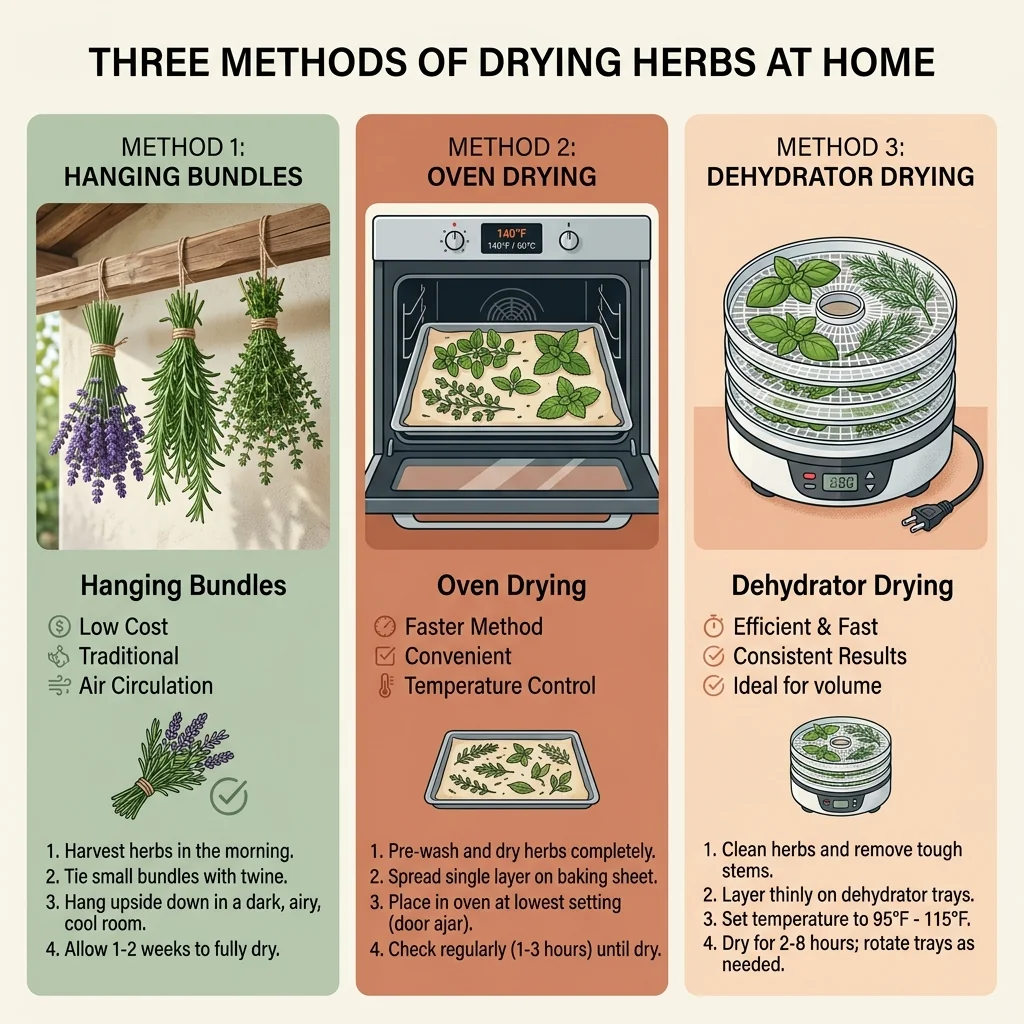
How to dry herbs at home (air, oven, dehydrator)
Drying is the best way to preserve woody herbs like rosemary, thyme, and oregano. Here are three methods, the temperatures to use, and which herbs to skip.
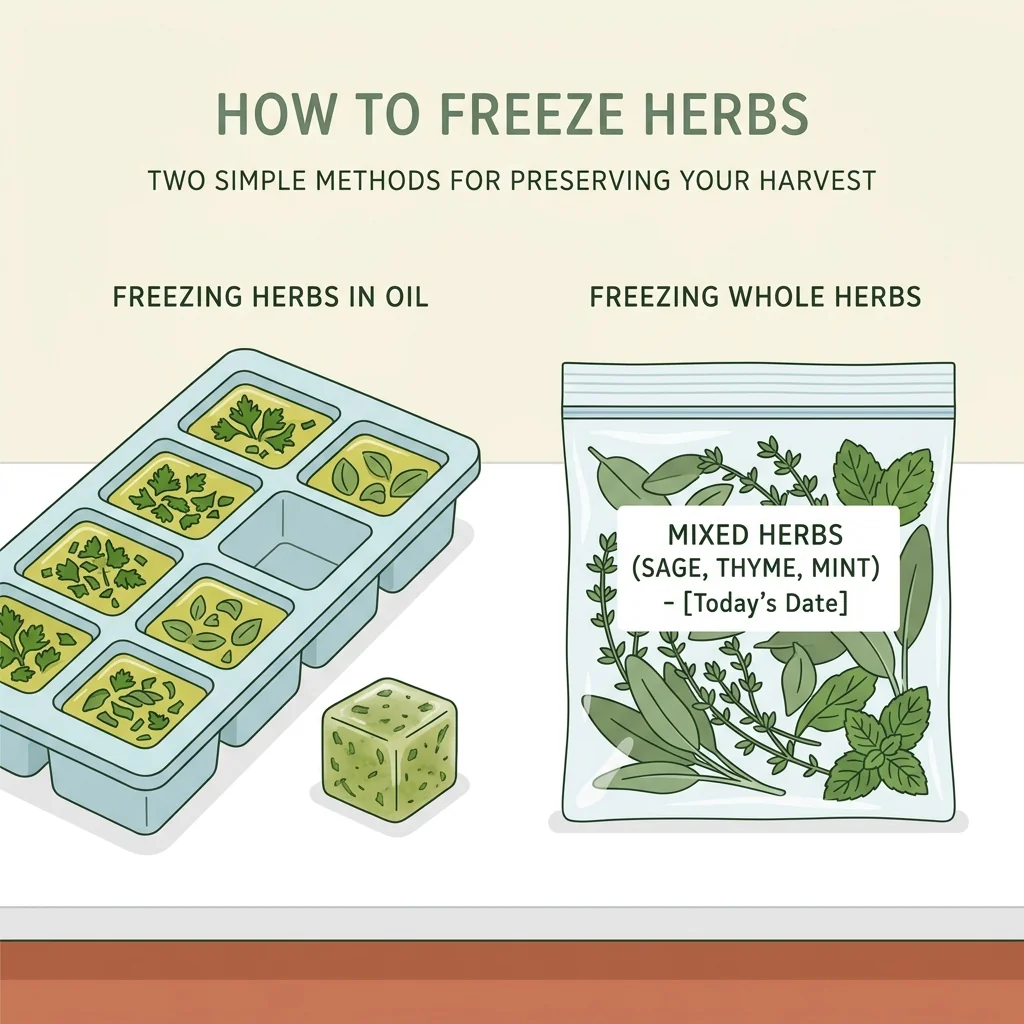
How to freeze herbs without losing flavor
Freezing beats drying for soft herbs. Chopped into oil-filled ice cube trays or frozen whole, basil and parsley keep far more of their fresh flavor.
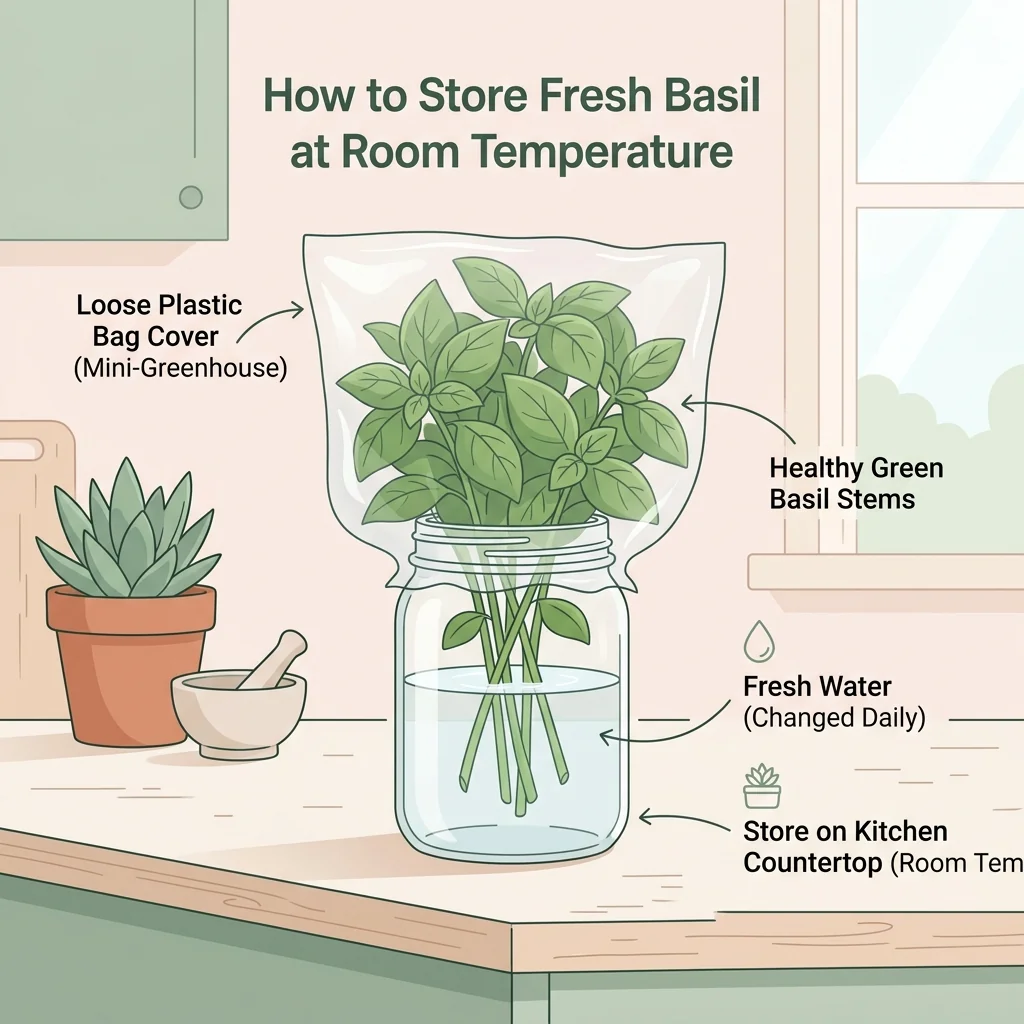
How to store fresh basil so it lasts
Basil is cold-sensitive, but storage also depends on whether it is a rooted plant, cut stems, or loose leaves. Use this test-and-inspect method.