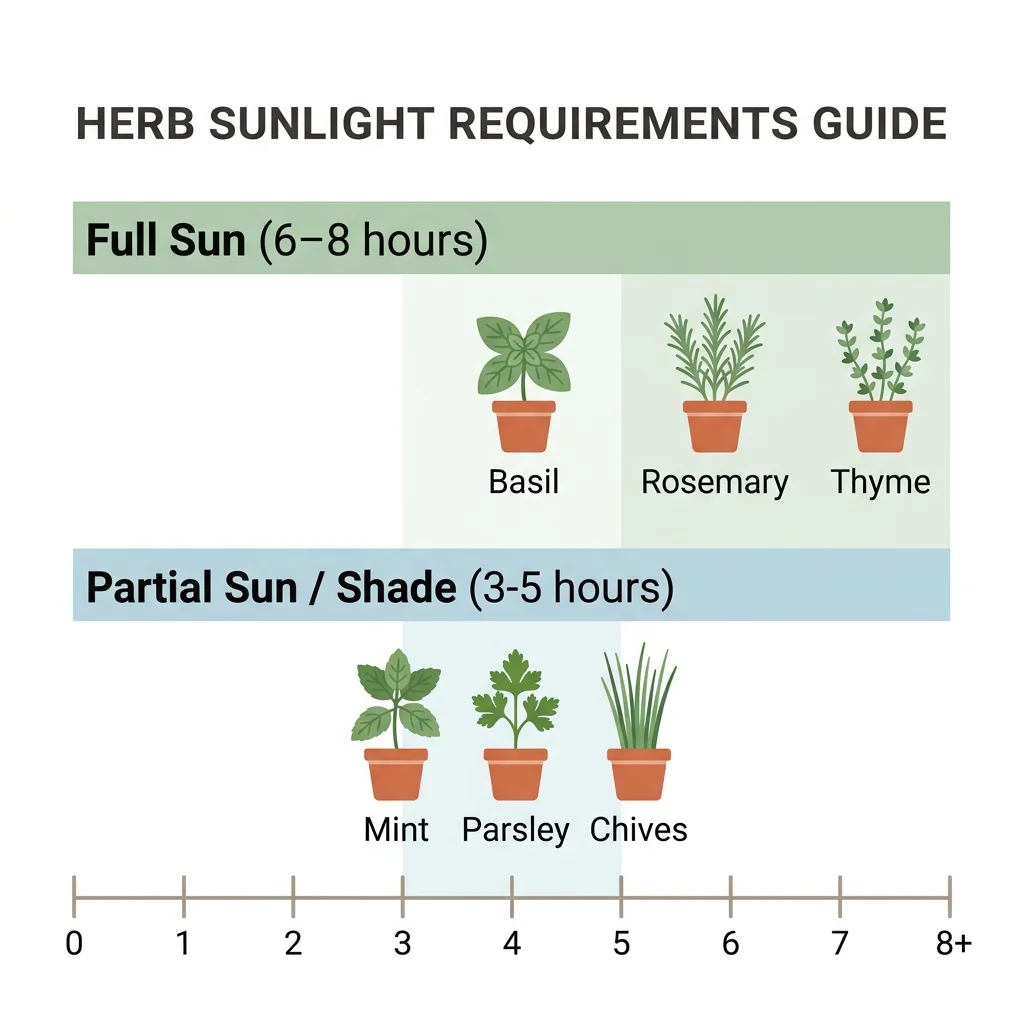
Herb sunlight needs by type
| Herb | Sun need | Hours of direct sun | Best spot |
|---|---|---|---|
| Basil | Full sun | 6-8 hours | Sunny window or balcony |
| Rosemary | Full sun | 6-8 hours | Brightest spot you have |
| Thyme | Full sun | 6+ hours | Sunny, airy spot |
| Oregano | Full sun | 6+ hours | Sunny window or balcony |
| Sage | Full sun | 6+ hours | Sunny spot |
| Dill | Full sun | 6+ hours | Sunny, sheltered spot |
| Chives | Partial to full | 4-6 hours | Sunny or bright window |
| Parsley | Partial sun | 4-6 hours | Bright window, some direct sun |
| Cilantro | Partial sun | 4-5 hours | Bright, cooler spot |
| Mint | Partial sun | 3-5 hours | Bright spot, tolerates shade |
Most culinary herbs are sun-lovers. As a quick answer: the majority want full sun, meaning 6 or more hours of direct light a day, while a handful get by on 3 to 5 hours of partial sun. The chart above sorts the common herbs so you can match what you grow to the light your window or balcony actually gets, rather than fighting it.
Full-sun herbs
These want as much direct light as you can give them and grow weak, leggy, or flavourless without it:
- Basil, rosemary, thyme, oregano, sage, dill. All want 6 or more hours of direct sun.
If you have a bright south or west exposure, these are the herbs that will reward it. The best of them for an outdoor sunny spot are covered in best herbs for a sunny balcony.
Partial-sun and shade-tolerant herbs
A few herbs cope with less light and are the right pick for a dimmer spot:
- Chives, parsley, cilantro, mint. They do reasonably well with 3 to 5 hours of direct light or a bright indirect window.
Mint and parsley are the most forgiving in low light, which makes them the go-to choices for a north-facing window or a shaded kitchen sill. See best herbs for low-light kitchens and windowsills for the full shortlist.
What “full sun” really means indoors
Light through a window is far weaker than open sky, so a “sunny” windowsill often delivers less than a herb needs. If your brightest spot still falls short, the realistic fix is a grow light rather than a more tolerant herb. Whether that is necessary, and how herbs cope without direct sun, is covered in can herbs grow indoors without direct sunlight and how much light do herbs need.
Use the chart as a starting point
The hours above are targets, not hard cut-offs. Herbs given slightly less sun simply grow slower and more sparsely rather than dying outright. Match the herb to the light first, then adjust pot size and watering to suit; the companion pieces on watering by herb close the loop.
Hours do not describe all plant light
Two sites with six hours of “sun” can deliver different amounts of usable light because intensity changes with season, latitude, cloud, glazing, shade, and time of day. Outdoor recommendations are therefore not a literal guarantee for a plant behind glass. Daily light integral (DLI) describes the total photosynthetically active light received over a day, while PPFD describes the instantaneous photon flux at a position. A timer supplies duration; it does not tell you whether a lamp is bright enough across the whole canopy.
You do not need an expensive meter to make a better first decision. Record when direct light reaches the leaves on three representative days, compare candidate positions at the same times, and observe the spacing and color of new growth. A phone app can compare spots, but its reading is not interchangeable with a calibrated PAR measurement.
Read the plant without overdiagnosing it
Longer internodes, leaning, smaller leaves, and weak regrowth together support a low-light diagnosis. One yellow leaf does not. Saturated roots, temperature stress, pests, and nutrient problems can overlap with light symptoms, so check the whole setup before moving the plant or feeding it.
When adding a grow light, begin with the manufacturer’s coverage and clearance guidance. Keep a consistent photoperiod with a dark period, adjust based on measured output if available and plant response, and protect electrical connections from water. There is no single correct distance for every fixture.
A simple seasonal light audit
Repeat the three-day observation near the shortest and longest days of the year or whenever a tree, awning, or neighboring building changes the exposure. Label each herb’s position and note harvest or regrowth. If a sun-loving herb repeatedly stretches while parsley remains compact, reserve that position for the more tolerant crop or supplement the light.
Sources
If you are matching herbs to light, also read
These guides cover full-sun, low-light, and north-facing cases plus the grow-light option when sun is short.
Common questions
How much sun do herbs need?
Most culinary herbs want full sun, which means 6 or more hours of direct light a day. Sun-lovers like basil, rosemary, thyme, and oregano are happiest with that much, while a few herbs tolerate as little as 3 to 4 hours.
Which herbs need full sun?
Basil, rosemary, thyme, oregano, sage, and dill are the strongest full-sun herbs. They want 6 or more hours of direct light and grow leggy or weak when they get much less.
Which herbs grow in partial sun or low light?
Mint, parsley, chives, cilantro, and chervil tolerate partial sun, doing reasonably well with 3 to 5 hours of direct light or a bright indirect spot. They are the best picks for a north window or shaded balcony.
Can herbs grow without direct sunlight?
Not well for long. No common herb truly thrives in deep shade. In a low-light spot you should either choose the most shade-tolerant herbs or add a grow light to make up the difference.
Related guides
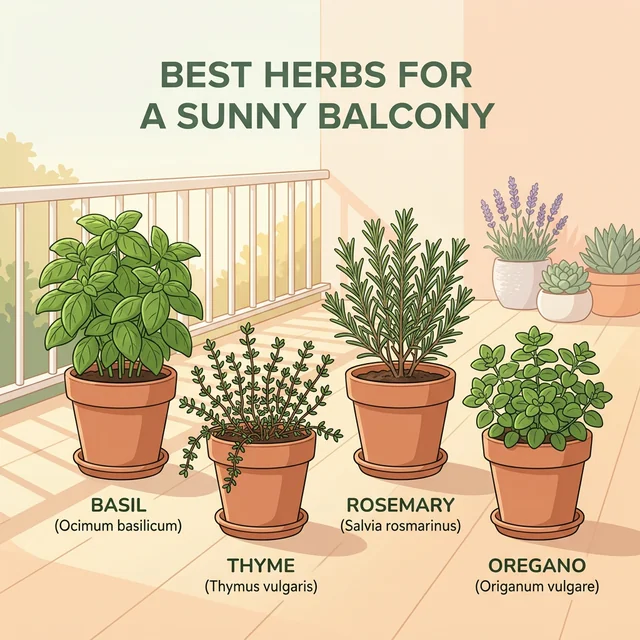
Best herbs for a sunny balcony: full-sun picks that handle heat and wind
A sunny balcony is perfect for herbs, but the intense heat and wind require the right crop choices. Start with basil, thyme, and rosemary for reliable harvests.
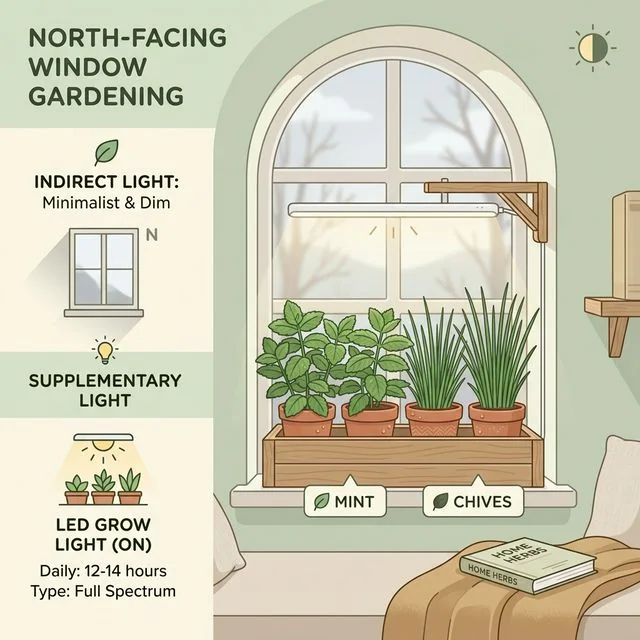
North-facing window herbs: what actually works and when you need a grow light
A north-facing window is widely considered the death sentence of an indoor garden. But with the right selection of shade-tolerant herbs and strategic placement, you can still harvest fresh greens year-round.
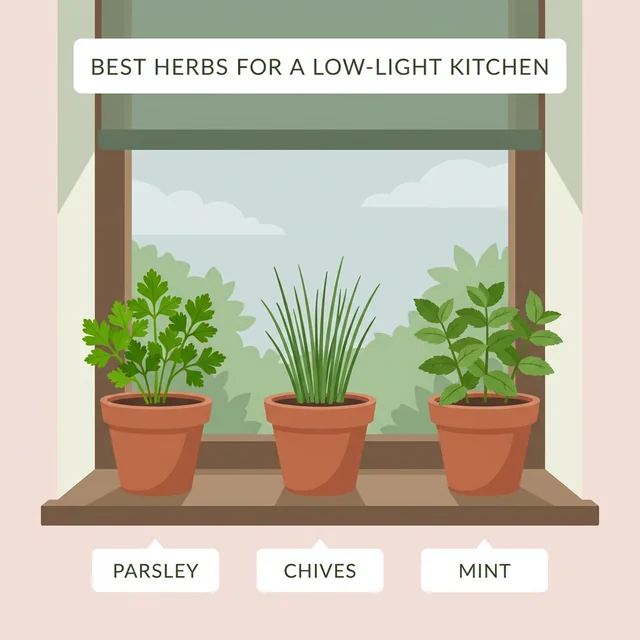
Best herbs for low light: what actually grows on a windowsill
Stop trying to force basil to grow in the dark. If your kitchen gets limited indirect light, stick to these forgiving herbs like parsley, chives, and mint.