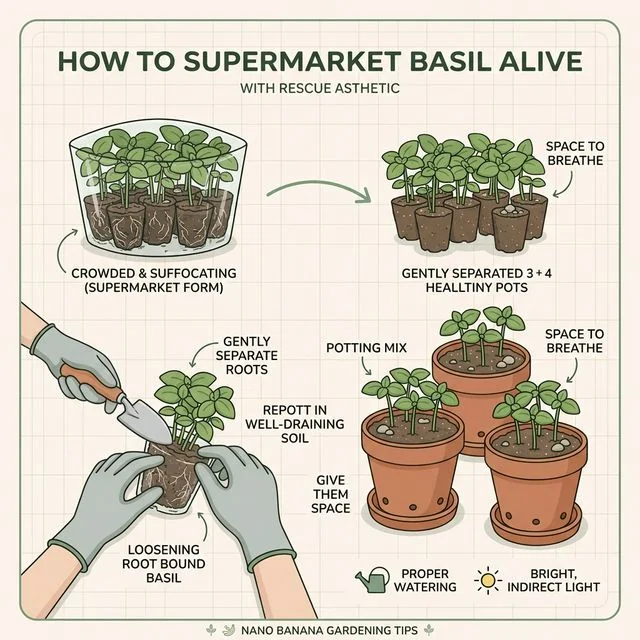
The Supermarket Death Spiral
| Timeline | What it Looks Like | Why it is Happening (The Botanical Reality) |
|---|---|---|
| Day 1-4 | Lush, green, beautiful on your counter. | It is surviving on the massive dose of fertilizer it received in the commercial greenhouse. |
| Day 5-9 | Constantly Wilting. You water it, and it wilts again 6 hours later. | The 20 plants have filled 100% of the pot with roots. There is almost zero dirt left to hold water. |
| Day 10-14 | Lower leaves turn bright yellow and drop. The stems collapse. | The plants are actively starving. The strongest plants are cannibalizing the weakest ones in a battle for survival. |
It is the most common entry point into indoor gardening. You are walking through the produce section, and next to the $4 plastic clamshell containing six sad leaves of cut basil, you see an entire, vibrant, living basil plant in a plastic pot for $5.
It seems like an incredible deal. You take it home, place it lovingly on your windowsill, and plan to eat fresh pesto for the rest of the year.
Exactly two weeks later, the plant is dead.
You didn’t necessarily do anything wrong. You watered it when it looked thirsty. You gave it light. The dark truth is that the commercial greenhouse set you up to fail. Supermarket herbs are not designed to live for a year; they are designed to look incredible for exactly three weeks while sitting under fluorescent grocery store lights.
If you want the plant to survive, you must immediately implement a rescue operation.
The Dirty Secret: It Is Not One Plant
Look closely at the base of your supermarket basil plant where the green stems meet the dirt.
A healthy, mature basil plant is a single, massive trunk rising out of a 6-inch pot. When you look at your grocery store purchase, you will likely count 15 to 25 incredibly thin, individual stems crammed tightly together.
Commercial growers achieve that “instant bushy” look by dropping two dozen seeds into a single 4-inch nursery pot. In the highly optimized, climate-controlled environment of a commercial greenhouse, those seeds race upward, creating a dense ball of foliage.
The moment they leave the greenhouse, the clock starts ticking. A 4-inch pot only contains enough soil volume to support the root system of one mature basil plant. You have twenty. Within days, those 20 plants completely exhaust the soil’s resources. They strangle each other in a battle for root space, suck up all the water matrix in hours (leading to the dramatic collapse detailed in Why Is My Basil Wilting Indoors?), and quickly starve.
The Rescue Operation: “Division”
To save the basil, you must forcefully separate the combatants. You need to take the 20 seedlings and split them up into manageable groups.
This process, known as division, will intentionally induce Transplant Shock. The plants will hate you for it initially, but it is the only way they survive long-term.
Step 1: Drown and Destroy
Water the pot heavily. Let it sit for 30 minutes so the roots are fully hydrated. Take the plant out of the plastic pot. Instead of gently massaging it, you must be a bit brutal. Hold the top leafy mass in one hand and the root ball in the other, and gently but firmly tear the dirt and root mass in half.
Step 2: Separate into Teams
Take your two halves and tear them in half again. You should now have four loose clumps of dirt, each containing 4 or 5 basil stems. Do not attempt to separate them down to single, individual stems—their roots are too tightly intertwined, and you will kill them. A cluster of 4 stems is perfectly fine.
Step 3: Repot into Mansions
You now have four separate basil clusters. Take four 6-inch pots with excellent drainage holes (refer to Plastic vs Terracotta Pots if you are unsure which to buy). Fill them with a high-quality, airy potting mix, plant one cluster in each pot, and water them heavily to settle the soil.
You just turned a $5 grocery trip into four beautiful, massive permanent houseplants.
Step 4: The Safety Prune
Because you violently severed hundreds of roots during the tearing process, the plant no longer has the root infrastructure to pump water all the way to its massive top canopy.
To help it survive the shock, you must perform a severe pruning. Snip off the top 30% of foliage from every single stem (following the node-cutting rules established in How to Harvest Herbs).
Eat that harvested top foliage tonight. Place your four new pots in a bright, indirect window to recover for a week, and then move them into blazing full sun. They will reward you with endless yields for the rest of the year.
Diagnosing a dying supermarket plant?
If your grocery store rescue is already heavily wilting or turning yellow, read these guides to diagnose exactly how it is suffering.
Common questions
Should I just leave it in the plastic sleeve if I water it every day?
No. The plastic sleeve traps humidity and prevents airflow, making it a breeding ground for gray mold (Botrytis). Rip the plastic sleeve off the moment you walk through your front door.
Why are the stems turning wood-colored and hard at the bottom?
This is called "corking" and is entirely normal for mature basil. It is turning its lower stem into wood to support the massive heavy canopy of leaves above it. It is not a disease.
What if I accidentally tear off too many roots while separating the plants?
Basil is incredibly resilient. If a stem snaps entirely off during division, put the broken stem in a glass of water on your windowsill. Within 10 days, it will grow a completely new root system, and you can plant it again.
Related guides
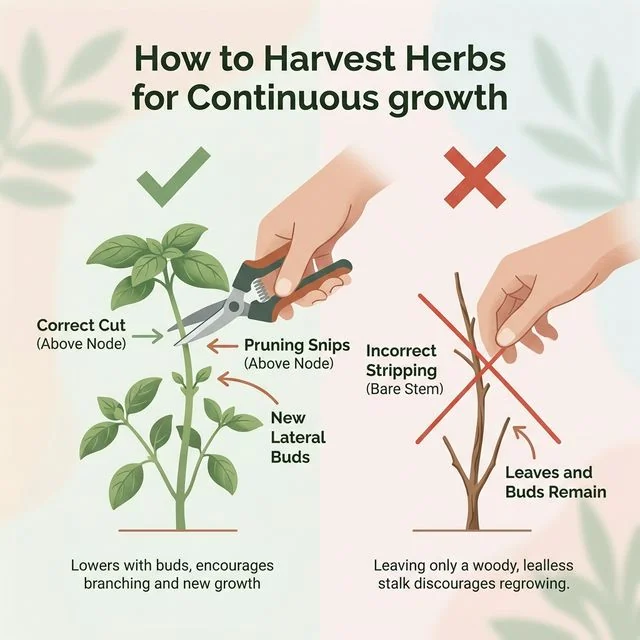
How to harvest basil, mint, parsley, and chives so they keep growing
The fastest way to destroy an indoor herb plant is to harvest it incorrectly. If you just pull random leaves off the stem, the plant will eventually go bald and die. Here is the exact botanical method to harvest your herbs so they yield endlessly.

Indoor herb garden setup for apartments without outdoor space
A practical apartment herb guide for people growing entirely indoors, with realistic advice on light, layout, containers, and everyday maintenance.
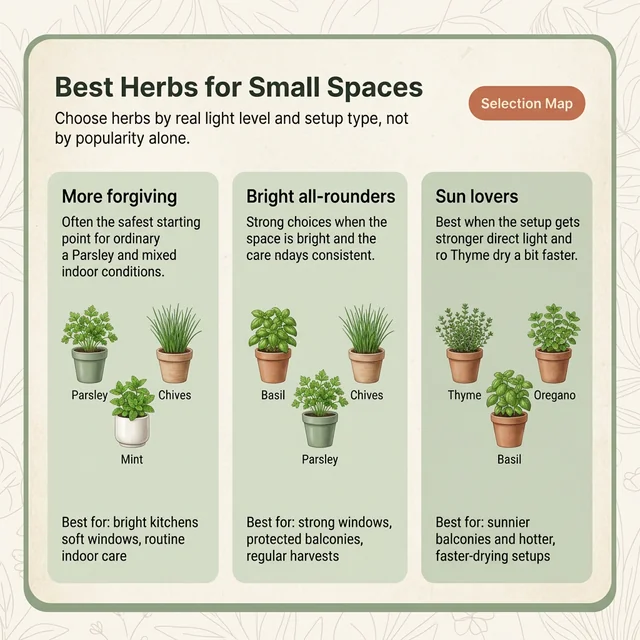
Best herbs for small spaces: what grows well in apartments, balconies, and windowsills
A practical guide to the herbs that actually perform well in compact homes, with selection logic for bright windows, balconies, and more forgiving low-space setups.