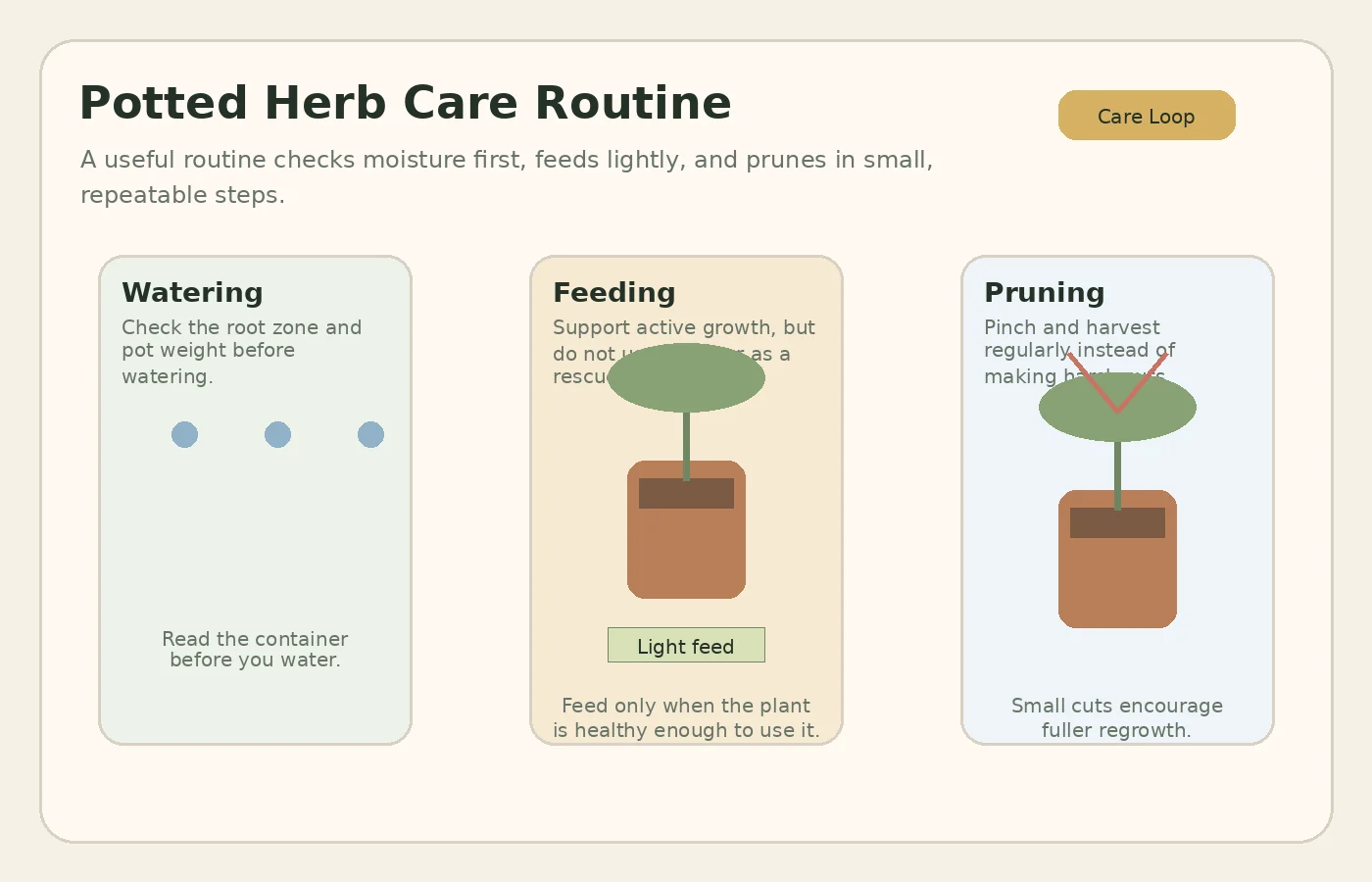
A practical baseline routine for common potted herb care tasks
| Task | What to check | Practical rule |
|---|---|---|
| Watering | Moisture below the surface and pot weight | Water thoroughly only when the root zone is starting to dry |
| Feeding | Growth rate, leaf color, and time since planting | Use light, occasional feeding instead of frequent heavy doses |
| Pruning | Stem length, branching, and harvest habit | Pinch regularly and avoid stripping large sections at once |
| Placement review | Stretching, pale leaves, or wet soil that lingers | Reassess light before assuming a fertilizer problem |
Potted herbs often fail in a slow, confusing way. At first the plants look fine. Then basil starts stretching, parsley stops regrowing well after harvest, mint becomes unruly, or the potting mix seems either wet forever or dry by lunchtime. Many growers respond by changing three things at once: more water, more fertilizer, and a harder prune. That usually makes the system harder to understand, not easier.
Good herb care is less about doing more and more about reading the plant correctly. Watering, feeding, and pruning are all connected to the basic setup. Light changes how quickly a pot dries. Container size changes how often you need to water. Root health changes whether fertilizer helps or hurts. If you are still building the system itself, begin with How to Set Up a Small-Space Herb Garden That Actually Works. If you are still calibrating light or containers, use this guide together with How Much Light Do Herbs Need? Realistic Sun and Grow Light Rules and Best Containers for Herbs: Pot Size, Drainage, and Material Guide.
Quick Care Logic
The short version is that most potted herb care comes down to four rules.
First, water based on how the root zone is drying, not on a rigid schedule. Second, feed lightly and only when growth suggests the plant can actually use extra nutrition. Third, prune in a way that encourages branching and repeat harvests instead of cutting randomly whenever the plant looks messy. Fourth, if the plant is struggling, check light and container conditions before assuming the care routine itself is the whole problem.
This logic matters because herbs are small but not simple. Basil in a sunny balcony box and parsley on a kitchen sill are not running the same care schedule even if you water them on the same day. A useful routine responds to context.
Watering Without Guesswork
Watering is usually the highest-impact part of potted herb care because containers create fast changes in moisture. Roots can only use water that is still in the root zone, and they also need oxygen around them. If the pot stays bone dry too often, growth stalls. If it stays soggy too long, roots struggle to breathe and herbs begin to decline even when the soil looks wet.
This is why the best watering method is observation, not memorization. A calendar can remind you to check the plants, but it should not replace checking the moisture itself.
Check the root zone, not only the surface
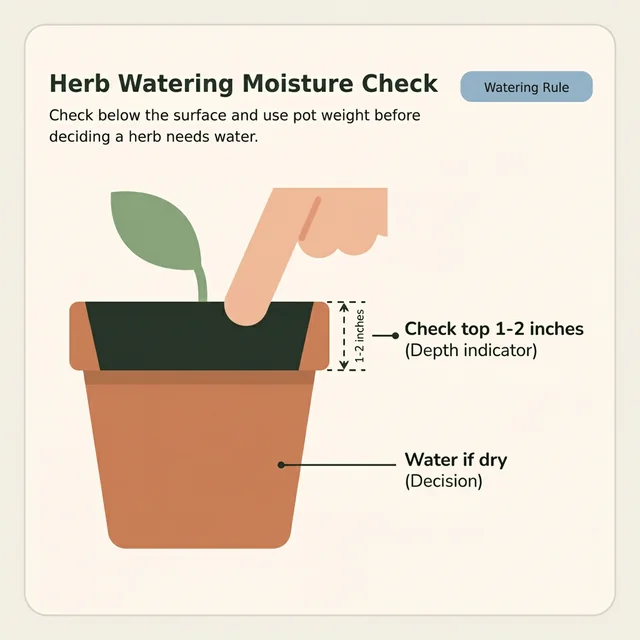
The top of a container can dry quickly while the lower root zone is still damp. If you water every time the surface looks dry, you often end up overwatering. A better approach is to press a finger into the potting mix about an inch down or learn the weight of the container when it is freshly watered versus when it is ready for the next drink.
If the mix is still cool and damp below the surface, wait. If it is drying in the active root zone and the pot feels noticeably lighter, water thoroughly until excess water drains out. That full watering is important. Tiny sips can leave the upper layer moist while the lower root zone stays uneven.
Different herbs dry at different rates
Basil and parsley usually prefer more even moisture than thyme or oregano. Mint often uses water quickly and grows vigorously, which means its container can dry faster than beginners expect. Chives are comparatively straightforward, but they still respond better to consistency than to stress swings.
This is one reason mixed containers become tricky. Several herbs may share one planter while wanting slightly different moisture patterns. If you want the easiest possible care routine, one herb per pot still tends to be the cleanest system, especially early on.
The environment changes the watering rule
The same herb in the same size pot will dry differently depending on the site. A sunny balcony with wind can turn watering into a daily check during hot weather. A bright but cooler windowsill may let the same plant go longer between waterings. Under a grow light, the drying speed depends on both light intensity and room conditions.
When people ask, “How often should I water potted herbs?” the honest answer is that frequency depends on light, airflow, root mass, pot size, and material. The practical habit is to check regularly and water only when the container actually needs it.
Feeding Without Overdoing It
Fertilizer is useful, but it is often treated like a rescue tool for problems it cannot fix. If herbs are pale, slow, or weak because the light is poor or the roots are stressed, more fertilizer does not solve the underlying issue. In some cases, it makes the container system harsher by adding salts to a root zone that is already under pressure.
That is why feeding should be measured and secondary. First get the basic environment right. Then use nutrition to support steady growth, not to force growth out of a stressed plant.
When potted herbs actually benefit from feeding
Herbs in containers eventually use the nutrients available in the potting mix. Fast-growing herbs or plants that are harvested frequently can benefit from occasional feeding once they are established and actively growing. Basil is a good example. A healthy, bright, well-watered basil plant can use a light feeding schedule productively. A leggy, shaded basil plant usually needs better light before it needs more nutrients.
Parsley, mint, and chives also respond well to reasonable feeding when they are growing steadily. Thyme and oregano usually need a lighter hand, especially if you are trying to keep compact, flavorful growth rather than pushing soft leafy bulk.
Use less than your instincts tell you
Many beginners overfeed because container labels and marketing language make more sound safer than it is. In practice, herbs usually respond better to light, occasional feeding than to heavy, frequent doses. The exact product matters less than the principle: moderate feeding, consistent watering, and enough light.
If a herb is not actively growing, skip the feed and solve the bigger issue first. If the plant is healthy but has been in the same mix for a while and growth has slowed gently rather than collapsed, a measured feeding may help restore momentum.
Signs feeding may help
Feeding is more likely to be useful when:
- the plant is established and actively growing
- light is adequate
- the container is draining properly
- repeated harvesting is removing new growth regularly
- the potting mix has been in use long enough that nutrient depletion is plausible
This is a calmer framework than “fertilize every week” because it lets the plant tell you whether the system is ready for more nutrition.
Pruning for Better Growth
Pruning sounds technical, but for potted herbs it is often just strategic harvesting. The goal is to keep the plant branching, productive, and compact instead of tall, sparse, or woody. Good pruning also improves airflow and helps the herb put energy into fresh usable growth.
Think pinching, not hacking
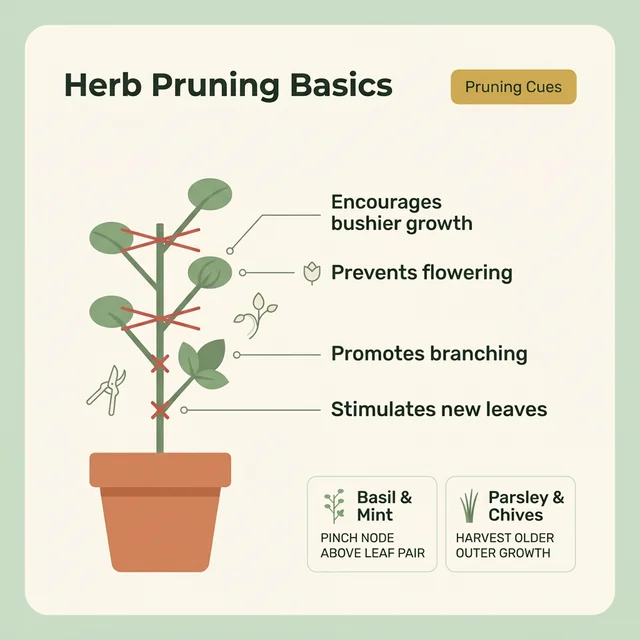
For herbs like basil and mint, frequent light pinching works better than long periods of neglect followed by one severe cut. Removing the tip above a pair of leaves encourages side shoots and keeps the plant fuller. This is why a basil plant harvested thoughtfully often looks better than one left alone “to get bigger.”
Parsley and chives are slightly different in habit, but the same principle holds: harvest in ways that support regrowth. Chives can be cut cleanly while leaving room for new blades to replace them. Parsley benefits from removing older outer stems rather than repeatedly snipping only the newest inner leaves.
Prune according to the herb’s growth style
Basil and mint respond well to regular pinching. Thyme and oregano can also be trimmed to maintain density, but they usually do not need the same style of repeated tip pinching as basil. Woody herbs like rosemary need a more restrained approach; heavy cuts into old woody material are less forgiving than light shaping of newer growth.
This is another reason it helps to know which herb you are growing before applying one universal rule. A care routine works best when it matches the plant’s habit, not when it treats every herb as identical.
When pruning helps solve problems
Pruning can correct legginess only up to a point. If the underlying light is poor, the plant often returns to weak growth after each trim. That is why pruning should be paired with honest placement decisions. Use pruning to shape healthy growth, not to compensate indefinitely for a bad site.
Environment-Based Care
The same herb can need a different routine depending on where it lives. Good care is environment-specific.
Balconies and sunnier outdoor spots
Outdoor containers often dry faster because of stronger sun and airflow. This usually means more frequent moisture checks and sometimes slightly larger pots or more moisture-retentive materials. Feeding can also matter more when growth is fast and harvests are frequent. Pruning tends to be useful here because herbs can become fuller and more vigorous when conditions are strong.
The main risk outdoors is not always under-watering alone. Rapid drying can create a cycle in which the plant swings between stress and recovery, especially in small pots. Stabilizing the container is often as important as changing the care schedule.
Windowsills and protected indoor spots
Windowsills are often easier to monitor because the plants stay in sight. That improves care simply because you notice problems sooner. But indoor protection also means less airflow and, in many homes, weaker light. Watering may need to be less frequent than on a balcony, and overwatering becomes more common if the grower responds to surface dryness rather than root-zone dryness.
Pruning remains useful indoors, but if growth is pale and stretched, the care routine should include a light review before it includes more fertilizer.
Grow-light shelves and indoor systems
Grow lights can make herb care more predictable because the lighting period is controllable. But they can also create false confidence. If the fixture is too weak or too far away, herbs may still behave like low-light plants. Under a suitable fixture, herbs often use water and nutrients more steadily, which can make care easier to standardize.
The important thing is that grow lights support the care routine only when they are actually meeting the plant’s light needs.
A Simple Weekly Routine
A useful potted-herb routine is usually small and repetitive rather than elaborate.
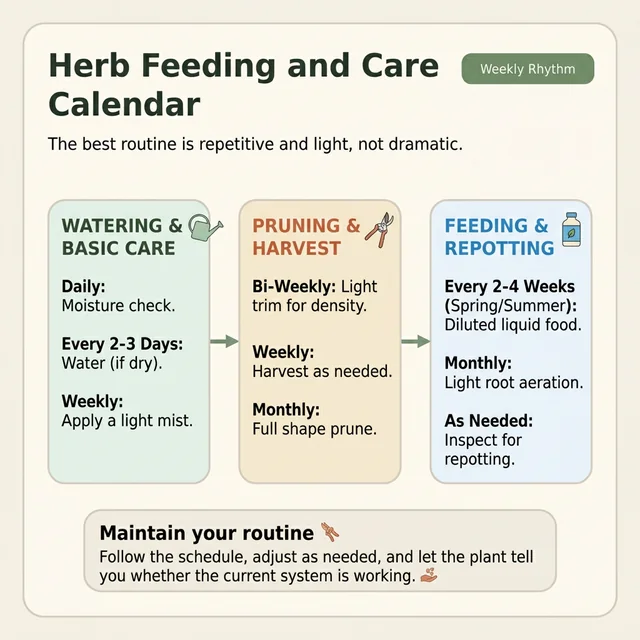
Each morning or every other morning in active growth, check moisture and general plant posture. Once or twice a week, inspect for stretching, yellowing, crowded growth, or roots pressing against the pot wall. Harvest lightly and regularly instead of waiting for the plant to become overgrown. Feed only when the plant is actively growing and the setup conditions are already good enough to support that growth.
This kind of routine works because it makes problems easier to catch early. A slightly thirsty basil plant is easy to fix. A chronically stressed herb that has been misread for weeks is harder to recover.
Common Mistakes
One common mistake is watering on schedule without checking the root zone. That turns care into repetition instead of observation.
Another is treating fertilizer like a universal fix. If herbs are pale because the light is weak or the roots are stressed, extra feed usually misses the real problem.
A third is waiting too long to prune and then cutting the plant back too hard. Most herbs respond better to light, regular harvests and small shaping cuts.
The fourth mistake is separating care from setup. A difficult watering routine often starts with a poor container, weak light, or an herb that was mismatched to the site from the beginning.
FAQ
How often should I water potted herbs?
There is no single schedule that fits every home. Water when the root zone is starting to dry, not simply because a certain number of days has passed. Light, pot size, airflow, and container material all affect timing.
Do potted herbs need fertilizer?
Usually yes, at least occasionally, once they have been growing in the same container mix for a while and are actively producing new growth. But feeding should be light and should not be used to compensate for poor light or bad drainage.
How do I prune basil without hurting it?
Pinch above a leaf pair so the plant branches outward instead of growing as one long stem. Frequent light pinching works better than waiting and removing large sections all at once.
Why are my herbs wilting even when the soil is wet?
That often points to root stress, poor drainage, weak light, or a container that stays saturated too long rather than to simple thirst. Wet soil and wilt together usually mean the root environment needs attention.
Can I care for thyme the same way I care for parsley?
Not exactly. Parsley often prefers more even moisture than thyme. Thyme usually tolerates a slightly drier cycle better, especially in bright conditions. The care routine should match the herb.
Related Guides
Use these next if you are refining the rest of the herb system:
- How to Set Up a Small-Space Herb Garden That Actually Works
- How Much Light Do Herbs Need? Realistic Sun and Grow Light Rules
- Best Containers for Herbs: Pot Size, Drainage, and Material Guide
- Best Herbs for Small Spaces: What Grows Well in Apartments, Balconies, and Windowsills
- How Often Should You Water Potted Herbs?
- Do Potted Herbs Need Fertilizer? Liquid vs. Slow-Release Options Explained
If this topic is relevant to you, also read:
Use these related guides to move into setup decisions, troubleshooting, or the next logical beginner step.
Related guides
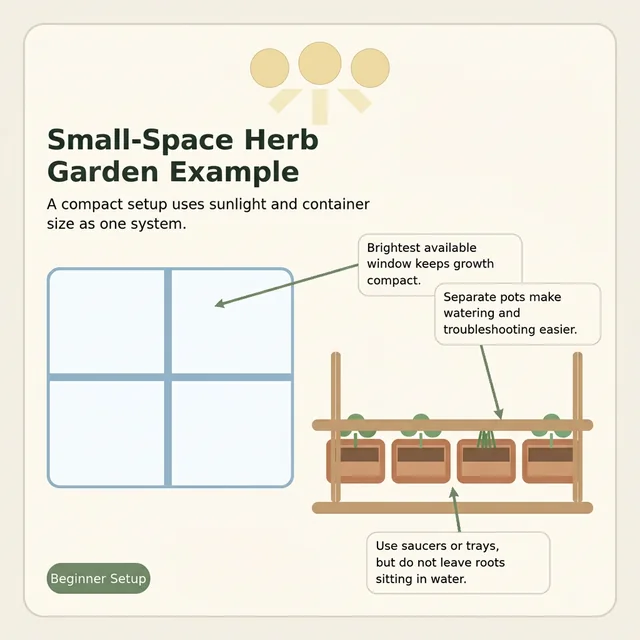
How to Set Up a Small-Space Herb Garden That Actually Works
A calm, practical guide to starting a herb garden on a balcony, windowsill, or bright indoor corner without overbuying or overcomplicating the setup.
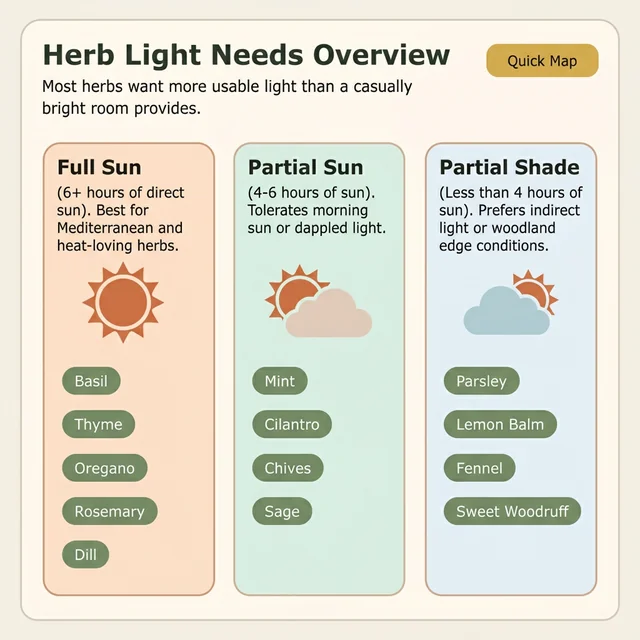
How Much Light Do Herbs Need? Realistic Sun and Grow Light Rules
A practical guide to herb light needs for real homes, with clear rules for sunny windows, balconies, dimmer apartments, and beginner grow light setups.
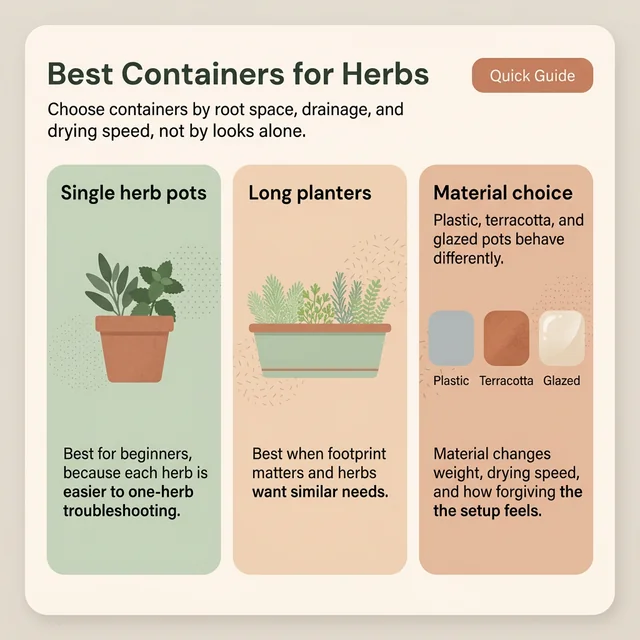
Best Containers for Herbs: Pot Size, Drainage, and Material Guide
A practical guide to selecting herb containers that make watering easier, reduce root problems, and actually suit apartments, balconies, and windowsills.