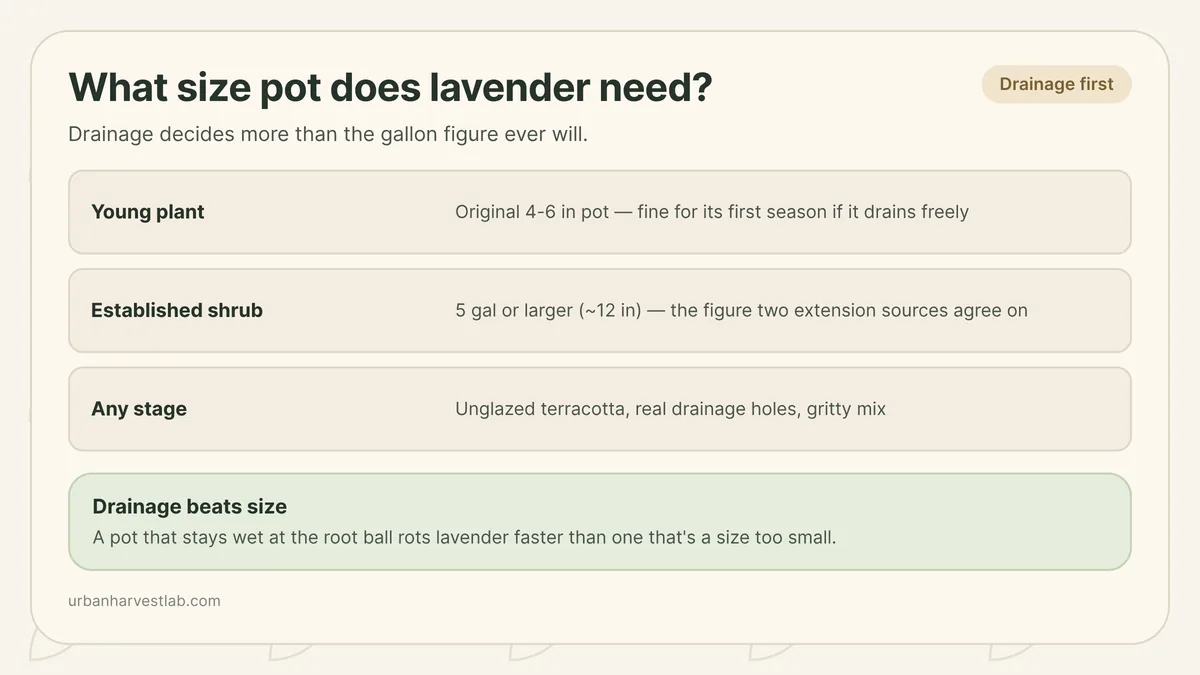
Lavender pot size at a glance
| Stage | Pot size | Notes |
|---|---|---|
| Young nursery plant | Original 4-6 in pot | Fine for its first season if it drains freely |
| Established shrub | 5 gal or larger (about 12 in diameter) | The figure two extension sources agree on for lavender |
| Any stage | Unglazed terracotta, real drainage holes, gritty mix | Dries faster than plastic — works with lavender's habit rather than against it |
Lavender needs at least 5 gallons of container once it is an established plant, but the pot’s size matters less than how fast it drains. University of Maryland Extension groups lavender with rosemary, sage, parsley, dill and bay leaf as a “larger herb” that wants a 5-gallon pot or bigger, and UGA Fulton County Extension puts lavender in the same 5-gallon bracket alongside its other Mediterranean perennials, rosemary and sage. Those figures slot into the general herb pot size chart, but lavender bends the chart’s usual logic: get the drainage wrong, and no size of pot rescues it.
Mediterranean roots hate wet feet more than a tight pot
Lavender comes from the dry, rocky hillsides of the Mediterranean, and it has spent far longer adapting to drought than to tolerating wet soil. In a container, that history becomes the single biggest factor in whether the plant makes it past its first winter. A pot that runs slightly small just dries out faster and stresses the plant; a pot that stays wet at the root ball rots it, usually for good. Between those two failure modes, an oversized pot holding soggy mix is the more dangerous one for lavender — the opposite of the rule that governs a thirsty herb like basil, where bigger is almost always safer.
The gravel myth still gets repeated for exactly this reason
Because lavender’s drainage stakes are so high, growers reach for extra insurance, and the oldest trick is a layer of gravel or broken pot shards at the bottom of the container. It is intuitive, and it is still in print: Texas A&M AgriLife Extension’s own container gardening guide recommends adding about an inch of coarse gravel to improve drainage. Washington State University Extension’s Linda Chalker-Scott has published the soil physics that contradicts it directly — water will not move from a fine-textured potting mix into a coarser material underneath until the fine layer above it is fully saturated, so a gravel layer creates a perched water table that holds the root zone wetter, not drier, than potting mix run straight to the bottom of the pot. For a plant this sensitive to wet roots, skip the gravel. What actually helps is drainage holes that are not blocked, a fast-draining mix — bagged potting soil cut with perlite, coarse sand, or grit — and a pot that avoids sitting in a saucer of standing runoff.
How much pot lavender actually needs
For the container size itself, two sources agree on a clear floor. University of Maryland Extension’s “larger herbs” group — rosemary, bay leaf, sage, parsley, lavender, dill and fennel — needs 5-gallon or larger pots. UGA Fulton County Extension’s “perennial herbs” group — sage, rosemary, lavender and mint — carries the same 5-gallon figure. On the diameter-to-volume table University of Illinois Extension publishes for straight-sided round pots, roughly 12 inches in diameter works out to about 5 gallons, so a pot in that range, with real depth to match, is a reasonable working target for one established plant. That number describes a mature shrub, not what to buy on day one.
From nursery pot to garden shrub, without skipping ahead
Lavender arrives from the garden center as a small plant in the nursery pot it came in, and the growth pattern from there is the same one that governs potted rosemary: it can stay close to that size for its first season, then needs sizing up as it builds woody stems and a wider root system over the following year or two. The mistake to avoid is the one that also kills potted rosemary — moving a small root ball straight into its eventual 5-gallon-or-larger pot “to save a step.” A large volume of mix around a small root ball holds moisture for weeks, which is exactly the condition lavender is least equipped to survive. Size up one pot at a time, and only once the current container is visibly full of roots. How to repot herbs without slowing growth covers the technique for making that move without setting the plant back.
Material favors lavender, and self-watering pots need caution
University of Illinois Extension notes that porous materials — unglazed terracotta and fabric pots — dry out faster than non-porous plastic or glazed ceramic, which works with lavender’s dry-between-waterings habit instead of against it; plastic vs. terracotta pots for herbs covers the full trade-off. A self-watering pot cuts the other way, keeping the medium consistently moist by design — self-watering pots for herbs covers the mechanism and the caution an airy mix and a small reservoir buy back.
A woody shrub outgrows a pot in stages, not once
Lavender does not stop at the 5-gallon floor the way a soft annual herb settles at its mature size. Left in the same container for several years, the woody crown thickens and the root mass fills the pot solid, and new growth thins out toward the plant’s interior — the same root-bound signal a smaller herb gives, but on a shrub scale. At that point, moving up another pot size (a 7- to 10-gallon range, if one is available) buys another few seasons; beyond that, most growers find dividing the crown or starting a fresh plant from a cutting easier than managing an increasingly heavy, unwieldy pot. A lavender being grown as a low hedge along a rail or a path is the exception worth planning for from the start: several plants in a long, deep trough at the same 5-gallon-per-plant volume gives the hedge look without any one pot needing to hold a shrub much past that size.
Overwintering a potted lavender
A container strips away the insulating mass of ground soil, so a potted perennial is meaningfully less cold-hardy than the same plant in a bed. University of Illinois Extension’s standard guidance for overwintering potted perennials is to treat the plant as one to two hardiness zones less hardy than it would be in open ground, then either sink the pot into the garden and mulch 6 to 12 inches of straw, leaves, or shredded bark over the top, or move it into an unheated garage or shed kept between 20 and 45°F. Colorado State University Extension’s PlantTalk Colorado adds a cheaper option for several pots at once: cluster them together with the largest on the outside and mulch heavily over the whole group. Either way, University of Illinois Extension notes that moist growing medium freezes more slowly than dry medium, so soil moisture is worth checking through winter rather than left to dry out completely — a detail that cuts against the instinct to withhold water from a drought-tolerant plant heading into the cold.
Cut for the kitchen or grown for the hedge, the pot doesn’t change
Lavender earns its spot in a container for reasons that have nothing to do with cooking: the scent, the silvery foliage, the low informal hedge along a path or a balcony rail. None of that changes the container math above. A lavender grown purely for its flowers still needs the same 5-gallon floor, the same fast-draining mix, and the same caution against a pot that outsizes its roots. Growing it to harvest as well only changes when you cut, not how it gets potted up in the first place.
Sources
- University of Maryland Extension: Growing Vegetables in Containers and Salad Tables
- UGA Fulton County Extension: Container Gardening — Thinking Outside the Box
- Texas A&M AgriLife Extension E-545: Vegetable Gardening in Containers
- Washington State University Extension: The Myth of Drainage Material in Container Plantings
- University of Illinois Extension: How to Grow Fruits, Vegetables, Herbs in Container Gardens
- University of Illinois Extension: Overwintering potted plants
- Colorado State University Extension, PlantTalk Colorado: Overwintering Container Plants
Getting a potted lavender's container right? Also read
These guides connect lavender's pot size to material choice, self-watering pots, and the repotting technique that avoids setting it back.
Common questions
What size pot does lavender need?
At least 5 gallons once it is an established plant. University of Maryland Extension and UGA Fulton County Extension both group lavender with rosemary and sage as a larger herb needing a 5-gallon container or bigger. On a straight-sided round pot that is roughly 12 inches in diameter with real depth to match.
Does lavender need more drainage or more room?
Drainage matters more. A pot that is a little small just dries out faster and stresses the plant; a pot that holds water at the root ball rots it, usually for good. Between those two failure modes, an oversized pot with poor drainage is the more dangerous one for lavender.
Can I start lavender in the small pot it comes in from the nursery?
Yes, for its first season. A young lavender can stay in the nursery pot it arrived in for a while, the same pattern as young rosemary. Move it up one pot size at a time as it fills the current one with roots, rather than jumping straight to a large final pot.
Is a self-watering pot good for lavender?
Approach it with caution rather than ruling it out. Self-watering containers keep the growing medium consistently moist by wicking water up from a reservoir, which works against a plant that wants to approach dry between waterings, and no source has tested lavender in one and measured the outcome. An airy mix, a small reservoir, and a deliberate dry interval between refills are what reduce the risk, the same caution rosemary, thyme, sage, and oregano need.
Related guides
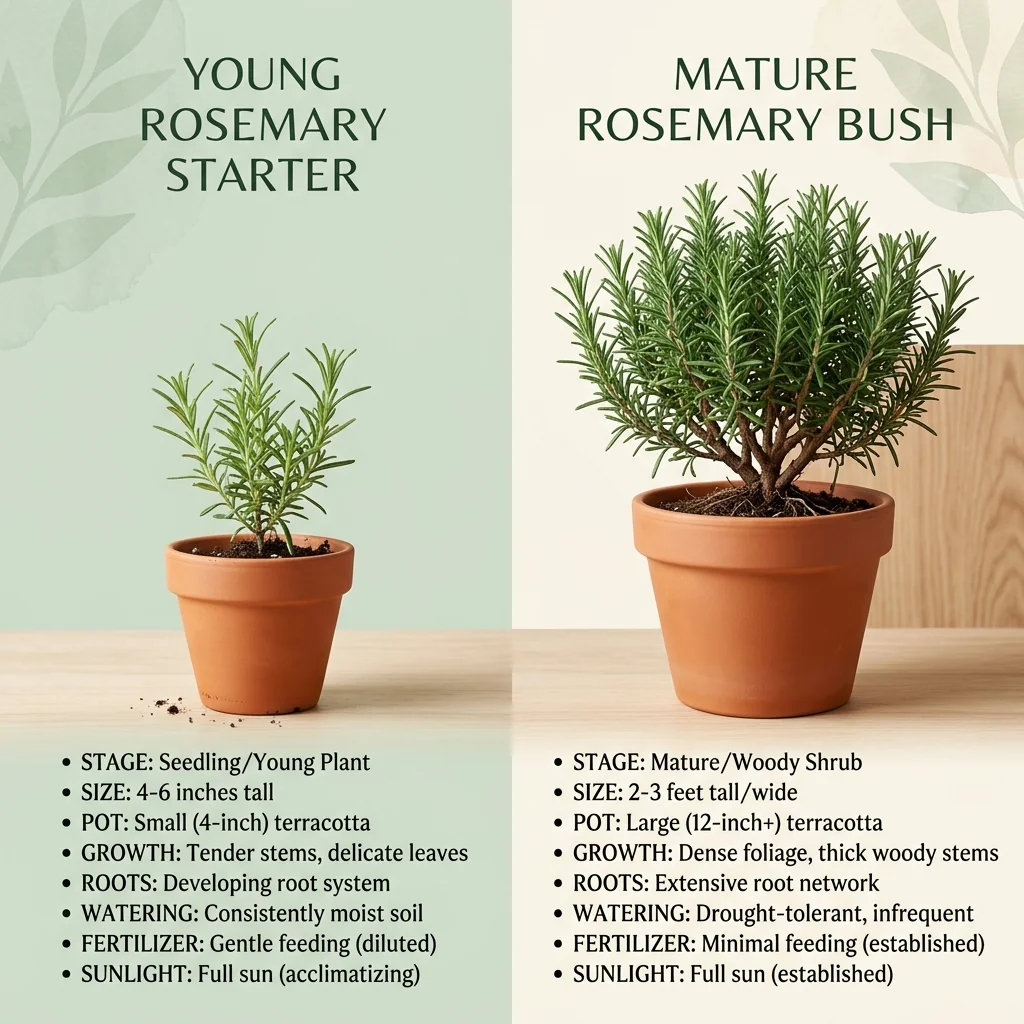
What size pot does rosemary need? Start small, size up
Rosemary is a small shrub in disguise. It starts in a modest pot but needs upsizing as it grows woody, plus the sharp drainage every Mediterranean herb demands.
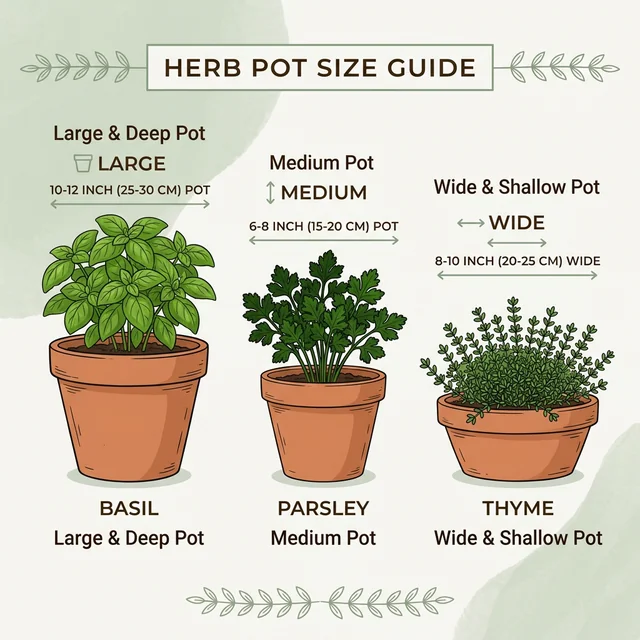
Herb pot size chart: basil, mint, parsley, thyme & chives
A practical herb pot size guide for the most common kitchen herbs, with simple size ranges that make container growing easier to read and maintain.
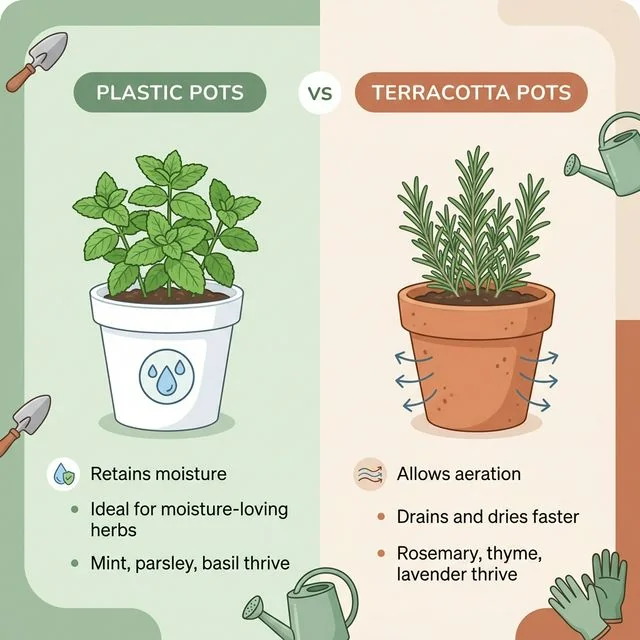
Plastic vs. terracotta pots for herbs: which makes care easier?
The material of your pot dictates how fast your soil dries out. If you put a thirsty mint plant in unglazed terracotta, you will be watering every single day. If you put rot-prone rosemary in a plastic pot, you must be extremely careful.