Which Herbs Belong in Self-Watering Pots?
| Herb Category | Specific Herbs | Self-Watering Verdict | Why? |
|---|---|---|---|
| Higher water use | Basil, mint, parsley, cilantro, lemon balm | Potential fit | A compatible reservoir can reduce dry swings; monitor aeration and actual moisture. |
| Drought-Tolerant (Mediterranean) | Rosemary, Thyme, Oregano, Sage | Do Not Use | These plants naturally grow in sandy, rocky, dry environments. Constant moisture against their roots will inevitably lead to fatal root rot. |
| Bulb/Grass-like | Chives, Garlic Chives | Proceed with Caution | They like even moisture but the bulbs can rot if the soil lacks sufficient perlite or aeration. |
The number one killer of indoor container plants is poor watering technique. As we outlined heavily in How Often Should You Water Potted Herbs? (Stop Guessing), humans are terrible at judging soil moisture. We either panic and water our plants every day, drowning them, or we forget about them for weeks, turning them to dust.
Because of this, the garden industry invented the “Self-Watering Pot.” It sounds like a technological miracle: pour water into a hole, walk away for two weeks, and return to a perfectly healthy basil plant.
But do they actually work? The answer is an emphatic yes—provided you use the right soil, grow the right herbs, and understand the core physics of how the pot functions.
How “Self-Watering” Actually Works
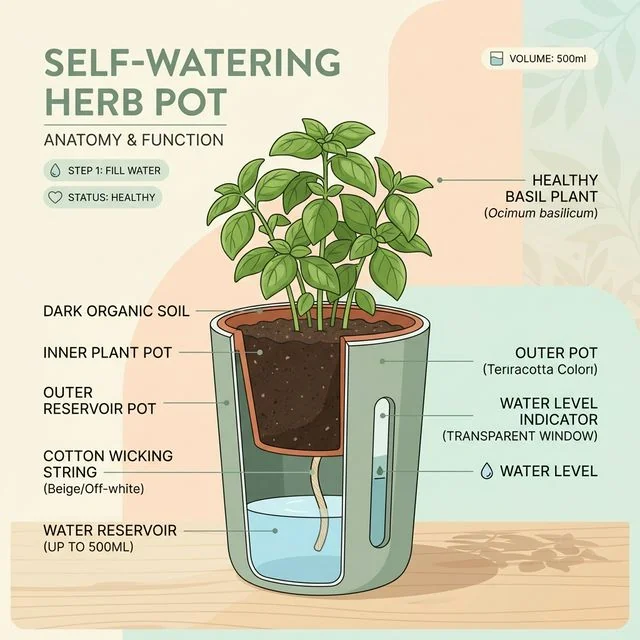
A self-watering pot is not an electronic robot. The technical, correct term is a Sub-Irrigated Planter (SIP).
A standard container has drainage holes on the bottom, allowing gravity to pull water down and out of the soil. A SIP works in reverse. It consists of two separate chambers:
- The Top Chamber: This holds the soil and the plant roots.
- The Bottom Chamber (Reservoir): This holds pure water.
The two chambers are connected by a “wicking mechanism.” In cheaper pots, this is a thick cotton string that dangles from the soil down into the water. In premium pots, it is a perforated plastic cone filled with soil that dips into the reservoir below.
Through capillary action, a compatible mix and wick can move water upward from the reservoir. That does not make moisture self-correcting: wick size, mix, reservoir design, roots, evaporation, and overflow determine whether the root zone is suitably moist or too wet.
Editorial note: The Amazon link here is an untracked shopping reference; Urban Harvest Lab does not currently receive a commission from it. Comparisons cover design features, and no named planter was hands-on tested.
The Key Requirement: A Compatible, Aerated Mix
If a self-watering pot fails, it is usually because the gardener used the wrong dirt.
The lower zone can stay moist for long periods. Dense garden or raised-bed soil may compact in a container and interfere with air-filled pore space and wicking. Decline does not follow a universal number of days, but a saturated, poorly aerated mix raises risk.
As discussed in Potting Mix vs. Raised Bed Soil for Herb Containers, use a mix intended for containers and the planter manufacturer’s recipe. Do not add a universal 50% perlite ratio: excessive amendment can break wicking or nutrient and water retention in another system.
Matching the Herb to the Pot
Not all herbs want a consistently damp environment. The golden rule of sub-irrigated planters is respecting the regional origin of the plant.
The Winners: Leafy, Fast-Growing Herbs
Herbs that grow lush, broad leaves evaporate (transpire) massive amounts of water every single day under a grow light or in a warm Balcony Garden. If you put Basil, Mint, Parsley, or Cilantro in a self-watering pot, they will explode with growth. The constant access to gentle wicking moisture prevents them from ever hitting wilt-inducing drought stress.
The Losers: Mediterranean Woody Herbs
If a plant originates from the rocky, sun-blasted hills of the Mediterranean, it has evolved to survive fierce droughts. Rosemary, Thyme, Oregano, and Lavender require their soil to go completely, bone dry between waterings.
Rosemary and similar herbs can be difficult in a continuously moist system, especially in cool or low-light conditions. Prefer a conventional draining pot when you need the mix to dry faster, or use a reservoir design only after measuring the actual root-zone behavior.
How to Avoid “The Swamp”
To use a self-watering pot successfully, you cannot treat the reservoir like an infinite well.
- Establish new plants as instructed: roots near the surface may need top-watering until the wick is working. Follow the planter instructions and verify moisture rather than assuming a universal two-week period.
- Manage refill timing from evidence: some systems call for a pause; others are designed for a maintained level. Follow the manufacturer and plant response instead of forcing roots dry for a fixed one or two days.
- Use fertilizer only as the system directs: some sub-irrigated systems accept a measured nutrient solution, while others warn against reservoir feeding. Follow the planter and fertilizer labels, monitor salt buildup, and flush or clean only as directed.
If basil or mint repeatedly dries between checks, a self-watering pot is one option after ruling out an undersized root volume, hydrophobic mix, extreme exposure, or poor watering technique. For a feature comparison, see Best self-watering pots for herbs.
Recommended self-watering pots
For higher-water-use herbs, look for a visible fill method, accessible reservoir, overflow protection, replacement wicks, stable base, and cleaning instructions. An indicator does not guarantee safe moisture. Browse self-watering herb planters on Amazon, or see the feature-by-feature breakdown in best self-watering pots for herbs. For rosemary or thyme, a conventional terracotta or plastic setup is easier to tune.
Sources
Troubleshooting a self-watering disaster?
If your plant is suffering inside a self-watering pot, check these guides to diagnose root rot or fungal gnats immediately.
Common questions
Do I ever water a self-watering pot from the top?
Yes, for the first two weeks! When you first transplant a tiny seedling into a large self-watering pot, its roots are too short to reach the moist, wicked soil at the bottom. You must top-water until the roots grow deep enough to tap into the moisture reservoir.
Can mosquito larvae breed in the water reservoir?
Yes, if the reservoir is exposed to open air outdoors. This is why high-quality self-watering pots have enclosed reservoirs with a tight-fitting fill tube. If you are growing indoors, this is rarely an issue unless you have a preexisting fungus gnat infestation.
How often should I let the reservoir go completely dry?
It depends on the system. Some designs expect a pause between refills so the root zone can draw air; others are built to hold a steady level and suffer if you let them swing. Follow the manufacturer's guidance and what the plant is doing, rather than imposing a fixed dry spell.
Related guides
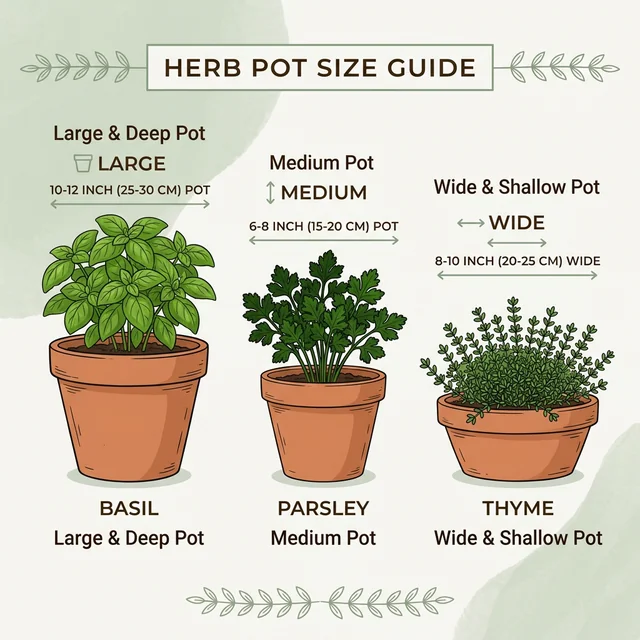
Herb pot size chart: basil, mint, parsley, thyme & chives
A practical herb pot size guide for the most common kitchen herbs, with simple size ranges that make container growing easier to read and maintain.
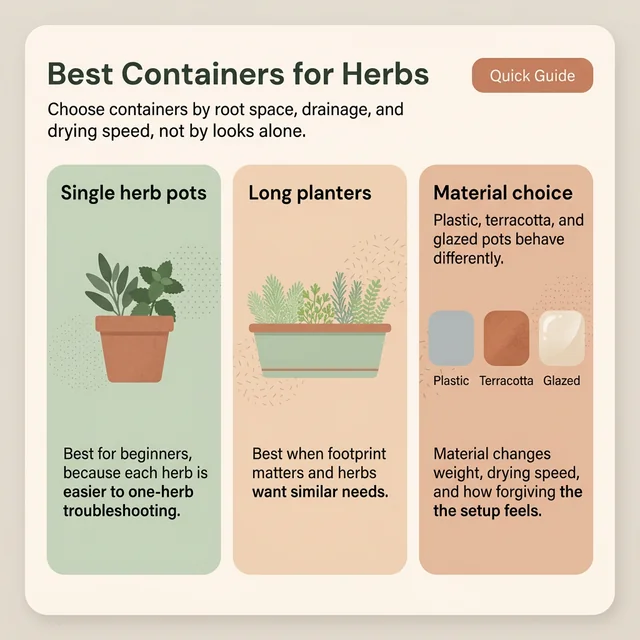
Best containers for herbs: drainage, pot size, and materials that work
A practical guide to herb containers that explains which pots work best, why drainage matters, and how material changes the way containers dry.
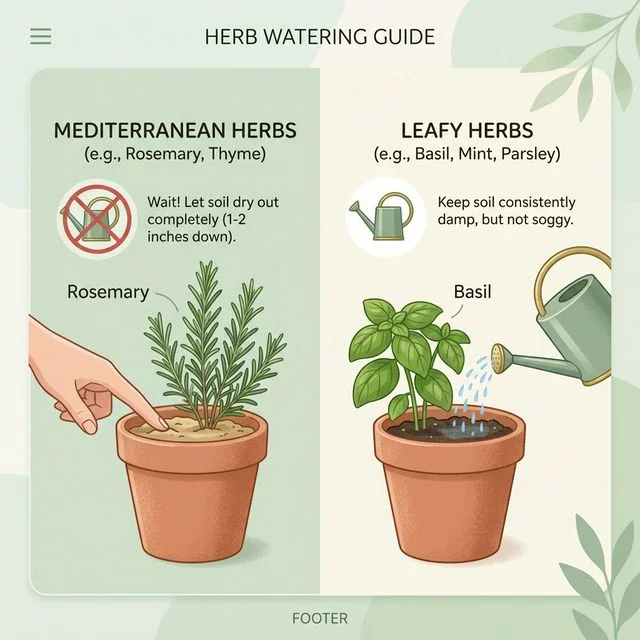
How often to water potted herbs: a by-herb chart
Most potted herbs should be checked often but watered only when the root zone is actually drying. Judge the pot instead of following a rigid calendar.