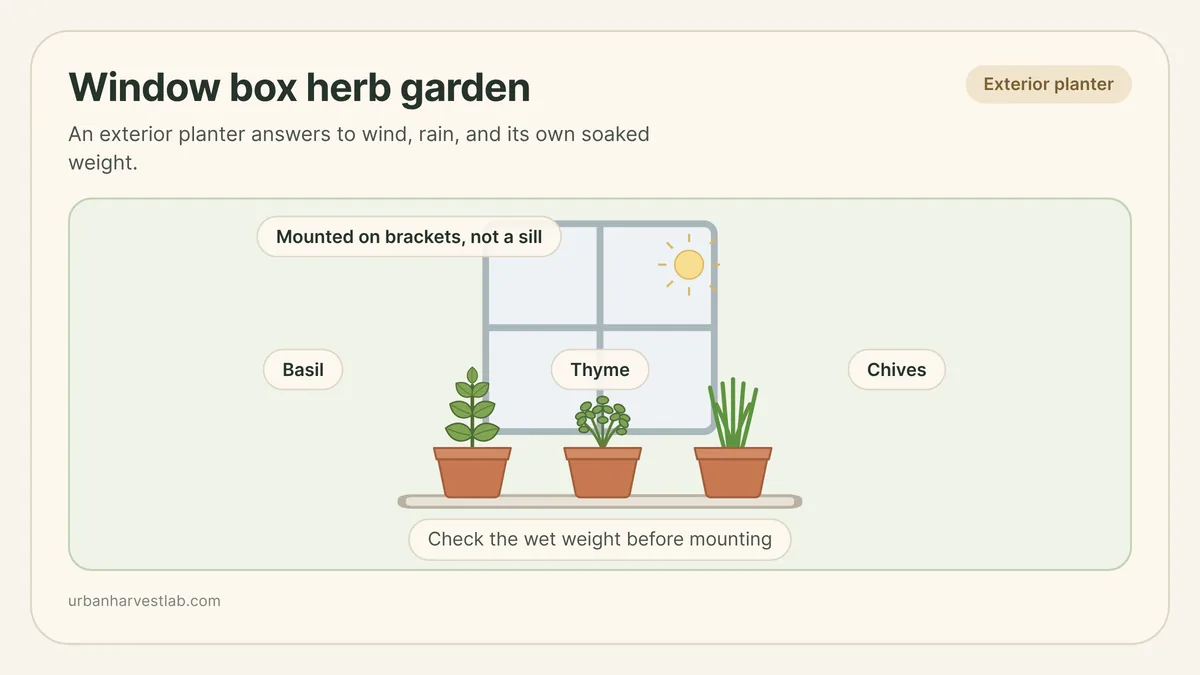
Herb size tiers for a standard 8 in deep window box
| Tier | Herbs | Fit in an 8 in box |
|---|---|---|
| Smaller herbs (University of Maryland Extension) | Basil, cilantro, thyme, mint, oregano, tarragon, marjoram | Comfortable at 2-5 gal each |
| Larger herbs (University of Maryland Extension) | Rosemary, bay, sage, parsley, lavender, dill, fennel | Tight; want 5 gal or more per plant |
| Named box mix (University of Kentucky Cooperative Extension) | Chives, thyme, basil, marjoram, summer savory | Fits a 12 x 48 x 8 in box grown together |
A window box is an exterior planter mounted or bracketed outside a window, and that single fact changes what has to be settled before you plant it. It is not the same thing as a container sitting on an indoor sill, and it is not the same thing as a pot standing on a balcony floor. It answers to wind, rain, and its own saturated weight pulling against a wall or railing, so the mounting and the load come before the herb selection, not after.
That ordering matters because the three planters get confused constantly, and the confusion is exactly where the risk hides. An 8-inch-deep box, the depth University of Kentucky Cooperative Extension used for a mixed herb planter, holds chives, thyme, basil, marjoram, and summer savory in one row.
Not a windowsill, and not a floor-standing balcony pot
An interior windowsill planter, the kind covered in growing a windowsill herb garden in a low-light home, rests on a flat, load-bearing sill inside the building envelope. It does not have to shed rain, resist wind, or be held up by a bracket, because the sill itself is already carrying furniture-level loads without comment. A floor-standing balcony container, the kind a beginner balcony herb garden starts with, has the opposite exposure to weather as a window box but the same lack of a mounting problem: it sits on a structural floor, so its concern is the floor’s total load capacity across every pot on it, not one bracket’s grip on one box.
A window box is mounted outside the building line, hung from brackets, resting on a ledge, or clipped to a railing, with nothing but that attachment between the box and the ground below. That is a genuine hazard category, not a gardening inconvenience: a box that comes loose falls onto whatever is under the window.
Weight when wet is the number that decides this, and it is not a fixed one
The single most important fact about a window box is that its weight changes enormously between dry and watered. Potting mix that feels light out of the bag holds far more water once it is thoroughly soaked, and a box planted with several mature herbs is carrying soil, root mass, foliage, the container itself, and, in a box with a built-in reservoir, retained water on top of all of that. None of that shows up if you judge the box by how it felt when you carried it up empty.
There is no single safe-weight figure that applies to every box, bracket, and wall, so this is not a number to estimate by eye. As an anchor: a 12 x 48 x 8 in box holds roughly 20 US gallons, and at 8.34 pounds per gallon the water alone in a saturated box that size runs about 165 pounds, before the box, the mix’s own solids, and the plants are counted. Work out the actual loaded weight for your box and mounting against the answer at how much weight can a balcony or window mount actually hold before you commit to a planting plan, not after the box is already up and full.
Mounting and anchoring: the part a light plastic box does not fix
A window box needs a bracket, ledge, or railing clip rated for its full wet weight, not its display weight in a shop. A few practical rules hold regardless of the specific hardware:
- Secure at more than one point. A box that only rests on a ledge by friction, or hangs from a single hook, has nothing stopping it if that one contact fails. Look for hardware that anchors at both the bottom and the top, or a bracket plus a safety chain or strap as a second line of support.
- Anchor into something structural. A masonry wall, a window frame’s structural member, or a properly rated railing bracket is a mounting point. Thin trim, a loose sill overhang, or a stucco skin with nothing behind it is not, whatever the anchor is rated for on its own packaging.
- Check building and railing rules before you drill or clip anything. Rented buildings, condos, and some railings have restrictions on exterior fixtures for exactly this reason.
- Re-check hardware after the first heavy watering and after strong wind, the same general bracket-and-rail checks covered in best herb planters for small spaces.
University of Illinois Extension notes that lightweight materials such as plastic, resin, and fiberglass are more prone to tipping once a container carries a large, top-heavy plant, which is a tipping risk on a shelf and a pulling-loose risk once the same box is bracket-mounted rather than free-standing. A light box is not automatically a safer box; it is a box that needs its mounting checked just as carefully as a heavy one.
How deep does the box actually need to be?
University of Illinois Extension’s own container terminology distinguishes short “azalea” pots, which it says suit plants with minimal roots such as herbs, from taller “standard” pots it treats as the safer default for more demanding plants — a window box is an azalea-proportioned container by shape, which is why the small-herb tier fits it and the taprooted herbs do not. Texas A&M AgriLife Extension gives “pots from 6 to 10 inches in size” as satisfactory for green onion, parsley, and herbs generally, without specifying whether that is depth or diameter, so treat it as a general scale figure rather than a depth to build the box around. But herbs are not one size class, and a standard box depth suits some of them better than others.
University of Maryland Extension splits culinary herbs into two tiers by container size. Its smaller herbs, basil, cilantro, thyme, mint, oregano, tarragon, and marjoram, grow well in 2- to 5-gallon pots, which an 8-inch-deep box can hold reasonably. Its larger herbs, rosemary, bay leaf, sage, parsley, lavender, dill, and fennel, are sized for 5-gallon-or-larger pots, which is a tight fit at best in a standard window box, and better suited to a larger container on the ground or a bigger box built specifically to that depth. UGA Fulton County Extension sorts by growth habit instead, putting basil, dill, cilantro, and savory in a 1-gallon annual-herb bucket and sage, rosemary, lavender, and mint in a 5-gallon perennial-herb bucket. The two sources agree only on sage, rosemary, and lavender at 5 gallons or more; UGA puts basil and cilantro at 1 gallon where Maryland puts them at 2 to 5, and mint at 5 gallons where Maryland calls it a smaller herb — and it flips dill from Maryland’s largest tier to its smallest. For the mix recommended above, the UGA figures are the more permissive reading, so basil and marjoram are comfortable at 8 inches either way. The two sources disagree because one sizes by life cycle and the other by root shape; what size pot does dill need resolves it at around 12 inches deep for the taproot, which puts dill out of a standard 8-inch box either way.
The most direct figure for a herb-only window box comes from University of Kentucky Cooperative Extension, which names a 12 x 48 x 8 in box as suiting chives, thyme, basil, marjoram, and summer savory grown together. That mix sits mostly inside Maryland’s smaller-herb tier, which is exactly why it works at 8 inches deep.
A workable herb mix for one box
Start from the University of Kentucky mix, chives, thyme, basil, marjoram, and summer savory, since it is a group deliberately chosen for one shared box at a standard depth. All five tolerate similar watering and none of them spreads aggressively enough to crowd the others out within a season. Give basil the most room in the row since it grows the fastest and fills in first; for exact per-plant sizing once you know how many herbs share the box, the herb pot size chart breaks the same herbs down individually.
Leave rosemary, sage, lavender, dill, and fennel out of a standard 8-inch box, or give one of them the whole box to itself rather than splitting the depth across several plants that all want more of it. Parsley is the one herb the sources disagree about by roughly fifteen-fold — Texas A&M’s table lists it at 1 gallon for 3 plants and its general pot range at 6 to 10 inches, while Maryland puts it in the 5-gallon-or-larger tier — and at the deep end of a box (8 to 10 in) it works in a row at 6-inch spacing, which is what what size pot does parsley need sets out. Keep mint out of any shared window box regardless of depth; it spreads by runners fast enough to choke out neighbors in one growing season, which is a crowding problem no box size fixes.
Choosing the box itself
Once the mounting and depth are settled, best herb planters for small spaces covers what to check in the planter itself, drainage, usable soil volume, and material trade-offs, all of which apply to an exterior box exactly as they do to any other planter. A window box adds one requirement on top: real drainage holes matter even more outdoors, because rain adds water on top of whatever you already gave the box, and a box that cannot shed that extra water stays waterlogged longer than an equivalent indoor container ever would. If you are building the box yourself, University of Kentucky Cooperative Extension warns against wood treated with creosote or pentachlorophenol anywhere near vegetables, which rules out reclaimed railway sleepers, old fence board, or salvaged treated lumber for a herb box. If you are lining or repurposing a plastic box, University of Maryland Extension lists recycling codes #2 (HDPE) and #5 (PP) as food-safe, with #3, #6, and #7 to avoid.
Sources
- Texas A&M AgriLife Extension E-545, “Vegetable Gardening in Containers”
- University of Maryland Extension, “Growing Vegetables in Containers and Salad Tables”
- University of Illinois Extension, “How to Grow Fruits, Vegetables, Herbs in Container Gardens”
- University of Kentucky Cooperative Extension, Daviess County, “Vegetables Grown in Containers Improves Accessibility”
- UGA Fulton County Extension, “Container Gardening: Thinking Outside the Box”
Before you plant a window box, settle these first
These guides cover the load math for a mounted planter and the general container decisions a window box still has to get right.
Common questions
How deep does a window box need to be for herbs?
An 8 in deep box, the standard depth University of Kentucky Cooperative Extension used for a mixed herb planter, fits chives, thyme, basil, marjoram, and summer savory well. Herbs University of Maryland Extension classes as larger, rosemary, sage, lavender, dill, and fennel, are sized for 5-gallon-or-larger pots and are a tighter fit in a standard box. Parsley is the exception worth checking separately: sources disagree on it by roughly fifteen-fold, and at 8 to 10 inches deep it works in a row at 6-inch spacing.
Is a window box the same as a windowsill planter?
No. A windowsill planter sits indoors on the sill itself, with no exterior weight or bracket to manage. A window box is mounted outside the window, on a bracket, ledge, or railing, so it has to survive wind, rain, and its own saturated weight in a way an indoor container does not.
How much does a planted window box weigh?
A 12 x 48 x 8 in box holds roughly 20 US gallons, and at 8.34 pounds per gallon the water alone in a saturated box that size is about 165 pounds, before the box, the mix's own solids, and the plants are counted. The total for your own box comes from weighing a one-gallon sample of soaked mix and scaling up; balcony weight limit covers that calculation in full.
Which herbs work well together in one window box?
Herbs with similar size and moisture needs share a box more easily. Chives, thyme, basil, marjoram, and summer savory are the mix University of Kentucky Cooperative Extension names for a standard box; keep spreading herbs like mint in a pot of their own.
Related guides
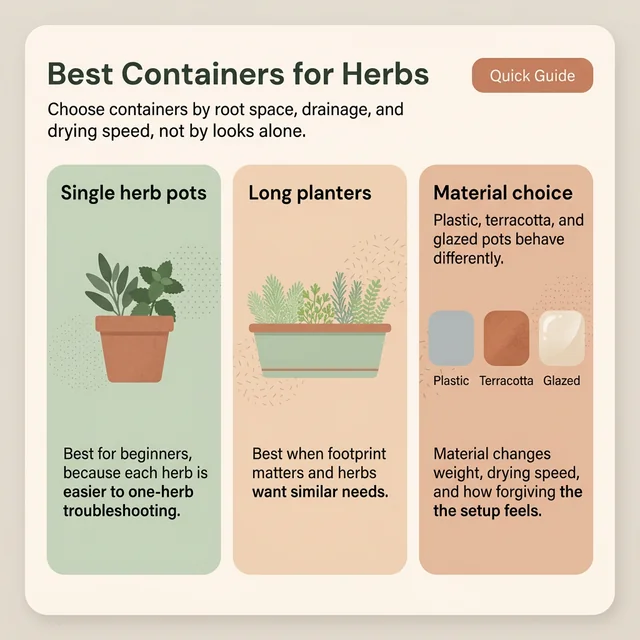
Best containers for herbs: drainage, pot size, and materials that work
A practical guide to herb containers that explains which pots work best, why drainage matters, and how material changes the way containers dry.
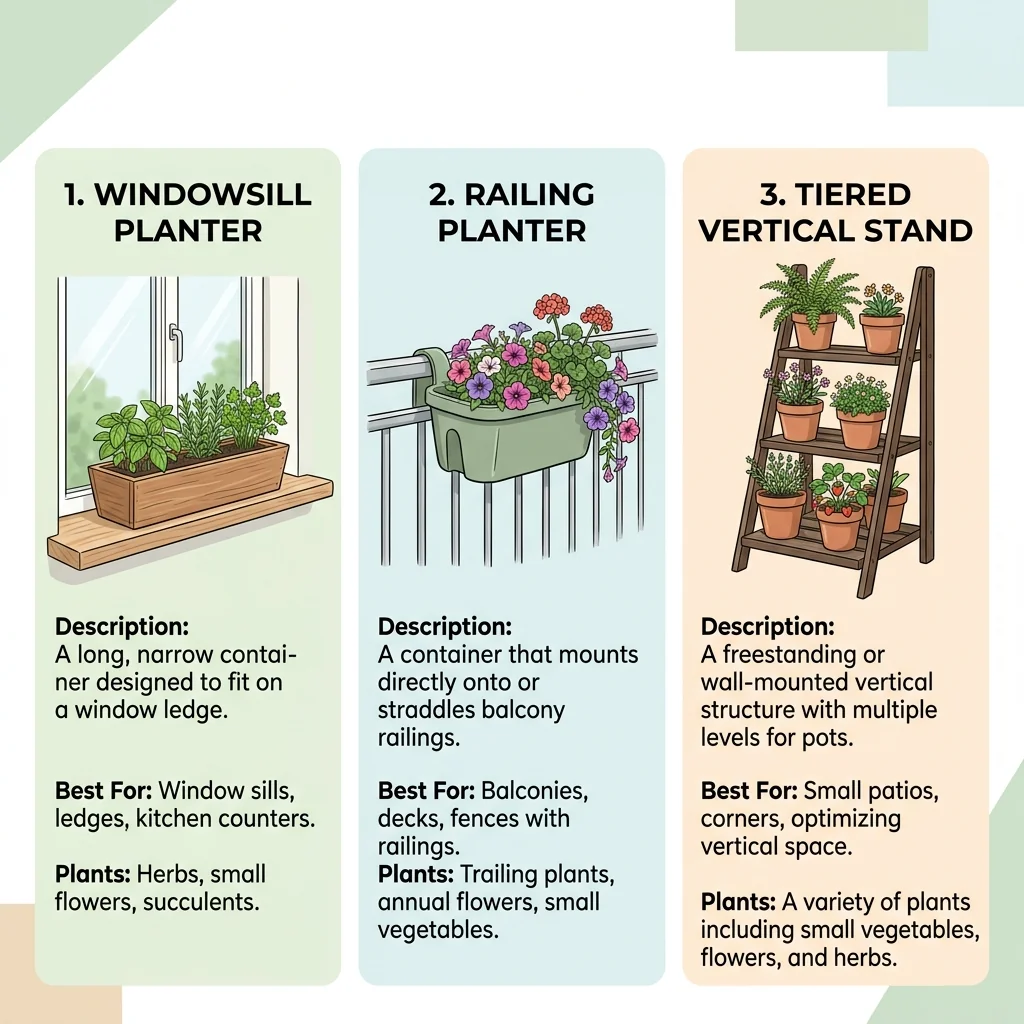
Best herb planters for small spaces
Small spaces reward planters that use vertical room and fit a sill or rail. Here are the best types for windowsills, balconies, and walls, and what to check before buying.
Windowsill herb garden guide for low-light homes
A practical windowsill herb guide for homes that feel bright enough to people but still struggle to keep basil and other herbs compact without extra help.