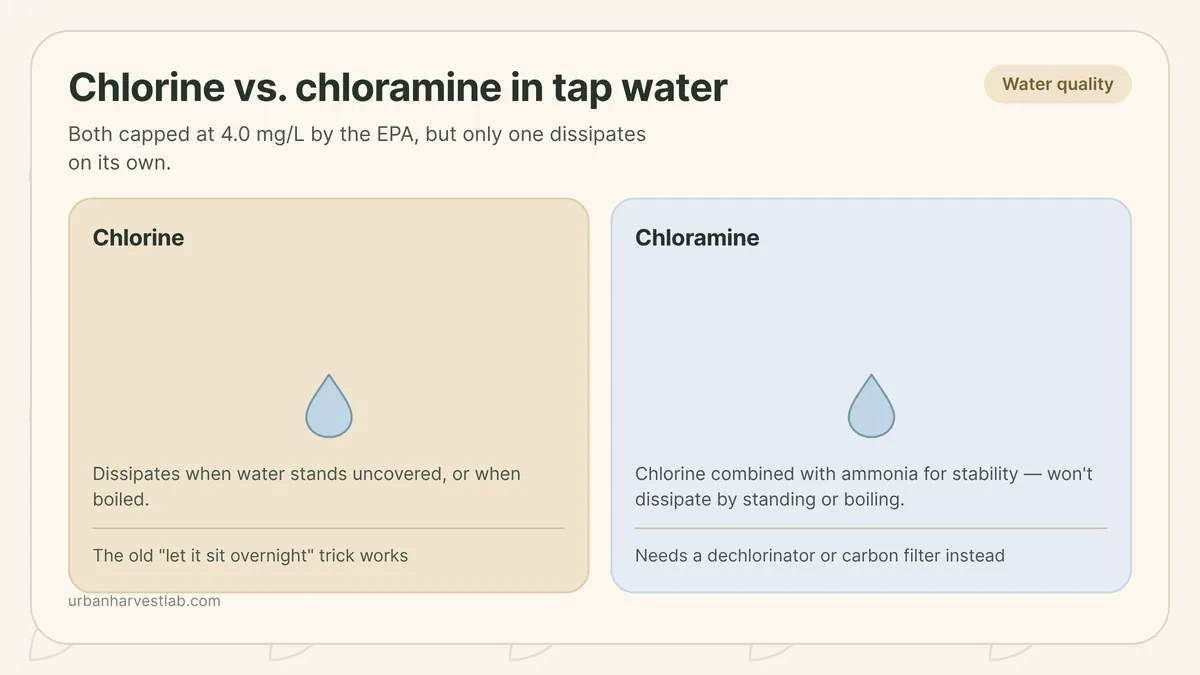
Chlorine vs. chloramine in tap water
| Property | Chlorine | Chloramine |
|---|---|---|
| What it is | Free chlorine or hypochlorite disinfectant | Chlorine combined with ammonia |
| EPA maximum residual | 4.0 mg/L, as Cl2 | 4.0 mg/L, as Cl2 |
| Dissipates from standing, uncovered water | Yes | No |
| Dissipates by boiling | Yes | No |
| Stability moving through pipes | Breaks down faster | Holds a residual longer, which is why utilities use it |
Quick answer: most municipal tap water does not need dechlorinating before it goes into a hydroponic reservoir. The EPA caps chlorine and chloramine at 4.0 mg/L in the distribution system, and that residual sits far below the levels university extension sources treat as a genuine problem for hydroponic source water. The one case worth paying attention to is chloramine: unlike chlorine, it will not dissipate just because the water sat out overnight or got boiled, so acting on it at all starts with finding out which disinfectant your utility actually uses.
If EC, pH and the rest of the source-water basics are still unfamiliar, start with hydroponic nutrient, EC, and pH basics before narrowing in on what your tap water specifically carries.
How much chlorine or chloramine is actually in your water
Under the EPA’s National Primary Drinking Water Regulations, utilities may not exceed a Maximum Residual Disinfectant Level of 4.0 mg/L for chlorine, 4.0 mg/L for chloramines, and 0.8 mg/L for chlorine dioxide, each measured as Cl2. EPA Region 9’s own chloramine guidance repeats the same 4.0 mg/L ceiling for both chlorine and chloramine. That is a legal maximum, not a typical reading — most systems run below it, but 4.0 mg/L is the worst case you would ever see out of a tap that is in compliance.
For context, EPA also caps disinfection byproducts separately: total trihalomethanes at 80 µg/L and haloacetic acids at 60 µg/L. Region 9 is explicit that the regulatory concern with a disinfectant residual is mostly about those byproducts, not the toxicity of the chlorine or chloramine itself at these levels.
Chlorine and chloramine are not the same chemical
Treating “chlorine” as a catch-all term is where most of the confusion starts. Chloramine is chlorine deliberately combined with ammonia, a practice utilities have used since the 1930s specifically because chloramine is a more stable, longer-lasting residual through a distribution system, even though it is a weaker disinfectant than chlorine on its own, according to EPA Region 9.
That extra stability is exactly what makes chloramine harder to get rid of at home. EPA Region 9 states it directly: unlike chlorine, chloramines do not rapidly dissipate on standing, and they do not dissipate by boiling either. Fish and pond keepers, who cannot tolerate either disinfectant in their water, have to actively neutralize or filter out chloramine rather than simply let it sit — the same standing-water trick that works for chlorine does nothing for it.
Practically, that means the advice to “fill a bucket and let it sit out overnight” is really advice about chlorine. It has been silent from the start on which disinfectant is in your particular water, and if your utility switched to chloramine at some point, that advice stopped doing anything without anyone announcing it.
Does the amount in your tap actually matter for plants
University of Missouri Extension lists a chlorine ceiling of under 70 ppm among the problematic-ion levels it flags for hydroponic source water, and Oklahoma State University Extension lists a chloride ceiling of under 140 ppm for acceptable irrigation water — a different ion from residual disinfectant chlorine, but a useful second data point on the same page. Both numbers describe water that is a poor hydroponic source; neither describes an ordinary municipal disinfectant residual.
Set those ceilings against the EPA’s 4.0 mg/L maximum residual and the gap is large: a tap water sample at the legal limit for chlorine or chloramine is still nowhere near the 70 to 140 ppm range that extension sources treat as a source-water problem. Missouri states that 1 ppm equals 1 mg/L, so the two figures are directly comparable — the legal residual limit works out to roughly one-seventeenth of Missouri’s own chlorine ceiling for source water. That gap is the practical reason dechlorinating tap water is optional rather than mandatory for most home hydroponic setups running on a normal municipal supply. It is not a reason to skip a water test altogether — hardness, alkalinity and other dissolved solids are separate questions with their own numbers, covered on tap water alkalinity and pH drift — it is specifically a reason not to add a dechlorination step purely because the water smells or tastes like a public pool.
Some guidance for propagating cuttings in a glass of water, or for soaking seeds, does advise skipping chlorinated tap water for that specific use. That advice is about a small, static, undiluted volume with no dilution or turnover — a different situation from a hydroponic reservoir on a normal municipal supply, where the extension ceilings above are the numbers that actually apply.
If you still want to dechlorinate anyway
For chlorine, standing water uncovered is a real mechanism, not a myth — EPA Region 9’s own comparison assumes chlorine dissipates on standing and by boiling, which is the basis for singling out chloramine as the exception. How long it takes depends on surface area, temperature and starting concentration, so treat “let it stand uncovered” as a direction rather than a fixed recipe, and smell-test rather than clock-watch.
For chloramine, the options are narrower. EPA Region 9’s advice to fish and pond keepers is that they must neutralize or remove chloramine, and that treatment products are sold at aquarium supply stores. A carbon filter rated for chloramine removal works on the same principle, as a practical alternative rather than something EPA specifically endorses for growers. If your water utility confirms it uses chloramine and you want it out before mixing nutrients, a fishkeeping dechlorinator dosed to its own label is the tool built for the job — the label’s contact time and dose are what govern, not a hydroponic rule of thumb.
Check your hose if you fill from one
Chloramine reacts with certain rubber compounds used in garden hoses, washing-machine hoses and water-heater hoses, and EPA Region 9 notes this can shed black or greasy particles into the water passing through them. If a reservoir gets filled through a hose rather than a tap directly, and dark flecks show up in the water, a chloramine-affected hose gasket is worth ruling out before assuming it is algae or biofilm from the system itself.
Because the reaction is with the rubber compound rather than with the water itself, it is a plumbing detail rather than a water-chemistry one: a hose or fitting rated for drinking water, without an internal rubber liner, does not shed these particles regardless of which disinfectant the utility uses. Worth checking before replacing a filter or dosing a dechlorinator that was not the source of the flecks in the first place.
Where the rest of your water-quality problem actually lives
Chlorine and chloramine cover one narrow question: what your utility added to disinfect the water on its way to your tap. Alkalinity, hardness and baseline EC are different measurements, and they are usually the bigger factor in how a reservoir behaves week to week — see tap water alkalinity and pH drift for the buffering side of source water. An EC or pH meter that has drifted or has gone uncalibrated for a while will also produce readings that look like a water-quality problem when they are really an instrument problem; choosing and calibrating pH and EC meters covers that separately.
It is also worth not confusing this with the deliberate use of bleach to sanitize a system between crops, which is a different, intentional application of chlorine at a much higher, short-contact concentration than anything in your tap — cleaning a small hydroponic system covers that dose and procedure. And if the real question is how often to refresh the nutrient solution itself rather than what is in the fill water, when to change hydroponic nutrient solution walks through that on its own terms, by crop length rather than by water chemistry.
Sources
Get the rest of your source water right
Chlorine and chloramine are one piece of source-water quality. These guides cover the others.
Common questions
Do I need to remove chlorine or chloramine before using tap water in hydroponics?
Usually not. The EPA's maximum residual for both chlorine and chloramine in tap water is 4.0 mg/L, which is far below the 70 to 140 ppm chlorine or chloride levels that University of Missouri Extension and Oklahoma State University Extension flag as a concern for hydroponic source water. Dechlorinating is a precaution, not a requirement, at normal municipal levels.
Does letting tap water sit out overnight remove chlorine?
It removes free chlorine, which dissipates on standing. It does not remove chloramine. EPA Region 9 states plainly that chloramine, unlike chlorine, does not rapidly dissipate on standing and does not dissipate by boiling either, so the old "let it breathe overnight" advice only helps if your utility disinfects with chlorine rather than chloramine.
How do I find out whether my utility uses chlorine or chloramine?
Your water utility publishes this, usually in its annual water quality report, and will tell you directly if you call or email. It is the fastest way to know whether standing water will do anything for your reservoir.
Does the chlorine in tap water harm hydroponic roots or beneficial microbes?
No. At 4.0 mg/L, the most EPA allows a utility to deliver, the residual sits far below the under-70-ppm chlorine ceiling University of Missouri Extension sets for hydroponic source water. What that extension ceiling describes is genuinely poor source water, not a disinfectant residual — a different and much larger number.
Related guides
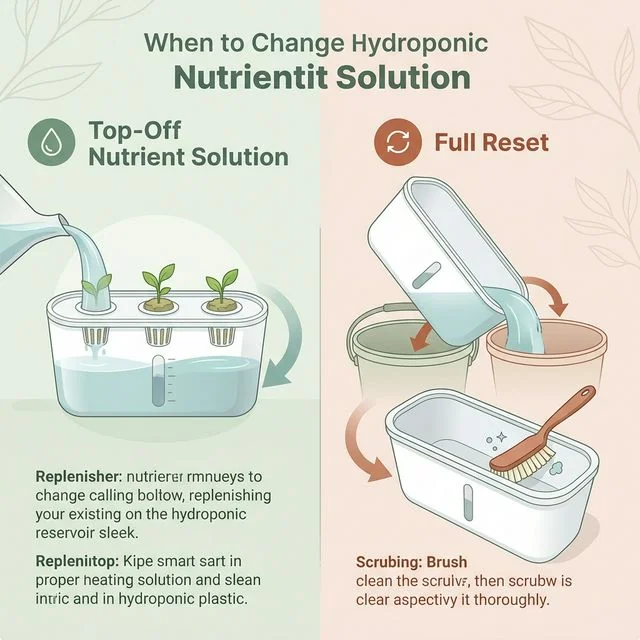
When to change hydroponic nutrient solution: top off vs full reset
A hydroponic reservoir should not be treated like a closed loop forever. This guide shows when a simple top off is enough and when a full reset is the safer move.
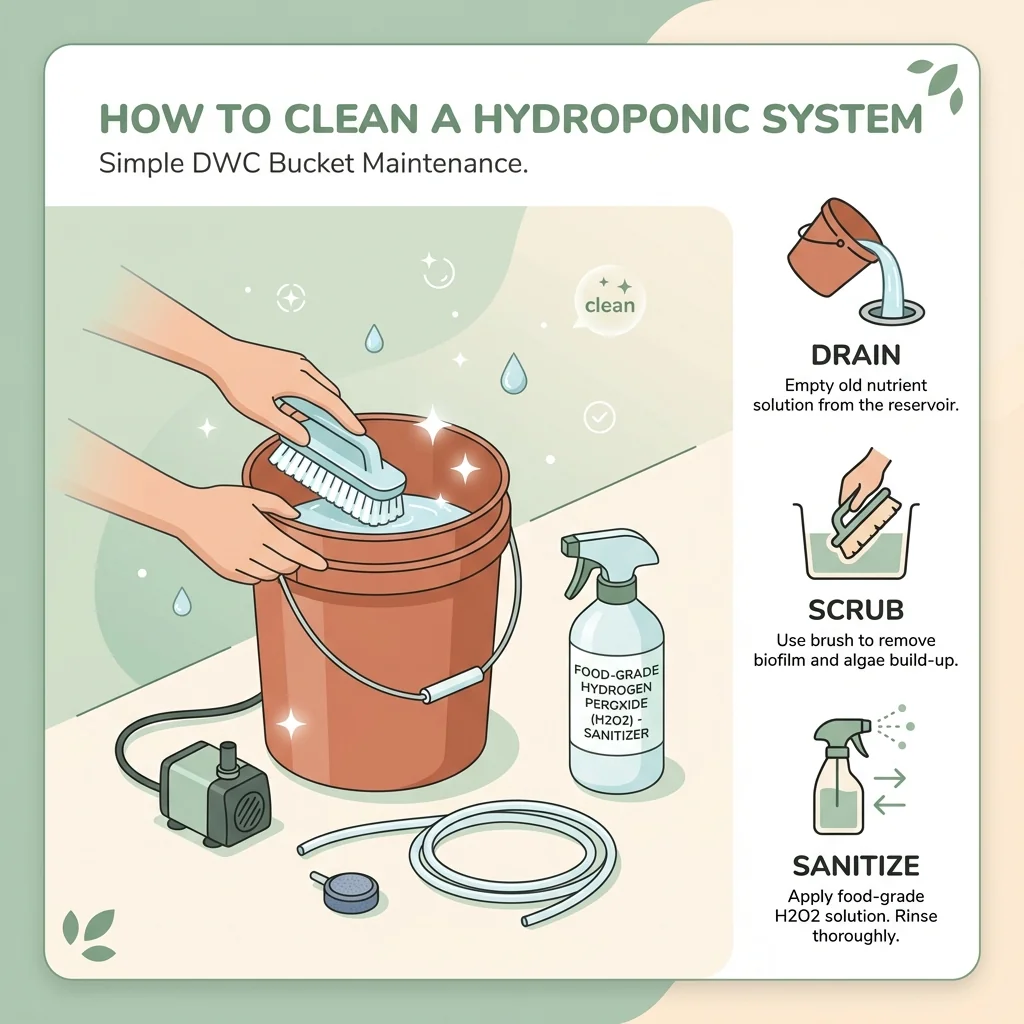
How to clean a small hydroponic system
A small hydroponic setup does not need constant chemical intervention. But between harvest cycles, a rigorous deep-clean is non-negotiable to prevent algae, mineral scaling, and deadly root rot spores from infecting your next crop. Here is the ultimate guide to system hygiene.
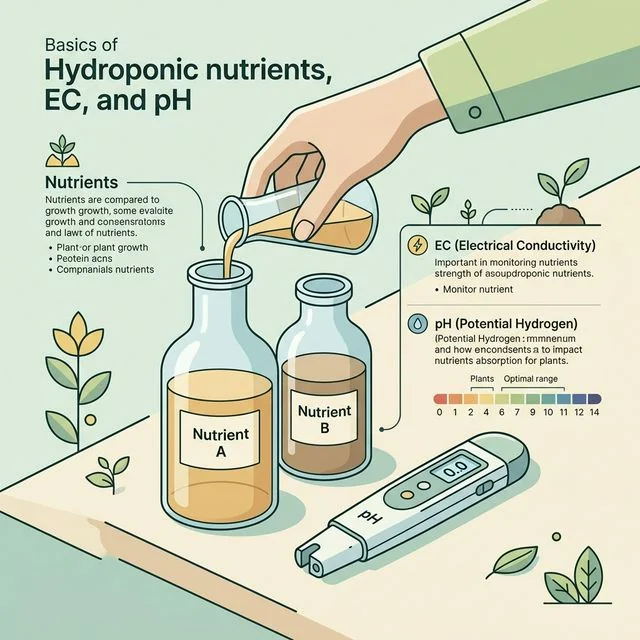
Hydroponic nutrient basics: EC, pH, dilution, and reservoir stability
Most hydroponic problems are not mysterious. They come from concentration drift, pH drift, heat, or neglected maintenance. This guide covers the basics clearly.