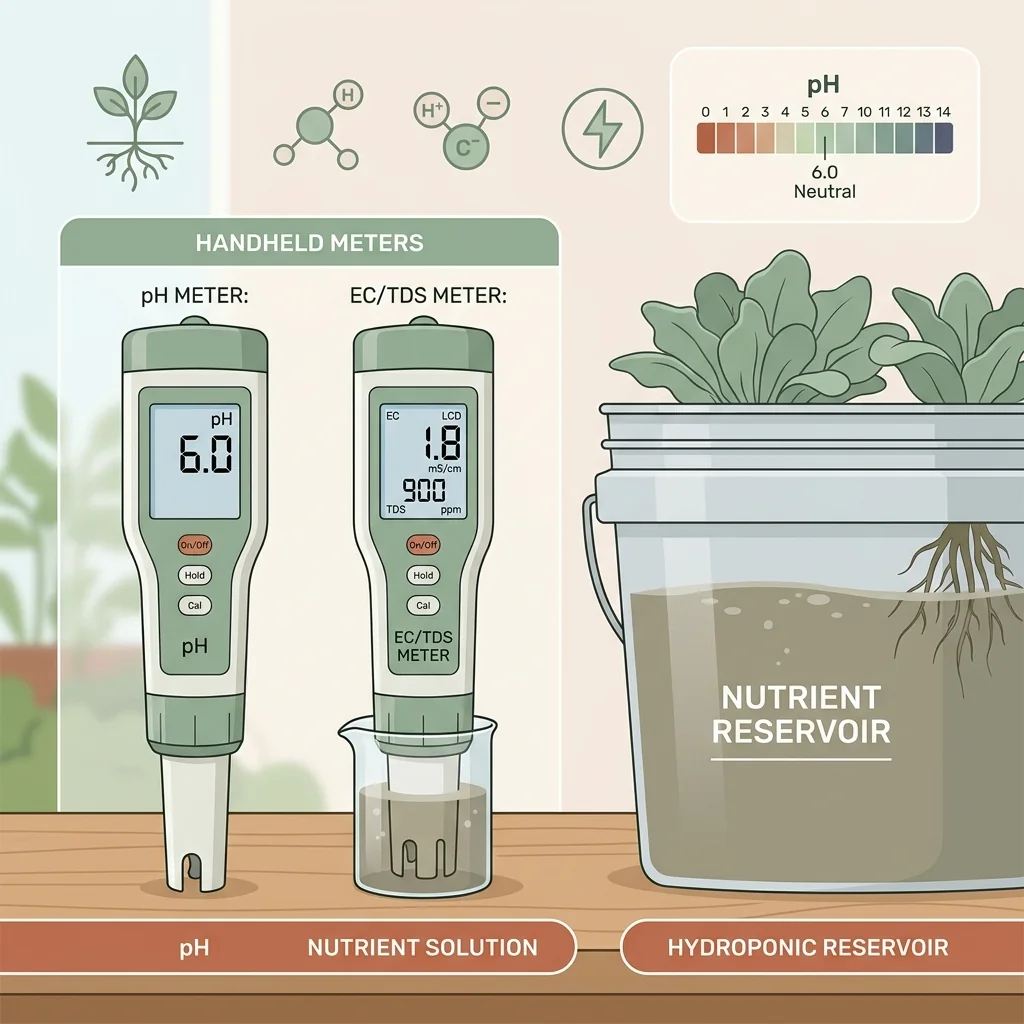
What to look for in EC and pH meters
| Feature | Why it matters | Notes |
|---|---|---|
| Accuracy | Wrong readings cause wrong fixes | +/- 0.1 pH is fine for home use |
| Easy calibration | All meters drift over time | Buy buffer/calibration solution too |
| Temperature compensation | Readings shift with water temp | Automatic (ATC) is best |
| Build and battery | Meters live near water | Replaceable batteries help |
Editorial note: Retailer links are untracked shopping references; Urban Harvest Lab does not currently receive a commission from them. The selection framework below is based on measurement and maintenance requirements.
A hydroponic pH meter and an EC meter answer different questions. The pH pen measures how acidic or alkaline the solution is. The EC meter measures electrical conductivity, a practical proxy for the total concentration of dissolved fertilizer salts. Neither reading identifies individual nutrients, and one cannot replace the other.
For most small home systems, buy two separate, waterproof pens that can be calibrated or checked against standards. Separate devices are easy to replace and let you verify one while cleaning the other. A combination meter is useful when you manage several reservoirs and value one probe assembly more than the lower replacement cost of separate pens.
Start with hydroponic nutrient, EC, and pH basics if the units are unfamiliar.
Quick buying decision
Choose a pH pen that states its accuracy, supports at least two-point calibration around pH 4 and 7, and has a cap designed to keep the glass electrode hydrated. Choose an EC meter that displays EC directly in mS/cm or µS/cm, can be checked with a conductivity standard near your working range, and makes its temperature-compensation behavior clear.
Avoid buying on resolution alone. A display that shows 5.83 has 0.01 resolution, but those extra digits do not prove the reading is accurate. For a home leafy-green system, stated pH accuracy around ±0.1 is generally more useful than a cheap pen displaying unstable hundredths.
If the budget only covers one device today, a pH pen is the more broadly useful first purchase when you are mixing nutrients according to a complete manufacturer’s dose. Add EC before you begin adjusting concentration from plant symptoms or running a recirculating reservoir. For dependable management, plan to own both.
Separate pens or one combination meter?
Separate pens usually give a beginner the clearest failure path. When the pH probe ages, you replace the pH pen without losing EC measurement. They also allow simultaneous checks and make it obvious which probe needs which storage method.
A combination meter reduces clutter and can log pH, EC, and temperature together. It costs more upfront, and a damaged cable, display, or shared body can remove both readings at once. Before choosing one, check whether the pH electrode is replaceable, what replacement costs, and whether the EC cell requires calibration or only verification for that specific model.
Do not assume a soil probe is suitable for a nutrient reservoir. Buy an instrument intended for liquids and for the conductivity range used in hydroponics.
What matters in a pH pen
Stated accuracy and stable readings
Look for an accuracy specification, not only a long display. The reading should settle predictably in fresh buffer and in a well-stirred sample. A hold or stability indicator is helpful because it discourages acting on the first fluctuating number.
Two-point calibration
Hydroponic solutions are usually mildly acidic, so pH 7 and pH 4 buffers bracket the useful region better than a single calibration point. Button-guided calibration is easier than an adjustment screw, but either can work when the procedure is repeatable.
Wet storage and a replaceable probe
The glass bulb must not dry out. Confirm that the cap holds storage solution and that replacement storage solution is easy to buy. A replaceable electrode raises the purchase price but can make sense for a better meter body used over several seasons.
Automatic temperature compensation
ATC compensates for the temperature response of the electrode. It does not make a warm reservoir biologically equivalent to a cool one, and it does not remove the need to let the probe and sample reach a stable reading.
What matters in an EC meter
Native EC units
Prefer a meter that shows mS/cm or µS/cm. TDS or ppm displays apply a conversion factor to EC, and manufacturers may use different factors. Two pens can therefore show different ppm values for the same solution while agreeing on conductivity. Record EC when comparing crops or guides.
Working range and conductivity standard
The meter should cover your source water and nutrient target without sitting at the edge of its range. A common verification standard is around 1.41 mS/cm, close to many leafy-green solutions, but always follow the meter manufacturer’s specified standard and procedure.
A clean, accessible sensor
Fertilizer residue and biofilm can slow or bias a reading. Choose a design you can rinse without touching or damaging the sensing surfaces. Waterproofing matters because the device will be handled above an open reservoir.
Calibration and verification workflow
Keep buffer and conductivity standards capped, clean, and within their storage guidance. Pour a small working amount into a separate clean cup; do not put a used probe into the stock bottle.
- Inspect the probe and clean it using the manufacturer’s method if residue is visible.
- Rinse as directed and gently shake off droplets rather than wiping the pH bulb.
- Calibrate pH at 7, rinse, then calibrate at 4.
- Return the pen to measure mode and read fresh buffer again. This verification step catches a failed calibration.
- Check the EC meter in its specified conductivity standard and allow the reading to stabilize.
- Measure a mixed, representative reservoir sample away from concentrated nutrient additions.
- Rinse both probes and return the pH electrode to storage solution; follow the EC meter’s storage instructions separately.
Calibration frequency depends on the device, use, and the consequence of a bad reading. Weekly two-point pH calibration is a conservative working routine for an actively managed home system. Calibrate or verify sooner after a drop, a dry probe, cleaning, a suspicious jump, or a reading that would trigger a large correction.
Browse pH buffers, EC standard, and probe storage solution
Know when not to trust the pen
Do not change a reservoir from one surprising reading. Rinse the probe, stir the solution, allow it to settle, and retest. Then check a fresh standard. If the meter cannot return close to the standard, will not complete calibration, drifts continuously in buffer, or takes much longer than normal to settle after cleaning, service or replace the probe.
A liquid drop kit can be a useful independent pH sanity check. Paper strips are less useful in tinted nutrient solutions because color interpretation becomes difficult. Neither is a substitute for EC measurement.
Record the date, standard lot or value, calibration result, reservoir reading, and any adjustment. Trends are more diagnostic than isolated numbers. Use why pH keeps rising and whether EC is rising or falling only after confirming the instruments.
Sources and further reading
- Oklahoma State University Extension: Electrical Conductivity and pH Guide for Hydroponics covers EC standards, pH buffers, solution mixing, and measurement order.
- University of Missouri Extension: Hydroponic Nutrient Solutions covers meter selection, weekly pH calibration, probe storage, and replacement indicators.
- Purdue Extension: pH and Electrical Conductivity Measurements in Soilless Substrates explains calibration near the working range and the value of consistent trend records.
Use your meters with these guides
These guides explain what the readings mean and the targets to aim for.
Common questions
What is the best EC or pH meter for home hydroponics?
Look for a meter that is accurate, easy to calibrate with included solutions, and has automatic temperature compensation. Reputable brands such as Apera, Bluelab, and HM Digital are popular for home use. The best meter is the one you will actually calibrate and use.
Do I need both an EC meter and a pH meter?
Ideally yes. The pH meter tells you whether plants can absorb nutrients, and the EC (or TDS) meter tells you how concentrated the solution is. They answer different questions.
Which should I buy first, EC or pH?
The pH meter. pH drifts faster and causes nutrient lockout sooner than EC problems, so if you can only buy one tool to start, make it the pH meter.
Do cheap pH meters need calibrating?
Yes, all pH meters drift and must be calibrated with buffer solutions, the cheaper ones more often. Buy calibration solution along with the meter, or your readings will slowly become meaningless.
Related guides
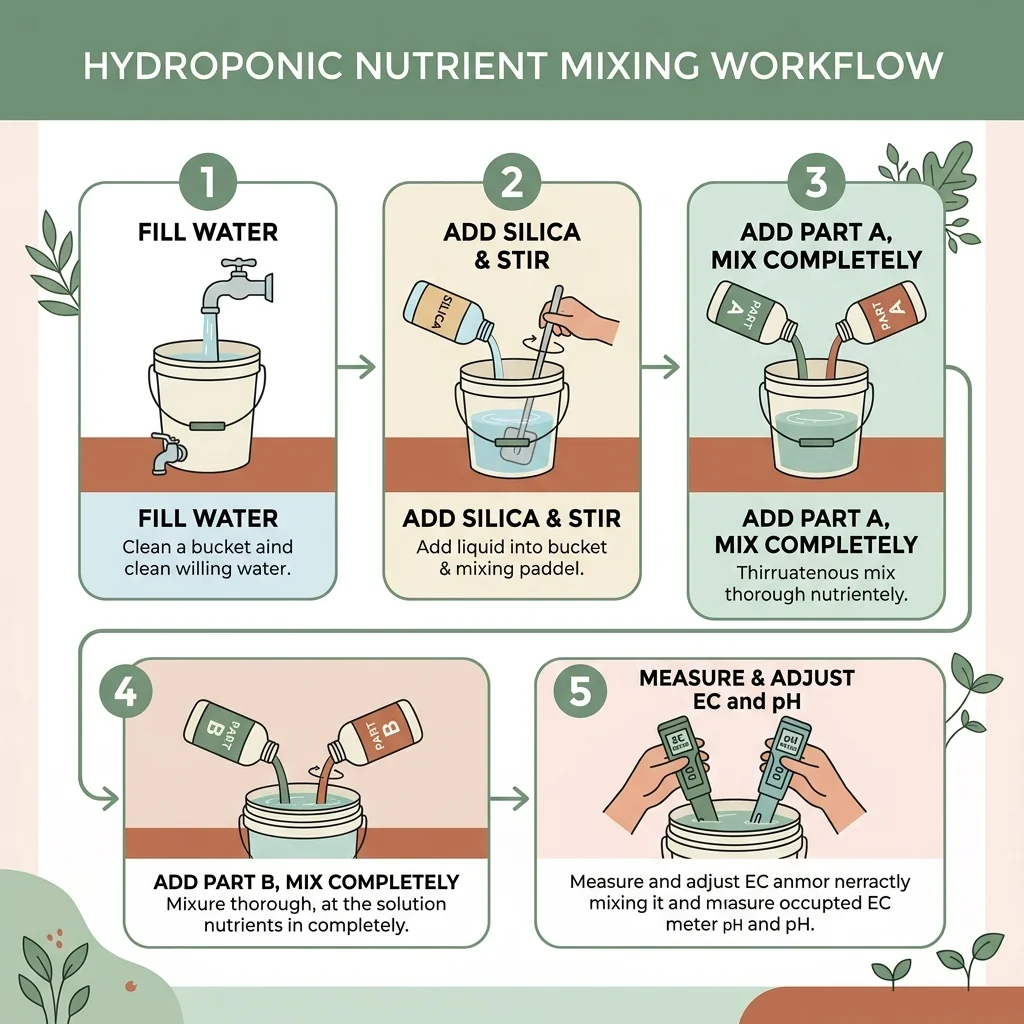
How to mix hydroponic nutrients: a beginner guide
Mixing hydroponic nutrients is simple once you know the order: water first, nutrients separately, measure EC, then adjust pH last. Here is the step-by-step.
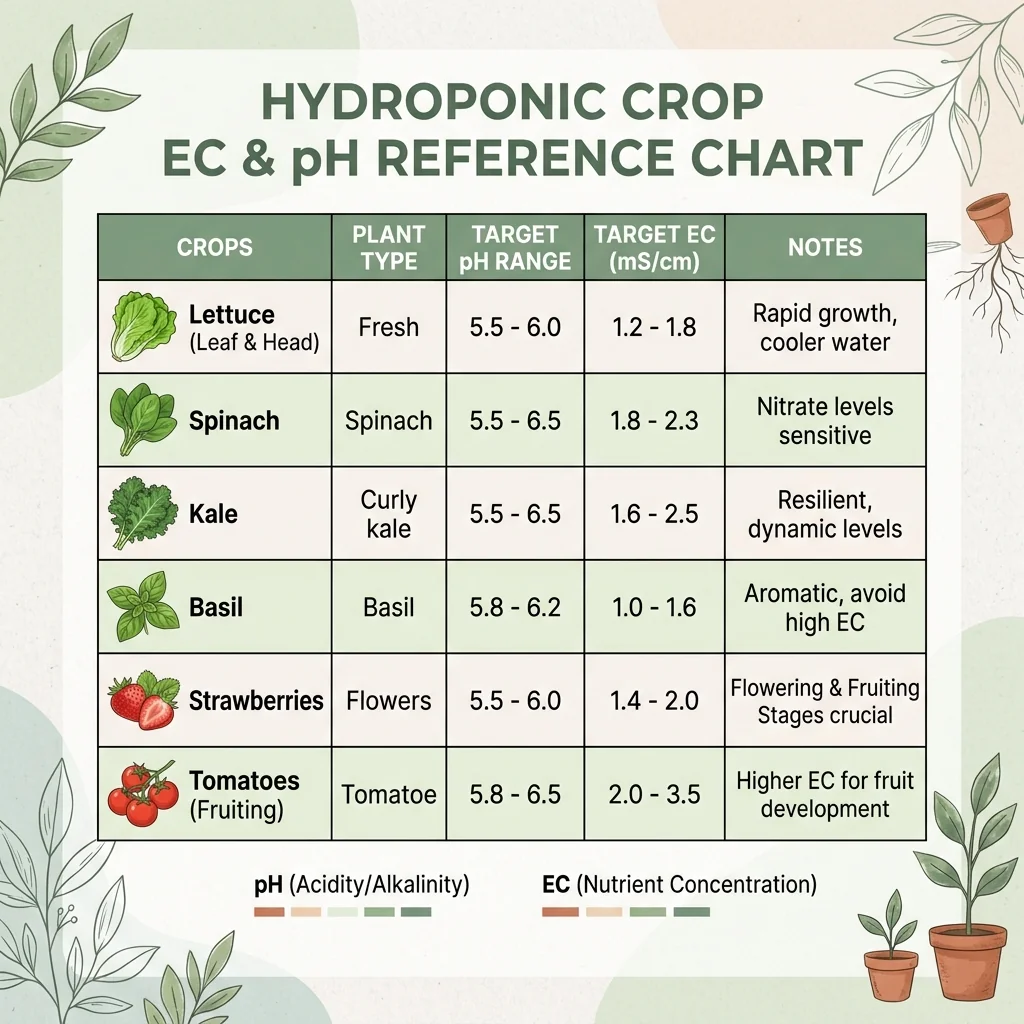
Hydroponic EC chart by crop (not just lettuce)
One reference chart for the EC and pH targets of common hydroponic crops, from leafy greens and herbs to fruiting plants, plus how to use the numbers safely.
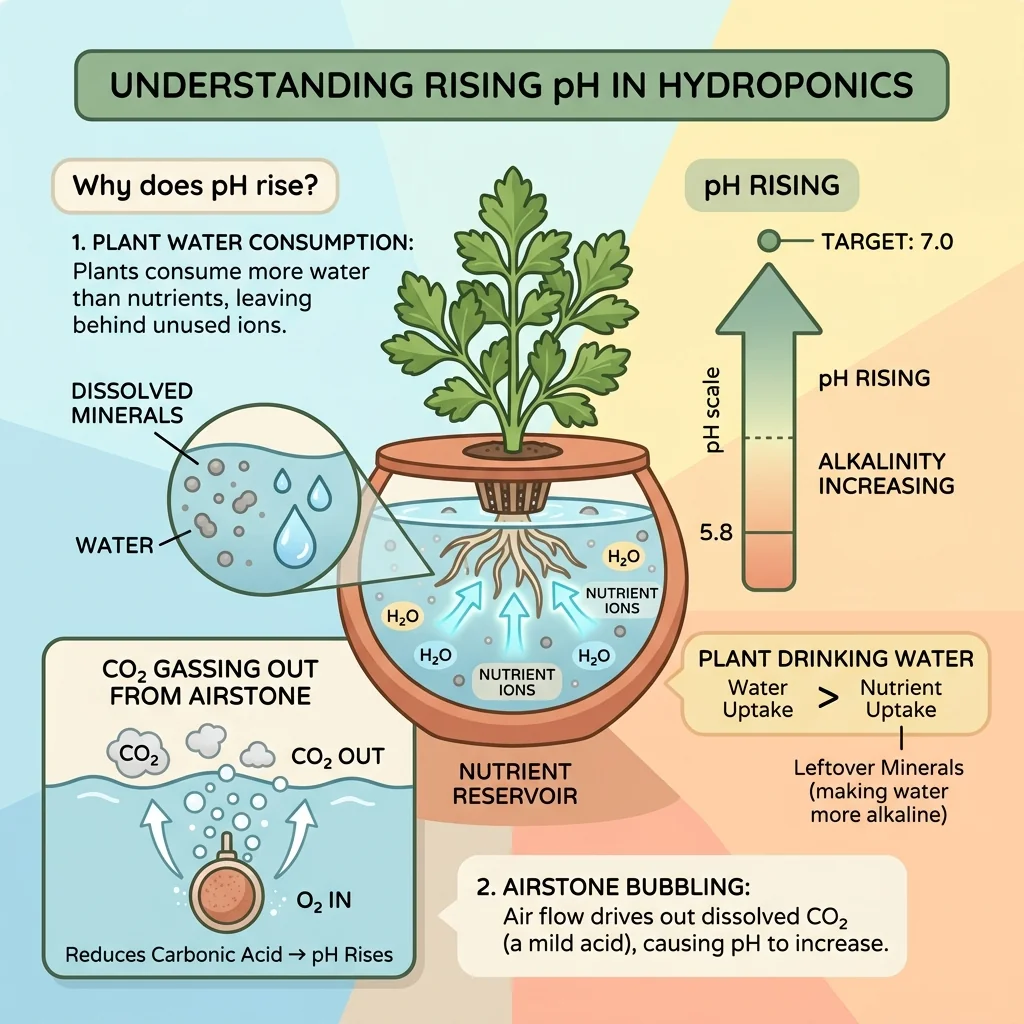
Why pH keeps rising in hydroponics (and how to stop it)
You balanced your hydroponic reservoir to a perfect 5.8 pH. Two days later, it has drifted back up to 6.8. This constant upward drift is the bane of hydroponic growers. Here is the chemistry behind why it happens and how to fix it.