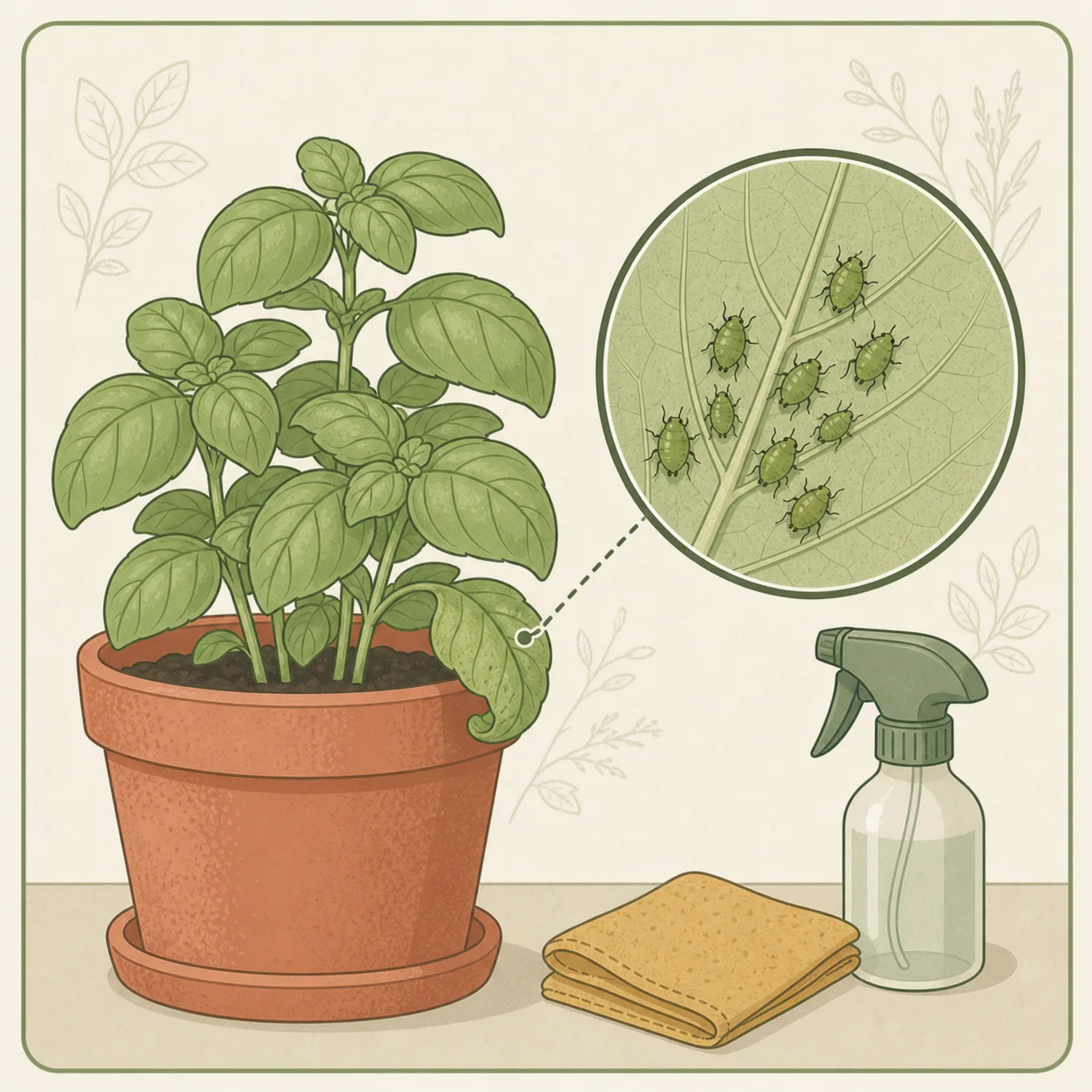
Troubleshoot the system before you change the inputs.
Symptoms
- Clusters of small soft-bodied insects on growing tips and leaf undersides.
- Sticky leaves, pale shed skins, or distorted new growth.
- Ant activity around an outdoor container or winged insects on nearby traps.
Possible causes
- A new plant introduced a small colony indoors.
- Tender, crowded growth allowed a population to build unnoticed.
- The first treatment removed exposed adults but missed hidden insects.
Quick fixes
- Isolate the affected herb and inspect neighboring plants.
- Rinse the whole plant, focusing on tips and leaf undersides.
- Repeat inspection every few days and follow any product label exactly.
Aphids compared with common lookalikes
| Clue | Aphids | Spider mites | Whiteflies |
|---|---|---|---|
| Visible pest | Soft pear-shaped clusters | Tiny moving dots | White winged adults |
| Residue | Sticky honeydew and shed skins | Fine webbing | Honeydew possible |
| Typical damage | Curled tender growth | Fine pale stippling | Yellowing and weak growth |
Aphids on indoor herbs usually appear as a colony on soft growing tips or the underside of young leaves. They are small, soft-bodied insects with long legs and a pair of short tube-like structures near the rear. Color varies, so green alone is not a diagnosis.
Use the broader potted herb problem guide if you cannot see an insect. Low light, wet roots, and nutrient stress can distort growth too. Pest control should begin only after a pest or a persuasive combination of signs is present.
Confirm the infestation
Move the plant into bright indirect light and use a hand lens. Inspect growing tips, the folds of curled leaves, stem junctions, and leaf undersides. Aphids often group together rather than distributing evenly.
Look for pale white fragments near the colony. These are shed skins, not a second white insect. Run a clean finger over a shiny leaf surface; sticky honeydew is another clue. Outdoors, ants may visit the honeydew, but ants alone do not confirm aphids.
Winged aphids can appear when a colony becomes crowded. A sticky card may detect them, but it does not control the insects feeding on the plant.
Isolate and define the affected area
Move the herb away from other plants without brushing leaves against them. Check every neighboring plant immediately and again over the following two weeks. Wash tools and hands after working on the infested plant.
Estimate whether the infestation is limited to one or two tips, distributed across the plant, or present across several pots. A small herb that can be replaced easily may not justify repeated treatment, especially if the edible canopy is heavily damaged.
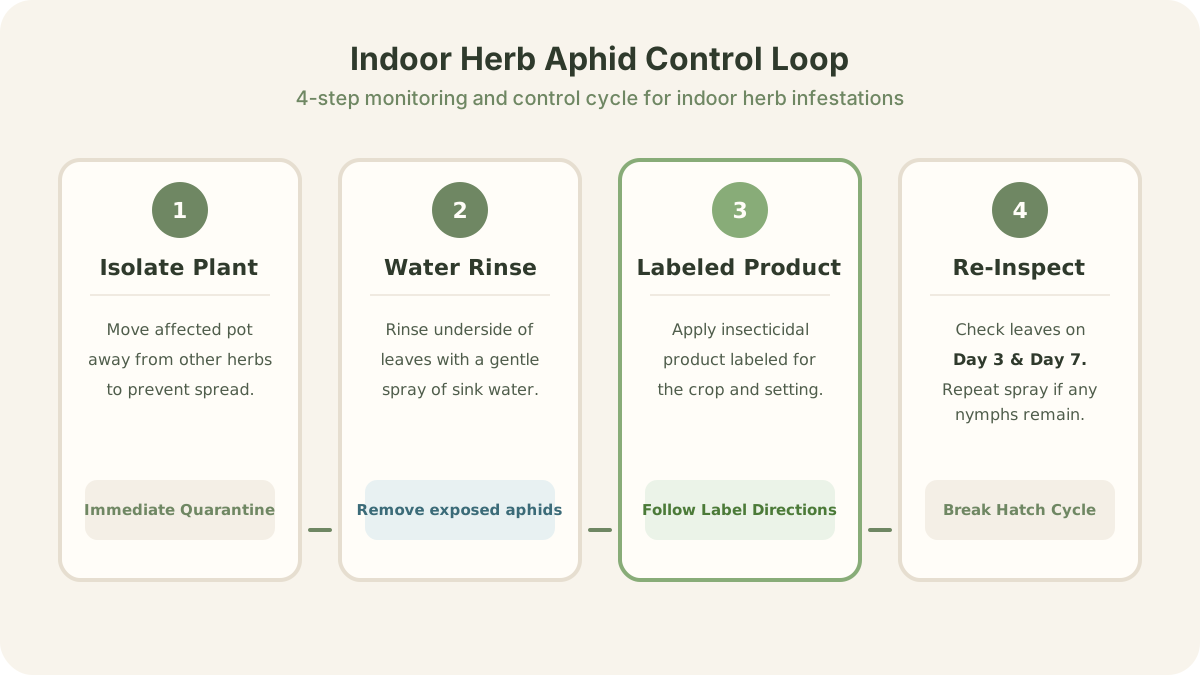
Use a four-step control loop
1. Prune the worst growth
Remove tips that are densely covered or too curled to inspect. Seal discarded material in a bag rather than carrying it uncovered past other plants. Do not remove so much foliage that an already weak herb cannot recover.
2. Rinse thoroughly
Support the pot so soil does not wash out, then use a firm but non-damaging stream of lukewarm water. Aim beneath leaves and around growing tips. Rinsing physically removes insects and honeydew without adding a residue.
Keep runoff away from uninfested pots. Let the plant drain before returning it to quarantine.
3. Reinspect on a schedule
Check after two to three days and again around one week. Repeat the rinse when live aphids reappear. The exact interval matters less than completing several inspections; hidden individuals can rebuild a colony.
Use the same route around the plant each time so no side is skipped. Photograph one marked tip to distinguish old damage from new distortion.
4. Escalate only when needed
If pruning and rinsing do not reduce the population, consult locally registered options. Insecticidal soap or horticultural oil products may be available, but the label must allow use on the crop and in the intended setting. Coverage is essential because these products generally work by contacting the pest.
Test a small section when the label directs, avoid treating heat- or drought-stressed plants, and obey harvest instructions. “Natural” does not mean risk-free or suitable for food crops.
Protect new growth during recovery
Give the herb appropriate light and stable water, not extra fertilizer as an emergency response. A flush of very soft growth can remain attractive to pests while damaged roots cannot use the nutrients efficiently.
Keep enough space between pots to inspect them and improve airflow. Check new plants before bringing them into the growing area and isolate arrivals for one to two weeks where practical.
When to discard the plant
Discarding is reasonable when a cheap annual herb is heavily infested, has little healthy leaf area, or repeatedly spreads aphids to more valuable plants. Bag it where it stands. Clean the saucer, nearby surface, and reusable pot before reuse.
Do not compost pesticide-treated material unless the product label and local guidance allow it. Never use an unlabeled systemic insecticide on a culinary herb.
Common mistakes
- Treating curled leaves without confirming the insect.
- Spraying only the top leaf surfaces.
- Returning the pot to the collection after one rinse.
- Using household detergent as though it were insecticidal soap.
- Fertilizing heavily to replace damaged growth.
- Ignoring neighboring plants and propagation cuttings.
Distinguish old damage from active feeding
Leaves curled during an infestation may remain curled after aphids are gone. Mark the newest clean leaf with a loose tag at the stem below it. If later leaves expand normally and repeated inspections find no live insects, the plant is recovering even though old foliage remains imperfect.
Honeydew also persists on shelves and leaves. Clean surfaces and rinse residue from foliage where the herb tolerates it. Stickiness after treatment is not proof of a living colony unless fresh honeydew or insects return.
Build a quarantine and harvest record
Place new herbs where leaves cannot touch the main collection. Inspect on arrival, after watering, and again near the end of a one- to two-week isolation period. Do not share saucers, scissors, or propagation water during that time.
Before using a product, identify what will be eaten and the next planned harvest. The label controls whether that use is allowed. Record product, dilution, date, treated pots, and earliest permitted harvest, and keep the original label. This prevents accidental early cutting and helps explain later leaf injury.
Outdoor colonies need a separate decision
On a balcony, predators such as lady beetles, lacewings, and parasitoid wasps may suppress aphids. Avoid broad-spectrum treatments that disrupt them. A limited outdoor colony on a vigorous herb may not justify the same response as aphids spreading across an indoor shelf. Observe population direction and damage, then begin with physical removal.
Check propagation material
Cuttings concentrate tender tissue, exactly where aphids prefer to feed. Inspect the mother plant before cutting and examine each node under magnification. Do not place suspect cuttings into a communal propagation tray where insects can move between stems.
If aphids appear after rooting begins, isolate the entire vessel. Rinsing delicate cuttings can dislodge them, so support each stem and use lower pressure. Heavily infested cuttings are usually easier to discard and replace after the mother plant is cleared.
Review after two weeks
At the end of quarantine, compare the tagged new leaf, inspection notes, and any trap catches. Clean growth plus repeated insect-free inspections supports returning the herb to the collection. Continued fresh distortion or live colonies means the control loop is not complete.
Place the recovered plant with enough space to see its undersides during normal watering. Prevention is not a one-time spray; it is making early inspection easy enough that a small colony never becomes invisible again.
Sources and further reading
- University of Minnesota Extension: Managing insects on indoor plants covers inspection, isolation, aphids, contact controls, and label use.
- UC Statewide IPM: Aphids provides identification and integrated management guidance.
Diagnose the plant before adding inputs
Pest damage can overlap with water, light, and root stress; use these guides to separate the signals.
Common questions
Can I eat herbs that had aphids?
Aphids themselves are not usually the main food-safety issue, but discard badly damaged or contaminated material, wash harvest thoroughly, and obey the harvest interval and edible-crop directions of any product used.
Does water remove aphids?
A firm rinse can remove many aphids and is a useful first step, but repeat inspections are needed because hidden insects and new young may remain.
Should I use dish soap on edible herbs?
Household detergents are not formulated or labeled as pesticides and can injure leaves. If physical controls are insufficient, choose a product specifically labeled for the pest, plant, and intended edible use.
Related guides
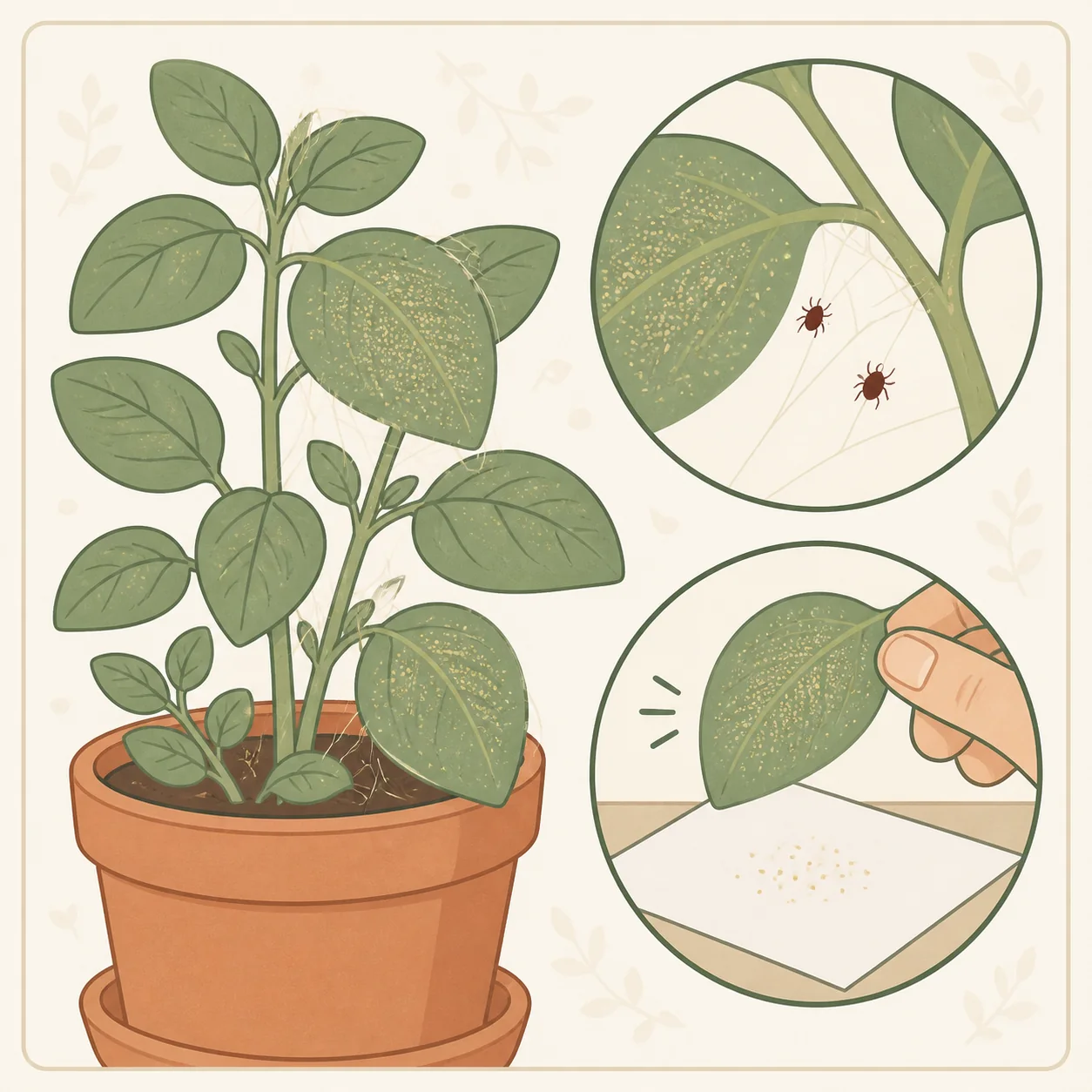
Spider mites on indoor herbs: signs, paper test, and control
Spider mites are easiest to control before webbing is obvious. Look for fine pale stippling and confirm moving specks over white paper.
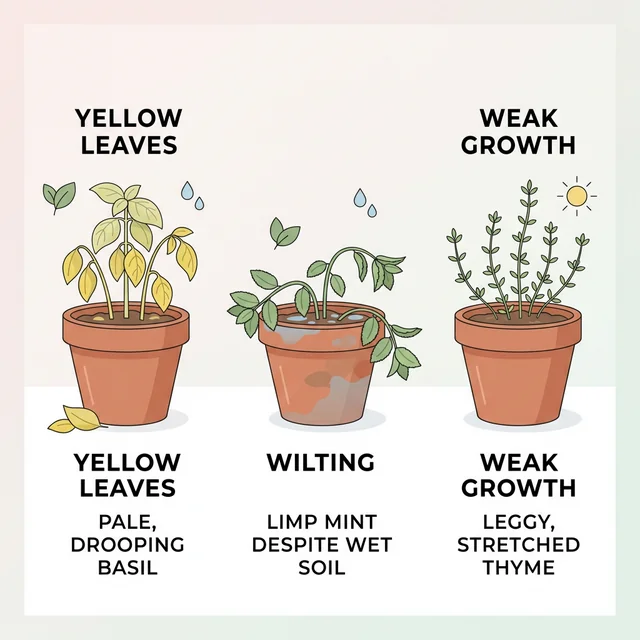
Common potted herb problems: yellow leaves, wilting, and weak growth
Common potted herb problems usually show up as yellow leaves, wilting, or weak growth, but the useful diagnosis starts with light, drainage, and root stress.
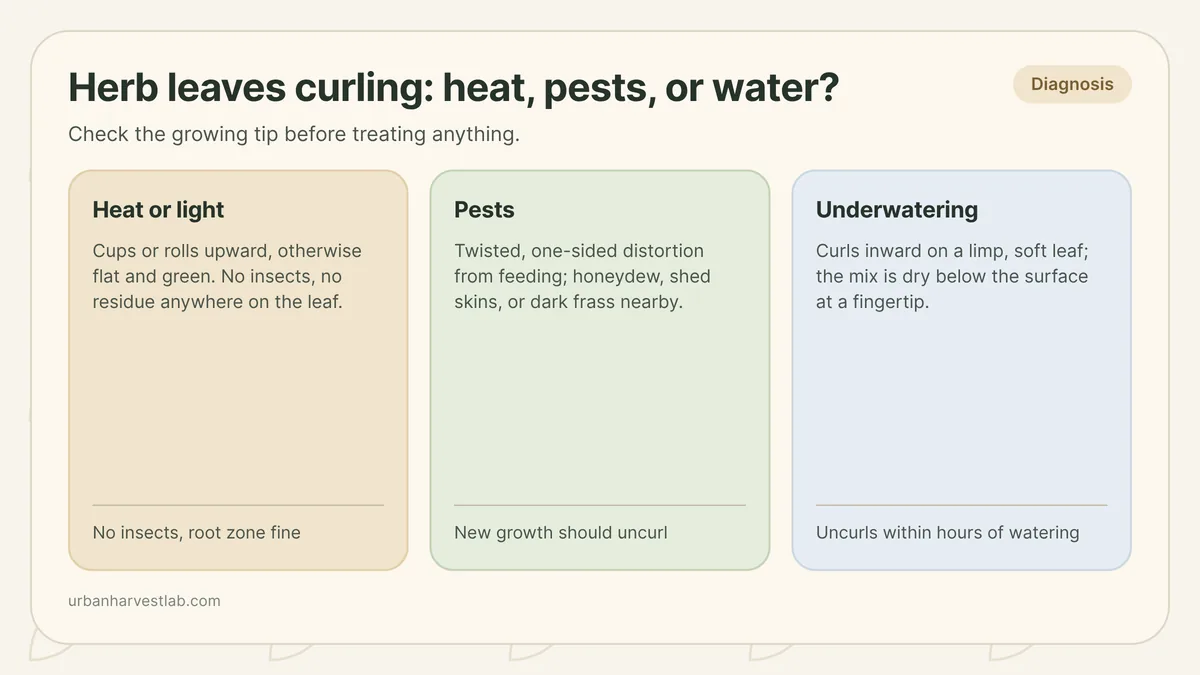
Herb leaves curling: heat, pests, or water
Curling herb leaves usually mean one of three things: heat or bright light, a pest on the growing tip, or a root zone that has gone too dry.