Troubleshoot the system before you change the inputs.
Symptoms
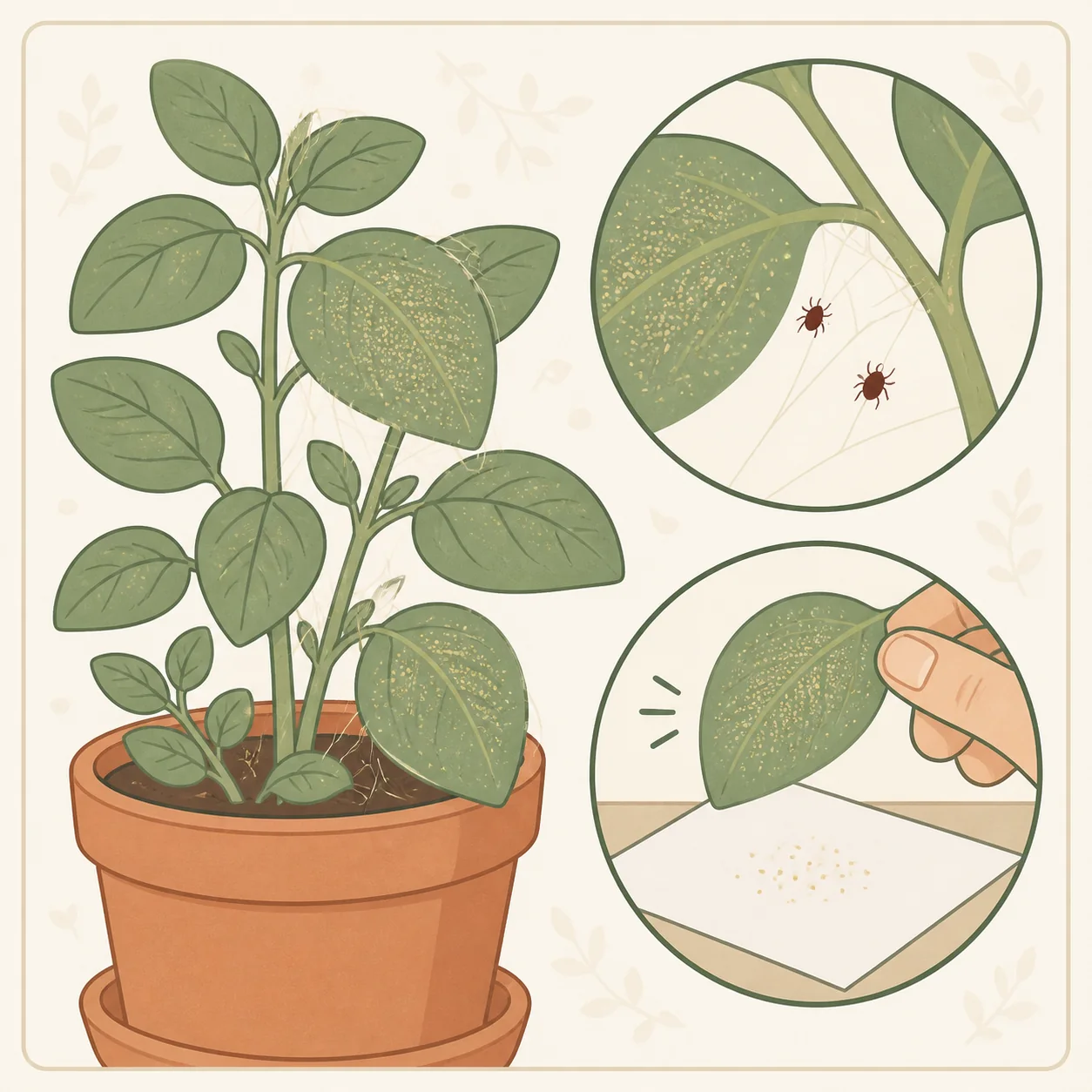
- Fine pale or bronze stippling across leaves.
- Tiny moving specks on leaf undersides or white paper.
- Fine silk around petioles and growing tips in an established infestation.
Possible causes
- Mites arrived on a new plant or cutting.
- Warm, dry conditions favored rapid population growth.
- Early leaf damage was mistaken for nutrition or watering stress.
Quick fixes
- Isolate the plant and test nearby foliage over white paper.
- Rinse leaf undersides and remove the worst affected growth.
- Reinspect repeatedly and use only products labeled for the edible crop.
Spider mite evidence by confidence
| Observation | What it suggests | Next check |
|---|---|---|
| Fine pale stippling | Sap-feeding damage possible | Inspect underside with lens |
| Moving specks on white paper | Mites likely | Confirm on several leaves |
| Fine webbing plus stippling | Established spider mite population | Isolate immediately |
| Sticky residue | Another pest more likely | Look for aphids, scale, or whiteflies |
Spider mites are tiny arachnids that feed by piercing plant cells. On indoor herbs, the first useful sign is often a field of pale pinpricks across a leaf. By the time silk spans multiple stems, the population may be large.
Do not diagnose mites from a yellow leaf alone. Begin with common potted herb problems when light or root stress remains plausible. Mite damage becomes convincing when stippling, a close inspection, and movement on a paper test agree.
Recognize early damage
Hold the leaf against a bright background. Spider-mite feeding produces numerous fine, separate pale points that can merge into bronzing. Damage often begins on older or sheltered leaves, but distribution varies.
Turn the leaf over and use a 10× lens if available. Look for tiny moving dots and small translucent spheres. Fine silk near veins or petioles is strong evidence, but dust, ordinary spider silk, and leaf hairs can mislead at a glance.
Unlike aphids, mites do not produce sticky honeydew. If the leaves and nearby surface are sticky, inspect for aphids, scale, mealybugs, or whiteflies.
Do the white-paper test
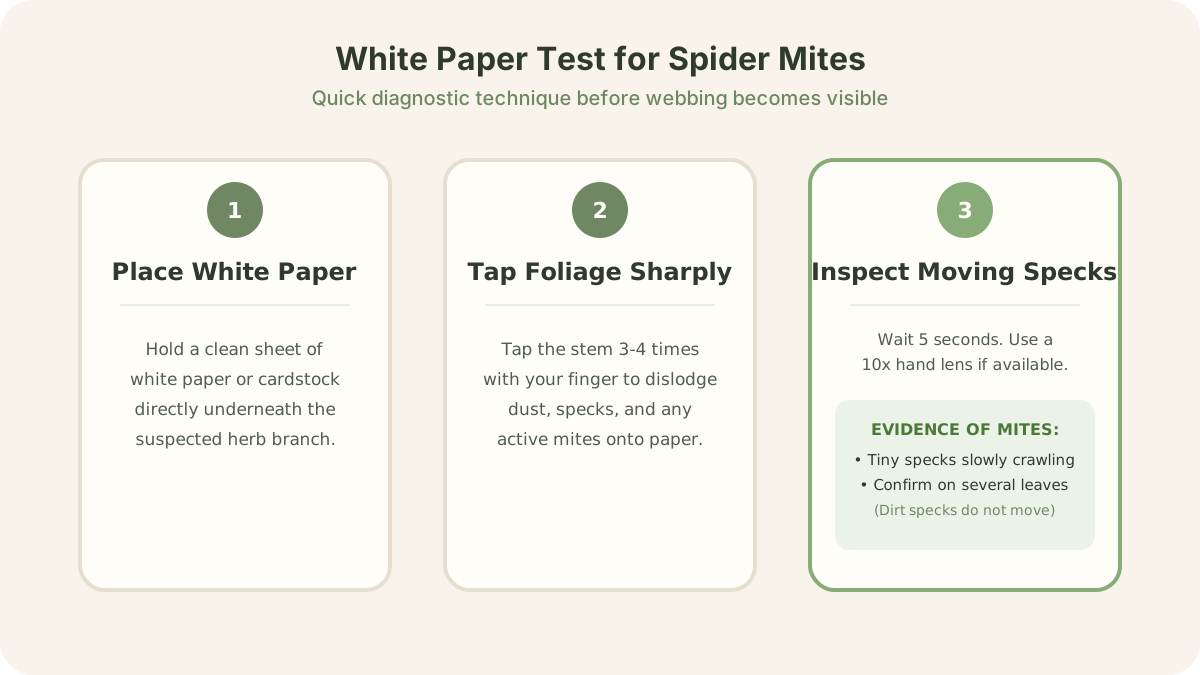
Place clean white paper beneath suspect foliage. Tap the leaf several times. Wait a moment, then watch the fallen specks under strong light or magnification. Mites may begin moving across the paper. Smearing an unknown speck is less reliable than observing movement and confirming the same pattern on several leaves.
Test the plant in multiple areas and test its neighbors. Record which pots are positive so isolation decisions are based on evidence.
Isolate without spreading them
Move the affected plant carefully, avoiding contact with other foliage. Work on uninfested plants first and the isolated group last. Clean cutting tools and the surface below the plant.
If several plants touch, treat them as an exposure group until repeated inspections remain clear. A quarantine space still needs suitable light; weakening the herb in darkness makes recovery harder.
Reduce the population physically
Prune leaves that are densely webbed or largely damaged, while retaining enough healthy foliage for recovery. Bag material immediately.
Rinse the plant thoroughly, emphasizing leaf undersides and stem junctions. Use water pressure the herb can tolerate. Repeat the white-paper test after the plant dries to judge how much the population fell.
Wiping individual broad leaves can help, but it is impractical on dense herbs. Rinsing and selective pruning usually cover more surface.
Decide whether a labeled treatment is needed
If live mites continue after physical removal, consult registered products for the specific edible crop and indoor or outdoor setting. Horticultural oil or insecticidal soap products can suppress mites when the label permits and coverage reaches them.
Contact materials do not repair damaged tissue and may not eliminate every life stage in one application. Follow the label’s interval, maximum applications, protective measures, and harvest directions. Test for leaf sensitivity as directed. Do not improvise stronger concentrations.
Some pesticides can worsen mite outbreaks by killing natural enemies without controlling the mites effectively. Product choice should come from local extension or regulatory guidance, not a generic household recipe.
Reinspect through the recovery period
Mark two or three leaves that still have usable green area and photograph them. Old stippling will remain even after control; look for damage on new leaves and for mites on the paper test.
Inspect every few days initially, then weekly after repeated negative tests. Continue checking nearby plants. Maintain appropriate watering and light, but avoid a sudden fertilizer push. Recovery is measured in clean new growth.
Environment helps, but is not the cure
Spider mites often multiply quickly in warm, dry indoor conditions. Improving plant hydration and avoiding hot, stagnant pockets can reduce stress. Raising room humidity indiscriminately is not a complete control and may encourage fungal disease or damage the building.
Instead, improve spacing, move the fixture if leaf temperature is excessive, and water according to the root zone. Use the measured light approach in PPFD and DLI for indoor herbs if heat and fixture distance are uncertain.
When replacement is the better decision
A heavily webbed annual herb with little healthy canopy can require repeated work while threatening every nearby plant. Bagging and replacing it may be the most responsible choice. Clean the pot, saucer, shelf, and tools before reuse.
Common mistakes
- Waiting for obvious webs before inspecting.
- Treating only the top of leaves.
- Assuming every tiny soil insect is a spider mite.
- Returning the plant after one negative test.
- Using an unlabeled mixture on an edible crop.
- Reading old stippling as proof that treatment failed.
Inspect the room, not just one pot
Check ornamentals, propagation plants, and overwintering vegetables sharing the room. Test foliage closest to the affected herb first, then plants along likely contact routes. Keep a simple map with positive, exposed, and clear groups.
Clean fallen leaves and dust from the shelf. This does not cure an infested plant, but it makes monitoring clearer and removes detached debris. Avoid carrying the plant through the collection repeatedly.
Make monitoring countable
Choose five leaves from different parts of each exposed plant. Tap each over a marked area of white paper and count moving specks for a fixed time. The count does not estimate the entire population, but repeating the same method shows direction.
A fall from many moving mites to zero across several checks supports control. One clean leaf does not. Continue until new foliage is clean and the exposed group has repeated negative tests.
Separate treatment injury from new damage
Oil, soap, heat, dehydration, and strong light can combine to injure foliage. If new patches appear soon after treatment, compare their position with treated surfaces and the label’s phytotoxicity warnings. Burn is not proof mites survived.
Record product, concentration, temperature, light conditions, and application time. Never keep soil saturated merely to raise humidity: that weakens roots and encourages fungus gnats without reliably controlling mites.
Inspect harvested and pruned material
Do not carry mite-covered cuttings through the kitchen or use them for propagation. Bag heavily affected material at the plant. If lightly affected herbs are otherwise suitable for harvest and no pesticide restriction applies, follow local guidance and wash them thoroughly; when webbing or contamination is extensive, discard them.
After pruning, repeat the paper test because removing the worst leaves can make a population look absent. Inspect stem junctions and small new leaves that were sheltered during rinsing.
Prevent reintroduction
Quarantine new plants and inspect any herb returning indoors after summer. Check pot rims, supports, and dense foliage before it joins the shelf. Keep plant leaves from touching across quarantine boundaries.
Record where the outbreak was first detected and which plants tested positive. If mites return, that map can distinguish an untreated reservoir plant from a newly introduced infestation and prevent repeating a broad, unfocused response.
Sources and further reading
- University of Minnesota Extension: Managing insects on indoor plants covers spider-mite signs, monitoring, and control categories.
- UC Statewide IPM: Spider Mites explains biology, damage, and integrated management.
Separate pests from environmental stress
Compare spider mites with aphids and general root, light, and care problems.
Common questions
Can spider mites fly?
No. They can spread on plants, hands, tools, clothing, and air currents carrying silk, but a flying insect is another pest.
Is webbing required to diagnose spider mites?
No. Fine stippling and mites found with magnification or a white-paper test may appear earlier. Heavy webbing usually means the population is already established.
Will raising humidity eliminate spider mites?
Humidity can influence population growth, but it is not a stand-alone control and excessive moisture can create other plant problems. Remove mites and monitor directly.
Related guides
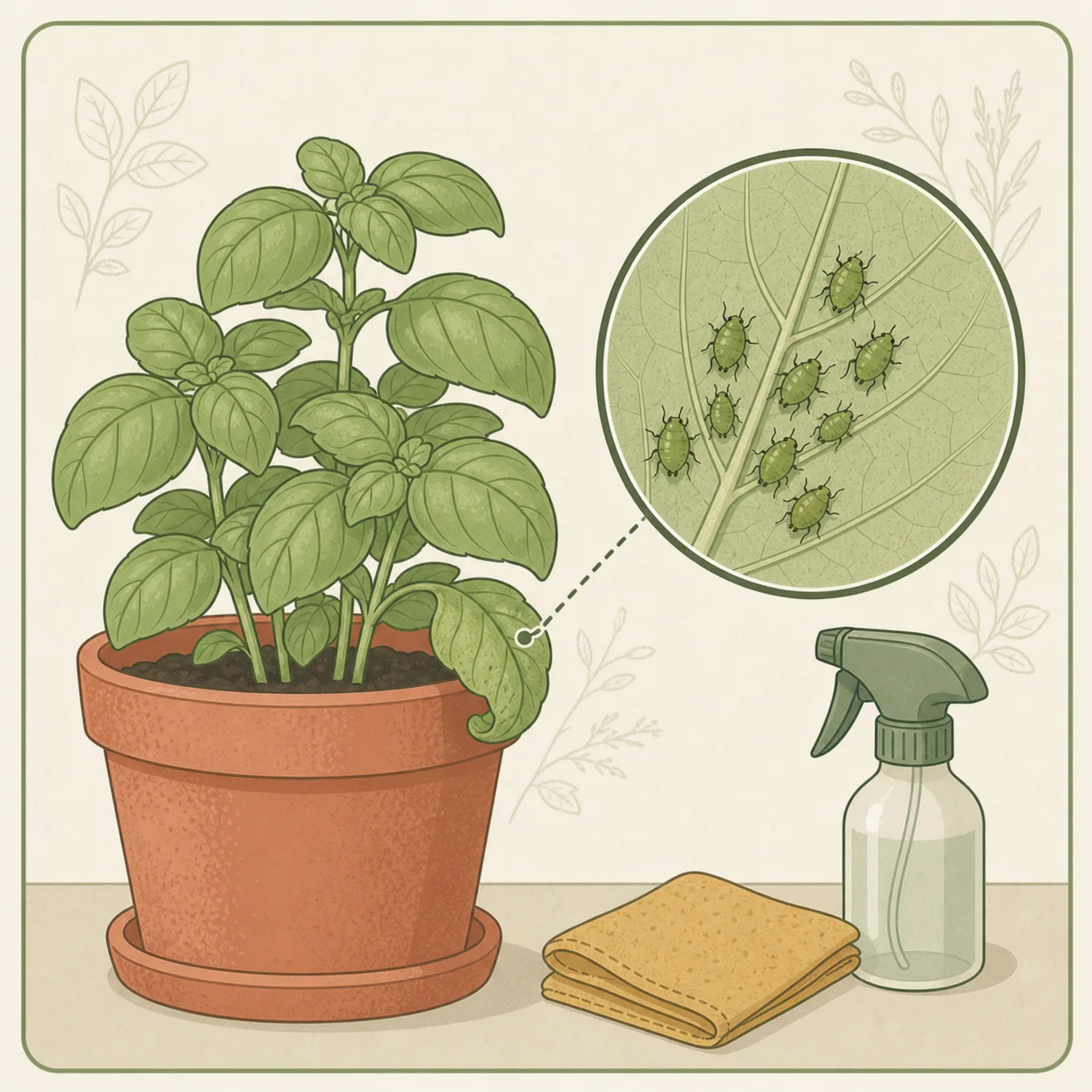
Aphids on indoor herbs: identify, isolate, and control them
Aphids are manageable when you find the colony, isolate the plant, remove most insects physically, and repeat inspections through the next generation.
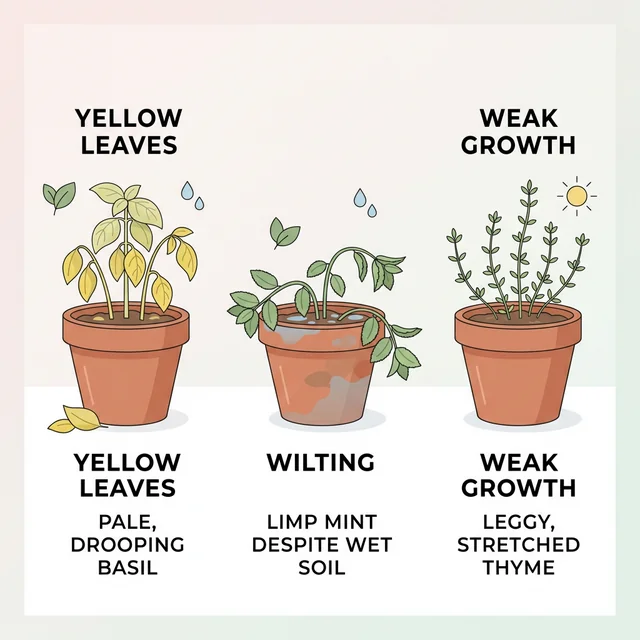
Common potted herb problems: yellow leaves, wilting, and weak growth
Common potted herb problems usually show up as yellow leaves, wilting, or weak growth, but the useful diagnosis starts with light, drainage, and root stress.
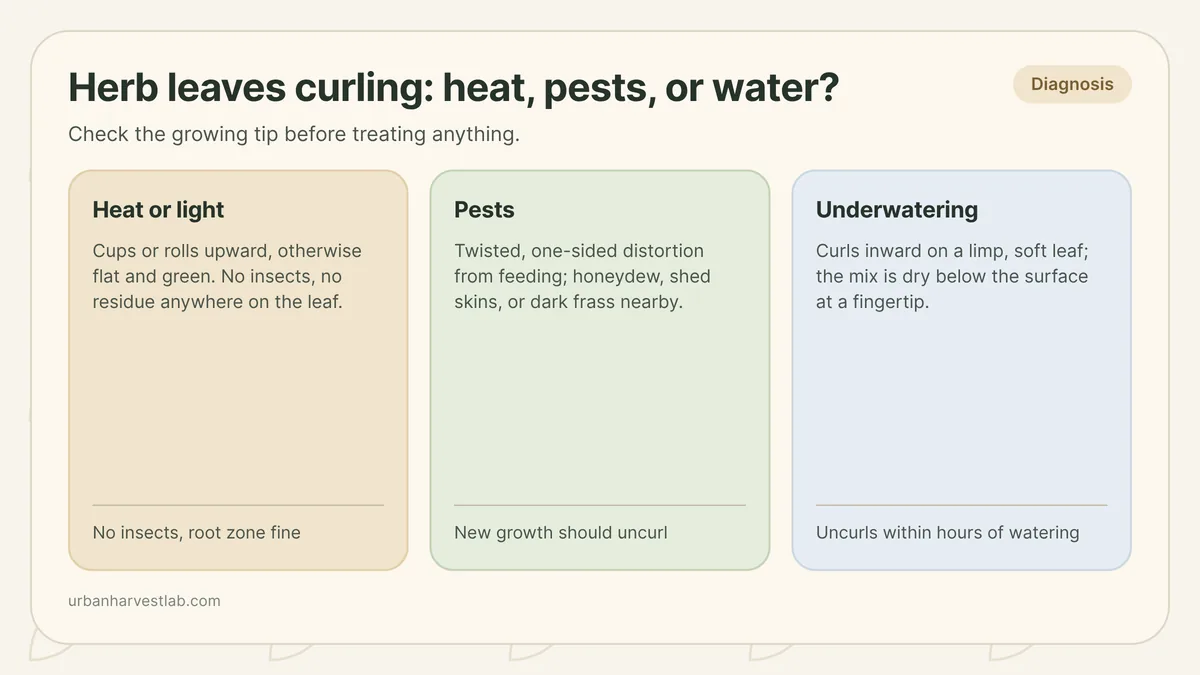
Herb leaves curling: heat, pests, or water
Curling herb leaves usually mean one of three things: heat or bright light, a pest on the growing tip, or a root zone that has gone too dry.