Troubleshoot the system before you change the inputs.
Symptoms
- Leaves curl upward or inward with no visible insects anywhere on the plant.
- New growth is distorted, sticky, or carries tiny moving specks on the underside.
- Curling shows up together with wilting, and the root zone feels dry below the surface.
Possible causes
- The plant is sitting in intense direct sun or a hot spot, with no insects on the growing tip and no dry root zone to explain the curl.
- Aphids or thrips are feeding on the growing tip and distorting tissue as it expands.
- The root zone has been dry long enough that the plant is losing more water through its leaves than its roots can replace.
Quick fixes
- Move the herb out of direct midday sun or away from a hot window, then recheck after it cools down.
- Inspect the underside of curled leaves and the growing tip with a hand lens before treating for a pest.
- Water thoroughly if the mix is dry at a fingertip, then watch whether new growth relaxes within a day.
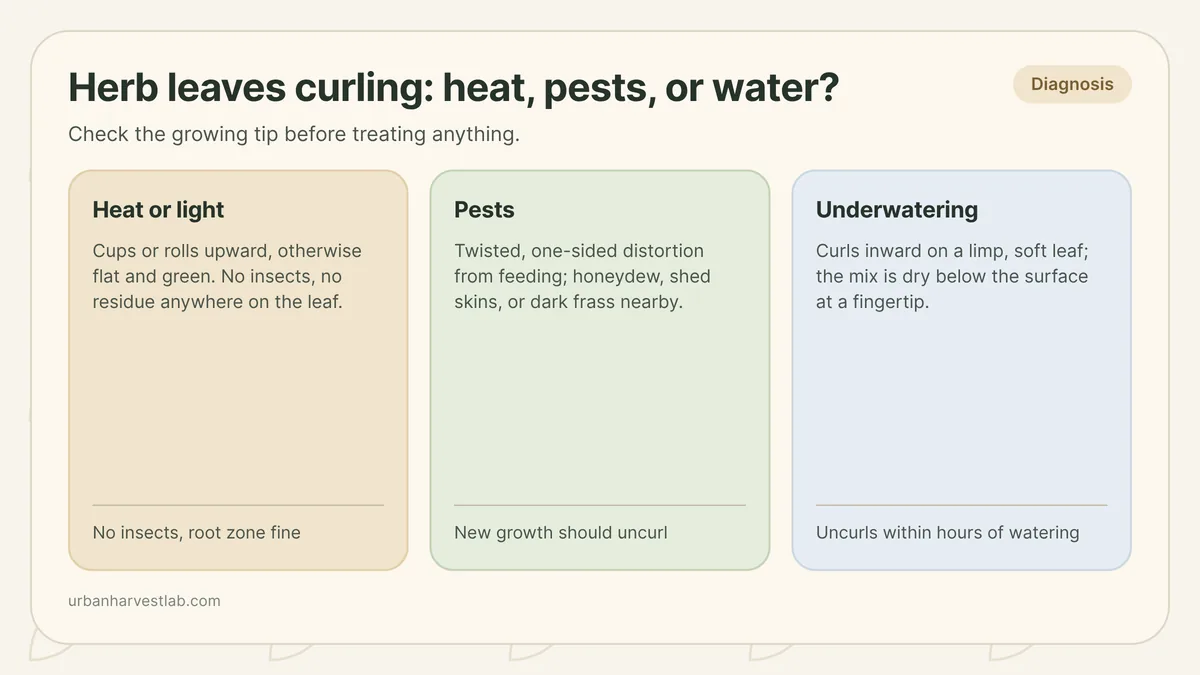
Herb leaf curl: heat, pests, or underwatering
| Clue | Heat or light | Pests | Underwatering |
|---|---|---|---|
| Leaf shape | Cups or rolls upward, otherwise flat and green | Twisted, puckered, or one-sided distortion | Curls inward on a limp, soft leaf |
| Other signs | None; no residue, no insects | Honeydew, shed skins, or dark specks of frass | Wilting, and the mix is dry below the surface |
| Response to a fix | No insects and no residue; the root zone is not dry | Damaged leaf often stays curled; new growth should not be | Uncurls within a few hours of a deep watering |
Curling herb leaves usually come down to one of three things: heat or bright light, a pest feeding on the growing tip, or a root zone that has gone too dry. Each one has its own fix, and treating one cause as though it were another wastes the time the plant needs to recover. Work through the three in order rather than reaching for a spray bottle first.
If curling is only one of several things your herb is doing at once — pale color, slow growth, a container that rarely seems to dry out — the broader common potted herb problems guide walks through light, root stress, and container issues in a fixed order before you narrow in on curling specifically.
Start with the undersides, not the leaf shape
Before deciding which of the three causes applies, turn a curled leaf over and look at the growing tip with a hand lens. This one check rules out or confirms an entire branch of the diagnosis: if you find insects, sticky residue, or dark specks, you are dealing with a pest regardless of how hot the room is or how the soil feels. If the underside is clean, move to light and water.
Heat and bright light: what is left when the first two checks are clean
UC IPM and Clemson do not actually list heat or bright light as a cause of leaf curl. They describe curl under pest feeding, chronic underwatering, and high-pH micronutrient problems, and Clemson’s list of heat-related damage on potted plants is hot, dry air causing brown tips and leaf margins — not curl. So treat this branch as what is left once you have checked the growing tip for insects and confirmed the root zone is not dry: a plant sitting in intense direct sun or a hot spot near a window, with no honeydew, no webbing, no residue, and older leaves affected about as much as younger ones.
If you land here, move the pot back from the glass or add light shade during the hottest part of the day. If the curling coincides with an actual heat wave rather than routine afternoon sun, the heat wave protection guide for container plants covers moving, shading, and watering plants through the worst of it. If the problem is chronic rather than a one-off hot afternoon — the herb is stretched, pale, and slow as well as curling — that is more often a light-level mismatch than a heat spike, and how much light herbs need is the page for sorting that out.
Pest-caused curling: check for insects before anything else
Two pests distort herb leaves as they feed, and both leave clues beyond the curl itself.
Aphids are soft-bodied insects identified by a pair of tube-like structures, called cornicles, projecting from the rear of the body — a feature no other common houseplant pest has. UC IPM notes that some aphid species inject a toxin into the plant as they feed, which is what causes the curl, and Clemson Cooperative Extension lists indoor aphids at about 1/16 to 1/8 inch long. Look for a cluster of these insects on the growing tip or leaf undersides, along with pale shed skins and honeydew that can turn the leaf sticky.
Thrips are longer and more slender, described by UC IPM as less than 1/20 inch long with narrow, fringed wings, while Clemson Cooperative Extension gives a slightly different size convention of less than 1/16 inch. UC IPM lists distorted, curled, or dead shoot tips as thrips damage, and the discriminator that separates thrips from spider mites is frass: thrips leave dark specks of excrement on the leaf surface, which mites do not.
Spider mites are a related lookalike worth ruling out even though they rarely cause true curling on their own — UC IPM describes their damage as fine pale stippling, sometimes with a bronze cast, and webbing as the one unambiguous sign once an infestation is advanced. If stippling and fine webbing are what you are actually seeing rather than curl, the spider mites guide covers identification and control.
Curl caused by a pest toxin is a useful discriminator on its own: unlike thirst curl, which relaxes once the root zone is watered, curl from a pest toxin does not reverse even once the pest is gone. Judge recovery by whether new leaves expand flat, not by whether the old, damaged ones ever uncurl. Once you have confirmed live insects, the aphids on indoor herbs guide sets out a repeatable isolate-and-rinse control loop suited to a plant you intend to eat.
Underwatering: curling that comes with wilting
Chronic underwatering produces wilting and leaf curling together, according to Clemson Cooperative Extension’s houseplant disorder guidance, and if it continues long enough, lower leaves yellow and the plant declines. Clemson also cautions that “the symptoms of over-watering and underwatering are similar,” so a wilted, curling canopy on its own does not settle which way the watering error runs — the overwatered vs underwatered guide covers the finger test, the weight test, and the response-to-watering test that do.
Confirm it with a finger test before watering: Clemson’s guidance is to push a finger into the mix up to the first joint, and if it is dry at the fingertip, the plant needs water. A pot that has become noticeably lighter than usual is another sign the root zone has dried out.
Water thoroughly and watch the response. A plant that visibly relaxes within a few hours of a deep watering was dry. One that stays wilted and curled after the mix is thoroughly wet is showing root injury rather than thirst — UC IPM states that plants with Phytophthora root and crown rot “don’t recover when irrigated.” For a herb that keeps drying out faster than expected between waterings, how often to water potted herbs covers adjusting the schedule to the pot, mix, and season, and potted herb care covers watering alongside feeding and pruning.
A few curls that are not heat, pests, or thirst
Occasionally a curling herb fits none of the three branches above cleanly.
High soil pH can lock up iron, manganese, or zinc and distort new growth in a way that looks similar to pest feeding, without any insect present. UC IPM puts the good range for nutrient availability at pH 6.0 to 7.5 and says that above it, iron, manganese, and zinc become unavailable, while Clemson gives herbs well-drained soil at pH 6 to 7. Test soil from the root zone specifically, as UC IPM recommends, once insects and a dry root zone have already been ruled out.
Potassium deficiency is another possibility, and it shows up on older leaves rather than the growing tip: UC IPM describes older foliage turning “yellowish or brown at the tips and margins and between veins,” with curled edges — a different pattern from the pest-driven distortion on new growth.
In basil specifically, Fusarium wilt is worth ruling out once a plant reaches 8 to 12 inches tall: University of Maryland Extension reports that infected leaves yellow, become malformed, and may curl, alongside internal stem browning that starts near the base of the plant. The basil stem turning brown and woody guide covers the stem-cut check that separates Fusarium from a plant that is simply dry or root-rotted.
All three are less common than the three main branches above and worth checking only once insects and a dry root zone have already been ruled out.
Common mistakes
- Reaching for an insecticide before turning the leaf over to check for an actual pest — and if you do spray, NPIC states that if your fruit or vegetable is not listed on the product label, you cannot apply the product to it; see neem oil on herbs: what the label decides.
- Fertilizing a curling herb on the assumption it is hungry; a stressed plant with compromised light or roots usually cannot use extra nutrients well.
- Watering an already-wet pot because the leaves are curled, without checking the root zone first.
- Judging recovery by whether old, pest-damaged leaves uncurl instead of watching new growth.
- Misting the foliage as a general response instead of addressing heat, pests, or the root zone directly.
Sources
- UC IPM Pest Notes: Aphids
- UC IPM Pest Notes: Thrips
- UC IPM Pest Notes: Spider Mites
- UC IPM Pest Notes: Phytophthora Root and Crown Rot in the Garden
- UC IPM: pH Problems
- UC IPM: Common Nutrient Deficiency Symptoms
- University of Maryland Extension: Fusarium Wilt in Basil
- Clemson HGIC: Houseplant Diseases & Disorders
- Clemson HGIC: Indoor Plants – Watering
- Clemson HGIC: Common Houseplant Insects & Related Pests
Diagnose before you treat
Curling can overlap with pests, watering, and light stress; use these guides to separate the signals.
Common questions
Will curled herb leaves uncurl on their own?
Leaves curled by thirst usually flatten out again once the root zone is watered, but UC IPM notes that some aphid species inject a toxin that curls the leaf, and that curl stays after the aphids are gone — so judge recovery by new growth, not by the damaged leaves.
Should I cut off curled leaves right away?
Not immediately. Curled leaves are useful evidence while you are still working out the cause. Once you have confirmed the cause and the plant is recovering, remove leaves that are badly damaged or that are crowding healthy new growth.
Can heat and pests both be involved at the same time?
Yes. A heat-stressed herb is not automatically pest-free, and Clemson Cooperative Extension notes that stressed plants are generally more susceptible to pests, so check the undersides for insects even when a hot windowsill looks like the obvious cause.
Does misting the leaves stop herb leaves from curling?
Misting does not address heat, pest, or underwatering causes directly, and repeatedly wetting foliage can encourage fungal problems on some herbs. Fix the root zone, light, or pest situation first.
Related guides
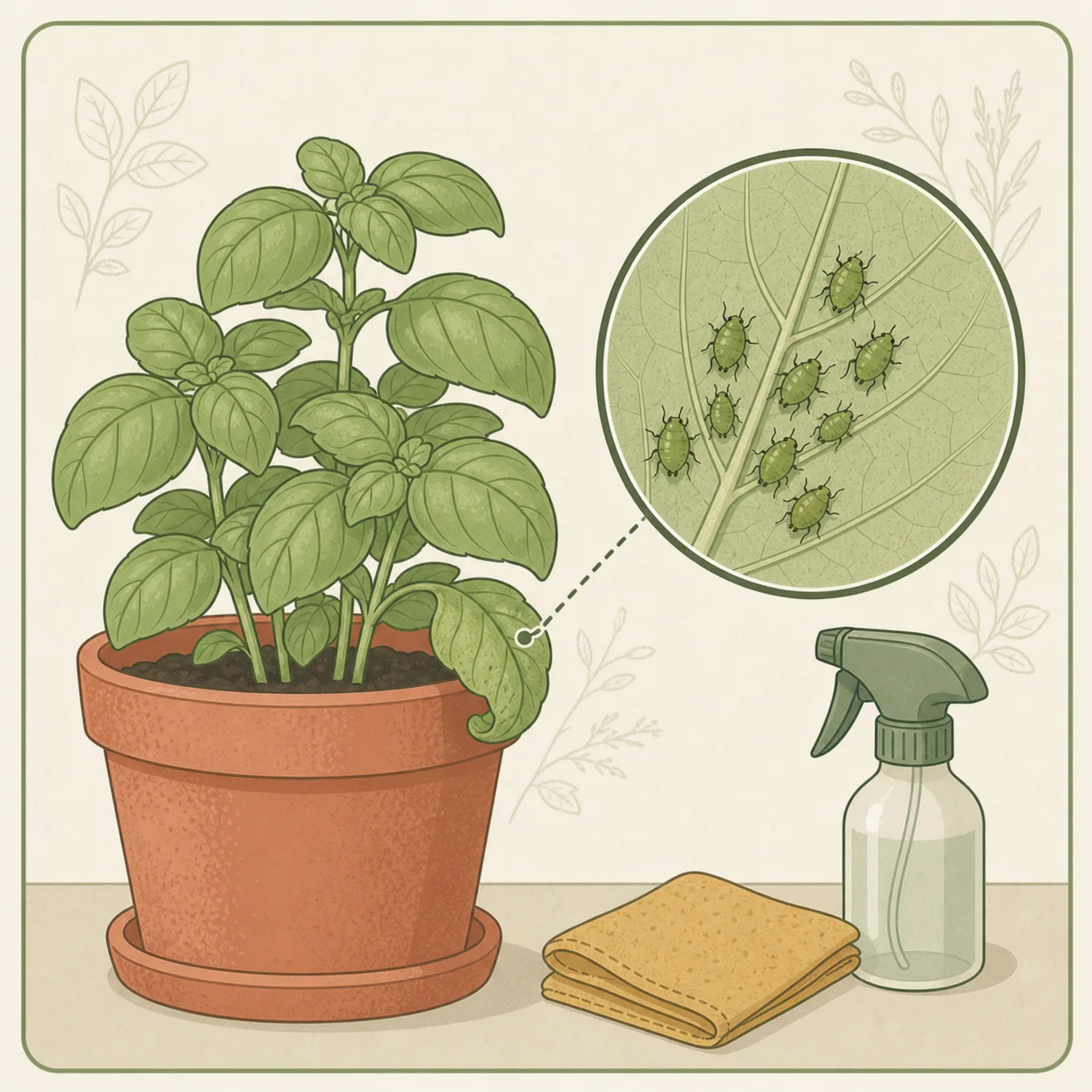
Aphids on indoor herbs: identify, isolate, and control them
Aphids are manageable when you find the colony, isolate the plant, remove most insects physically, and repeat inspections through the next generation.
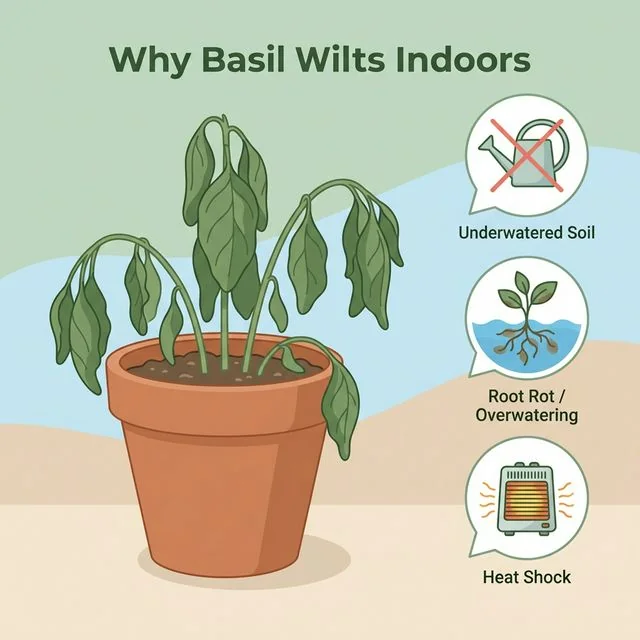
Why is my basil wilting indoors? Stop the droop
Basil is famous for being dramatic. If your plant suddenly wilts into a sad green puddle, don't panic. Here is exactly how to diagnose the droop and revive it.
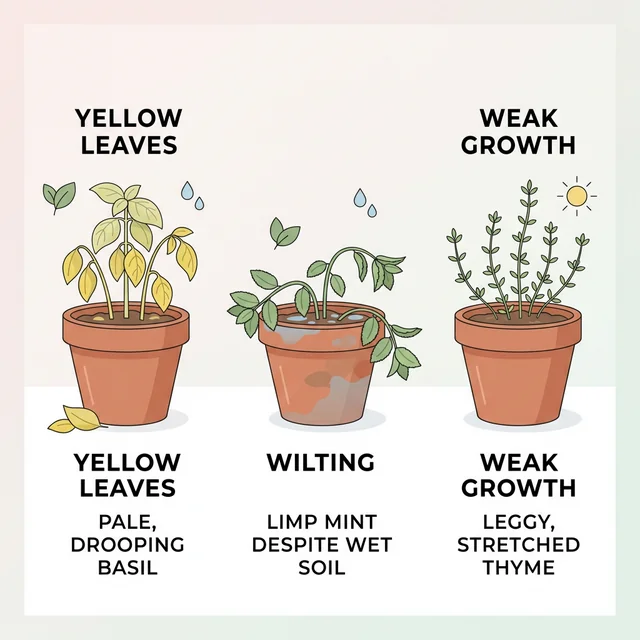
Common potted herb problems: yellow leaves, wilting, and weak growth
Common potted herb problems usually show up as yellow leaves, wilting, or weak growth, but the useful diagnosis starts with light, drainage, and root stress.