
Troubleshoot the system before you change the inputs.
Symptoms
- A tight cluster of small buds or a spike forms at the tip of a stem.
- The top of the stem has stopped producing full-size leaf pairs.
- Small white or pale flowers open at the stem tip.
Possible causes
- Basil is a tender annual and flowers as part of its normal cycle, often in mid- to late summer according to the RHS.
- Overcrowded plants tend to start flowering sooner, according to the RHS. Supermarket pots are usually packed with thin seedlings.
- Leaves are not being picked often enough, so tips are left to run to bud.
- A potassium-rich feed such as tomato feed encourages flowering, according to the RHS.
Quick fixes
- Cut the flower stem back to just above the first leaf pair beneath it.
- Thin or divide crowded plants and switch to a balanced feed.
- Pick from the tips every few days so no shoot is left to bud.
- Start a replacement plant if most stems are already in bud.
Pinch the flower spike off as soon as you see it, cutting just above the first leaf pair beneath the buds. Penn State Extension says basil flowers should be pinched off throughout the summer, because the flavor is adversely affected if the plant is allowed to flower. The plant is not sick. It is an annual starting its seed phase, and your job is to push that back for as long as you can.
If you want the full cutting routine for basil, mint, parsley and chives, the herb pruning guide covers it.
Check that it is flowering
A flower spike forms at the tip of a stem: a tight whorl of small buds that stretches into a spike, opening to small pale flowers. The leaves just below it usually shrink. Three other things look similar at a glance and are not the same problem:
- Tall, stretched stems with widely spaced leaves and no buds. That is a light or pruning issue, covered in leggy basil indoors.
- Brown, hard stems at the base with healthy growth above. See why basil stems turn brown and woody.
- Cilantro going to seed. That is a different species with its own triggers, handled in cilantro bolting.
Pinch it or let it bloom
Pinch, if you cook with the leaves. Three horticultural sources agree on the reason:
- Penn State Extension: “The flavor will be adversely affected if the plant is allowed to flower.”
- The RHS: flowering “does affect the flavour of the leaves”.
- University of Illinois Extension: herbs are best harvested before they start to flower, otherwise leaf production declines, and removing flowers as they appear keeps new leaves coming.
Iowa State Extension adds that for annual herbs grown for their foliage, removing flower buds encourages additional leaf growth and may enhance flavor. Letting it bloom is a real option in two cases. The RHS says it is worth letting plants bloom eventually, or letting one plant flower early if you have several, since basil flowers are rich in nectar and feed bees and other insects. If you are at the end of the season anyway, a flowering plant on the balcony is a reasonable last act. Keep one flowering plant and pinch the others, and you get both.
How to cut a flower spike
- Find the first pair of full-size leaves below the buds.
- Cut or pinch the stem just above that pair. Iowa State Extension recommends cuts just above a leaf or pair of leaves to encourage regrowth.
- Look for two tiny shoots in the leaf axils below the cut. Those become the new branches.
- If several stems are in bud at once, work through them in turn. Penn State Extension’s routine of cutting a branch back to its first set of leaves each time it has six to eight leaves keeps the plant branching and removes tips before they bud.
Those cut tips are food. Use them.
If the whole plant has gone to spike, University of Illinois Extension says annual herbs can be cut back 50-75 percent and still recover, and Iowa State Extension gives the same type of cut as back to within 4 to 6 inches of the ground. Cut above a leaf pair or a pair of side shoots, not into bare stem. Whether a particular plant that far gone recovers depends on its health, the weather and how much leaf is left, so judge by whether new leaf pairs appear.
Delay the next spike
Cutting buds off treats the symptom. These steps push the next round back:
- Pick often. Penn State Extension says to keep picking the leaves regularly to encourage growth through the summer, and to watch for early flowering from about six weeks after planting. Harvesting from the tips takes off the shoots that would otherwise bud. The harvest guide shows how to do it without stripping the plant.
- Give each plant room. The RHS says overcrowded basil tends to start flowering sooner and thins seedlings to 10-20 cm (4-8 in) apart. A pot of supermarket basil is typically a dense clump; the RHS says such pots often contain overcrowded plants that soon start flowering, though they may survive if divided and repotted promptly.
- Check the feed. The RHS advises a balanced liquid fertiliser for leafy growth and says to avoid potassium-rich feeds such as tomato feed, as they encourage flowering.
- Plan the replacement. Penn State Extension describes basil as a tender annual that must be replanted every season. Sow or buy a second plant mid-season so the first can retire when it stalls.
When the plant is finished
If every stem is in bud, the leaves have shrunk and a cut-back does not bring new pairs, the plant has reached the end of what it will do. Take a handful of cuttings first: the RHS says basil is easy to root from softwood cuttings taken in summer, using a non-flowering shoot snipped just below a leaf and stood in a jar of water. Pick a shoot without buds.
Sources
Keep basil productive
Pruning and harvest technique, plus the other basil problems that can look like a flowering plant.
Common questions
Basil flowering: what should I do?
Pinch or cut the flower stem off just above the first pair of leaves below it. Penn State Extension says basil flowers should be pinched off throughout the summer and that the flavor is adversely affected if the plant is allowed to flower. Then harvest regularly so new shoots replace the spike.
Are basil leaves still edible after the plant flowers?
Yes, they can be picked and eaten, but the RHS notes that flowering affects the flavour of the leaves, and the University of Illinois Extension says leaf production declines once herbs start to flower. Pinch the spikes early if leaf flavour is the goal.
Should I ever let basil flower?
It is a fair choice late in the season, or on one plant out of several. The RHS points out that basil flowers are rich in nectar and feed bees and other insects. Expect fewer and less flavorful leaves from that plant.
Can I stop basil from flowering completely?
No. Penn State Extension describes basil as a tender annual that must be replanted every season, so it is heading for flowers and seed regardless. Pinching, regular harvest and avoiding crowding delay it.
Related guides
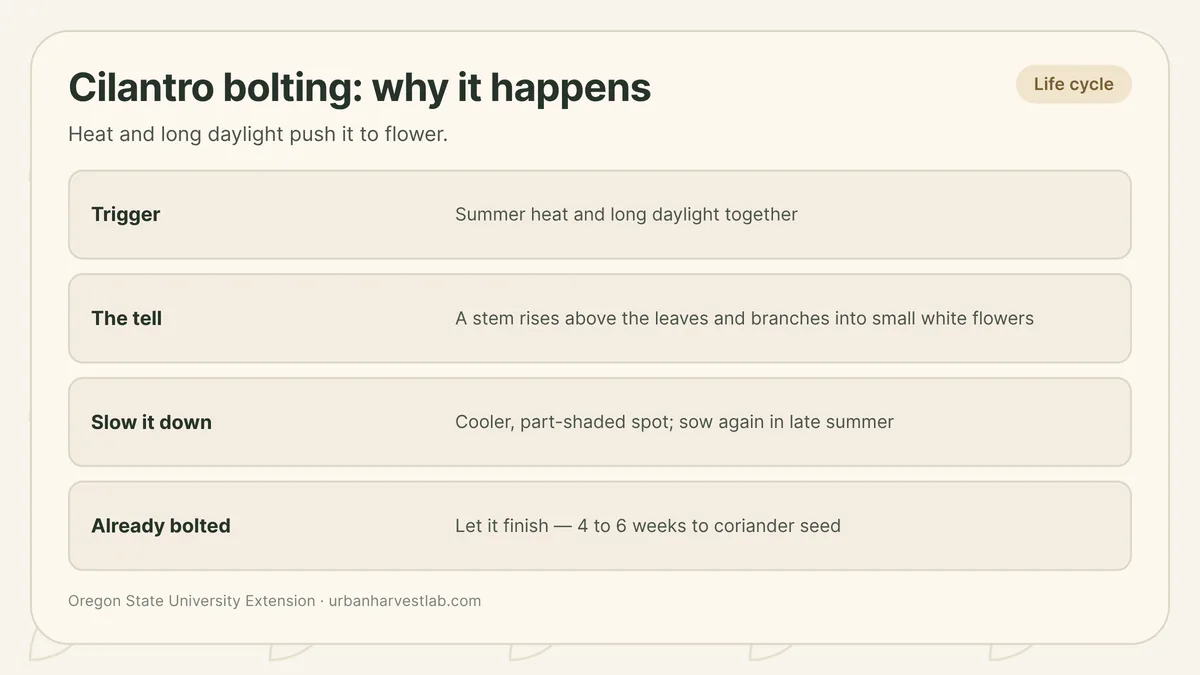
Cilantro bolting: why it happens and how to slow it down
Cilantro is an annual that bolts once heat and long daylight hours push it toward flowering, and cooler placement, sowing timing, and succession sowing are what actually slow it down.
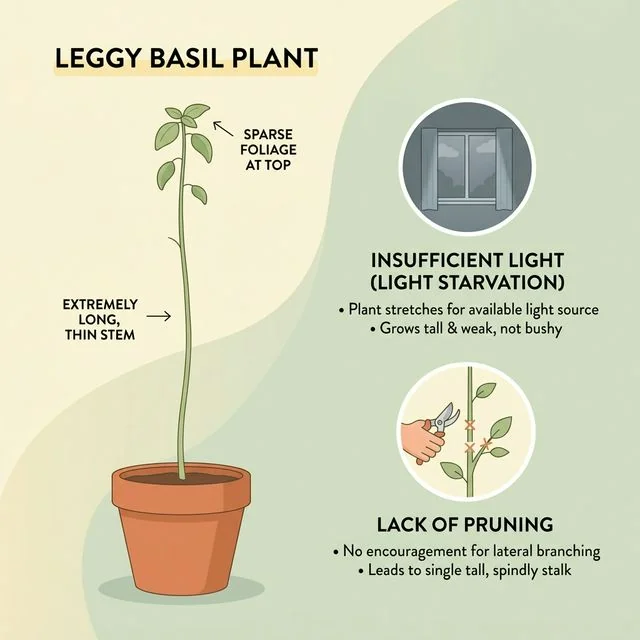
Leggy basil indoors: light problem or pruning problem?
A bushy, compact basil plant is the goal of every gardener. If your plant is growing into a ridiculously tall, flimsy vine with only a few leaves at the top, you have 'leggy' basil. Here is how to diagnose and fix it.
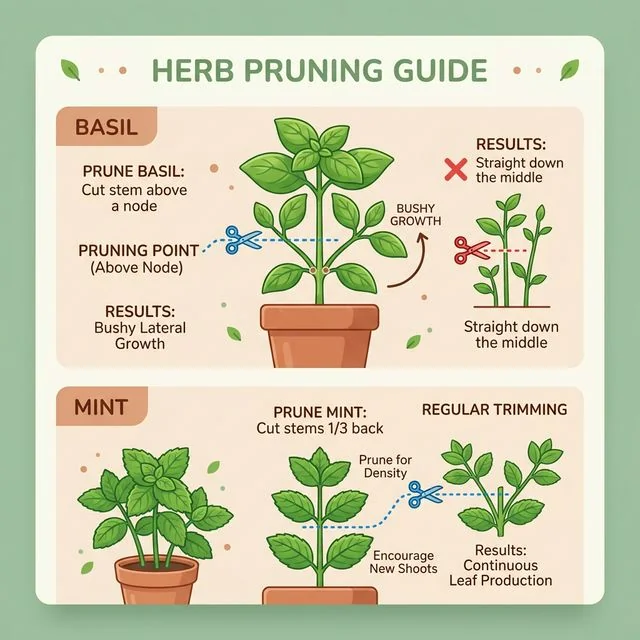
How to prune basil, mint, parsley, and chives without stunting growth
Basil and mint should be cut above a node, parsley should be harvested from the outer stems, and chives should be cut like a small patch of grass.