Troubleshoot the system before you change the inputs.
Symptoms
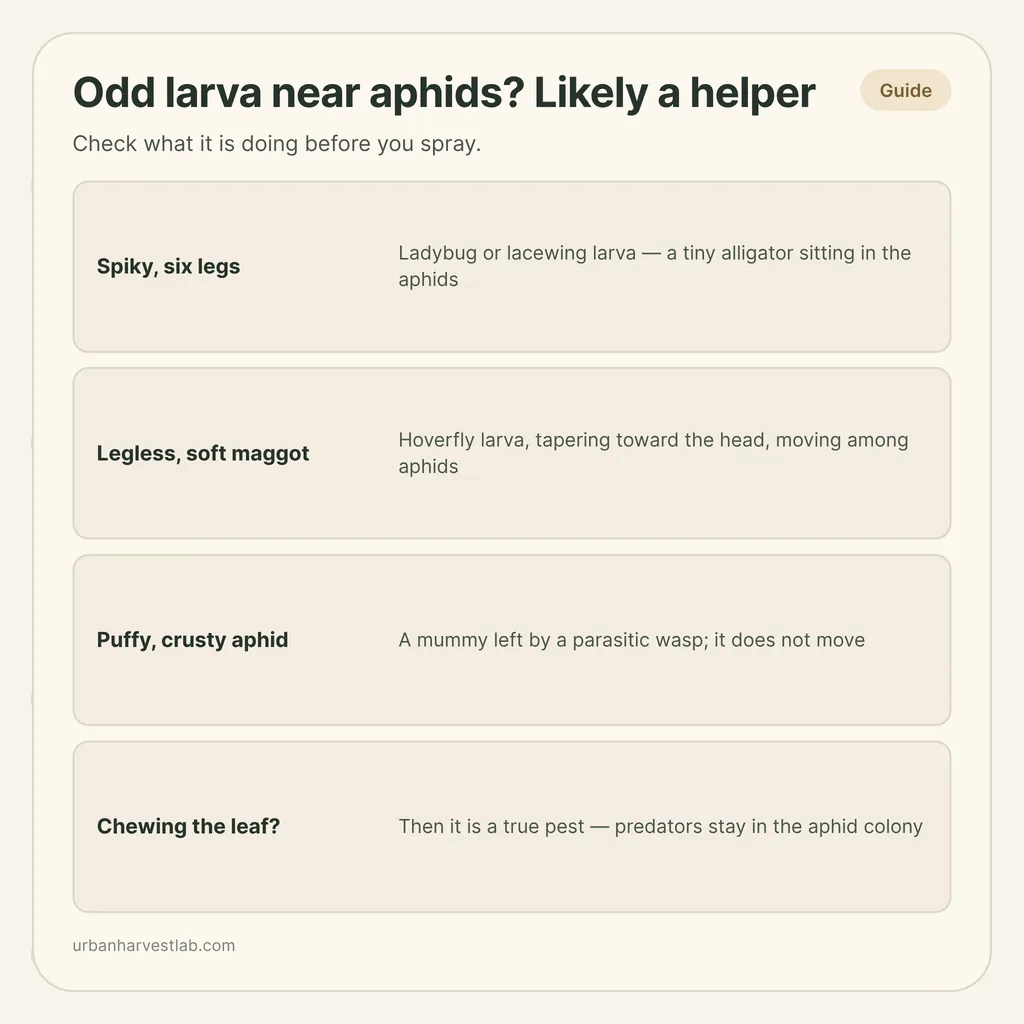
- A spiky or flattened larva with six legs crawling through an aphid colony
- A soft, legless, maggot-like grub among aphids, tapering toward the head
- Puffy, hard, tan, gold or black aphids that no longer move, some with a round hole
- Small stalked eggs or oval clusters of yellow eggs on leaves near aphids
Possible causes
- Lady beetle larvae feeding on aphids
- Lacewing larvae feeding on aphids and other soft-bodied insects
- Hoverfly (syrphid) larvae feeding on aphids
- Aphids parasitised by tiny wasps, now mummies
Quick fixes
- Leave the larva or mummy where it is and do not spray the plant for the next few days
- Check the leaf: if the larva sits inside the aphids and the leaf is not being chewed, it is a predator
- If aphids need handling, knock them off with a strong stream of water instead of spraying the whole plant
- Keep ants off the plant, because ants protect aphids from their natural enemies
A creature that looks like a tiny alligator, a flat grey maggot or a puffy tan aphid is most likely a predator or a parasite of the aphids around it. Leave it alone. These are the immature stages of insects that feed on aphids. If you are weighing whether to buy ladybugs, what releasing them really does is a separate question. Here you are working out what already arrived.
UC IPM’s aphid guide says the larval, or immature, stage of natural enemies such as lady beetles and lacewings most often feeds on aphids. That is why the ugly stage is the useful one.
First, check what it is doing
Position tells you more than colour. A predator sits in the aphid colony and moves from aphid to aphid. A pest sits on bare leaf and leaves holes behind.
UC IPM says certain caterpillars and the larvae of many types of flies resemble syrphid larvae, but that watching for predatory behaviour tells them apart. So give it a few minutes. If it is chewing the leaf edge, you are looking at something else, and the herb pest identification chart is the place to match it. If it is probing or grabbing aphids, read on.
UC IPM also recommends checking plants for aphids at least twice a week when growth is fast. Use that same look to note which predators are already present.
Ladybug larvae: the spiky alligator
UC IPM describes convergent lady beetle larvae as active, with long legs, resembling tiny alligators, and growing up to 1/4 inch (6 mm) long. The RHS says ladybird larvae are usually greyish-black with variable amounts of orange-red or white markings, and that some species are spiny. It gives a longer upper size of 12 mm (about 1/2 inch) across UK species.
Two points help:
- The orange gets brighter with age. UC IPM says the orange blotches become more prominent on older instars. A small, dark, nearly plain larva and a bigger, more colourful one can be the same species.
- Species differ. The RHS describes the seven-spot ladybird larva as grey with four pairs of orange markings, and the harlequin larva as spiky with two orange stripes.
The eggs are the first clue. UC IPM says lady beetle eggs are yellow, oblong, about 1 mm long and laid on end in clusters of about 10 to 30 on leaves and green stems near aphids. Find a yellow cluster standing upright beside aphids and you can expect larvae within days.
The pupa is the stage people mistake for a pest. UC IPM says it is about 5 mm (1/5 inch) long and glued to plant parts near where the larva fed. It starts orange and develops black blotches before the adult emerges. It will not move, and that is normal.
Lacewing larvae: the flat one with pincers
UC IPM says green lacewing larvae are elongate and flattened with distinct legs, and resemble tiny alligators like the ladybug larvae. The body is about 1/2 inch long or less. The feature that separates them is the mouthparts: UC IPM describes prominent, paired, tube-like jaws that curve inwards. The RHS says lacewing larvae seize aphids and other small insects with their curved jaws, and that those larvae reach up to 8 mm.
UC IPM adds that larvae use their sharp mouthparts to impale prey and suck out its body contents. They eat more than aphids. UC IPM lists mites, thrips, mealybugs, scales and others among their prey.
Some lacewing larvae look like a lump of debris. The RHS says some camouflage themselves by placing sucked-out aphid skins among the bristles on their backs, and UC IPM says larvae of certain genera cover their body with plant debris or prey remains. A “moving pile of rubbish” in an aphid colony is a good candidate.
The eggs are distinctive. UC IPM says each lacewing egg is laid on the end of a silken stalk attached to the plant. The pupa sits in a roundish cocoon about 1/8 to 1/4 inch across, with silk you can see through.
Hoverfly larvae: the soft maggot
Hoverfly (syrphid or flower fly) larvae look nothing like their adults. UC IPM says larvae of most species are maggot-like, without true legs, and taper toward the head. Colour is commonly brown, greenish, pink or whitish, and the body contents visible through the thin skin can change the colour depending on what the larva ate. Mature larvae of most species are 1/5 to 4/5 inch (5 to 20 mm) long. The RHS describes them as flattened, relatively broad, up to 12 mm, and often semi-transparent.
UC IPM names the prey as mostly slow-moving, soft-bodied insects, especially aphids. The adult fly is a different animal: UC IPM says many adults are black with orange, yellow or white bands and look like bees or wasps, but they have one pair of wings, not two.
Hoverfly eggs are small and easy to miss. UC IPM describes them as oblong, slightly curved, grey to white and about 1 mm or less in length, usually laid singly near the food. The pupa is hard and teardrop-shaped in most species.
Aphid mummies: the shells that stop moving
Some aphids on your leaf are not alive. UC IPM says that several days after being parasitised by an Aphidius wasp, the aphid becomes a crusty, puffy, smooth mummy that is brown, gold or tan. Wasps in another family, the Aphelinidae, leave black mummies. The RHS describes the mummy as whitish brown and inflated.
Look for a rounded hole. UC IPM says some mummies have a hole where the adult wasp chewed out. A living aphid is soft and has no holes visible to the naked eye. The adult wasp is tiny, slender and black and yellowish, 1/8 inch (3 mm) or less.
The timing matters. UC IPM says the wasp larva kills the aphid about 7 to 10 days after the egg is laid, and that the parasitoid does not change an aphid’s appearance until about a week after the egg is laid. Because of that delay, UC IPM says the percentage of parasitised aphids can be higher than the percentage of mummies you see. The colony may be in worse shape than it looks.
Before you spray
UC IPM’s aphid guide says that substantial numbers of natural enemies, including mummified aphids, can mean the aphid population will fall quickly without treatment. So the order is: look, wait a few days, then decide.
If you do need to act, UC IPM suggests a strong stream of water to knock aphids off sturdy plants. Its pest note says soaps, neem oil and horticultural oil kill only aphids present on the day they are sprayed, and that these materials can kill some natural enemies on the plant that are hit by the spray. They leave no toxic residue, so natural enemies that move in afterwards survive. UC IPM also says most insecticides will destroy beneficial insects along with the pest, and that systemic insecticides might harm beneficial insects on flowering plants.
Ants work against you. UC IPM says ants protect aphids from natural enemies, and its advice is to keep them off the plant. For aphids on herbs and other small plants, aphids on indoor herbs covers handling a colony that predators have not cleared.
The RHS says that by early to mid-summer aphid predators often wipe out colonies. That is a sound reason to put up with some aphids for a while in spring.
Sources
- Convergent lady beetle, Natural Enemies Gallery, UC IPM
- Green lacewings, Natural Enemies Gallery, UC IPM
- Syrphid flies, Natural Enemies Gallery, UC IPM
- Aphid Aphidius parasitoids, Natural Enemies Gallery, UC IPM
- Aphids, Home and Landscape, UC IPM
- Aphid predators, Royal Horticultural Society
- Ladybirds, Royal Horticultural Society
Aphids and the insects that eat them
Identify the pest, decide whether to release predators, and work out what else is eating your herbs.
Common questions
What do ladybug larvae look like?
UC IPM describes convergent lady beetle larvae as active, long-legged and tiny-alligator-shaped, growing up to 6 mm (1/4 inch) long. The RHS says ladybird larvae are usually greyish-black with variable orange-red or white markings, and some species are spiny.
Are lacewing larvae harmful to plants?
No. UC IPM lists mites and soft-bodied insects such as aphids, thrips and mealybugs as lacewing larval prey, and says the larvae impale prey with sharp mouthparts and suck out the body contents. Look for a flattened, alligator-like body with curved, tube-like jaws.
What is a hoverfly larva and should I remove it?
It is a legless, maggot-like larva, often brown, green, pink or whitish, that tapers toward the head. UC IPM says most syrphid larvae prey mainly on soft-bodied insects, especially aphids, so leave it where it is.
What is an aphid mummy?
It is an aphid killed by a parasitic wasp larva that developed inside it. UC IPM describes a crusty, puffy, smooth shell that is brown, gold or tan, or black for some wasp families, often with a round exit hole where the adult wasp emerged. Leave mummies on the plant.
Related guides
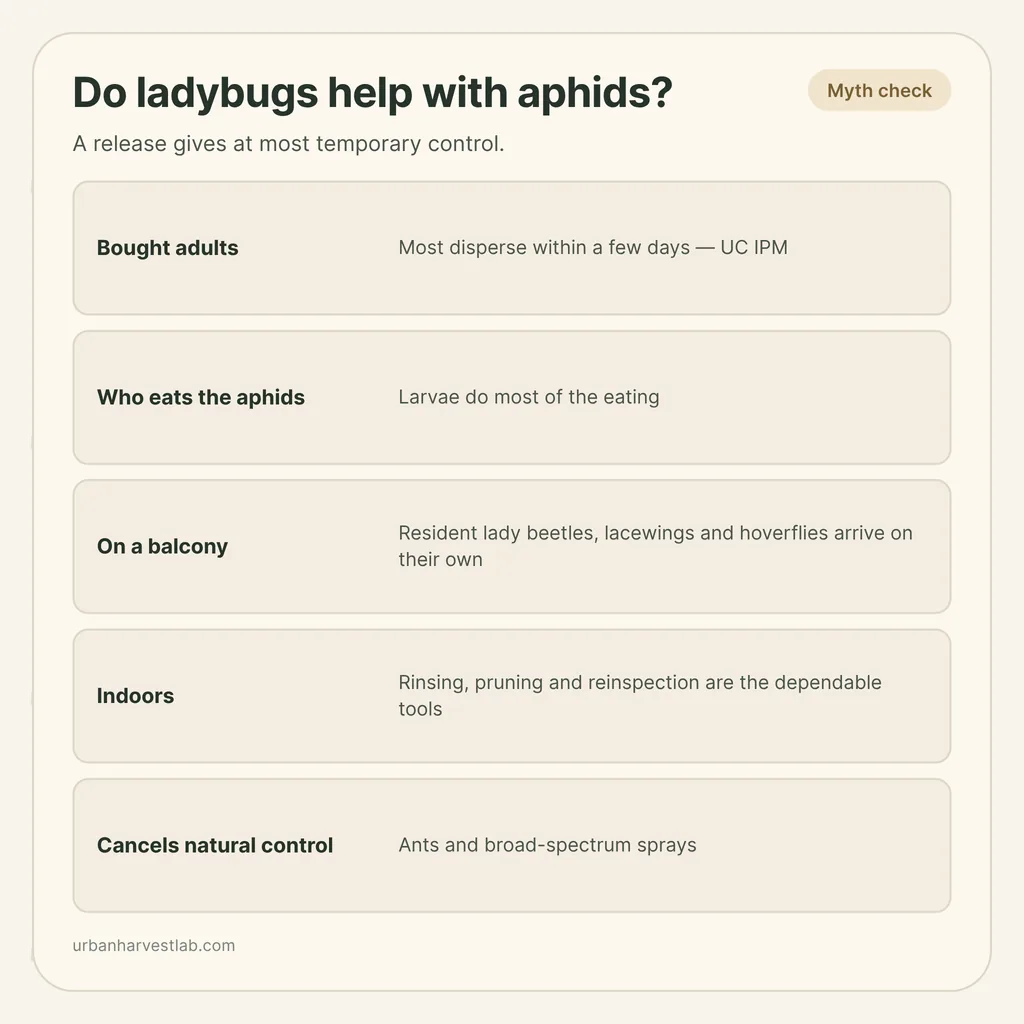
Do ladybugs help with aphids? What releasing them really does
Purchased lady beetles are adults that disperse fast, so a release rarely clears a pot. Ladybug larvae and other resident predators do the lasting work.
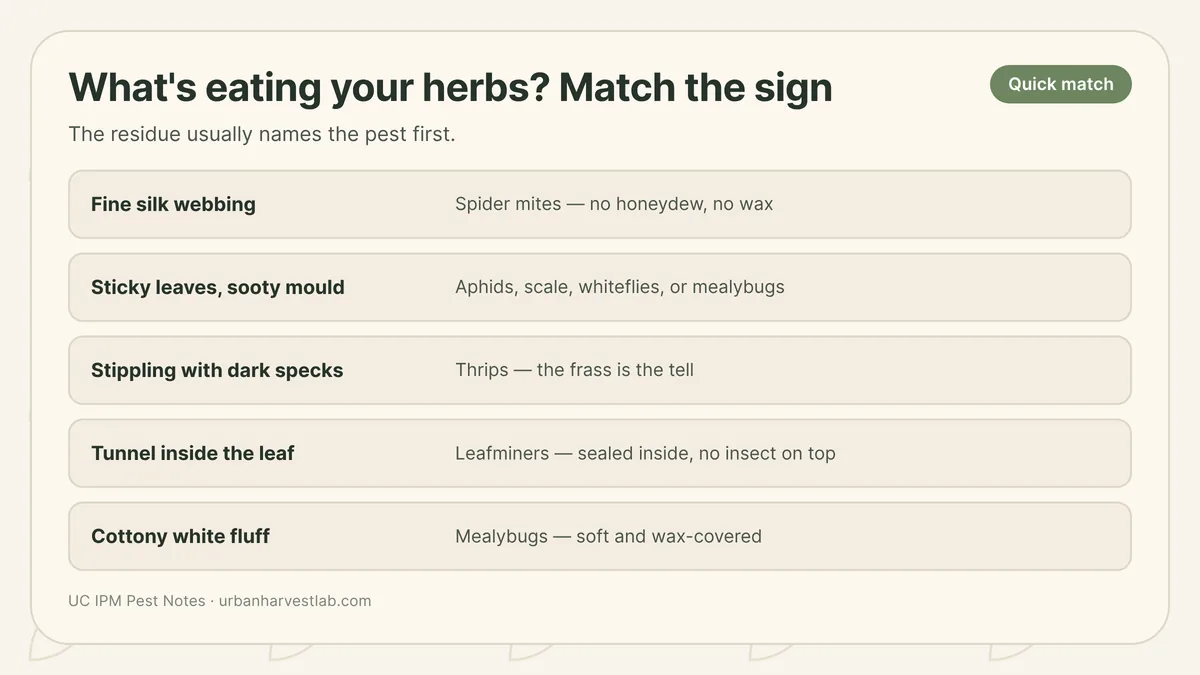
What's eating your herbs? Match the signs to the pest
Every common herb pest leaves its own tell before you ever spot the insect itself. Pick out what you are actually seeing, then go straight to the page that treats it.
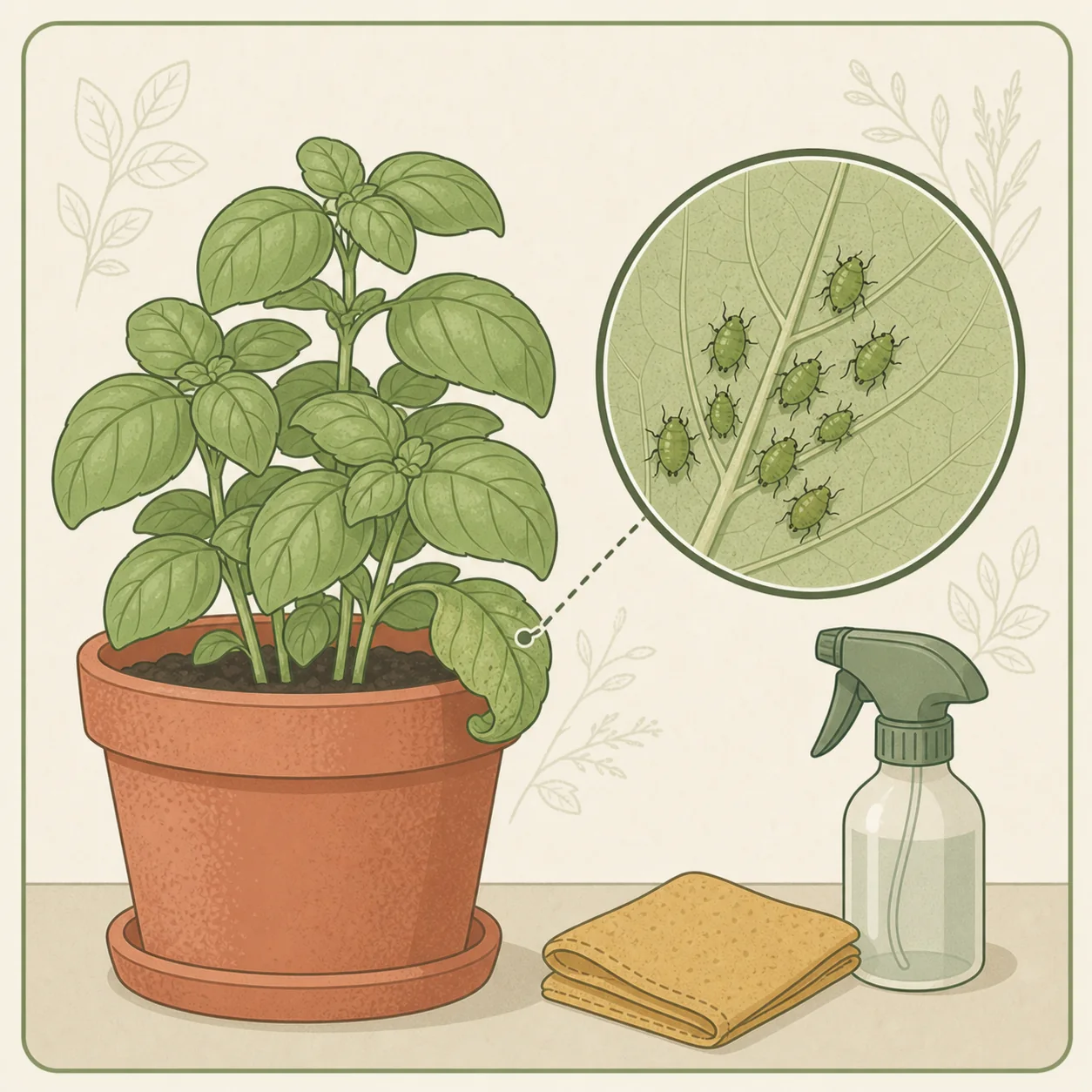
Aphids on indoor herbs: identify, isolate, and control them
Aphids are manageable when you find the colony, isolate the plant, remove most insects physically, and repeat inspections through the next generation.