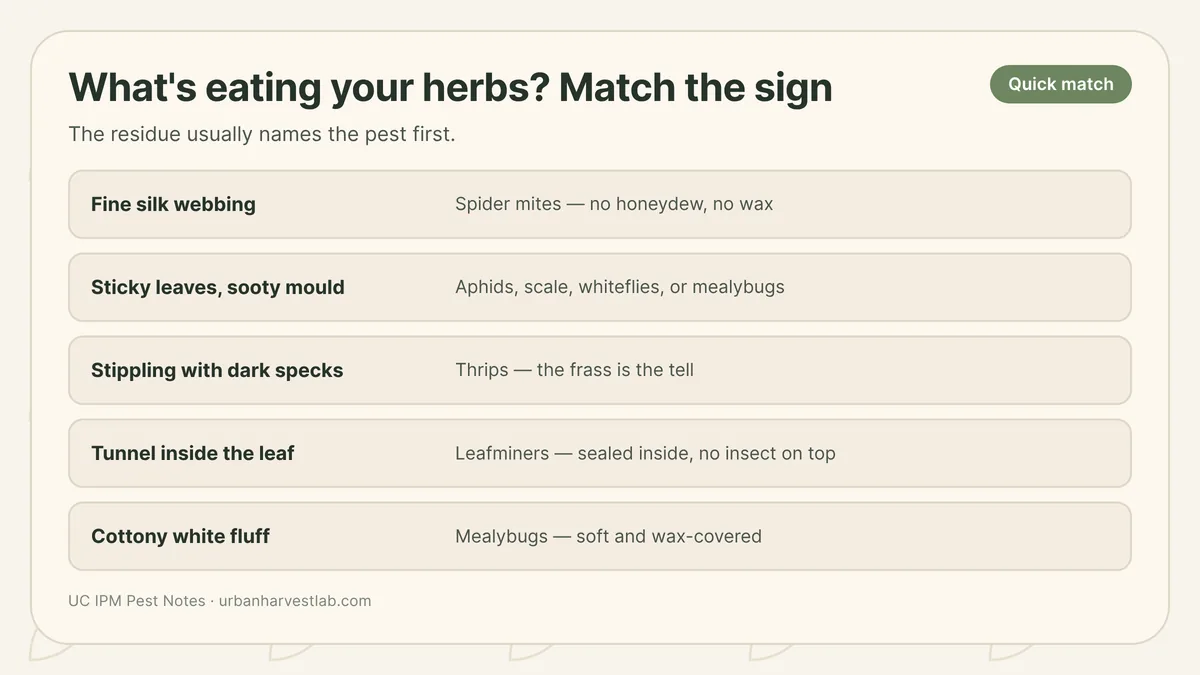
The sign in front of you usually names the pest before the insect itself does: fine silk webbing, sticky honeydew, silvery stippling next to dark flecks, a winding tunnel inside the leaf, or a cottony white mass at a leaf joint each belong to a different insect. If the plant just looks generally unwell, without any of those signs, start with common potted herb problems instead, because light, root stress, and overwatering produce yellowing and wilting that has nothing to do with a pest. Ragged holes with slime trails or clean chewed edges are not on this list either; those come from chewing pests, covered on the holes in herb leaves page.
Assuming a pest is on the table, the fastest path is matching what you actually see against the short list below, then confirming with the one check that separates it from its look-alikes.
Match the sign to the pest
| Sign you see | Most likely pest | What separates it |
|---|---|---|
| Fine silk webbing on stems, leaf axils, or growing tips | Spider mites | No honeydew, no wax |
| Sticky leaves, or black sooty mould growing on the residue | Aphids, soft scale, whiteflies, or mealybugs | Find the insect itself to tell them apart |
| Silvery or bronze stippling with tiny dark specks of droppings nearby | Thrips | Stippling without the specks can still be mites |
| Fine pale stippling, no specks, no silk | Spider mites or thrips | Tap over white paper, or look for fringed wings |
| A winding pale tunnel inside the leaf, no insect visible on the surface | Leafminers | No frass on top, it is sealed inside the mine |
| White, cottony fluff where a leaf meets the stem | Mealybugs | Soft and wax-covered, not a flattened bump |
| A flattened, shell-like bump with no sticky residue anywhere on the plant | Armored scale | The cover lifts off the body; soft scale’s does not, and soft scale leaves honeydew |
| Tiny white insects that lift off in a small cloud when the plant is disturbed | Whiteflies | Not fixed in place like scale |
| Small dark flies rising from the soil surface, not from the leaves | Fungus gnats | Adults fly; the larvae feed in the mix, not on the leaves |
| Tiny wingless specks on the soil surface that jump when disturbed | Springtails | UC IPM: a furcula tucked under the abdomen springs them into the air; gnats fly, springtails jump |
Find yours
Check the boxes for every sign present on the plant right now, not the signs you remember from last week. Old stippling and old curl can outlast the insect that caused them, so the checklist is only as good as what is on the plant today.
Check what you see right now
Select every sign present on the plant. The result updates as you check and uncheck boxes, and lists every suspect when a sign is shared.
Most likely
Select a sign
Check every box that matches, then read the confirming test.
- Read next
- —
No signs selected yet.
The logic behind the checklist is short enough to run in your head without it: webbing means mites. Cottony wax means mealybugs. A flattened bump with no honeydew means armored scale; the same bump with honeydew means soft scale. Frass next to stippling means thrips; stippling with nothing else could still be either mites or thrips. A tunnel sealed inside the leaf means leafminers. Flies over the soil, not on the leaves, mean fungus gnats. Everything else that produces honeydew without webbing, wax, or a fixed bump is most often aphids, confirmed by the two small tube-like structures projecting from their rear end, which the University of California’s Statewide Integrated Pest Management Program calls the one feature that “distinguishes aphids from all other insects.”
Aphids: clusters, honeydew, and curling new growth
Aphids are soft-bodied and pear-shaped, clustering on growing tips and the undersides of young leaves, and UC IPM notes their color varies by species from “green, yellow, brown, red, or black.” Large colonies “turn leaves yellow and stunt shoots,” and the honeydew they excrete “often turns black with the growth of a sooty mold fungus,” which is usually the first thing a grower notices. A population can move from a single winged arrival to a visible colony fast: UC IPM gives seven to eight days from newborn nymph to reproducing adult in warm weather, with each female capable of up to 80 offspring in a week. Some species also inject a toxin that curls the leaf permanently, so curled new growth can persist after the aphids themselves are gone. The full identification and control routine, including when isolation and rinsing are enough and when a labeled product is warranted, is on the aphid page.
Spider mites: stippling that turns to silk
Spider mites are barely visible without magnification. UC IPM lists adults at under 1/20 inch long, with eight legs and a pair of eyespots, and describes their damage as “stippling of light dots on the leaves,” sometimes bronzing as it accumulates. Stippling alone does not confirm mites, because thrips produce a similar pale speckling. The sign that does confirm them is silk: UC IPM states that dense webbing “sets them apart from aphids/thrips,” though absence of webbing does not rule mites out, since silk is a later-stage sign that shows up once the colony is established. A population can complete a generation in under a week under favorable conditions, which is why one rinse rarely finishes the job. The spider mite page covers the white-paper test for confirming live mites and the isolation and rinse routine that follows.
Thrips: the frass is the tell, not the size
Thrips are similarly tiny: UC IPM gives adults at under 1/20 inch, while Clemson Cooperative Extension gives a slightly different figure, under 1/16 inch, both agreeing on long fringed wings. What separates thrips from mites is not size but residue: UC IPM identifies “dark specks of excrement” as the confirming sign, something spider mites do not leave behind. Thrips damage also reads differently once you know to look, producing “distorted, curled, galled, or dead shoot tips” and a scabby, silvery discoloration, and Clemson adds early leaf drop and flower bud death to the list of symptoms on houseplants. A generation can complete in as little as two weeks in warm conditions, with up to eight generations a year by UC IPM’s count, so a single treatment usually needs a follow-up. That schedule, along with the yellow sticky traps and white-paper shake test used to monitor them, is covered on the thrips page for indoor herbs.
Whiteflies: a small white cloud that lifts off
Whiteflies announce themselves visually rather than through residue: UC IPM describes the adults as tiny insects with “yellowish bodies and four whitish wings,” while Clemson gives a size range of 1/10 to 1/16 inch and notes the wings are held roof-like over the body at rest, moth-like from a distance. Disturbing the plant is often the fastest confirmation, since a cloud of adults will lift briefly before resettling on the undersides of leaves. The first nymphal stage, the crawler, is “barely visible even with a hand lens” by UC IPM’s own description, which is why an infestation is often well underway by the time it is noticed. Whiteflies also excrete honeydew, so a sticky leaf with no cottony wax and no fixed bump, combined with adults that fly rather than sit still, points here rather than toward scale or mealybugs. Monitoring, trap placement, and the treatment sequence for balcony vegetables and herbs are on the whitefly page.
Scale: armored bumps against the honeydew-producing kind
Scale insects split into two groups that behave differently enough to need separate handling. UC IPM describes armored scale as having a “flattened, platelike cover that is less than 1/8 inch in diameter,” a cover that “usually can be removed from the body,” and, critically, they “do not secrete sticky honeydew.” Soft scale is the opposite on the honeydew question: it “grow[s] up to 1¼ inch long,” excretes honeydew, and its cover “doesn’t lift off.” That single distinction, honeydew or not, is the fastest way to tell which kind of scale you have without a lab. UC IPM also gives the test for whether a scale colony is still active: dead scales “fail to exude fluid when squished,” while a parasitized one may look puffy or darkened with a round exit hole where a natural enemy emerged. Armored scale runs through several generations a year; most soft scale species complete just one. The scale page for rosemary and other woody herbs covers the sticky-tape monitoring method used to catch crawlers before they settle and grow their cover.
Mealybugs: cottony masses hiding in the joints
Mealybugs are easy to mistake for mold at a glance. Clemson Cooperative Extension gives adults at 1/8 to 1/4 inch long, and UC IPM describes the wingless adult females as having “oval, segmented bodies covered with wax,” while the mobile crawler stage is “yellow to orangish or pink” and lacks the waxy coating. They favor hidden spots: “the crown of a plant, in branch crotches, on stems near soil,” and the gaps where touching leaves shield them from view, and a few species feed on roots rather than foliage at all. UC IPM is explicit that mealybugs can be confused with “cottony cushion scale, woolly aphids, soft scales, and whiteflies, which also produce wax and honeydew,” so a cottony appearance alone is a strong lead, not a certainty, until you find the crawlers underneath the wax. A female lays 100 to 200 or more eggs over a 10- to 20-day period, and UC IPM counts two to six generations a year, which is why a single treatment rarely finishes a colony off. The mealybug page has the alcohol-swab spot treatment and the repeat schedule that a wax-covered pest needs.
Leafminers: the damage is inside the leaf, not on it
Leafminers are the one entry on this list where the insect itself is rarely what you see. The larva feeds between the upper and lower leaf surfaces, and Clemson describes the result as “winding discolored trails or irregular blotches” that are “unsightly but rarely serious.” UC IPM’s description of the related citrus leafminer gives the mechanism precisely: a “thin dark line” runs “inside the meandering serpentine mine just under the surface,” which is the larva’s frass trail, sealed where you cannot wipe it off. A full leafminer life cycle runs three to seven weeks by UC IPM’s estimate, and because the larva is protected inside the leaf tissue for most of that time, sprays aimed at the surface reach it poorly. The leafminer page for basil and greens covers why pruning affected leaves reaches the larva a spray cannot.
Fungus gnats: living in the potting mix, not on the leaves
Fungus gnats break the pattern above because the damage and the insect both live in the potting mix, not on the foliage. UC IPM describes the adults as slender, about 1/16 to 1/8 inch long, with antennae “longer than their head,” a detail that separates them from the similar-looking shore fly, whose antennae are short and bristle-like. At 75°F, UC IPM gives the life cycle as roughly three days from egg to hatch, about ten days of larval feeding, and another four days as a pupa before the adult emerges, a cycle fast enough that a soil surface kept damp keeps producing new adults faster than sticky traps remove them. If the flies you are seeing come up from the pot when you water rather than off the leaves, the fungus gnat page covers the watering change that actually breaks the cycle. Wingless specks that jump rather than fly are a different soil dweller, sorted out on the springtails versus fungus gnats page.
When honeydew alone will not tell you which pest it is
Sticky leaves rule out webbing pests immediately, but they leave four possibilities open: aphids, soft scale, whiteflies, and mealybugs all excrete it. Outdoors, ants tending the honeydew are a further clue that one of these four is present, since UC IPM notes that ants “protect scales and aphids from their natural enemies” in exchange for the sugary residue, but ants alone do not identify which insect is being tended. The tiebreaker is the insect or its cover, not the honeydew itself: soft, clustered, and mobile points to aphids; fixed under a flattened cover points to soft scale; covered in loose white wax points to mealybugs; and small white insects that scatter into flight point to whiteflies. Check the plant again after finding the honeydew, specifically for one of those four, rather than treating for aphids by default because they are the most familiar name.
Confirm before you treat anything
Identification decides which page to read next; it does not decide which product is legal to use. US EPA states plainly that pesticide labels “are legally enforceable,” and the National Pesticide Information Center is just as direct: “Do not use pesticides in any manner other than those specifically listed on the label; it is against the law.” The detail that trips up most herb growers is the crop itself: per NPIC, “if your fruit or vegetable is not listed on the label, that means you cannot apply the product to it,” and a product can carry a zero-day wait before harvest or a much longer one, since the pre-harvest interval is set per product and per crop rather than by the active ingredient alone. Neem oil is a common first choice against soft-bodied herb pests, and NPIC’s own fact sheet describes its active component, azadirachtin, as working by interfering “with insect hormone systems, making it harder for insects to grow and lay eggs,” rather than by killing on contact, which is why it reads as slow compared to a spray that knocks insects down immediately. Whatever the label allows, coverage matters more than concentration: Colorado State University Extension notes that insecticidal soaps “act strictly as contact insecticides, with no residual effect,” so undersides and hidden crevices need direct contact, and horticultural oil carries the same coverage requirement.
Common mistakes
- Diagnosing from old damage. Stippling, curl, and tunnels can outlast the insect that made them; judge by what is active today.
- Treating for aphids because sticky leaves are the only sign found, without checking whether the insect underneath is actually scale, whiteflies, or mealybugs.
- Assuming webbing has to be dramatic before it counts. Fine strands at a growing tip are enough to confirm mites.
- Spraying a product with no herb or edible-crop listing on its label, or with no stated pre-harvest interval for the crop you are about to cut.
- Giving up on a check after one leaf. Several signs, especially frass and crawlers, are easy to miss without checking more than one spot.
Sources
- UC IPM Pest Notes: Aphids
- UC IPM Pest Notes: Spider Mites
- UC IPM Pest Notes: Thrips
- UC IPM Pest Notes: Whiteflies
- UC IPM Pest Notes: Mealybugs
- UC IPM Pest Notes: Scales
- UC IPM Pest Notes: Citrus Leafminer
- UC IPM Pest Notes: Fungus Gnats
- Clemson HGIC: Common Houseplant Insects & Related Pests
- Colorado State University Extension: Insect Control — Soaps and Detergents
- National Pesticide Information Center: Reading Pesticide Labels
- National Pesticide Information Center: Preharvest Interval
- National Pesticide Information Center: Neem Oil General Fact Sheet
- US EPA: Introduction to Pesticide Labels
Rule out non-pest causes first
Not every yellow or wilting herb has an insect on it. Check these before treating for a pest that is not there.
Common questions
What is eating my herbs if I cannot find any insect?
Look for what the insect left behind instead of the insect itself. Honeydew, fine webbing, dark flecks of frass, a winding tunnel inside the leaf, or a cottony mass at a leaf joint each point to a specific pest well before you spot it moving.
Does sticky residue mean the pest is aphids?
Not necessarily. Aphids, soft scale, whiteflies, and mealybugs all produce honeydew. Sticky leaves rule out webbing pests like spider mites, but you still need to find the insect itself to tell which honeydew producer you have.
Can a herb have more than one pest at the same time?
Yes, especially on a stressed or crowded plant. Check each sign separately rather than assuming one insect explains everything you see, and inspect the whole plant, not just the leaf where you noticed the first problem.
Are holes chewed in the leaves covered by this chart?
No. Ragged holes with slime trails point to snails or slugs, and holes with no slime point to caterpillars or earwigs. Those are chewing pests, not the sap-feeding and leaf-mining insects this chart sorts out; the guide to holes in herb leaves covers them instead.
Related guides
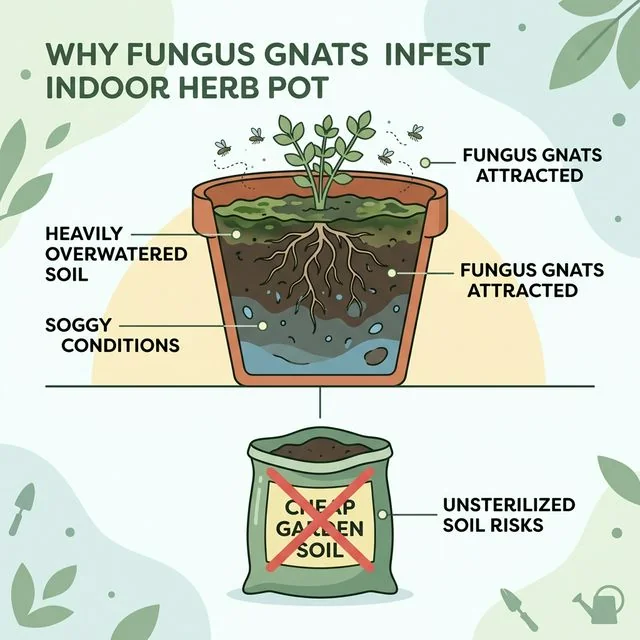
Why fungus gnats keep coming back in herb pots
Fungus gnats are the absolute bane of indoor gardeners. If a cloud of tiny black flies eradicates your peace every time you walk past your basil plant, you are treating the symptom, not the cause.
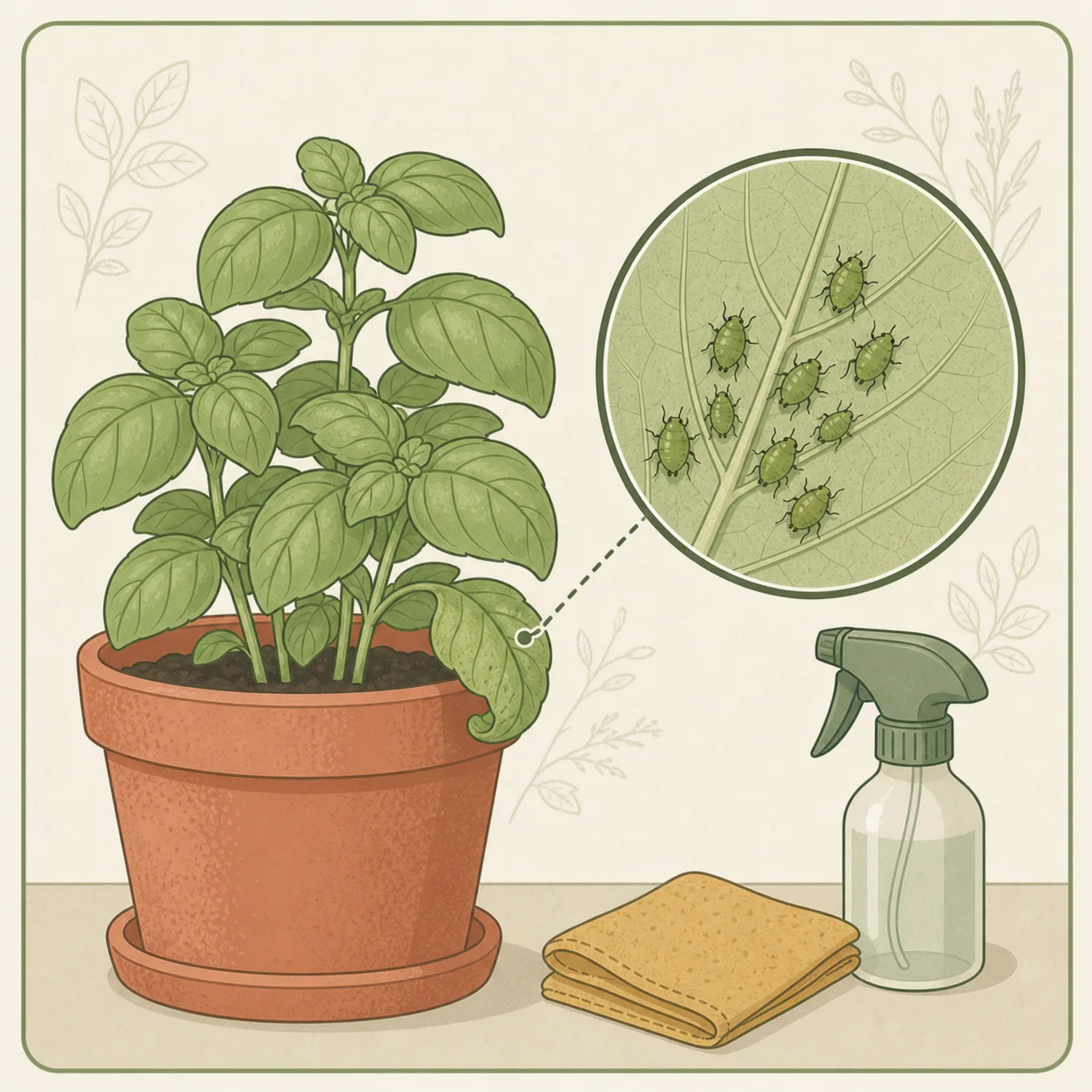
Aphids on indoor herbs: identify, isolate, and control them
Aphids are manageable when you find the colony, isolate the plant, remove most insects physically, and repeat inspections through the next generation.
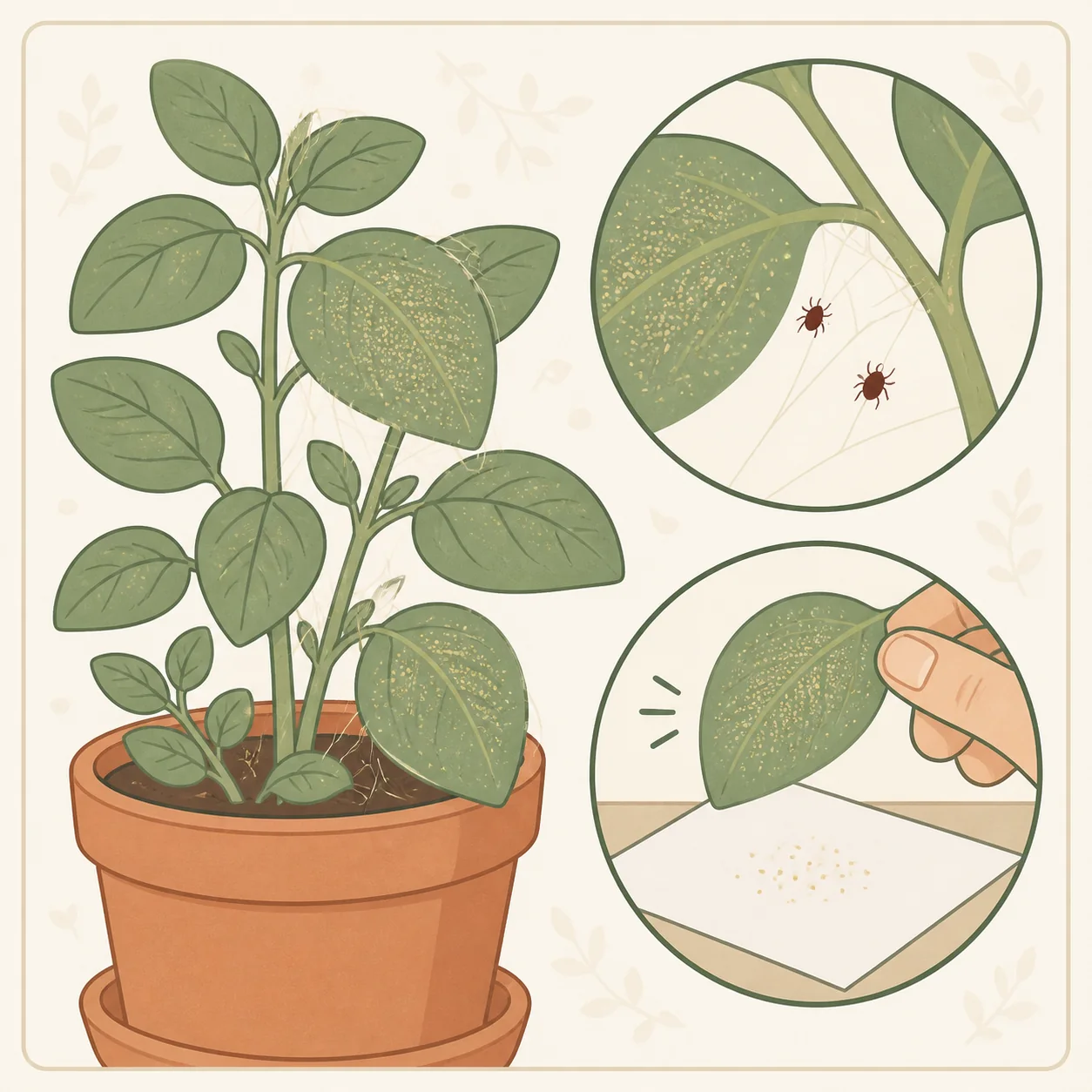
Spider mites on indoor herbs: signs, paper test, and control
Spider mites are easiest to control before webbing is obvious. Look for fine pale stippling and confirm moving specks over white paper.