Aphid predators compared for a balcony or indoor shelf
| Helper | Stage that eats aphids | What to know |
|---|---|---|
| Lady beetle (ladybug) | Larvae feed most; adults feed too | Purchased adults disperse within days; resident ones arrive on their own |
| Lacewing | Larvae | Larvae seize aphids with curved jaws; adults feed on nectar and honeydew |
| Hoverfly (flower fly) | Larvae | Legless maggots; adults come for flowers |
| Parasitoid wasp | Larva inside the aphid | Leaves a swollen, tan, shiny aphid mummy with an exit hole |
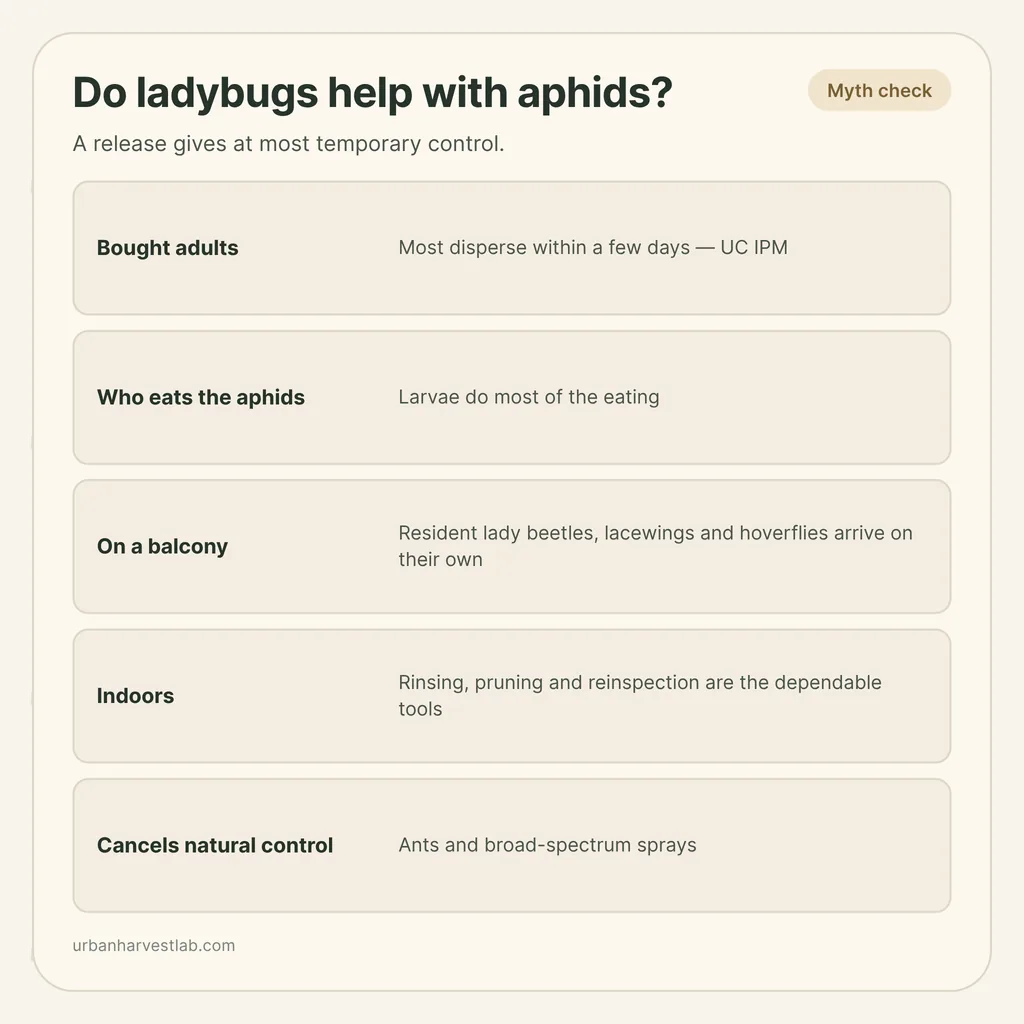
Not reliably, if you buy them. Ladybugs that already live around your plants help a lot with aphids, but the adult beetles sold for release mostly leave. UC IPM says commercially available lady beetles “may give some temporary control when properly handled, although most of them will disperse from your yard within a few days.” On a balcony you get more from protecting the predators that show up on their own. Indoors, the dependable tools are the ones in aphids on indoor herbs: isolate, rinse, prune, recheck.
What UC research found about released lady beetles
The beetle sold in stores is the convergent lady beetle, Hippodamia convergens. UC IPM notes that suppliers collect these adults from their overwintering sites, and that they disperse by nature: most fly away from the release site within one or two days, even when aphids are plentiful. A UC IPM retail newsletter puts it more bluntly, reporting that about 95% of released beetles in research studies flew away within 48 hours.
The beetles are hungry while they last. UC IPM says each adult can eat about 100 aphids a day before it disperses. That is not the same as 100 aphids a day for as long as it takes, because it is gone in a day or two.
Scale matters too. UC research describes one large, heavily infested rose bush that needed two applications, a week apart, of about 1,500 lady beetles each. The same newsletter notes that most packages sold in stores hold only enough beetles to treat one aphid-infested shrub or a few small plants. Those are outdoor rose numbers, and they show how much has to go right, not a dose for a pot of basil.
Aphids also rebuild fast. UC IPM says each adult aphid can produce up to 80 offspring in a matter of a week. A beetle that leaves after a day or two is up against a population that is already replacing itself.
Larvae do the work, and bought adults rarely stay to lay eggs
UC IPM’s aphid note says the larval, or immature, stage of natural enemies such as lady beetles and lacewings most often feeds on aphids. A larva cannot fly off. It hatches near the aphids its mother laid eggs beside, and UC IPM says it pupates near where it fed.
This is where purchased adults fall short. The UC IPM retail newsletter says lady beetles are unlikely to lay eggs on the plants they are released on. A release therefore tends to deliver the adult stage you can watch leave, not the larval stage that would have stayed.
Learn the larva, because it is the stage people squash. UC IPM describes convergent lady beetle larvae as active, with long legs, resembling tiny alligators, growing up to about 6 mm long, blackish with orange blotches. Eggs are yellow, oblong, and laid on end in clusters of about 10 to 30 on leaves and green stems near aphids. Pupae are about 5 mm and glued to plant parts. Other species look different, but the RHS gives the common shape: an elongate body with three pairs of obvious legs, mostly black or dark grey, some with yellow or orange markings.
Lacewing larvae eat aphids too, and the RHS says they seize prey with curved jaws. Hoverfly larvae, by contrast, are legless maggots. If something odd is sitting in the middle of an aphid colony and the aphids around it are shrivelling, leave it alone.
Balcony or indoors: what changes
On a balcony
UC IPM states that naturally occurring predators work best, especially in garden and landscape situations. Adult lady beetles are good fliers and readily move among plants, and UC IPM says predators such as lady beetles and lacewings visit plants when aphids are abundant.
Timing explains why you might not see them yet. The RHS notes that in spring aphid populations increase before natural enemies are active in sufficient numbers, and that if you wait a while they will often give the control. By early to mid-summer, the RHS says, aphid predators often wipe out colonies.
Check twice a week while plants are growing quickly, as UC IPM recommends. Look for lady beetle larvae, lacewing larvae, hoverfly larvae and aphid mummies. UC IPM says mummified bodies mean an aphid has been parasitized, and that substantial numbers of any of these natural control factors can mean the population will fall rapidly without treatment. Mummies are shiny, bloated and tan. Aphids killed by a fungus look different: UC IPM describes them as reddish or brown, fuzzy and shriveled.
Indoors
The UC IPM figures above describe outdoor plants. The RHS says biological control is mainly used in greenhouses, though some can be used outdoors, and it lists lacewing larvae, hoverfly larvae, predatory midge larvae, parasitoid wasps and a rove beetle among the aphid predators sold for greenhouse or indoor plants. It lists the two-spot ladybird among those sold by some suppliers. None of that is a promise for a particular living room, and the RHS notes aphids are most active in spring and summer on garden plants and all year round indoors. For a handful of herb pots, the isolate-and-rinse routine on the aphids page is less to manage.
If you do release anything live, UC IPM’s handling points apply: do it at dusk or early evening, and not on plants that have been sprayed with insecticides, because residues from most insecticides are likely to kill the beetles. UC IPM adds that wetting the plants first and releasing beetles at the base of the plants in the late evening may slow dispersal.
Two things that quietly cancel natural control
Ants. UC IPM says ants protect aphids from natural enemies. The RHS says ants tending aphids will remove aphid predators. If ants are climbing the stem, ladybugs of any origin are working against the tide. Ants in plant pots explains how to find the honeydew source and deal with both.
Broad-spectrum sprays. UC IPM advises avoiding broad-spectrum insecticides that can be toxic to natural enemies. Contact products such as insecticidal soap and oils behave differently. UC IPM says soaps, neem oil and horticultural oil kill only aphids present on the day they are sprayed and leave no toxic residue, so natural enemies that migrate in afterwards are not killed, though some already on the plant and hit by the spray can be. Soap or oil is a later step on edible plants and the label decides whether it is allowed at all; choosing a pest treatment for plants you will eat walks through the order, and insecticidal soap on edibles covers the soap itself.
Better than buying beetles
- Take the aphids off. UC IPM lists pruning infested leaves and stems, and knocking aphids off sturdy plants by shaking or with a strong stream of water. The RHS suggests squashing colonies between finger and thumb.
- Keep checking. Catching a colony early is cheaper than relying on predators to catch up with it.
- Give predators a reason to stay. UC IPM suggests growing flowering plants that provide nectar and pollen for adult lady beetles, and the RHS says adult hoverflies can be encouraged by providing lots of flowering plants. Attracting pollinators to a balcony covers which flowers and how to keep them pesticide free.
- Prevent the introduction. New plants are the usual way a colony arrives indoors, which preventing pests on indoor herbs deals with.
Sources
- UC IPM Pest Notes: Aphids, University of California Statewide IPM Program
- Convergent lady beetle, Natural Enemies Gallery, UC IPM
- Lady Beetle Releases for Aphid Control: How to Help Them Work, UC IPM Retail Nursery and Garden Center IPM News, June 2011
- Aphid predators, Royal Horticultural Society
- Aphids, Royal Horticultural Society
- Ladybirds, Royal Horticultural Society
Deal with the aphids themselves
Natural enemies are a bonus, not a plan. These pages cover finding, removing and preventing the pest.
Common questions
Do ladybugs help with aphids?
Yes, ladybugs that already live around your plants do, and their larvae do most of the eating. Bought adults are a weaker bet. UC IPM says most released beetles disperse from a garden within a few days, and a heavily infested rose bush in its research needed two releases of about 1,500 beetles each.
Will ladybugs work on indoor plants?
The release numbers and behavior UC IPM publishes come from outdoor plants, so they are not a promise for a windowsill. The RHS says biological control is mainly used in greenhouses and names other predators, such as lacewing larvae, hoverfly larvae and parasitoid wasps, among those sold for aphids on indoor plants. For a few herb pots, rinsing and pruning is simpler.
Should I buy ladybugs for my balcony?
Check first for aphids with lady beetle larvae, lacewing larvae, hoverfly larvae or tan mummified aphids among them, because resident predators may already be at work. UC IPM says naturally occurring predators work best in garden and landscape settings, and bought beetles are adults that readily fly away.
How do I tell a ladybug larva from a pest?
UC IPM describes convergent lady beetle larvae as active, long-legged, blackish with orange blotches, up to about 6 mm long, and likening them to tiny alligators. Leave them where they are feeding among the aphids, and avoid spraying that stem.
Related guides
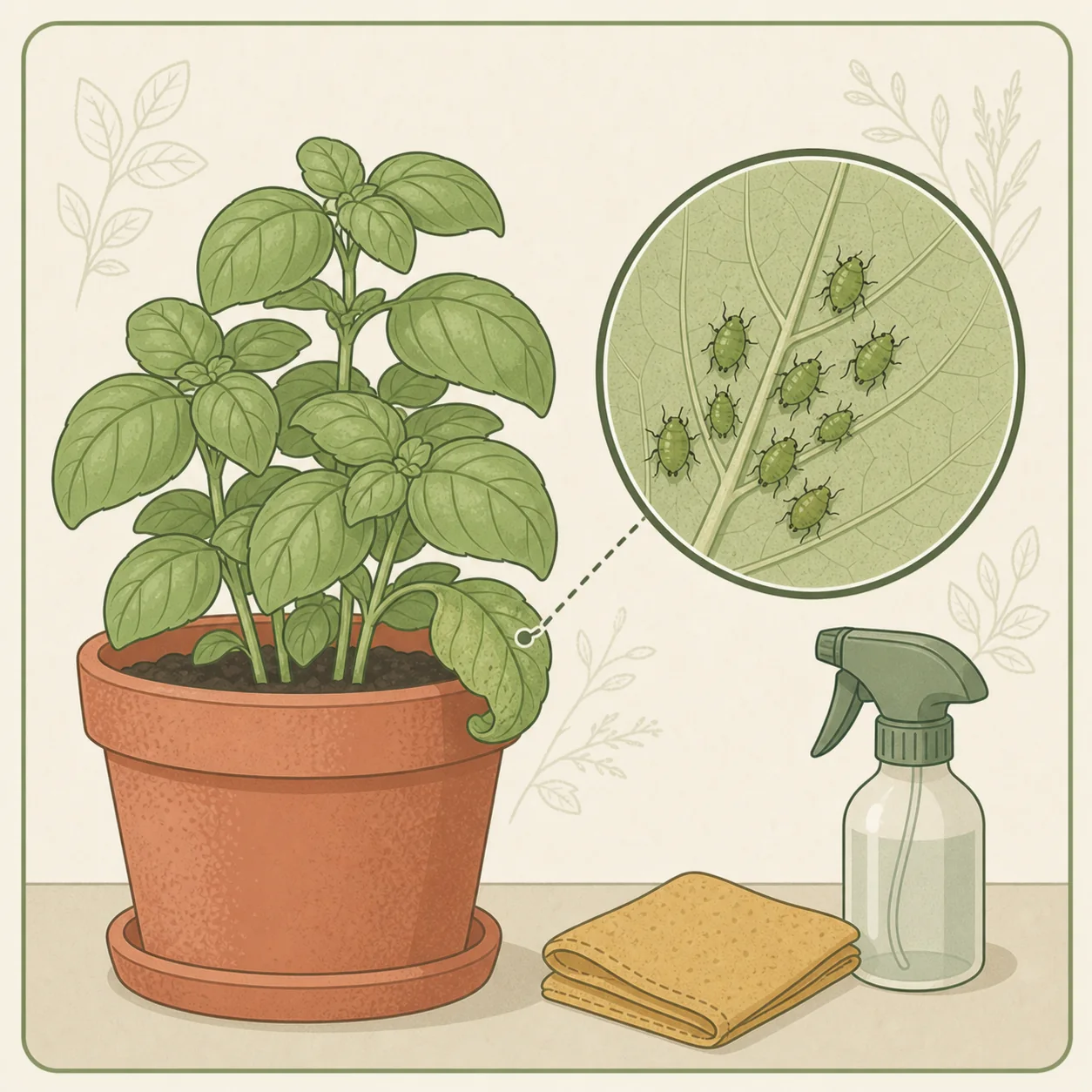
Aphids on indoor herbs: identify, isolate, and control them
Aphids are manageable when you find the colony, isolate the plant, remove most insects physically, and repeat inspections through the next generation.
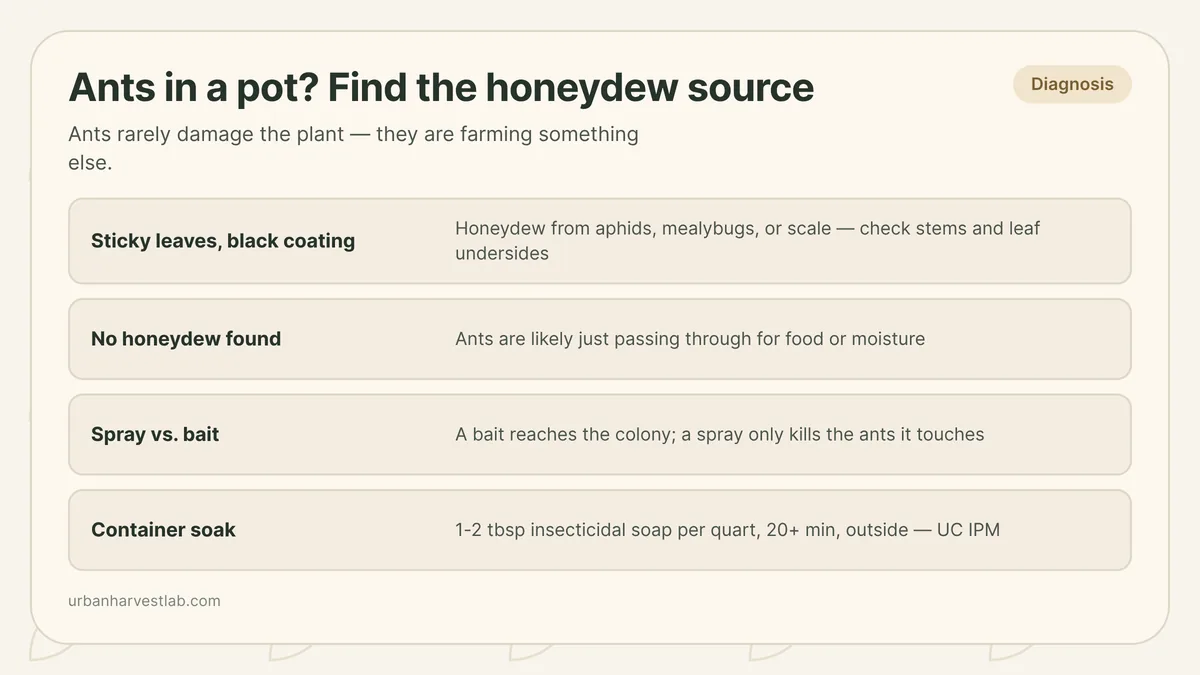
Ants in potted plants: what they mean and how to stop them
A trail of ants on a potted plant is almost always chasing honeydew from another pest, not damaging the plant itself, so the fix starts with finding that pest.
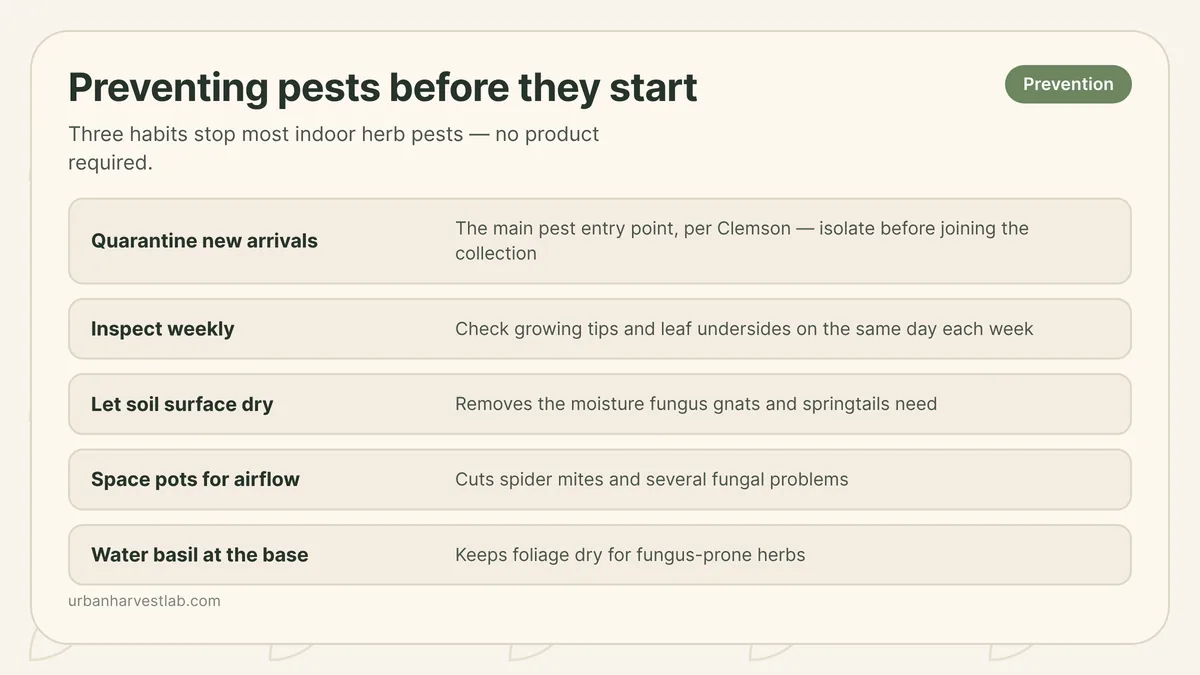
Preventing pests on indoor herbs before they start
Most indoor herb pests arrive on a new plant or one that spent summer outdoors, and most of them are stopped by isolating that plant, checking it on a schedule, and keeping the soil and air from favoring the pest in the first place.