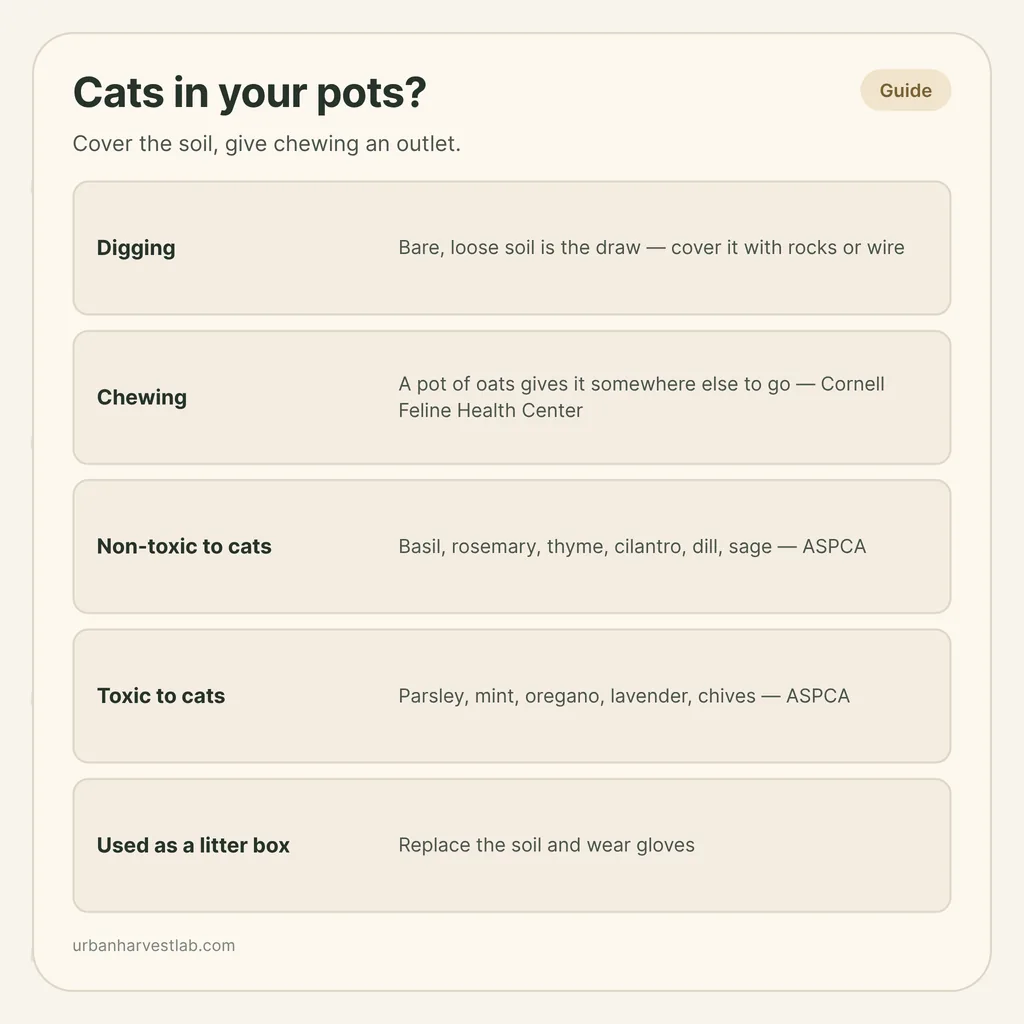
Troubleshoot the system before you change the inputs.
Symptoms
- Soil scattered around the pot, roots exposed, or a seedling dug out and lying on its side.
- Chewed or bitten leaf tips on a plant that is otherwise healthy.
- A smell of urine from the pot, or droppings buried in the soil.
Possible causes
- Loose, bare potting soil invites scratching and digging.
- An indoor cat with little access to grass or other greens is chewing leaves.
- The pot has become a litter box.
Quick fixes
- Cover the soil surface with larger rocks or chicken wire that the stems can grow through.
- Grow a pot of oats or another grain for the cat to chew.
- Check every plant within reach against the ASPCA list, and move anything toxic or unidentified out of reach.
- If a cat has used the pot as a litter box, replace the soil and wear gloves.
Take away the reward and the reach. Cats dig in pots because bare, loose soil is easy to scratch, so cover the surface with rocks or wire, give the cat a pot of its own grass to chew, and check every plant within reach against the ASPCA list before you leave the two together. If the digging is by squirrels or birds rather than a cat, the fixes are in squirrels and birds digging in pots.
Digging, chewing or using it as a toilet
The three problems have different fixes, so tell them apart first.
- Soil thrown out, roots showing, a seedling on its side. This is digging. New Mexico State University Extension says it is “the bare, loose soil which is easy for them to scratch in that attracts them.” University of Wisconsin-Madison Extension adds that digging in the potting mix can also damage roots.
- Bitten leaf tips on an otherwise healthy plant. This is chewing. Cornell Feline Health Center says cats may chew on plants as part of normal investigation and play, or simply because they crave vegetable matter.
- A urine smell or buried droppings. The pot is being used as a litter box. Skip to the soil section below, because that changes what you do with the potting mix.
Make the soil a poor place to dig
Rocks. University of Wisconsin-Madison Extension says placing rocks on the soil surface can deter the digging cats often enjoy. Choose rocks heavy enough that a cat cannot push them aside.
Chicken wire. New Mexico State University reports gardeners calling chicken wire over the area the most effective deterrent, because it discourages the digging and scratching that is part of feline behaviour. The wire has to cover every patch of clear, loose soil. In a pot, cut it to the rim, make a hole or slit for each stem, and fix the edge so a cat cannot lift it. NMSU’s caution applies even more in a small pot: choose a material that will not girdle the stems and that you can remove when you replant. It also notes the wire can come off once plants form a dense cover over the soil. A thick, established plant fills a pot this way, but a newly potted seedling does not.
Coarse surfaces rather than fine ones. University of Maine Cooperative Extension says cats are attracted to soil with the same texture as kitty litter, so use mulches that are coarse. NMSU’s column also records a suggestion that bark mulch may be attractive because it is easy to move aside to reach the soil. A fine, loose top layer is the least cat-proof surface you can offer. Mulch depth and type for containers are in mulch for potted plants.
Out of reach. Cornell Feline Health Center says the only way to guarantee protection for both your houseplants and your cat is to block access to the plants. On a balcony or in a small flat that can mean a shelf the cat cannot reach, a hanging pot, or a closed room. For a layout built around the windowsill, see setting up an indoor herb garden in an apartment.
Give the chewing somewhere else to go
University of Wisconsin-Madison Extension suggests growing oats or other grains in a pot: they grow quickly and give a cat a salad all winter, and a plant of its own may distract the cat from yours. Cornell Feline Health Center also lists oat grass among its alternatives, together with catnip and catmint, and adds that a cat may still keep snacking on houseplants. Catnip comes with a catch. The ASPCA lists it as toxic to cats because it “can cause vomiting and diarrhea” in some. Oats are the simpler choice.
Cornell’s other suggestions address the cause: dedicated play time and toys for a bored cat, and a cat food with more fibre. Its closing advice is to consult a veterinarian or veterinary behaviourist if the behaviour persists.
Check your plants against the ASPCA list
If the cat will get at a plant, find that plant on the ASPCA Animal Poison Control list before you decide what to do. These are the ratings for common pot plants:
| Plant | ASPCA rating for cats | What the ASPCA records |
|---|---|---|
| Basil | Non-toxic | |
| Rosemary | Non-toxic | |
| Thyme | Non-toxic | |
| Cilantro | Non-toxic | |
| Dill | Non-toxic | Dermatitis with prolonged contact |
| Sage | Non-toxic | |
| Lemon balm | Non-toxic | |
| Parsley | Toxic | Photosensitisation (sunburn, dermatitis); large amounts are needed to cause this effect |
| Mint | Toxic | Vomiting and diarrhoea with large ingestions |
| Oregano | Toxic | Mild vomiting and diarrhoea |
| Lavender | Toxic | Nausea, vomiting, inappetence |
| Chives, garlic, onion | Toxic | Chives: breakdown of red blood cells (haemolytic anaemia), blood in urine, weakness |
| Tomato plant | Toxic | Solanine; hypersalivation, severe gastrointestinal upset; the ASPCA notes ripe fruit is non-toxic |
| Lemon | Toxic | Essential oils and psoralens; the ASPCA notes the fruit is edible but skins and plant material can cause problems |
Two points follow from the table.
The entries differ in what they record. The ASPCA lists mild vomiting for oregano and, for parsley, a reaction that needs large amounts. The chives, garlic and onion entries record damage to red blood cells, and the tomato plant entry records severe gastrointestinal upset, weakness and a slow heart rate. A cat that has eaten any of them, or any plant you cannot identify, is a call to ASPCA Poison Control at (888) 426-4435 or to your veterinarian. A consultation fee may apply.
Citrus peel is not a safe deterrent, even though it is often suggested. The ASPCA lists the lemon plant as toxic to cats and says skins and plant material can cause problems, so leave peels and citrus oils off the soil.
The table covers herbs; the flowers and foliage plants on the same shelf need the same check. University of Wisconsin-Madison Extension tells owners to identify every houseplant they have, check the list with a veterinarian, and keep anything they cannot identify out of reach. Cornell’s list of plants that can be deadly for cats includes lilies (Lilium) as well as dumb cane, English ivy, philodendron and poinsettia, so flowers and foliage plants sharing the shelf with your herbs belong in the same check.
When the pot has become a litter box
Replace the soil. New Mexico State University’s advice to a gardener whose flower box had been used as a litter box is to put in new potting soil, because the cat increases the rate of salt accumulation in the soil.
Handle it with care. University of Maine Cooperative Extension says cat feces can contain parasites that affect the health of people. It advises wearing gloves when gardening, and washing hands and under the fingernails thoroughly afterwards if you did not wear them. That is a good reason to cover a pot of herbs or lettuce before the first visit.
What to skip
University of Maine Cooperative Extension says some repellents sold at garden centers may be effective, but notes that some may not be labelled for use around food crops and may be irritating to people. Read the label and see choosing a pest treatment for plants you will eat before putting anything on a herb you plan to harvest. A physical cover has none of those limits.
If the damage on your herbs is chewed leaves rather than a cat, the cause is more likely one of the common potted herb problems.
Sources
- University of Wisconsin-Madison Extension: Houseplants and your pets
- New Mexico State University, Southwest Yard & Garden: cat damaged soil (August 2005)
- New Mexico State University, Southwest Yard & Garden: cat problem in the garden (February 2000)
- University of Maine Cooperative Extension: Keeping cats out of the garden
- Cornell Feline Health Center: Destructive behavior in cats
- ASPCA Animal Poison Control: toxic and non-toxic plants
Other animals and problems in the pot
Cats are one of several animals that treat a pot as a place to dig. These pages cover the others and the sprays you might reach for.
Common questions
How do I keep my cat out of my potted plants?
Cover the soil. University of Wisconsin-Madison Extension says rocks on the soil surface can deter the digging cats often enjoy, and New Mexico State University describes chicken wire laid over loose soil. Cornell Feline Health Center says the only way to guarantee protection for plants and cat is to block access, so a shelf or hanging pot out of reach is the surest option.
Is basil safe for cats?
The ASPCA Animal Poison Control list gives basil as non-toxic to cats. It gives the same rating to rosemary, thyme, cilantro, dill and sage. It lists parsley, mint, oregano, lavender and chives as toxic to cats.
Why does my cat chew on my plants?
Cornell Feline Health Center says cats may chew plants as part of normal investigation and play, or because they crave vegetable matter, and that cats who chew houseplants are usually indoor cats with little access to grass or other greens. Oat grass is one of its suggested alternatives.
My cat used a pot as a litter box. What should I do with the soil?
New Mexico State University advises replacing the soil with new potting soil, since the cat increases salt accumulation in it. University of Maine Cooperative Extension notes that cat feces can contain parasites that affect people and says to wear gloves, and to wash hands and under the fingernails when you work without them.
Related guides

Squirrels and birds digging in pots: barriers that work
Craters in the soil, uprooted seedlings and bare roots on the rim usually mean a squirrel or a dust-bathing bird. Cover the soil surface and the digging loses its payoff.
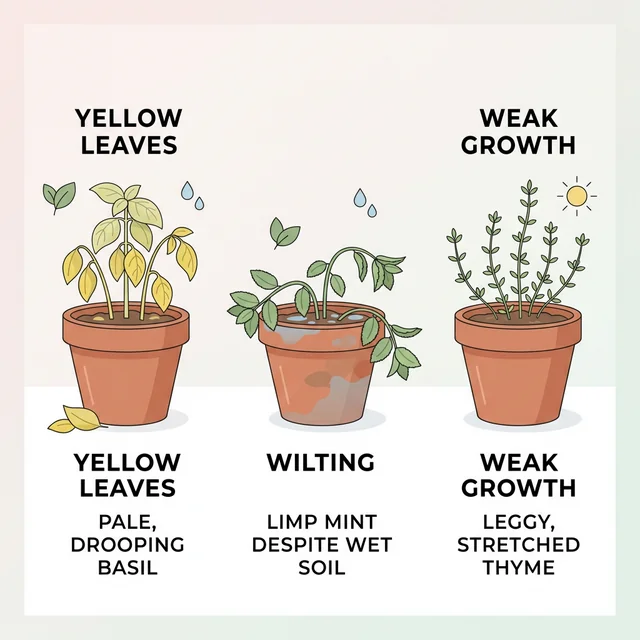
Common potted herb problems: yellow leaves, wilting, and weak growth
Common potted herb problems usually show up as yellow leaves, wilting, or weak growth, but the useful diagnosis starts with light, drainage, and root stress.
Choosing a pest treatment for plants you are going to eat
Once you know which pest you have, the next question is what you can treat it with without compromising the food. The answer is a ladder of methods, and the label on any product you buy sets the legal limits of the top rung.