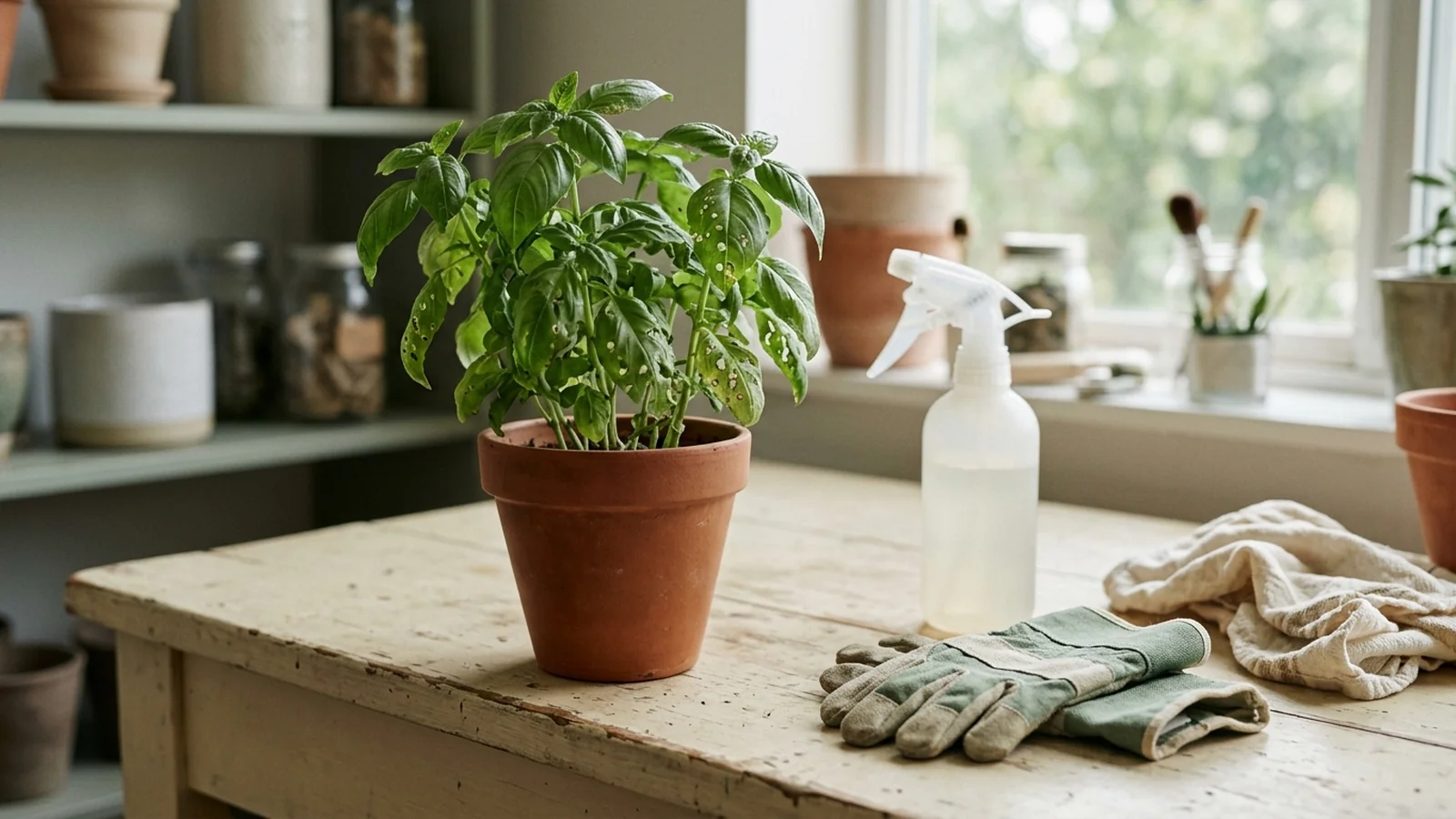
Work up the ladder rather than down it: take the pest off by hand, knock it off with water, and reach for a spray only when the population keeps climbing — and then only with a product whose label names the crop you intend to eat. That last condition is a legal one, not a matter of taste, and it decides more edible-crop pest questions than any argument about which substance is gentlest.
Identification comes first. If you have not matched the damage to an insect yet, the herb pest identification chart is the step before this one, because the same leaf stippling can come from two different animals with two different answers. What follows assumes you know what you are looking at.
The rung most people skip: deciding whether to treat at all
UC IPM defines integrated pest management as an ecosystem-based strategy built on long-term prevention through biological control, habitat manipulation, changes to cultural practice and resistant varieties, with pesticides used only after monitoring indicates they are needed. Read that ordering carefully. Chemical control is not the default that other methods delay; it is the option that has to earn its place.
And the threshold for earning it is higher than most growers assume. UC IPM writes that most plants host one or more aphid species and that their feeding usually does not damage or kill established plants. On spider mites, the same programme notes that a small number of mites is usually not reason for concern, and that mites are sometimes gone by the time you notice the damage, with plants often recovering after they leave. For scales, UC IPM states that plants are not harmed by a few scales, and that even high populations of certain species apparently do not damage plants. Leaf mines are the clearest case of all: UC IPM’s leafminer guidance describes the damage on established plants as largely cosmetic, and points out that many insecticides registered for residential use struggle to reach larvae sitting inside the mine.
There is also a cost to treating when you did not need to. UC IPM records that spider mites frequently become a problem after insecticide applications, partly because the insecticide kills the mites’ natural enemies and partly because certain materials stimulate mite reproduction. A spray aimed at one insect can hand you a worse infestation of another.
So before anything else, ask three questions. Is the plant actually losing growth, or does it merely look imperfect? Is the population rising week on week, or has it stalled? Are there predators already on the plant doing the work? If the damage is cosmetic and static, the correct treatment is a hand lens and a second look in a week.
Rung one: take them off by hand
Physical removal is unglamorous and it works, particularly on the handful of pots most balcony growers are dealing with. UC IPM’s aphid guidance recommends pruning infested leaves and stems outright. Clemson Cooperative Extension lists handpicking, removing and destroying infested parts, wiping each insect with a cotton swab dipped in rubbing alcohol, and washing smooth-leaved plants by swishing the foliage in tepid water every two to three weeks.
That last one is worth adopting as a habit rather than a response. For mealybugs tucked into branch crotches and leaf joints, the swab method reaches places a spray droplet skips, and it targets the individual insect rather than the whole plant. UC IPM recommends testing an alcohol solution on a small part of the plant a day or two beforehand, since foliage varies in how it reacts.
Hand removal also has the cleanest answer to the question this whole page is about: nothing has been applied to the crop, so nothing sets a wait before harvest. You are back to ordinary kitchen practice.
Rung two: a strong jet of water
Water is the most underrated tool in the sequence. UC IPM’s advice on aphids is to knock populations off by shaking the plant or spraying it with a strong stream of water, and adds the detail that makes it worth doing: most dislodged aphids will not be able to return to the plant, and their honeydew is washed off at the same time.
For spider mites, UC IPM says regular, forceful spraying with water often reduces numbers adequately, provided you get good coverage — especially on the undersides of leaves, which is where mites live. Mites also do well in warm, dry conditions, so repeatedly wetting the foliage works against the environment they prefer as well as against the animals themselves.
Two practical limits. Sturdy plants tolerate this; soft seedlings and brittle woody stems may not. And a jet of water indoors means moving the pot to a sink, a shower or a balcony rail, which is a reason people skip a method that would have been enough. If you are treating aphids on indoor herbs or spider mites, try this before buying anything.
Rung three: insecticidal soap
Insecticidal soaps are, in Colorado State University Extension’s description, potassium salts of fatty acids — potassium attached to long carbon chains. They kill by disrupting cell membranes so the insect dies of rapid dehydration, and they can also strip the protective waxes that cover some insects, leaving them vulnerable to drying out on their own.
What that mechanism can reach is narrow and specific. Colorado State lists small, soft-bodied arthropods: aphids, young scales, whiteflies, psyllids, mealybugs and mites. What it cannot reach is equally clear — larger insects such as caterpillars, sawflies and beetle larvae are generally immune to soap sprays, as are large adult flying insects with tougher exoskeletons. If your holes in leaves came from a caterpillar, soap is the wrong tool and no amount of it will change that.
The single most consequential fact about soap is that it has no afterlife. Colorado State University Extension states that soaps act strictly as contact insecticides, with no residual effect, and that sprays must be applied directly to and thoroughly cover the insect targets. Clemson puts the same point in the form growers actually need: once the soap solution dries, it has no effect against pests. UC IPM’s version is that soaps and oils kill only the insects present on the day they are sprayed.
Three consequences follow, and they are where most soap applications fail:
- Coverage beats concentration. The undersides of leaves, shoot tips and leaf joints are where soft-bodied pests sit. A drenched upper leaf surface and a dry underside is a failed application, regardless of what you mixed.
- One spray is a partial treatment. Eggs hatching after the spray dries are untouched. Clemson’s instruction for mites is to spray once a week for several weeks; UC IPM notes that aphid, whitefly and mite sprays may need repeating without fixing an interval.
- A pest that hides is a poor target. Mealybugs shelter in crowns and branch crotches, and some species feed on roots, which is why UC IPM pairs sprays with direct swab treatment for them.
Rung four: horticultural and plant-based oils
Oils sit one step further up because they are more aggressive towards the plant, not because they are more powerful against the pest. UC IPM describes horticultural oils as specially refined petroleum products and gives them good control of most scales when the timing is right — sprayed soon after most crawlers have emerged and most scales are still in the young nymph stage. That timing requirement is the thing to take away: on scale insects on rosemary and other woody herbs, an oil applied against armoured adults does much less than the same oil applied against crawlers.
Oils work by contact and smothering, so the coverage rule from the previous rung applies in full. UC IPM’s instruction is to thoroughly wet the infested plant parts, typically shoot terminals and the underside of leaves, and its mite guidance states that oils and soaps must contact mites to kill them, so excellent coverage is essential and repeat applications may be required.
Neem oil belongs to this group, and it comes with its own label complications worth reading separately before you buy anything — what the label decides before you spray neem covers the crop-list and wait-time questions specific to it.
The label is the law, and it outranks everything above
Here is the rule that governs every product in the top two rungs. The US Environmental Protection Agency states that pesticide labels are legally enforceable, and that all of them carry the statement: it is a violation of federal law to use this product in a manner inconsistent with its labeling. EPA describes the label as the place where its evaluation becomes a set of conditions, directions and precautions defining who may use a pesticide, and where, how, how much and how often.
For food crops, one sentence from the National Pesticide Information Center decides most questions: if your fruit or vegetable is not listed on the label, you cannot apply the product to it. A soap or oil registered for ornamentals only may not lawfully be sprayed on basil you plan to eat, however mild the ingredient is. UC IPM’s own materials show the same principle in practice, annotating certain products in its aphid guidance as nonfood crops only.
That is also why this ladder gives methods and substances rather than mixing instructions. Rates and dilutions are set per formulation in the directions-for-use section of the label you bought, and a rate carried over from a different container or a home recipe sits outside the framework that makes the product legal on food in the first place.
What sets the wait before you can harvest
The National Pesticide Information Center defines the preharvest interval as the wait time between a pesticide application and when a crop can be harvested, and says the label states how long the crop must remain in the garden or field after spraying.
The number is a property of the product and the crop together, not of the substance. NPIC states that wait times for the same fruit or vegetable can differ between products, because the EPA sets residue tolerances for every pesticide on each crop individually. Two containers of the same active ingredient can carry two different intervals for basil, and both are correct for their own contents.
A zero-day interval is an ordinary outcome rather than a warning sign. NPIC notes that for products which can be applied up to the day of harvest, the label may list zero days, or list no time at all. So the number worth finding is the one printed on your container for your crop — and if the crop is not on the list, the interval question does not arise, because the application was not permitted.
The ladder at a glance
| Method | What it controls | How it is applied | What sets the wait before harvest |
|---|---|---|---|
| No treatment, monitor instead | Light or static populations; cosmetic damage; infestations natural enemies are already reducing | A hand lens and a repeat inspection in a week; UC IPM treats pesticides as materials used after monitoring shows they are needed | Nothing is applied, so no interval arises |
| Hand removal | Mealybugs, scales, caterpillars, slugs, individual clusters on a few pots | Handpicking, pruning out infested leaves and stems, wiping insects with an alcohol-dipped cotton swab, washing smooth foliage in tepid water | Nothing is applied, so no interval arises |
| Strong stream of water | Aphids, spider mites on sturdy plants | Forceful spray over the whole plant, with deliberate coverage of leaf undersides; repeated as populations rebuild | Nothing is applied, so no interval arises |
| Insecticidal soap | Small soft-bodied arthropods — aphids, young scales, whiteflies, psyllids, mealybugs, mites; not caterpillars or beetle larvae | Contact spray wetting the insects themselves, undersides included; no residual once dry, so repeats are part of the method | The preharvest interval printed on that product’s label for that crop, which is legally binding |
| Horticultural oil | Most scales when timed to the crawler stage; also used against mites, whiteflies and mealybugs | Thorough wetting of shoot terminals and leaf undersides, within the label’s temperature and condition limits | The preharvest interval printed on that product’s label for that crop, which is legally binding |
| Neem and other plant-based oils | Grouped with the contact oils by UC IPM for mites, thrips and mealybugs; acts through feeding disruption rather than fast knockdown | Contact spray with the same coverage and temperature constraints as other oils | The preharvest interval printed on that product’s label for that crop, which is legally binding |
Conditions that turn a treatment into plant damage
Soaps and oils injure plants under predictable circumstances, and the sources are unusually specific about them.
Heat and drought stress are the main two. UC IPM’s instruction is not to apply soaps or oils to drought-stressed plants or when the temperature exceeds 90°F, adding that these materials may be phytotoxic to some plants. Its scale guidance is stricter still: do not apply oil when it is foggy, freezing below 32°F, hot above 90°F, when relative humidity is above 90%, or if rain is expected in the next 24 hours — and in hot locations, make sure plants are well irrigated before spraying the foliage.
Interactions matter too. UC IPM advises against using sulfur when temperatures exceed 90°F, and against applying sulfur within 30 days of an oil spray.
Species differ, and repeat exposure accumulates. Colorado State University Extension notes that certain plants are sensitive to insecticidal soap sprays and may be injured, and that damage can build up with repeated exposure. Clemson’s remedy is the one to adopt as standard practice: test insecticidal soap, or any other insecticide, on a small part of the plant before treating the whole thing. Clemson names ivy, dieffenbachia, begonia and several ferns and lilies among the sensitive houseplants, which is a reminder that “safe on plants” is a per-species claim.
And the substitution that looks thrifty is the one to avoid. Colorado State University Extension warns that dish soaps contain powerful detergents that can injure plants, damage soil and contaminate waterways, in contrast with commercial insecticidal soaps that are formulated to kill insects and tested for efficacy.
Where the sequence usually breaks down
- Jumping to a spray on the first aphid, when shaking the plant or a jet of water would have settled it.
- Spraying only the tops of leaves, then concluding the product failed.
- Treating once and expecting the result to hold while a new generation hatches into a dry, residue-free plant.
- Buying a product labelled for ornamentals and using it on a culinary herb because the ingredient sounds harmless.
- Mixing stronger than the label states after a disappointing first application, which raises the injury risk without extending the kill.
- Spraying an oil during a heat wave, on a pot that has been left dry, or within a month of a sulfur application.
- Skipping the step that costs least: keeping pests off indoor herbs in the first place, since Clemson notes that most houseplant pests arrive on newly purchased plants or on plants that spent the summer outdoors.
Treatment on an edible plant is a narrow decision, and the ladder narrows it further. Most of the time it ends on one of the bottom three rungs, and the top two are reached with a label in hand.
Sources
- UC Statewide IPM Program, “What is Integrated Pest Management (IPM)?”
- UC Statewide IPM Program, Pest Notes 7404, “Aphids”
- UC Statewide IPM Program, Pest Notes 7405, “Spider Mites”
- UC Statewide IPM Program, Pest Notes 7408, “Scales”
- UC Statewide IPM Program, Pest Notes 74174, “Mealybugs”
- UC Statewide IPM Program, Pest Notes 74137, “Citrus Leafminer”
- Colorado State University Extension 5.547, “Insect Control: Soaps and Detergents”
- Clemson Cooperative Extension HGIC, “Common Houseplant Insects & Related Pests”
- US EPA, “Introduction to Pesticide Labels”
- National Pesticide Information Center, “Preharvest Interval”
- National Pesticide Information Center, “Reading Pesticide Labels”
Identify it first, then keep it from coming back
Treatment only works on a confirmed pest, and the method that costs least is the one that stops the next arrival.
Common questions
What can I safely spray on herbs and vegetables I am going to eat?
Only a product whose own label names your crop, or a category that covers it. The National Pesticide Information Center puts it plainly: if your fruit or vegetable is not listed on the label, you cannot apply the product to it. That rule holds regardless of how mild the active ingredient sounds, and it applies to insecticidal soaps and horticultural oils exactly as it applies to anything else.
How long after spraying can I harvest?
Read the preharvest interval on the container you used, for the crop you sprayed. The National Pesticide Information Center defines it as the wait between application and harvest, notes that wait times for the same fruit or vegetable differ between products because the EPA sets residue tolerances per pesticide per crop, and adds that some labels list zero days or no wait at all.
Is insecticidal soap the same as dish soap diluted in water?
No. Colorado State University Extension describes insecticidal soaps as potassium salts of fatty acids formulated and tested to kill insects, and warns that dish soaps contain powerful detergents that can injure plants, damage soil and contaminate waterways. A registered product also carries a crop list and a wait time, which a kitchen mixture does not.
Do I have to treat every pest I find?
Not at all. UC IPM notes that aphid feeding usually does not damage or kill established plants, that a small number of spider mites is usually not reason for concern and that plants often recover once mites have left, and that plants are not harmed by a few scales. On top of that, UC IPM warns that spider mites frequently become a problem after broad-spectrum insecticides kill their natural enemies, so an unnecessary spray can leave you worse off.
Why did my soap spray stop working after a day?
It did not stop working; it was finished when it dried. Clemson Cooperative Extension states that once the soap solution dries it has no effect against pests, and UC IPM notes that soaps and oils kill only the insects present on the day they are sprayed. New insects hatching afterwards are untouched, which is why coverage and repeat applications matter more than concentration.
Related guides
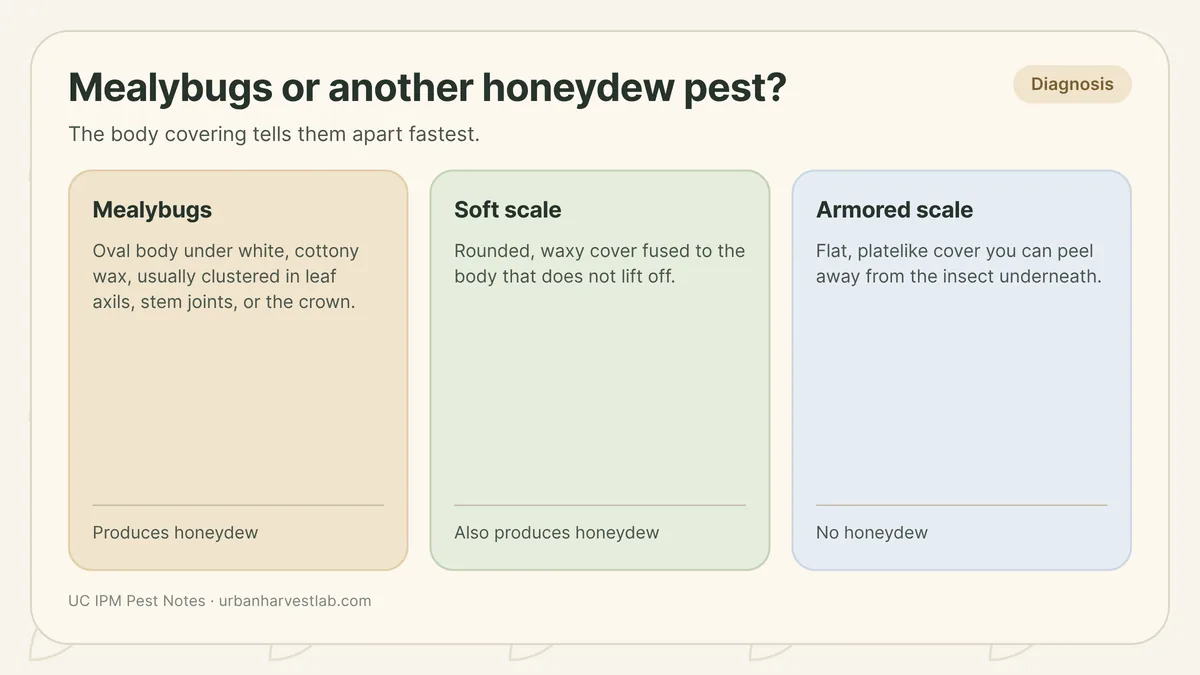
Mealybugs on indoor herbs: identify them and stop the spread
Mealybugs show up as white, cottony masses tucked into leaf axils and stem joints, and they keep coming back until every hiding spot and every generation has been treated.
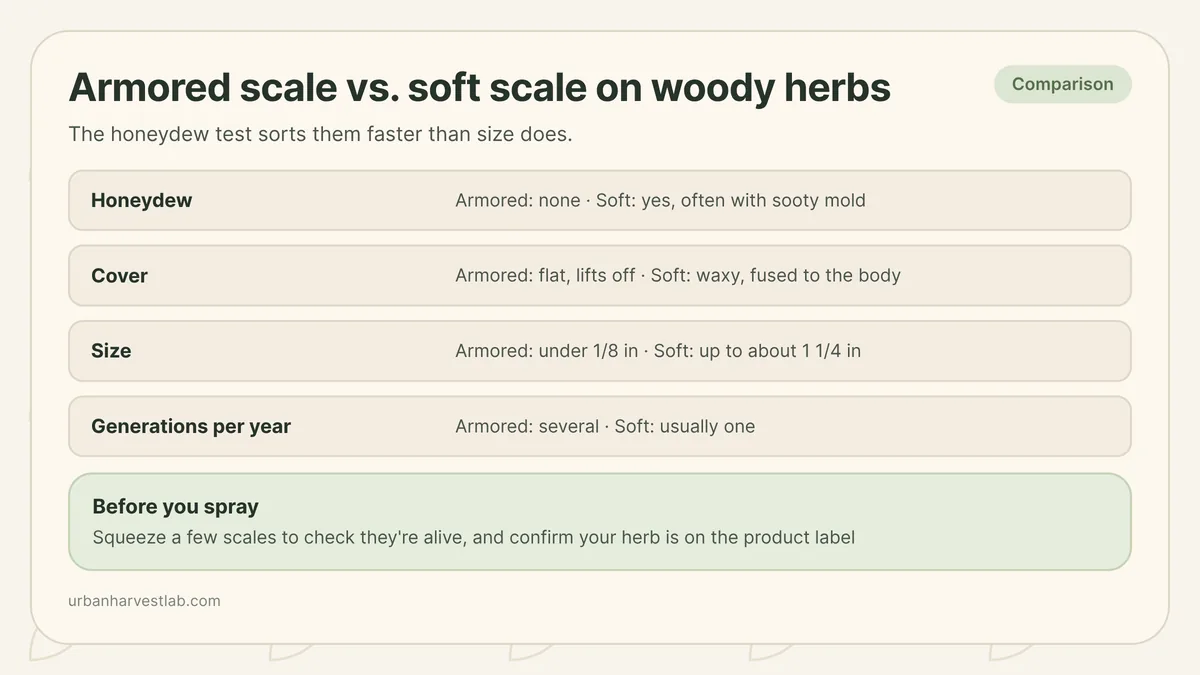
Scale insects on rosemary and other woody herbs
Scale on a woody herb often goes unnoticed until the leaves turn sticky or a stem starts to die back, and the right treatment depends on which kind of scale you have.
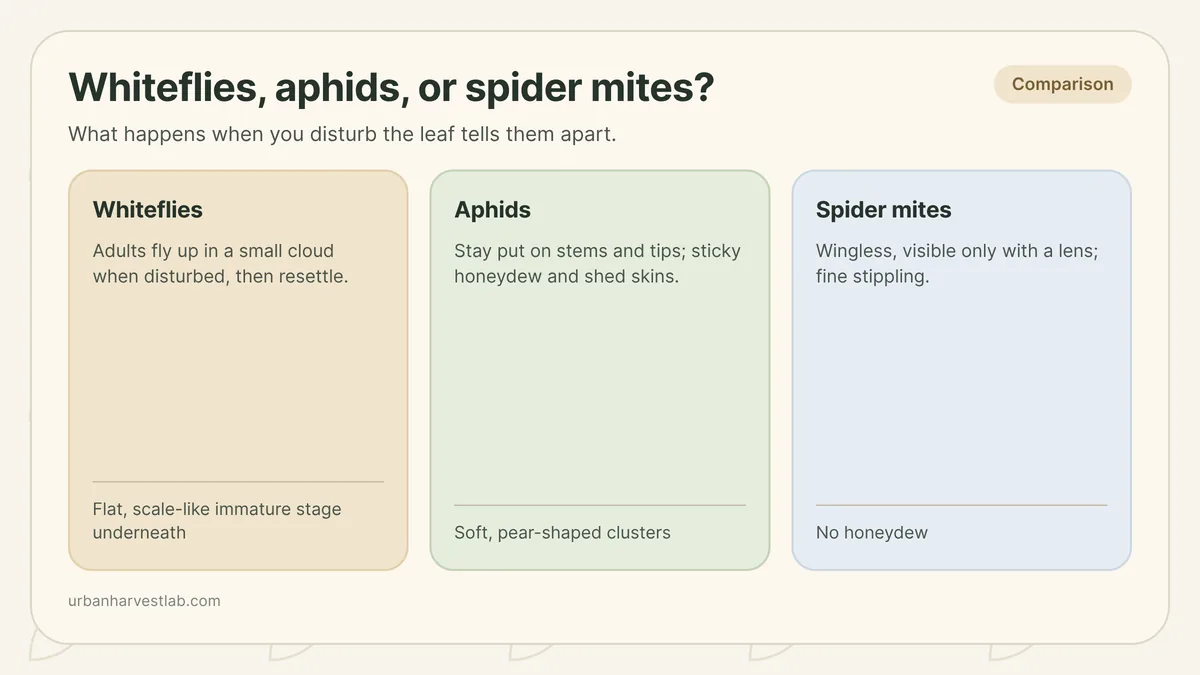
Whiteflies on balcony vegetables: identify them and bring the numbers down
Whiteflies on a balcony vegetable plant are easiest to confirm by disturbing the foliage and watching what flies up, then working the population down with sprays, traps, and repeat checks.