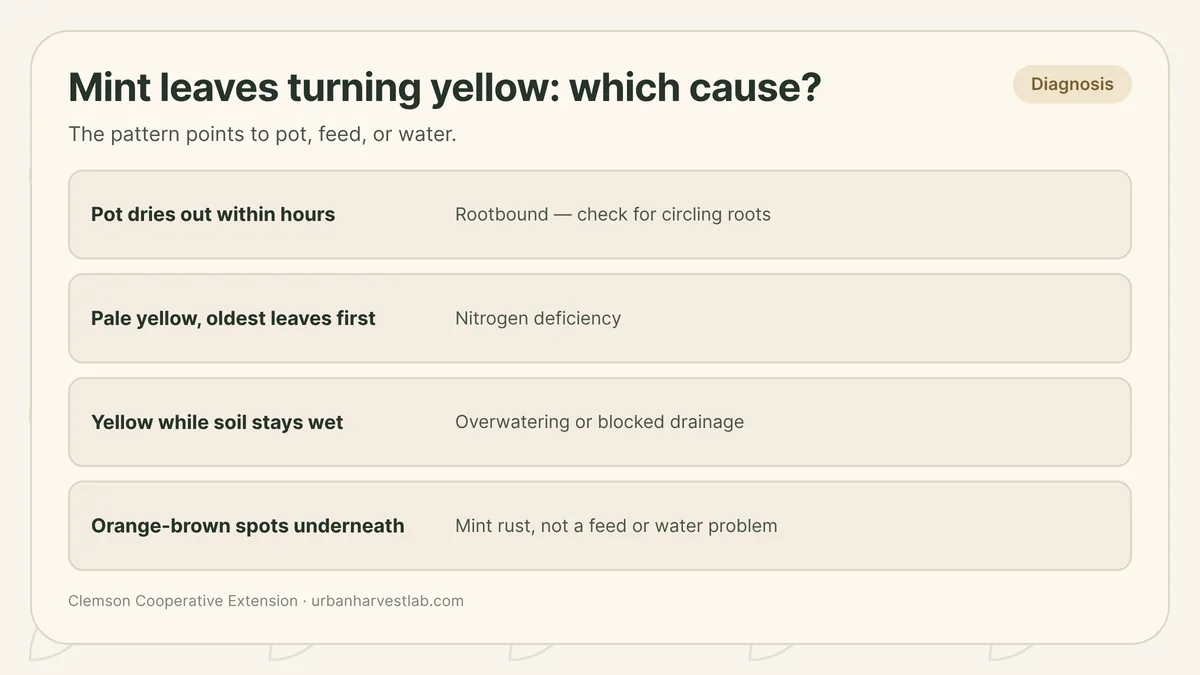
Troubleshoot the system before you change the inputs.
Symptoms
- Leaves fade to an even pale yellow, often starting with the oldest growth lowest on the stem.
- The pot dries out within hours of watering, and stems look tired between waterings even though you water often.
- Lower leaves yellow and go limp while the soil stays wet for several days after watering.
Possible causes
- The pot is too small for how fast mint fills it with roots, so the mix cannot hold enough moisture between waterings.
- Nitrogen is genuinely short, or feeding has drifted for a long stretch without any correction.
- The root zone is staying saturated too long, roots are losing oxygen, and drainage is not clearing fast enough.
Quick fixes
- Slide the rootball out and check whether roots have circled into a dense mat before changing anything else.
- Confirm pot size and watering are already correct, then feed lightly rather than assuming a deficiency first.
- Let the surface dry more between waterings and confirm every drainage hole is actually clear.
Yellow mint: pattern, likely cause, and first check
| Yellowing pattern | Likely cause | First check |
|---|---|---|
| Pot dries out within hours; lower leaves yellow and dull despite frequent watering | Rootbound pot | Slide the rootball out and look for roots circling the pot |
| Even, pale yellow starting on the oldest leaves; new growth small and sparse | Nitrogen deficiency | Confirm pot size and watering are already right, then feed at a diluted rate |
| Lower leaves yellow while the soil stays wet for days; plant does not rebound after watering | Overwatering or blocked drainage | Check drainage holes and let the surface dry more between waterings |
| Orange-brown raised spots on the underside of the leaf, yellow blotches above | Mint rust | Confirm the pustules, then remove affected growth rather than adjusting water or feed |
Yellow mint leaves usually come from one of three places: a pot mint has outgrown, nitrogen running short, or soil that has been staying wet. Look at how fast the pot dries out and where the yellowing starts, and the pattern will point to one of the three before you change anything. A fourth cause, mint rust, looks nothing like the other three once you know what to check for.
Start with the pot: mint fills it faster than you expect
Mint is a perennial that spreads by shallow, dense runners, and a container that felt roomy in spring can be a solid mat of roots by midsummer. Clemson Cooperative Extension describes mint as wanting “rich, moist or even damp soil in part shade” and notes it “can become invasive if not confined,” which is exactly the growth habit that fills a small pot fast. If you have not sized the pot correctly for a spreading root system in the first place, that is worth fixing before anything else — see what size pot mint actually needs.
The tell for a rootbound cause is not the yellow color itself but how the pot behaves around it. Clemson’s repotting guidance lists the signs to check: repot when “roots are in a solid mass around the rootball,” when roots are “growing out of the drainage hole,” or when “the plant requires frequent watering or wilts shortly after watering.” A mint pot that was thoroughly watered this morning and is already dry to the touch by evening, with lower leaves dulling to yellow in between waterings, fits this pattern more than a feeding problem does — mint’s root mat is dense enough to out-compete the mix for water long before the plant is actually short on nitrogen.
If the rootball comes out solid and circling, Clemson’s fix is a pot “1 or 2 inches larger in diameter than the current pot,” scoring a tight mass with a knife to loosen it before replanting. For mint specifically, that is often better solved by dividing the clump and giving a healthy outer section a pot of its own rather than sizing up indefinitely — the method is in how to repot herbs without shocking them.
Nitrogen deficiency: an even pale yellow that starts on the oldest leaves
If the pot and root space check out, nitrogen is the next thing to look at, and it has a specific pattern rather than a vague one. UC IPM describes nitrogen-deficient foliage as turning “uniformly pale green to yellowish,” with new growth that is sparse and undersized rather than distorted. Because nitrogen moves within the plant, this deficiency shows first on the oldest, lowest leaves as the plant pulls nitrogen out of them to support new growth — not on the newest leaves.
That mobility rule is useful, but it is not the whole story for every nutrient. UC IPM groups iron and manganese together as immobile nutrients that show up on new foliage instead, appearing “undersized and yellow to whitish, except for green along the veins.” Illinois Extension’s chlorosis page disagrees with that grouping for two of those nutrients: it places manganese and zinc deficiencies as developing “on the inner or the older leaves first and then progress[ing] outward,” rather than on new growth. The two extension services simply do not agree on where manganese and zinc show up first, so if old-leaf yellowing does not respond to a nitrogen feed within a couple of weeks, check soil pH before assuming the diagnosis is wrong: UC IPM gives 6.0 to 7.5 as the range for good nutrient availability and Clemson gives pH 6 to 7 for herbs, and above that range iron and manganese are usually present in the soil but not available to the roots rather than genuinely absent. The nutrient lockout and soil pH guide covers testing and correcting pH directly.
If pot size and pH both check out and the pattern still matches nitrogen, Clemson Cooperative Extension’s indoor-plant guidance is to feed every two to three months at label rate, or at roughly one-tenth the label rate at each watering during the growing season, and not at all during winter dormancy. Clemson’s herb sheet also flags the opposite mistake worth avoiding: soil that is too fertile tends to produce lush leaves that lack flavor, so more is not automatically better for a culinary herb. See do potted herbs need fertilizer for the full feeding routine.
Overwatering: yellow leaves in soil that will not dry
The third common cause looks similar to the first two at a glance but behaves differently over a few days. Missouri Botanical Garden lists “stunted slow growth with yellowing leaves” among the symptoms of overwatering, and explains the mechanism: roots sitting in saturated soil lose access to oxygen, and “the longer the air is cut off, the greater the root damage,” after which dying roots stop supplying water and nutrients and become vulnerable to rot.
Clemson’s guidance is blunt about how easily this gets misread: “The symptoms of over-watering and under-watering are similar. Both lead to poor root health, root decline and possibly death of the plant.” Wilting is not proof of thirst, since a plant with damaged roots wilts the same way whether the soil is dry or soaked. The discriminator that actually works is checking the root zone directly rather than the leaves: “Stick your finger into the mix up to the first joint; if it is dry at your fingertip it needs water,” and a heavy, saturated pot is a different problem than a light, dry one.
Response to watering is the second useful check. Where root rot has set in, UC IPM notes that affected plants “don’t recover when irrigated,” unlike a genuinely dry plant that perks up within a couple of hours of a good soak. If your mint has been on a fixed watering schedule regardless of how the surface looks, dial that back to the surface-drying method covered in how often to water mint rather than watering by the calendar.
Rust looks nothing like the other three, once you check the underside
Before treating yellow mint as a pot, feed, or water problem, flip a few leaves over and look for raised orange pustules — a spotty, localized mark that none of the other three causes produce. That is mint rust, a fungal disease rather than a nutrient or drainage problem, and it does not respond to feeding or a change in watering. The RHS is direct about the ceiling on treatment: no fungicides are available for use on mint or other culinary herbs, so management means removing infected growth and rhizomes rather than adjusting the water or feed you have been using. If you see the pustules, mint rust covers identification and what to do next.
Work through it in order
Check the pot first, since it is the fastest of the three to rule out. Slide the rootball out; if it is a dense, circling mat, that is your answer, and a bigger pot or a fresh division solves it without touching feed or watering at all.
If the pot and roots look fine, look at where the yellowing starts, and flip a few leaves at the same time: orange pustules underneath mean rust, not any of the causes above. Otherwise, work through nitrogen and overwatering as the comparison table above lays out.
Whatever the cause, judge success by new growth rather than the damaged leaves, since badly yellowed leaves may not fully recover. Remove leaves that are fully yellow, keep partly green ones unless they show disease, and make one change at a time so you can actually tell which correction worked.
Sources
- Clemson Cooperative Extension: Herbs
- Clemson Cooperative Extension: Indoor Plants – Transplanting & Repotting
- Clemson Cooperative Extension: Indoor Plants – Watering
- UC IPM: Common Nutrient Deficiency Symptoms
- UC IPM: Phytophthora Root and Crown Rot in the Garden
- Illinois Extension: Chlorosis
- Missouri Botanical Garden: Overwatering
- RHS: Mint Rust
Get mint's pot and watering right first
Most yellow-mint cases trace back to the container and the watering rhythm. These cover both in detail.
Common questions
Why are my mint leaves turning yellow?
The three usual causes are a pot mint has outgrown, short nitrogen, and soil that stays wet too long. Check whether the pot dries out within hours despite regular watering, whether yellowing starts on the oldest leaves in an otherwise normal watering routine, or whether the lower leaves are yellowing while the soil stays wet for days. Each points to a different fix.
Does yellow mint mean it needs feeding?
No. Nitrogen deficiency is one cause, but a rootbound pot and overwatering both produce yellow leaves too, and are more common in containers than a real nutrient shortage. Check pot size and watering before feeding.
Can a rootbound mint plant turn yellow even if I water it often?
Yes. Mint's shallow, dense root mat can fill a small pot within a season, and once that happens the soil dries out within hours, so frequent watering does not actually rewet it fully. Yellowing plus a pot that goes bone dry fast is the rootbound pattern.
Is yellowing the same thing as mint rust?
No. Mint rust shows as small orange-brown pustules on the underside of the leaf, not a general yellow fade, and it needs its own removal-based response rather than a change to water or feed.
Related guides
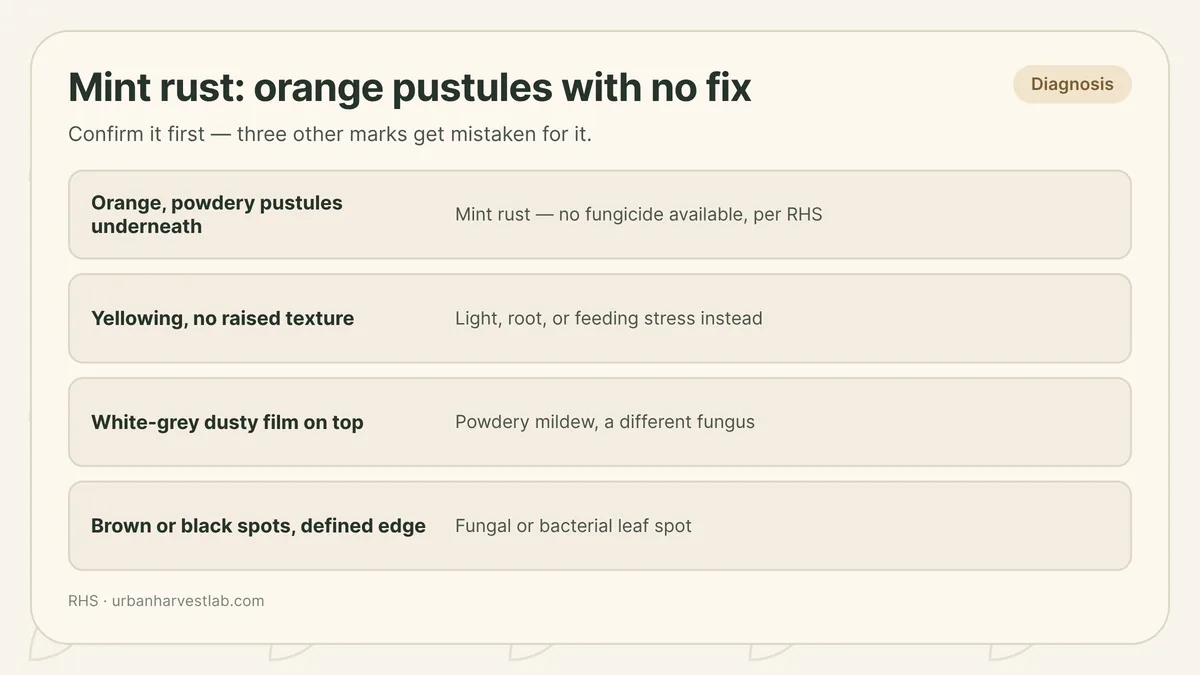
Mint rust: orange leaf pustules with no real cure
Mint rust cannot be treated away once it is on the leaf. The realistic job is removing infected growth, improving airflow, and knowing when to start over.
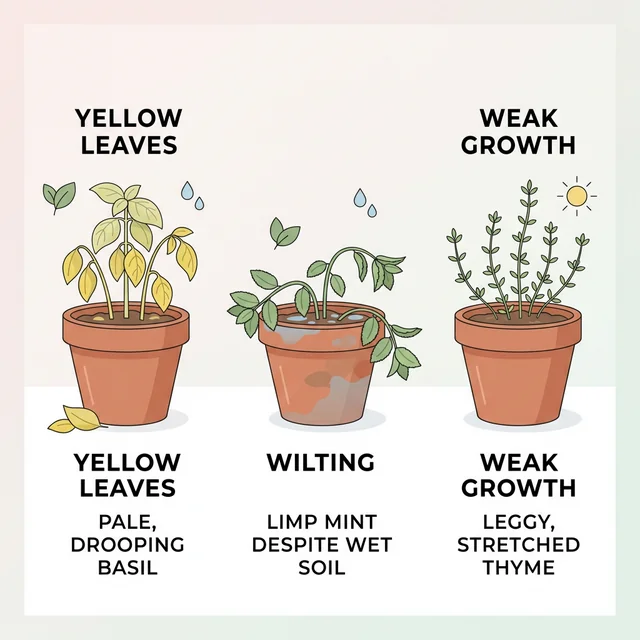
Common potted herb problems: yellow leaves, wilting, and weak growth
Common potted herb problems usually show up as yellow leaves, wilting, or weak growth, but the useful diagnosis starts with light, drainage, and root stress.
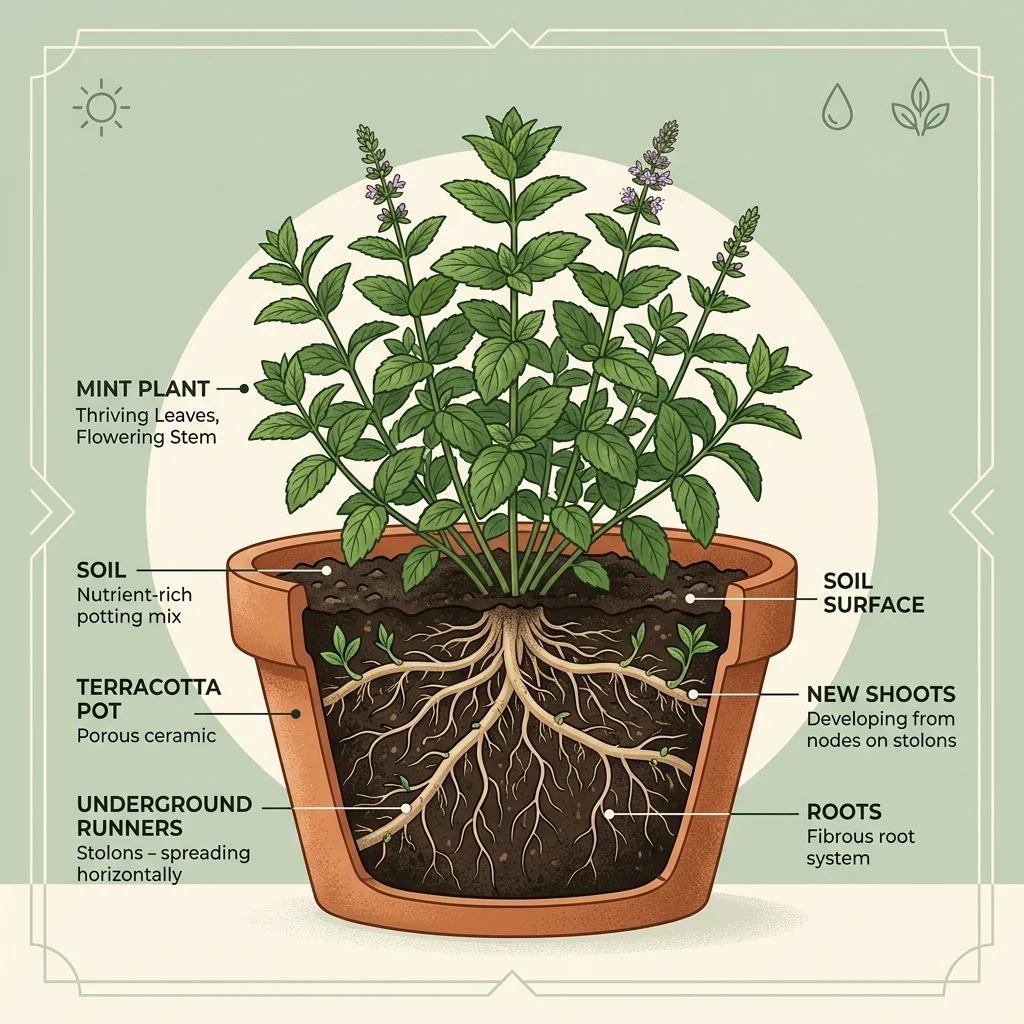
What size pot does mint need? Give it its own
Mint is a vigorous spreader that will crowd out anything it shares a pot with. Give it a roomy container of its own, 8 to 12 inches wide, and you will get years of growth.