Troubleshoot the system before you change the inputs.
Symptoms
- Orange to rust-colored powdery pustules, mostly on the underside of the leaf.
- A pale or yellow patch on the upper leaf surface directly above a pustule.
- Leaves that curl, dry out, or drop early once pustules spread across the plant.
Possible causes
- Rust spores reached the foliage and established in the leaf tissue.
- The fungus was already established in the rhizomes of a perennial mint patch from an earlier season.
- Crowded, still-air growing conditions let spores move easily between touching leaves.
Quick fixes
- Remove and bag infected leaves as soon as pustules appear; do not compost them nearby.
- Space plants out and thin the stand so air moves between the remaining leaves.
- Replace a badly infected planting with clean cuttings rather than trying to treat it.
What's actually on your mint leaves
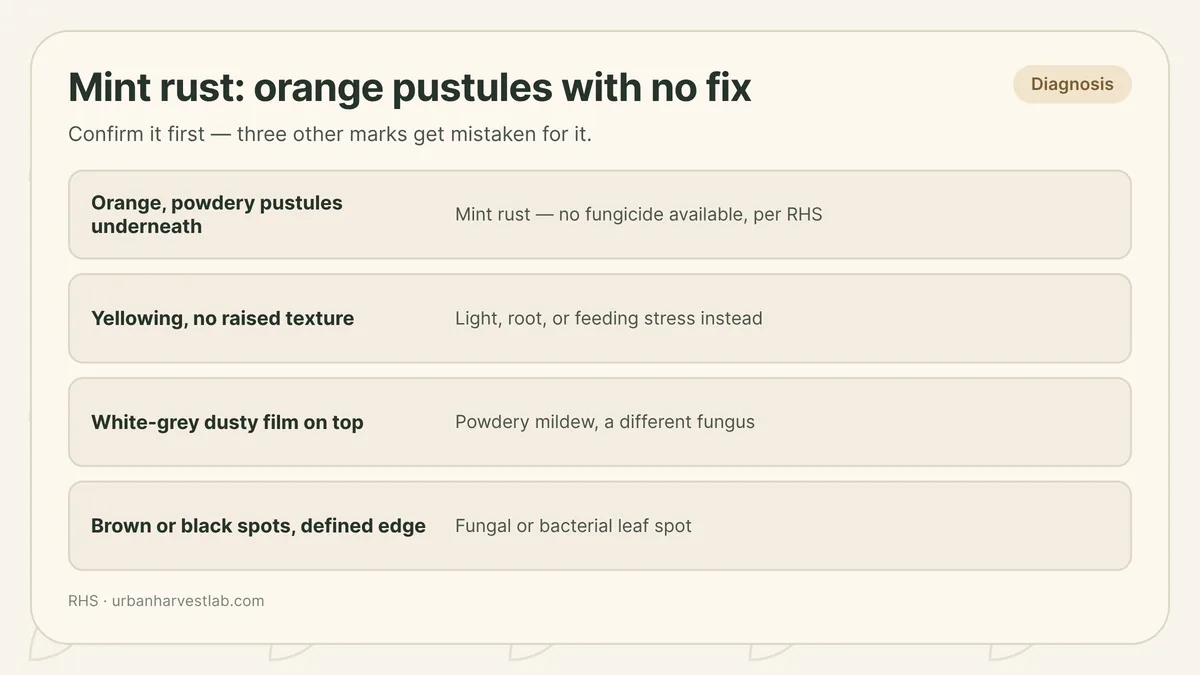
| Pattern | More consistent with | Confirmation |
|---|---|---|
| Orange, powdery pustules on the leaf underside | Mint rust | Check for a matching pale patch on the upper surface |
| Yellowing with no raised texture or orange dust | Light, root-zone, or feeding stress | Check root-zone moisture and light before assuming disease |
| White or gray dusty film across the top of the leaf | Powdery mildew | No orange pustules underneath; different fungus, different fix |
| Brown or black spots with a defined edge | Fungal or bacterial leaf spot | Ring pattern points fungal; water-soaked with ooze points bacterial |
Mint rust shows up as orange, powdery pustules on the underside of mint leaves, and once it has taken hold in a leaf there is no fungicide fix: RHS states that no product with activity against mint rust is available for use on mint or other culinary herbs. The realistic job is not curing the leaf in front of you. It is removing what is already infected, slowing the spread through the rest of the planting, and deciding when a badly affected patch is worth replacing rather than nursing along.
Start with the general potted herb diagnosis if you are not sure the problem is disease at all. Rust has a specific look, and confirming it before you change your watering, feeding, or light setup saves a season of fixing the wrong thing.
Orange, powdery, and only on the underside
Rust announces itself with texture, not just color. Check the underside of the leaf first: mature pustules are raised, powdery, and distinctly orange or rust-colored, often with a matching pale or yellow patch on the upper surface directly above. Brush a finger across a pustule and orange spore dust comes away on your skin, which a plain discoloration will not do.
That texture is what separates rust from three problems it gets confused with constantly. Plain yellowing with no raised bumps and no orange dust usually traces back to light, root-zone moisture, or feeding rather than disease; the mint leaves turning yellow diagnosis covers that before you reach for a disease explanation. White or gray dusty patches spread across the top of the leaf, rather than orange pustules underneath, point to powdery mildew instead, a different fungus with a different management path. Brown or black spots with a defined edge, sometimes ringed or water-soaked, are more consistent with the black spots on herb leaves diagnosis than with rust.
Mint is the herb rust is named after, for a reason
Clemson HGIC’s herb guide notes that mint prefers rich, moist soil in part shade and is usually grown from cuttings, roots, or transplants. Rust is the disease RHS treats as mint’s characteristic problem — the plant most associated with this fungus in the first place.
No fungicide fix exists once the fungus is in a leaf, and that is a label fact, not a matter of trying a stronger product. The US EPA states that pesticide labels are legally enforceable and that using a product inconsistent with its labeling is a violation of federal law, and the National Pesticide Information Center puts the consequence plainly: if your crop is not listed on the label, you cannot apply the product to it. RHS adds the UK-specific piece: no fungicides with activity against mint rust are available for gardeners to use on mint or other culinary herbs there. Between the two, spraying your way to a clean plant is not a realistic option wherever you garden.
Part of why a single removal pass does not finish the job is that the infection is not confined to the leaf you can see. RHS’s own recommended fix for a bad case, removing infected plants and rhizomes rather than just the affected leaves, points at where the fungus actually lives in a perennial mint patch: below ground, in the rhizomes, carried over from one season to the next. A plant that looks clean in spring can still put out infected new growth later in the year without any fresh exposure, because the source was not only on the leaves to begin with.
Cut it out and bag it
Once you have confirmed pustules, act rather than waiting to see whether the patch clears on its own. Pinch or cut off infected leaves and stems with clean scissors and bag them, rather than dropping them on the soil or the compost pile nearby, since spores on fallen foliage can reinfect the same patch.
Wipe down scissors and wash your hands between plants if you are working across more than one mint container, and avoid brushing infected foliage against clean growth while you carry it away. Work through the least-affected plants before the heavily infected ones, so you are not moving spores from a bad pot onto a lightly affected one.
Removing leaves is maintenance on an ongoing perennial, not a one-time cure. Expect to repeat it through the growing season on a plant you are keeping in place, and treat a rising rate of new pustules as the sign that removal alone is not keeping pace with the spread.
Space and airflow help the plant recover, not the infection clear
Spacing and ventilation are the standing advice against foliar fungal disease on herbs generally — RHS gives no overcrowding and better ventilation for grey mould, and UC IPM gives air circulation and a sunny position for powdery mildew — and the same handling keeps a mint patch workable while you are removing infected growth from it. Thin a dense clump so leaves are not touching each other, and space multiple containers apart instead of lining them edge to edge. If mint is growing in open ground, cutting back overhanging growth from nearby plants can open up airflow around the patch as well.
Watering at the root zone rather than overhead, and earlier in the day so any leaf surfaces that do get wet have time to dry before evening, is the same no-overhead-watering practice Penn State recommends for basil downy mildew. None of this clears an infection already present, but a well-spaced, well-drained patch produces new leaf faster than a crowded one, which matters once you are removing infected foliage on a regular basis.
Decide whether to start over from clean stock
For a lightly affected plant, ongoing removal plus better spacing can keep a mint patch usable for a season. For a badly infected planting, most of the leaves affected and new growth coming in infected as fast as you remove it, RHS’s recommendation is to remove the infected plants and rhizomes altogether and start again from clean stems, rather than continuing to manage the original planting.
In practice that means taking cuttings from a mint plant you know is unaffected, not from the infected one, and rooting them separately; regrowing herbs from cuttings covers how. If you are replanting into the same bed or container, clear out the old rhizomes as completely as you can first, since fragments left behind can regrow and carry the infection straight into the new planting.
For anyone dividing rhizomes specifically to guarantee clean stock, RHS gives a hot-water treatment of 44 degrees C (111 degrees F) for 10 minutes as a way to treat rhizomes before replanting. That is a precise temperature and timing rather than a rough soak, and it is worth attempting only with a thermometer to hold the water steady.
RHS and Clemson both cover managing rust and neither addresses whether leaves from an affected plant are safe to eat. The practical handling is to harvest only clean, unaffected growth and discard leaves showing pustules, rather than treating edibility as a question with a documented answer.
Keep rust from starting in the first place
Buy or accept new mint from a source you trust, and check the undersides of leaves before adding a plant next to healthy mint already growing on a windowsill or in a bed. Give plants the spacing described above from the start, rather than correcting it after pustules have already shown up. If one container position produces rust more than once, treat the position itself, its airflow, its shade, how crowded it gets, as part of the problem rather than just the plant currently in it.
Clean pots, trays, and tools at the end of a season before reusing them for a new mint planting, and keep infected foliage out of a compost pile that will end up back near the same bed.
Common mistakes
- Assuming a plain yellow patch is rust when there is no raised, powdery texture underneath it.
- Reaching for a general fungicide not labeled for mint or another culinary herb.
- Removing infected leaves once and expecting the plant to stay clean afterward.
- Composting infected foliage near the same bed or container.
- Replanting into the same soil without clearing out old rhizomes first.
- Waiting until most of the planting is affected before deciding to start over.
Sources
Confirm it is rust before you change anything
Orange pustules point to rust, but plain yellowing, powdery patches, and black spotting all have separate causes and separate fixes.
Common questions
Can mint rust be treated with a fungicide?
RHS states that no fungicides with activity against mint rust are available for use on mint or other culinary herbs, so spraying is not a lawful or effective option for an edible planting.
Will removing the infected leaves cure my mint?
Removing infected leaves slows the spread and keeps the plant tidier, but it does not clear the infection on its own. The fungus can persist in a perennial mint's rhizomes below ground, so new growth can come in infected again later in the season.
Can I eat mint that has rust on some leaves?
RHS and Clemson both cover identification and control, not edibility. Harvest only clean, unaffected growth and discard leaves showing pustules rather than treating this as a settled food-safety question.
How do I start a new mint plant that will not have rust?
Take cuttings from a mint plant you know is unaffected, not from the infected one, and root them separately. If you are dividing rhizomes specifically to guarantee clean stock, RHS gives a hot-water treatment of 44 degrees C (111 degrees F) for 10 minutes as a way to treat them before replanting.
Related guides
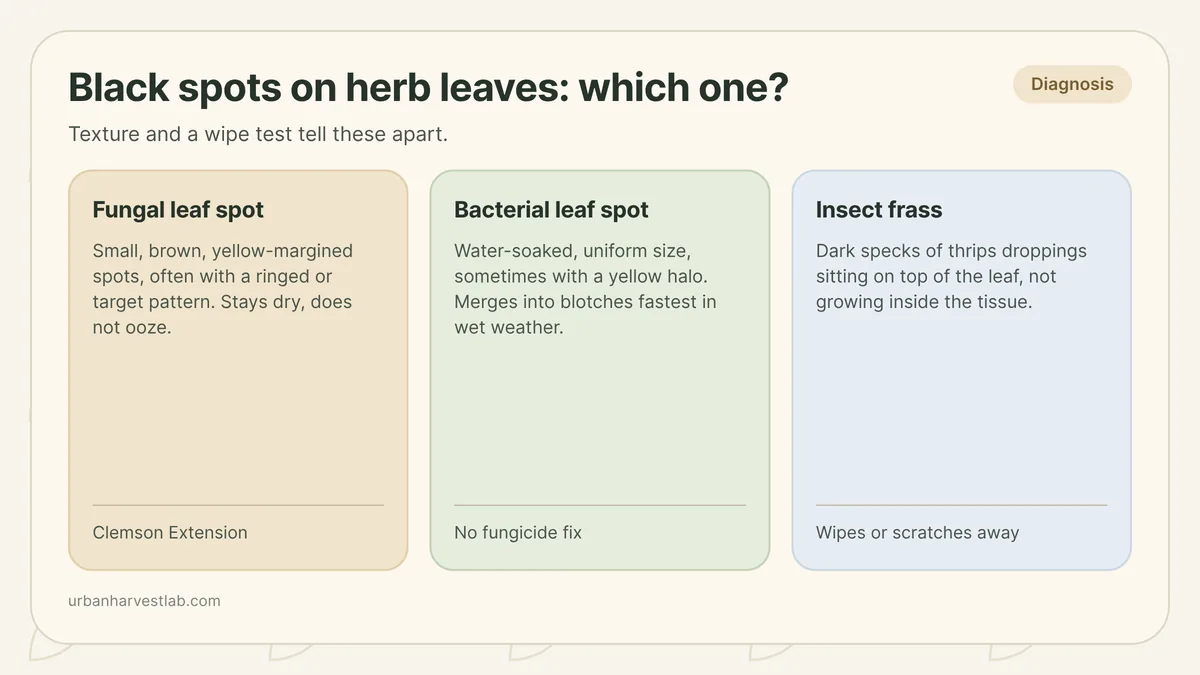
Black spots on herb leaves: fungus, bacteria, or frass
Black spots on herbs can be a fungal disease, a bacterial disease, or just insect droppings sitting on the leaf, and each one calls for something different.
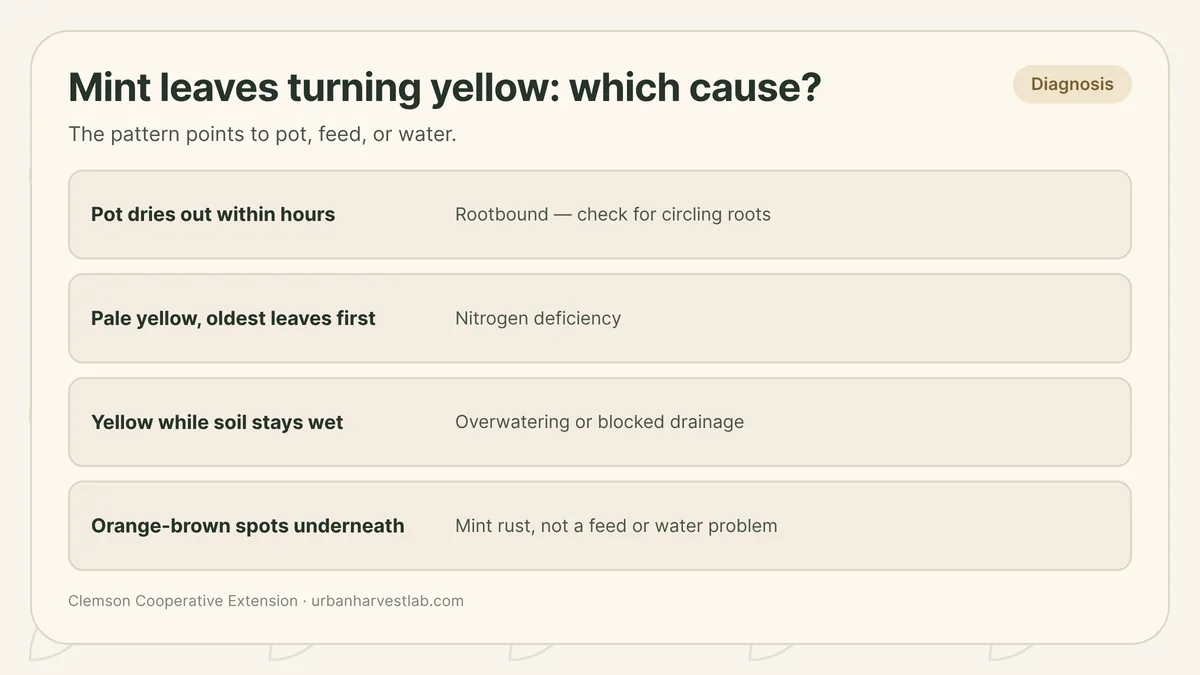
Mint leaves turning yellow: pot size, feeding, or water
Yellow mint leaves have three usual sources: a pot the roots have outgrown, short nitrogen, or soil that stays too wet. The pattern tells you which.
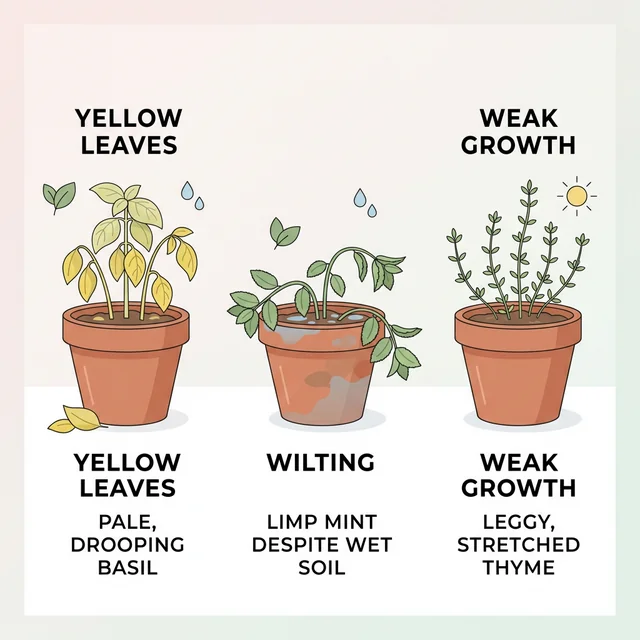
Common potted herb problems: yellow leaves, wilting, and weak growth
Common potted herb problems usually show up as yellow leaves, wilting, or weak growth, but the useful diagnosis starts with light, drainage, and root stress.