Troubleshoot the system before you change the inputs.
Symptoms
- Needles browning or dropping while the soil underneath still feels damp.
- Whole stems turning grey or soft, or pulling away cleanly at the base.
- Sparse, leggy new growth with needles paling from the inside of the plant outward.
- Sticky patches or small, immobile bumps along the woody stems.
Possible causes
- Soil that stays wet for hours at a time has let root rot take hold, since rosemary needs to dry out between waterings.
- The pot has gone root-bound, or is oversized for the current root mass, and either extreme stresses the roots.
- The plant is too far from a bright window, or was hit by a sudden cold snap, and is showing light or temperature stress rather than a watering problem.
Quick fixes
- Check whether the plant recovers within a few hours of a deep watering before assuming it needs more water.
- Slide the plant partway out of its pot to check root color, firmness, and how tightly roots fill the container.
- Inspect the stems and the undersides of the needles for scale before treating this as only a drainage or light problem.
Rosemary is a Mediterranean shrub built to survive drought, and wet roots undo it faster than almost anything else — Clemson Cooperative Extension describes rosemary as wanting “well-drained soil” and “dry, sunny areas,” and a pot that stays wet works against that from the start. But wet roots are not the only way to lose a rosemary plant, and treating every case as a watering problem misses the ones that are not. Work through the causes below in order, starting with the most common, and use how the plant responds to water rather than how the leaves look alone. For symptoms that show up across potted herbs generally, start with the potted herb problem guide instead.
Read the response to water, not just the leaf
A wilted rosemary can be dry or drowning, and from across the room the two look almost identical. Check the root zone before reading the leaves: Clemson’s finger test (“stick your finger into the mix up to the first joint; if it is dry at your fingertip it needs water”) and its weight test (a dry pot shows “a definite loss in weight” compared with one that is still holding moisture) both tell you what the soil is actually doing. Clemson Cooperative Extension also notes that any injury to the root system, including rot caused by too much water, cuts a plant’s ability to take up water in the first place — so how the plant responded to its last watering is a second, confirming read: one that perked up within a few hours after a normal watering was genuinely dry, and one that stayed limp has a root problem water alone will not fix. Once you know the plant is genuinely dry, the watering schedule for rosemary sets the dry-side rhythm to follow instead of a fixed calendar.
Overwatering and poor drainage
Clemson Cooperative Extension lists rosemary’s native preference plainly: it wants “well-drained soil” and “dry, sunny areas,” the opposite of the moisture habits that suit basil or mint. A pot with no drainage hole, a decorative cachepot that traps runoff in a hidden saucer, or a dense potting mix that holds water around the roots for days recreates exactly the conditions this plant is least equipped to handle.
Waterlogged soil starves the roots of the one thing a healthy root needs besides moisture: air. The Missouri Botanical Garden states plainly that “the longer the air is cut off, the greater the root damage,” and once roots have been sitting oxygen-starved for long enough they stop moving water and nutrients up into the plant at all. That is why a rosemary that has been sitting wet for weeks can show stunted growth and yellowing leaves that look, at first glance, like a feeding problem rather than a drainage one — the roots simply can no longer deliver what a fertilizer would supply.
Fixing this cause is mostly a container decision rather than a watering-schedule tweak: a pot with real drainage holes, a gritty mix that does not compact, and a saucer that gets emptied rather than left to soak. See the rosemary pot size guide for the container side in full, including why a too-large pot around a small root ball causes this same problem even with careful watering.
Root rot: when wet soil becomes an infection
Rosemary’s woody crown makes this cause harder to catch early than it is in a soft-stemmed herb: the needles can stay green for a while even after the roots underneath have started to fail, so by the time the whole plant looks dull the infection is often already established. UC IPM’s pest note on Phytophthora root and crown rot puts a number on how fast that window closes: the pathogen “can establish in as little as 4 to 8 hours of soil saturation,” so one blocked drainage hole or a saucer left full over a long weekend is enough on its own.
The signs sit both below and at the soil line. UC IPM describes “darkened areas in the bark around the crown and upper roots,” and cutting into an affected stem reveals “reddish brown zones … in the inner bark and outer layer of wood” instead of the pale tissue underneath healthy bark. Clemson’s houseplant disease guidance adds the visible cue at ground level: a wilted stem sometimes “girdled at or near soil level by a ring of brown or black tissue,” with roots that have turned “brown to black and may be soft” — on rosemary this often shows up as one or two stems failing at the base while the rest of the shrub still looks fine, rather than the whole plant wilting at once. Several different fungi can produce this pattern in houseplants, including Rhizoctonia, Pythium, Botrytis, Phytophthora, Alternaria, and Sclerotinia, according to Clemson.
UC IPM is blunt about what comes next: “a plant with a substantial Phytophthora infection rarely recovers.” Needle drop that started from the inside of the plant and spread outward, paired with a girdled stem at the soil line, is usually past the point where correcting drainage brings the plant back — the more useful move at that stage is starting a new rosemary in fresh, fast-draining mix rather than nursing the old one. Caught earlier, before the crown itself is girdled — damp soil and a few blackened roots, but firm woody stems and some pale root tissue left — the odds are better once drainage is corrected.
Root-bound or an oversized pot
Rosemary is a shrub, and shrubs outgrow pots in both directions. Clemson’s repotting guidance lists the signs of the tight end: roots “in a solid mass around the rootball,” roots “growing out of the drainage hole,” or a plant that “requires frequent watering or wilts shortly after watering” even though the routine has not changed. A root-bound rosemary dries out fast because there is barely any soil left between the roots to hold water, and that symptom — wilting within a day of a deep soak — can look like underwatering when the real fix is a bigger pot.
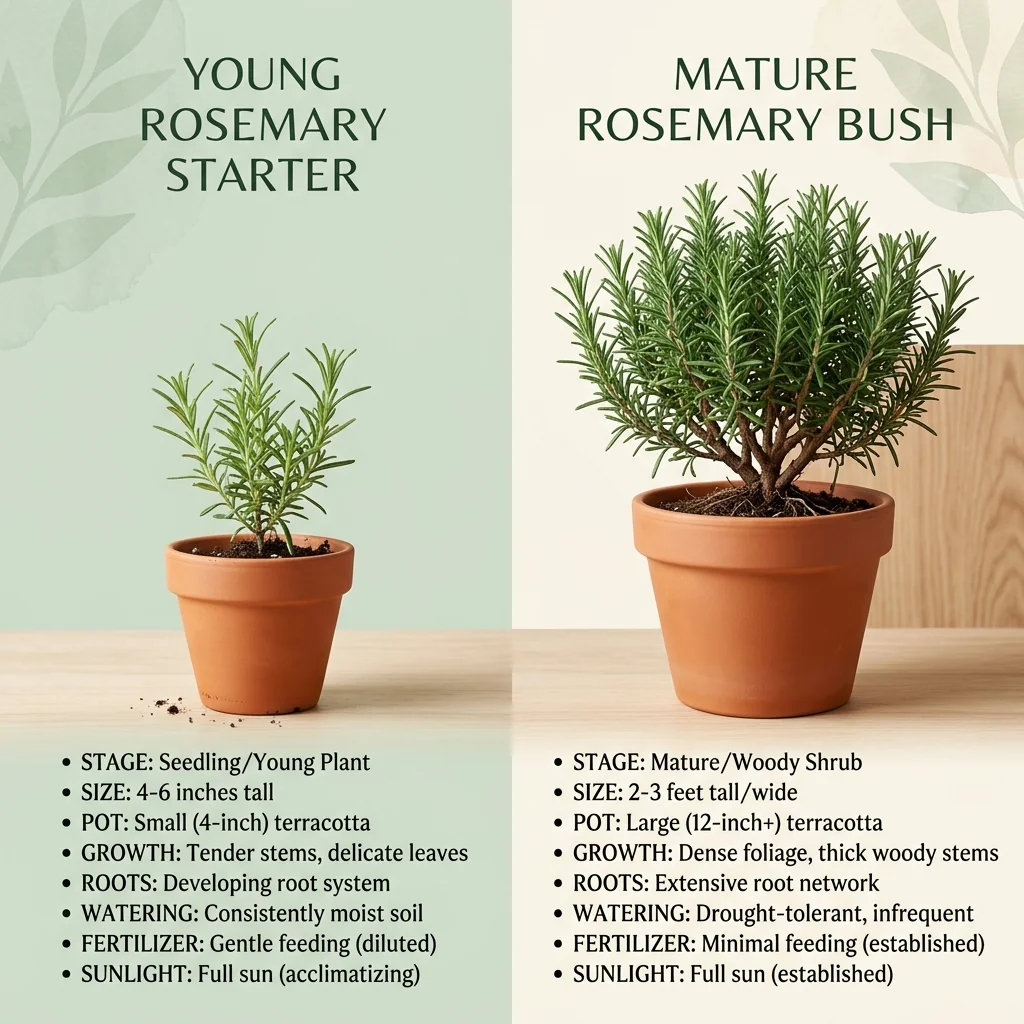
Clemson’s rule of thumb for sizing up is modest on purpose: choose a pot “1 or 2 inches larger in diameter than the current pot” rather than jumping straight to a large container, which recreates the overwatering risk above around a root mass too small to use all that soil. See root-bound herb signs for the general signs across herbs, and the rosemary pot size guide for rosemary’s specific upsizing schedule as it matures into a woody shrub.
Not enough light
A rosemary that is fading rather than obviously rotting is sometimes just short on light. Clemson notes that “almost all herbs grow best in an area that is sunny for at least six hours each day,” and rosemary sits at the sun-demanding end of that range rather than tolerating the low end of it. Indoors that bar is easy to miss: Clemson’s indoor plant guidance notes a well-lit home averages under 100 foot-candles against more than 10,000 foot-candles outdoors, and maintaining an indoor plant takes roughly 100 foot-candles for twelve hours a day just to hold steady. Rosemary is a full-sun plant and does not thin out gracefully indoors; pushed too far from a window, it responds with sparse, leggy growth and needles that pale and drop from the interior of the plant outward, a different pattern from the browning-at-the-base that root rot produces.
Feeding a light-starved rosemary does not fix this — Clemson’s own fertilizing guidance for indoor plants sets at least 200 foot-candles for 12 hours a day as the light level foliage plants need before feeding does any good, since a plant that dim cannot use the extra nutrients. Check the light guide for herbs to judge whether a windowsill is bright enough for a sun-loving herb like rosemary, and what to change if it is not.
A hard cold snap
Cold damage reads differently from the causes above because it tracks a specific event rather than building over weeks. A rosemary that was fine one week and shows sudden browning after a cold night, a drafty window, or a spell left outside too late in the season is more likely reading a temperature event than a watering one, especially if nothing about the watering routine changed. Root rot, by contrast, builds gradually and shows the girdled, soft stem tissue at the soil line described above rather than a sudden change tied to a specific cold night. Clemson names ‘Arp’ and ‘Hill Hardy’ among the hardier rosemary cultivars, worth knowing if cold exposure is a repeat pattern where you grow it rather than a one-off accident. The guide to overwintering rosemary and thyme in pots covers protecting a potted plant through the cold season in full.
Scale insects on the woody stems
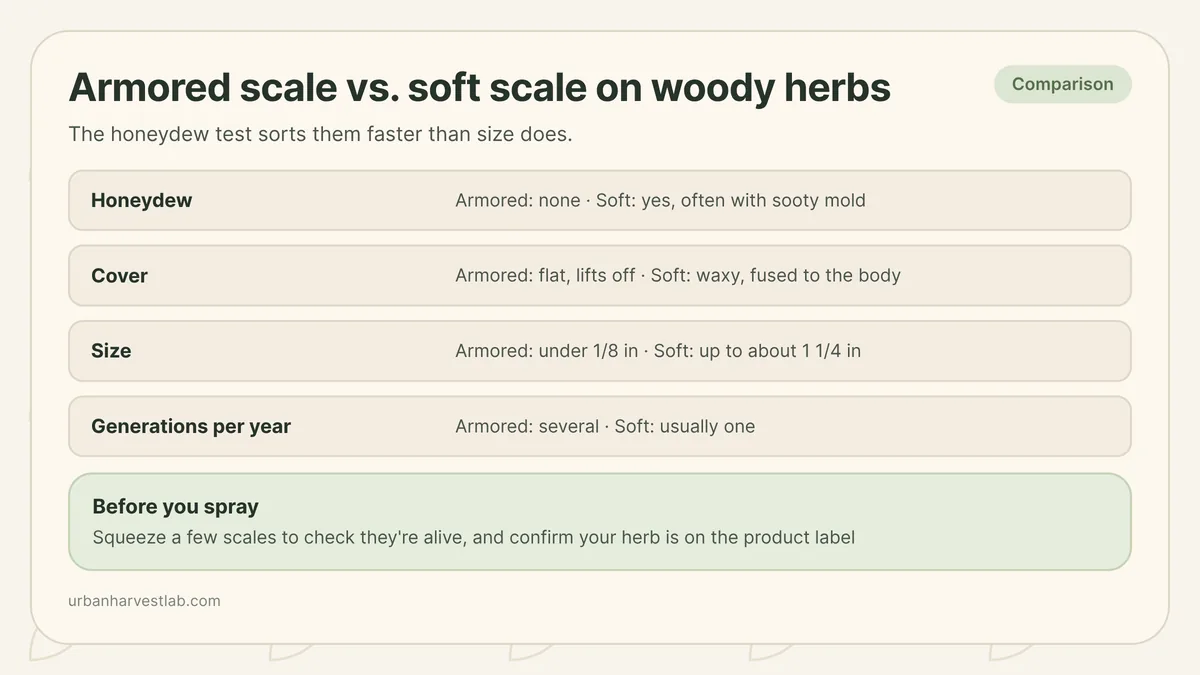
Small, immobile bumps on the stems, sticky leaves, or a fine black coating point to scale rather than a root or light problem. Clemson’s pest guidance notes that a plant already stressed by another cause tends to be more susceptible to pests, so a rosemary already struggling with wet roots or low light is also the one most likely to pick up an infestation on top of it. See scale insects on rosemary and other woody herbs to identify which kind is present and time treatment so it actually reaches the insect.
Match the pattern to the cause
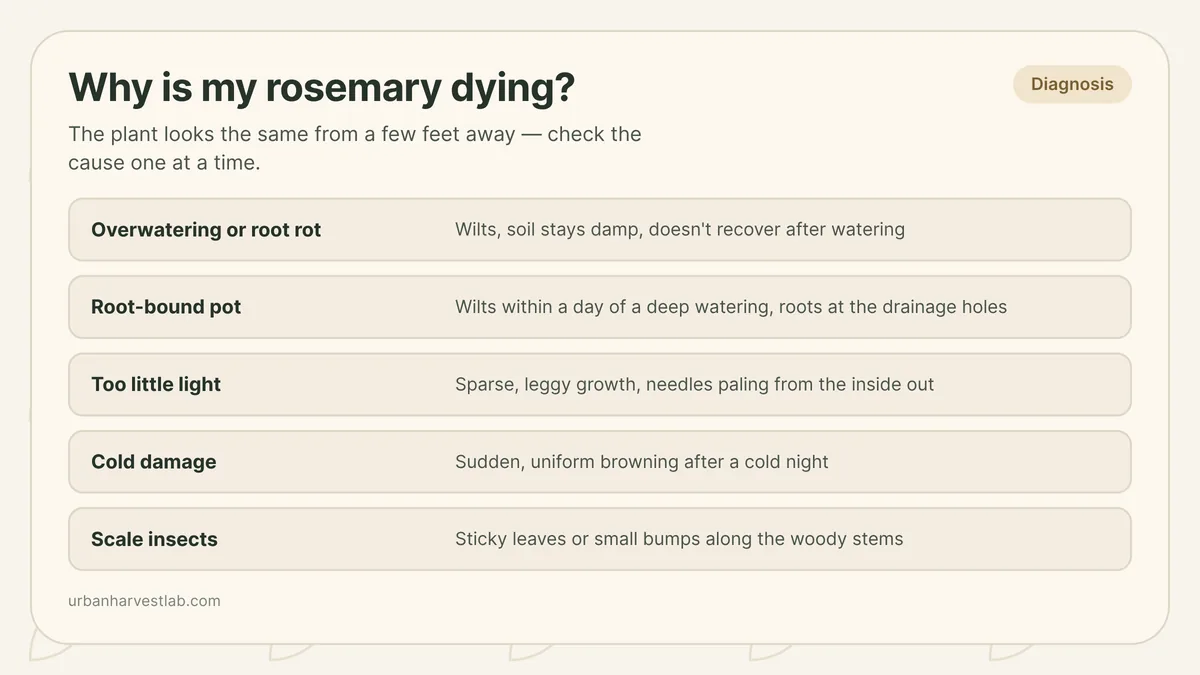
| What you see | Most likely cause | Check next |
|---|---|---|
| Wilts, soil damp, does not recover after watering | Overwatering or root rot | Root color and firmness, drainage holes |
| Wilts within a day of a deep watering, roots at the drainage holes | Root-bound pot | Root mass against pot size |
| Sparse, leggy growth, needles paling from inside out | Too little light | Distance to a bright window |
| Sudden, uniform browning after a cold night | Cold damage | Timing against recent weather |
| Sticky leaves or small bumps on the stems | Scale insects | Stems and needle undersides |
Common mistakes
- Watering a wilted rosemary before checking whether the soil underneath is already damp.
- Fertilizing a plant that is short on light instead of moving it closer to a window.
- Repotting straight into a large pot “to be safe,” which recreates the overwatering risk around a small root ball.
- Blaming a cold night for damage that actually started at the roots weeks earlier.
- Treating for scale before ruling out the drainage or light problem sitting underneath it.
When to start over
Once you have decided to discard a badly rotted plant, dispose of the old potting mix rather than reusing it — the fungi behind Phytophthora and the other rots Clemson lists can persist in mix that looks fine. Start the new rosemary in a clean pot with real drainage holes and a gritty mix from the start.
Sources
- UC IPM Pest Notes 74133: Phytophthora Root and Crown Rot in the Garden
- Clemson HGIC: Herbs
- Clemson HGIC: Houseplant Diseases & Disorders
- Clemson HGIC: Indoor Plants – Transplanting & Repotting
- Clemson HGIC: Indoor Plants – Cleaning, Fertilizing, Containers & Light Requirements
- Clemson HGIC: Common Houseplant Insects & Related Pests
- Missouri Botanical Garden: Overwatering
Narrow down what is actually wrong
Once a cause fits, these guides cover the fix in full.
Common questions
Why is my rosemary turning brown and dropping needles?
Brown, dropping needles usually mean the roots are struggling, most often because the soil has stayed wet. Check whether the soil is damp a few inches down and whether the plant perks up after watering; if it does not, root rot is more likely than thirst or cold.
Can a dying rosemary be brought back?
It depends how far root damage has gone. A rosemary with soft, dark roots and stems that pull away easily near the soil line is showing the pattern UC IPM associates with Phytophthora root rot, and a plant with a substantial infection rarely recovers. Firm, pale roots under a plant that is simply dry or cold-stressed have a much better chance once the underlying cause is corrected.
Is my rosemary dead or just dormant for winter?
Scratch a stem with a fingernail. Green or pale tissue underneath means the stem is alive even if the needles look dull; grey, dry, or brown tissue all the way through means that section is gone. Test several stems, since a plant can lose some branches to cold or rot while others stay alive.
Why does my rosemary keep dying even though I water it regularly?
Watering on a fixed schedule is often the problem itself, not the fix, since rosemary needs to dry out between waterings rather than being watered by the calendar. Check the soil and the pot drainage before assuming the plant needs more water; the watering schedule guide for rosemary covers the dry-side rhythm that actually suits it.
Related guides
Scale insects on rosemary and other woody herbs
Scale on a woody herb often goes unnoticed until the leaves turn sticky or a stem starts to die back, and the right treatment depends on which kind of scale you have.
Common potted herb problems: yellow leaves, wilting, and weak growth
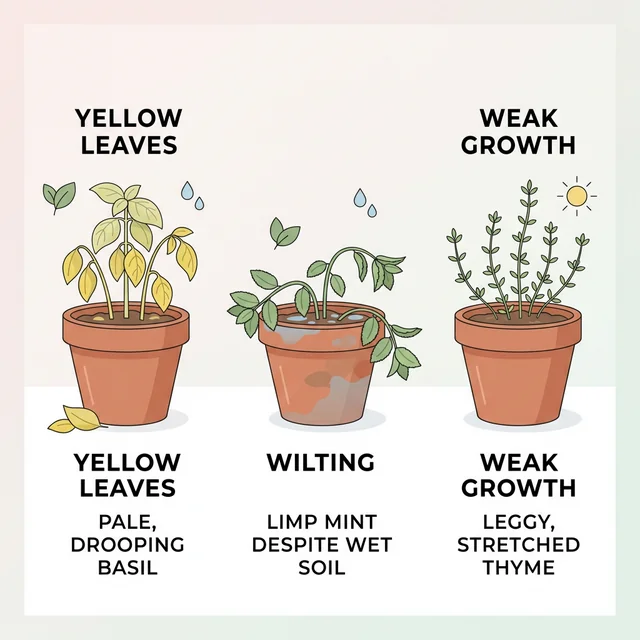
Common potted herb problems usually show up as yellow leaves, wilting, or weak growth, but the useful diagnosis starts with light, drainage, and root stress.
What size pot does rosemary need? Start small, size up
Rosemary is a small shrub in disguise. It starts in a modest pot but needs upsizing as it grows woody, plus the sharp drainage every Mediterranean herb demands.