Troubleshoot the system before you change the inputs.
Symptoms
- Small oval or rounded bumps on stems and the underside of the needles that do not move when touched.
- Sticky honeydew on leaves, the pot rim, or the surface below the plant, sometimes coated in black sooty mold.
- Yellowing, thin foliage, or dieback concentrated on one or two woody stems rather than across the whole plant.
Possible causes
- Soft scale has established on the stems and is excreting honeydew that feeds sooty mold and attracts ants.
- Armored scale is feeding under a hard, removable cover that produces no honeydew, so the foliage stays dry.
- An earlier treatment killed the exposed crawlers but missed insects already sheltered under a cover.
Quick fixes
- Squish a few scales to check whether they are still alive before spending time on a treatment plan.
- Wrap clear double-sided tape around an infested stem to catch crawlers and time your next spray.
- Prune out the most heavily encrusted stems and confirm the product label lists your herb before spraying the rest.
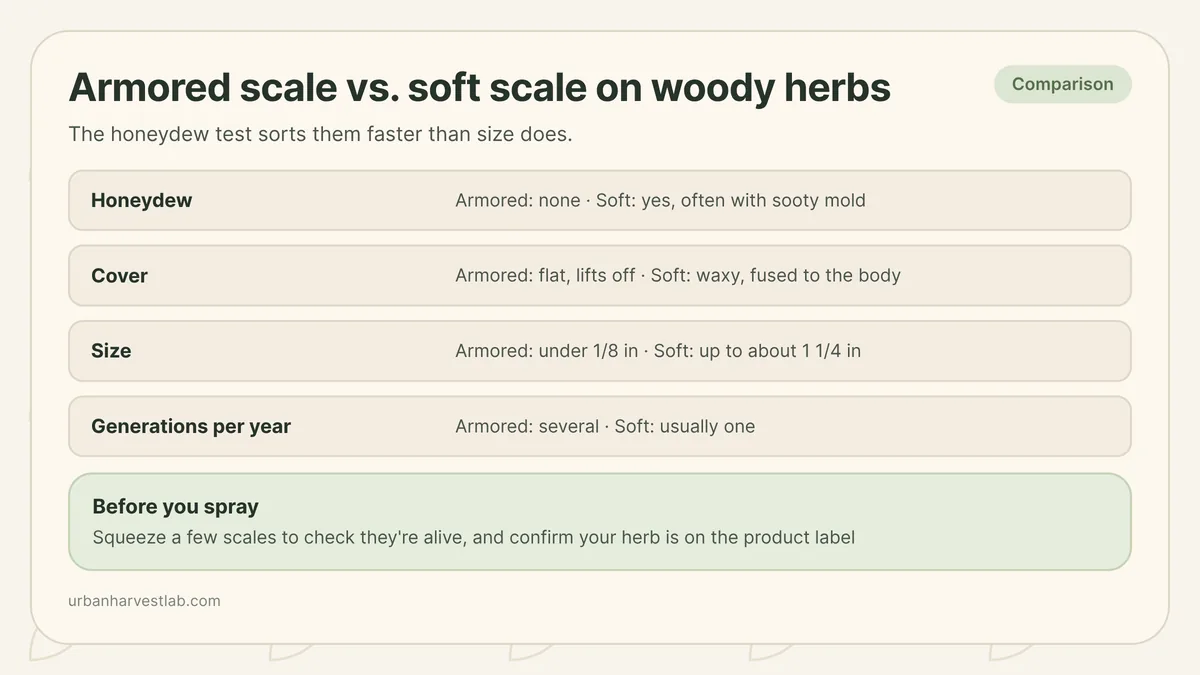
Armored scale vs. soft scale on woody herbs
| Clue | Armored scale | Soft scale |
|---|---|---|
| Honeydew | None | Yes, often with sooty mold |
| Cover | Flat, lifts off the body | Waxy, does not lift off |
| Size | Under 1/8 inch across | Up to about 1 1/4 inch long |
| Generations per year | Several | Usually one |
Small bumps clustered on a rosemary stem, with sticky leaves nearby, usually mean scale. Armored scale forms a flat cover and produces no honeydew, while soft scale grows a waxy shell and excretes the sticky residue that turns leaves shiny and sometimes black. The two need different handling, and because soap and horticultural oil work only on contact, timing the spray to the crawler stage matters more than the product you buy.
Woody herbs are not the same reading as a wilting basil plant. Scale on rosemary, sage, and thyme is often missed because the bumps sit on tough, slow-growing stems rather than on soft new growth, and the first thing many growers notice is a single stem declining while the rest of the plant looks fine. The broader potted herb problem guide is a better starting point if the plant is declining without any visible insect.
Run a finger along the stem: gritty bumps that do not move
A living infestation feels gritty or bumpy rather than smooth. UC IPM’s pest note on scale insects describes armored scale as carrying a “flattened, platelike cover that is less than 1/8 inch in diameter,” and that cover “usually can be removed from the body” with a fingernail, leaving the soft insect underneath exposed. Soft scale looks different: it can “grow up to 1¼ inch long,” and its cover does not lift off, because the wax is fused to the insect itself. Clemson Cooperative Extension gives a broader working range for houseplant scales generally, from about 1/16 to 1/2 inch in diameter, which fits comfortably around UC IPM’s more specific armored-scale figure. If the bumps do not match either description, the herb pest identification chart can help sort scale from other stationary or slow-moving pests before you treat anything.
The honeydew test is the fastest way to sort the two apart. Soft scale “excrete[s] honeydew,” while armored scale “do[es] not secrete sticky honeydew” at all, according to UC IPM. So sticky leaves, a tacky pot rim, or ants filing up and down a stem point toward soft scale, aphids, mealybugs, or whiteflies rather than armored scale. A dry, gritty bump with no stickiness anywhere nearby is more likely armored. Left in place, honeydew tends to blacken with sooty mold — UC IPM’s aphid pest note describes the residue as turning “black with the growth of a sooty mold fungus,” and the same fungus colonizes soft scale’s honeydew just as readily. Ants often show up for the same reason: UC IPM’s ant pest note explains that outbreaks of honeydew-producing pests are frequently worse where ants are tending them, because the ants keep off the parasites and predators that would otherwise thin the colony.
Check whether the scale is even alive
Before you treat anything, squeeze a few of the bumps between your fingernails. A dead scale “fail[s] to exude fluid when squished,” per UC IPM, which is the answer to the common complaint that the bumps are still there weeks after a spray. Old scale covers do not fall off the stem just because the insect underneath has died. A scale that has already been parasitized looks different again: it “may become puffy or darken” and shows a “round exit hole” where the parasitoid emerged. Finding several exit holes on a stem is a sign that natural control is already doing part of the job, and a broad spray at that point mostly kills the parasites rather than the pest.
Generation timing explains why one treatment rarely finishes the job. UC IPM gives armored scale several generations a year, so a fresh wave of crawlers can appear within weeks of a spray that looked successful. Most soft scale species complete one generation each year — brown soft scale is the exception — which means a soft-scale infestation caught late in its cycle may need only one well-timed application, while an armored-scale problem usually needs more than one.
Why a hard-shelled scale is harder to kill than a soft-bodied pest
Insecticidal soap and horticultural oil both work by direct contact: Colorado State University Extension explains that soap kills through “disruption of cell membranes, causing the insect to die from rapid dehydration,” and that it controls “small, soft-bodied arthropods, such as aphids, young scales, whiteflies, psyllids, mealybugs, and mites.” Notice what is on that list — young scale, not adult, hardened scale. CSU’s own guidance is that “soaps and detergents act strictly as contact insecticides, with no residual effect,” so a product has to touch the actual insect to do anything at all, which is why coverage and timing to the crawler stage matter more than the product itself.
That is the whole reason timing beats product choice for scale. A crawler — the newly hatched, mobile stage before it settles down and grows a cover — is soft-bodied and exposed, closer in practice to an aphid than to the armored adult it will become. Spraying stems covered in mature, shelled scale with soap or oil is far less effective than spraying the same stems while crawlers are actively moving.
Time the spray to the crawler stage
UC IPM’s monitoring method for scale is built around exactly this problem: wrap infested twigs with transparent double-sided sticky tape during spring, check it weekly, and watch for crawlers, which “get stuck on the tape and appear as yellow or orange specks.” Replace the tape each week rather than trying to read old catches. Once the tape starts catching specks, you have a window in which a contact spray actually reaches the vulnerable stage instead of bouncing off a hardened cover.
Rate and conditions matter alongside timing. UC IPM’s general oil guidance calls for a 1 to 2% oil solution in a high volume of water, and for scale specifically the note is not to apply oil “when it is foggy, freezing (under 32°F), hot (over 90°F)” — a narrower set of conditions than the generic 90°F ceiling given for other pests. Coverage has to reach the undersides of stems and needles, not just the top surface facing you, since soap and oil have no residual action once they dry.
Treat what you actually have
Start by pruning the most heavily encrusted stems and disposing of them away from other woody herbs; scale rarely justifies discarding a whole rosemary plant the way a severe root rot might, but a stem that is more shell than foliage is not worth spraying. For the remaining growth, a well-timed soap or oil application aimed at crawlers, repeated as tape monitoring shows a new hatch, is the pattern UC IPM’s sources support. Readers reaching for neem oil instead should check the neem oil safety guide for herbs, since neem works by disrupting insect growth rather than by contact and carries its own label questions on a culinary crop.
Before you spray anything on an herb you plan to cook with, read the label. The National Pesticide Information Center is direct about this: “Do not use pesticides in any manner other than those specifically listed on the label; it is against the law,” and the EPA’s own framing is that “it is a violation of Federal law to use this product in a manner inconsistent with its labeling.” If rosemary, sage, or the herb you are treating is not named on the label, the product cannot legally go on it, regardless of what else is in the bottle. Wait times before harvest work the same way — NPIC notes that preharvest intervals “can differ between products” even for the same crop, so there is no single number to memorize for oil or soap on a woody herb. Some labeled products list a wait of zero days; others do not. Read the one in your hand.
Common mistakes
- Spraying a stem covered in hardened adult scale and expecting the same result as spraying a crawler.
- Assuming the bumps are dead once the spray is finished, without squeezing a sample to check.
- Applying oil within two weeks of a sulfur treatment for another problem, which UC IPM warns can injure the plant.
- Treating honeydew and sooty mold as the disease, when they are a byproduct of the insect underneath.
- Reaching for a product without checking that the herb is named on its label.
Rule out the growing conditions before you blame the insect
Rosemary, sage, and thyme all want the same growing conditions — Clemson’s herb guidance calls for “well-drained soil” and “dry, sunny areas” for rosemary, “excellent drainage and dry soil in full sun” for sage, and “very well drained soil that stays dry” for thyme. A plant kept too wet, too shaded, or otherwise stressed outside that range is not more likely to attract scale from nowhere, but Clemson’s own pest guidance notes that stressed plants “tend to be more susceptible to pests” generally, which is one more reason a woody herb that is also declining for unrelated reasons is worth checking against rosemary dying before you assume scale explains everything. A container that stays too wet for rosemary’s preferences is its own problem, and matching pot size to the plant is covered in the rosemary pot size guide.
Inspect a new woody herb before it joins the rest
Most scale arrives the way most houseplant pests do: Clemson’s pest guidance notes that infestations “most often come into the home on newly purchased plants or on those that have been outside for the summer,” and that preventing an infestation is easier than eliminating one already established. Inspect a new rosemary or sage plant’s stems, not just its leaves, before it sits next to the rest of your collection. Space woody herbs enough that you can see each stem clearly during routine watering, since that is when a light infestation is easiest to catch before it needs a spray at all. Keep an eye on stressed plants specifically — one that is struggling for other reasons is the one worth checking first the next time you walk past with a hand lens.
Sources
- UC IPM Pest Notes: Scales
- UC IPM Pest Notes: Aphids
- UC IPM Pest Notes: Ants
- Colorado State University Extension 5.547: Insect Control — Soaps and Detergents
- Clemson HGIC: Common Houseplant Insects & Related Pests
- Clemson HGIC: Herbs
- National Pesticide Information Center: Neem Oil General Fact Sheet
- National Pesticide Information Center: Preharvest Interval
- National Pesticide Information Center: Reading Pesticide Labels
- US EPA: Introduction to Pesticide Labels
Separate scale from a drainage or watering problem
Rosemary, sage, and thyme decline from root stress as often as from insects, so rule out the setup before you spray.
Common questions
What does scale look like on rosemary?
Look for small oval or rounded bumps stuck to the stems and the underside of the needles that do not move when you touch them. UC IPM describes armored scale as a flattened, platelike cover less than 1/8 inch across, while soft scale can grow closer to an inch and a quarter long and coats nearby leaves with sticky honeydew.
Why is my rosemary sticky?
Sticky residue on a woody herb usually means a honeydew-producing pest such as soft scale, aphids, or mealybugs, since armored scale does not produce honeydew at all. Check the stems themselves for the bumps rather than assuming the residue is sap or dew.
Will insecticidal soap or neem oil kill scale on rosemary?
Soap and horticultural oil are contact treatments, and Colorado State University Extension notes they work on small, soft-bodied stages such as young scale rather than hardened adults sitting under a cover. Neem oil works differently: the National Pesticide Information Center states its active component, azadirachtin, repels pests and disrupts their growth rather than killing on contact, and it is used in over 100 registered products, so the label on the bottle decides whether a given neem product may go on rosemary, sage, or thyme. Timing the spray to when crawlers are active, and checking that the label lists your herb, matters more than which product you pick.
Is it safe to cook with rosemary that had scale?
Rinse the harvest well, and prune away and discard stems heavily encrusted with scale rather than cooking with them. If you sprayed anything first, check the product label: a label that does not list your crop means the product cannot legally be used on it, and any wait before harvest is set by that specific label, not by the active ingredient in general.
Related guides
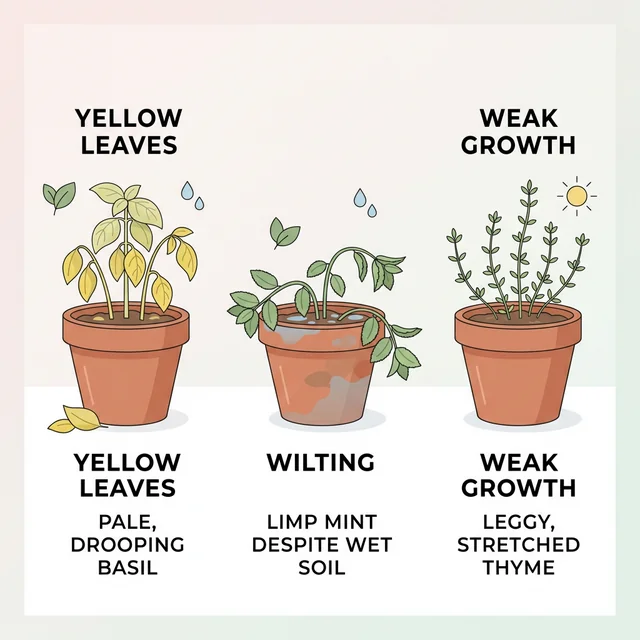
Common potted herb problems: yellow leaves, wilting, and weak growth
Common potted herb problems usually show up as yellow leaves, wilting, or weak growth, but the useful diagnosis starts with light, drainage, and root stress.
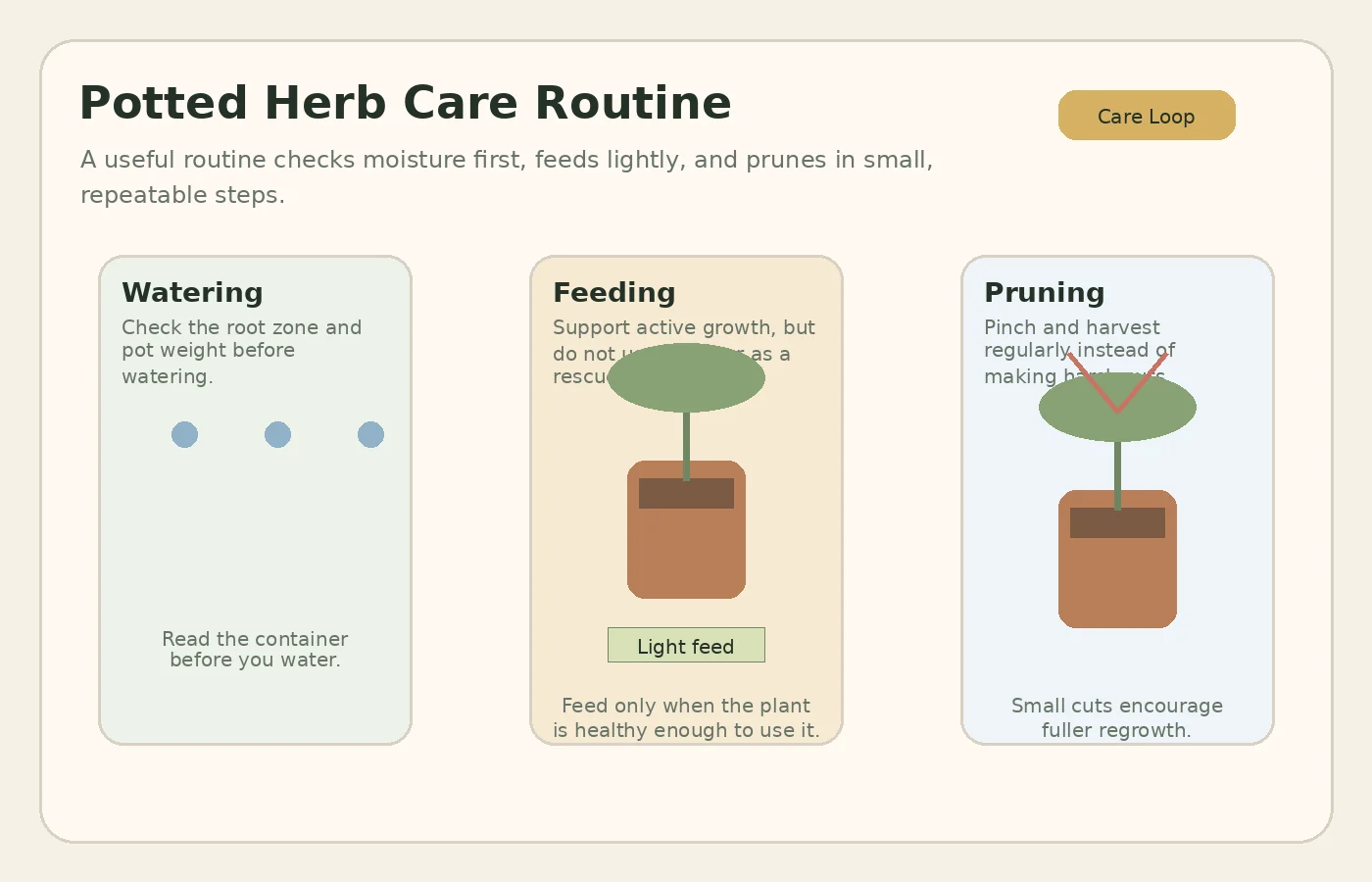
Potted herb care: watering, feeding, and pruning without guesswork
A practical guide to keeping basil, parsley, mint, thyme, and chives healthy by matching watering, feeding, and pruning to the setup.
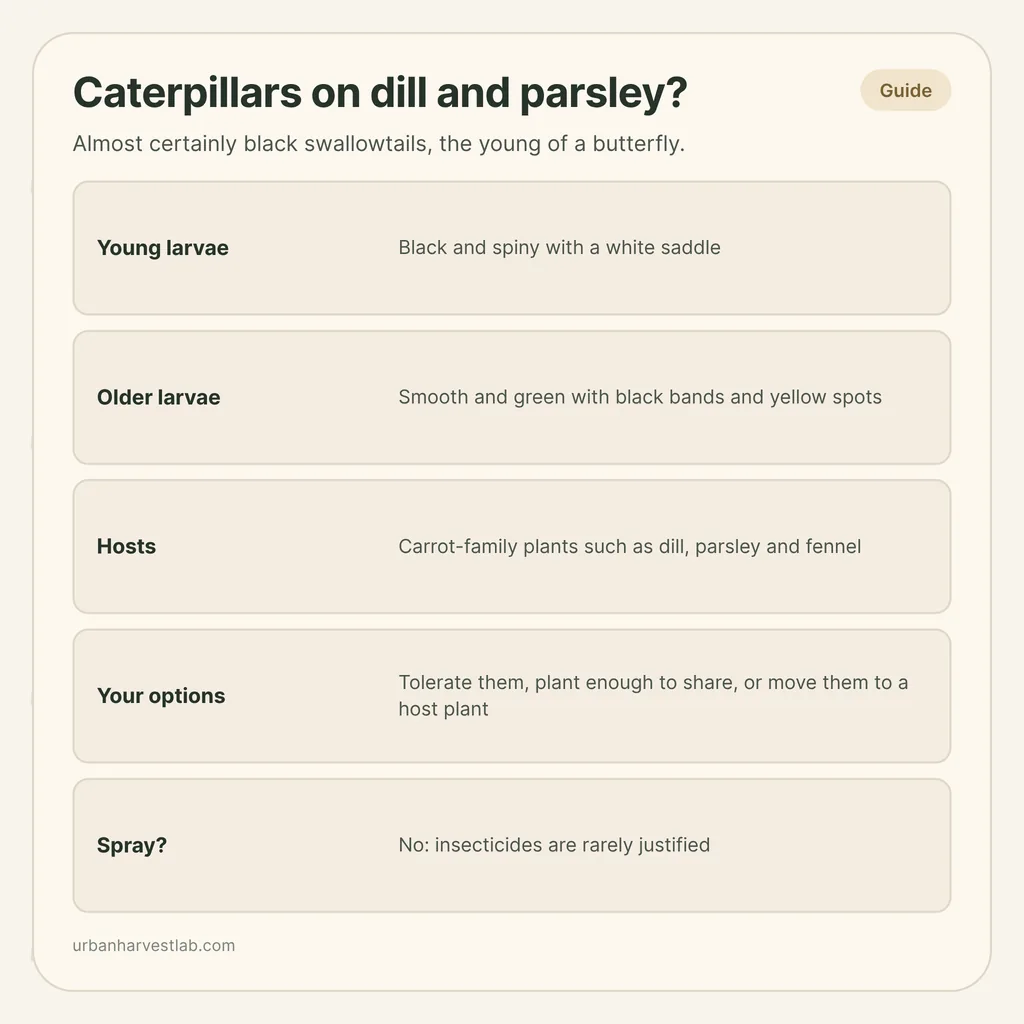
Caterpillars on dill and parsley: black swallowtails, and what to do
A pot of dill reduced to bare stalks and fat banded caterpillars on the stems is a black swallowtail, a butterfly in the making. Here is how to spot it, how much damage to expect, and how to share or relocate.