Troubleshoot the system before you change the inputs.
Symptoms
- Tiny specks moving across the soil surface or along the pot rim, especially right after watering.
- A small cloud of insects rising when the pot is bumped or watered.
- Insects clustered near the drainage holes or in a saucer that has been holding water.
Possible causes
- Potting mix that stays damp between waterings instead of drying out, especially one heavy in peat moss or compost.
- A saucer or cachepot holding water against the bottom of the pot.
- A high-organic potting mix that holds moisture at the surface longer than it should between waterings.
Quick fixes
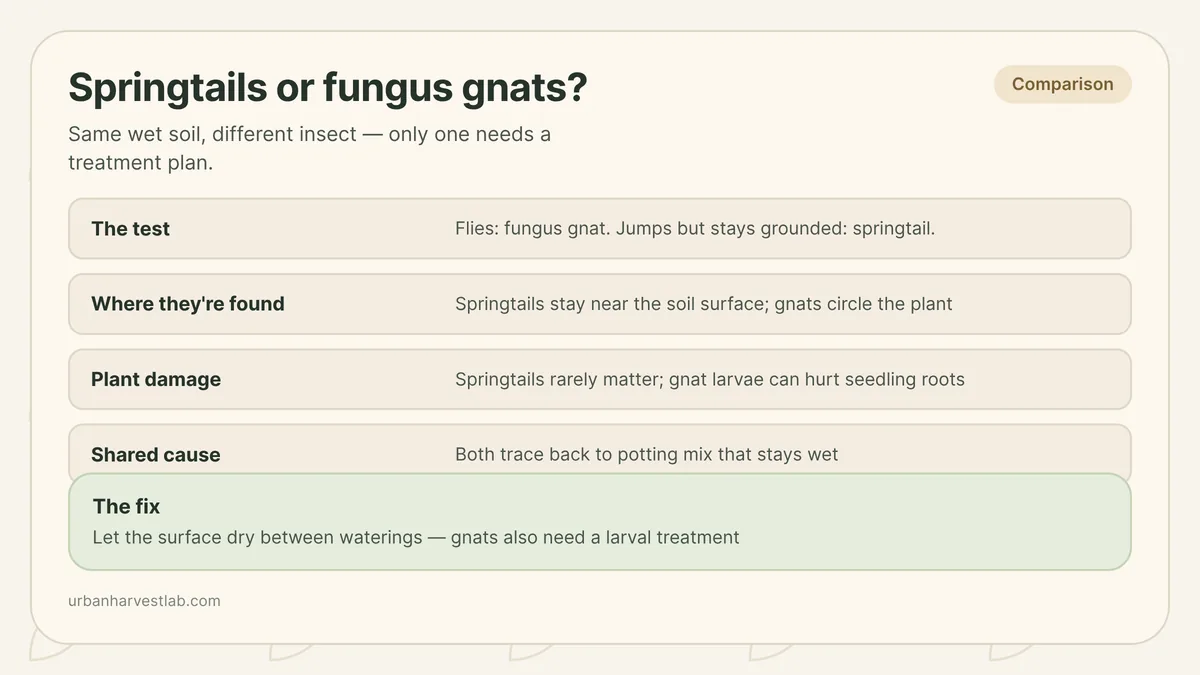
- Watch what the insects do for ten seconds: flight means fungus gnats, jumping without flight means springtails.
- Let the surface of the potting mix dry to the touch before watering again, regardless of which one you have.
- Empty any saucer of standing water once the pot has finished draining.
Springtails vs. fungus gnats
| Clue | Springtails | Fungus gnats |
|---|---|---|
| Wings | None on any life stage | Present on adults; they fly |
| Movement when disturbed | Jump or spring using a tail-like organ | Fly erratically around the plant |
| Where you find them | On the soil surface, rarely far from it | Flying and circling around the plant |
| Adult size | About 1/16 in. (UC IPM) or about 1/5 in. (Clemson) — the sources disagree | About 1/16 to 1/8 inch |
| Do they damage the plant | Rarely enough to matter | Larvae can hurt roots and stunt seedlings in large numbers |
| Does spraying help | Not recommended; fix the moisture instead | Only alongside a larval treatment and drier soil |
If the bugs in your potting soil fly, they are fungus gnats. If they jump or spring but stay on or near the soil surface, they are springtails. Both mean the same underlying thing: the potting mix has been staying wet longer than it should, but they are not the same insect, and only one of them regularly needs a treatment plan.
Confusing the two is easy from across the room, because both show up as small dark specks near the base of a plant. If the insect count is low and you cannot yet tell what it is doing, start with the broader potted herb problem guide before assuming it is a pest at all.
Watch what it does for ten seconds
This is the fastest and most reliable field test, and it does not need a hand lens. Disturb the soil surface, or run a finger near the pot rim, and watch the insects’ first move.
Fungus gnats take off. They are true flies with a pair of wings, and adults measure about 1/16 to 1/8 inch long, according to UC IPM. Clemson Cooperative Extension gives a similar 1/8-inch figure for the adults. Once airborne they fly erratically around the plant, which is usually the moment someone notices them at all.
Springtails do not fly, because they have no wings at any life stage. Instead, UC IPM describes a “tail-like mechanism,” called a furcula, tucked under the abdomen that acts as a spring and flicks the insect into the air. That jump is why springtails are sometimes mistaken for fleas rather than for gnats. After the jump, they land back on or near the soil surface. They do not circle the plant, and they do not head for a window.
A second look, if the test was ambiguous
Size is a weaker discriminator than behavior here, partly because the two extension sources that measure springtails do not agree with each other. UC IPM describes springtails as “minute, wingless insectlike arthropods about 1/16 inch long,” while Clemson’s houseplant pest sheet gives a considerably larger figure of about 1/5 inch. That is close to a threefold difference between two land-grant extension sources, so treat a size estimate as a rough sanity check rather than as proof, and lean on the wings-and-movement test first.
Color is also not much help on its own. Springtails run whitish, bluish, or dark grey to black. Fungus gnat adults are dark-bodied with slender legs and antennae longer than the head, with wings that read light grey to clear rather than solid. A third look-alike is worth ruling out here: UC IPM gives short, bristle-like antennae as the shore fly’s discriminator against the fungus gnat’s longer ones, and shore flies also come out of wet potting mix, so the same moisture fix applies to either.
Why you are seeing either one at all
Neither insect is attracted to a clean, dry pot. Clemson’s pest fact sheet lists the presence of both fungus gnats and springtails as an indicator of overwatering, and UC IPM makes the same point about springtails specifically: their “continued presence indoors is an indicator of moisture.” Fungus gnat larvae feed on the fungus and decaying organic matter that build up in potting mix kept constantly damp, and springtails feed on similar fungal and decaying material at the soil surface. Dry the mix out and the food source for both disappears.
That shared cause is also why a bag of fresh, high-organic potting soil can produce either insect within days of the first heavy watering: Clemson lists the presence of either insect as an indicator of overwatering, and UC IPM’s springtail guidance calls for reducing moisture and excess organic matter, the same combination a peat- and compost-heavy mix supplies at the surface.
Springtails rarely need a response beyond drying the soil
UC IPM states plainly that springtails “do not bite humans or pets, nor do they spread disease or damage household furnishings.” Some species will chew on the roots and leaves of seedlings, but the same source adds that springtails “rarely cause enough damage to plants to warrant control measures.”
Because of that, UC IPM’s guidance is to skip insecticides for springtails altogether: sprays are “generally not recommended,” since they only offer temporary relief and do not touch the excess moisture that is the actual cause. Reducing watering frequency and cutting back on excess organic matter in the mix is the guidance UC IPM gives instead, and it is usually enough on its own.
Fungus gnats are the one worth watching more closely
Fungus gnat adults are mostly a nuisance rather than a plant threat, but UC IPM is specific that the larvae are different: “when present in large numbers, [they] can damage roots and stunt plant growth, particularly in seedlings and young plants.” A tray of new seedlings with a heavy gnat population is a different situation from a single mature herb with the occasional adult drifting past.
At 75°F, UC IPM describes the full life cycle taking roughly three days for eggs to hatch, about ten more days for the larvae to develop into pupae, and another four days before adults emerge — close to a seventeen-day generation from egg to flying adult. That timeline is why one round of drying the soil or one sticky trap rarely ends an established infestation outright; a population already mid-cycle keeps producing new adults for a couple of weeks even after the surface starts drying properly.
Fungus gnats also come with a monitoring trick springtails do not: UC IPM notes that yellow sticky traps cut into smaller squares catch flying adults, and raw potato chunks pressed into the soil surface attract larvae, letting you check for them without digging through the pot — Clemson describes the larva itself as whitish with a shiny black head, up to about 1/4 inch long, which is what to look for on the underside of the chunk. The full step-by-step eradication routine, including where Bti drenches and beneficial nematodes fit into the timeline, is covered in the fungus gnat guide for herb pots rather than repeated here.
Fix the shared cause, then treat only what is left
Because both insects trace back to the same excess moisture, the first move is identical no matter which one you have: let the top of the potting mix dry out between waterings, and stop letting a saucer hold standing water against the base of the pot. If the diagnosis and watering habits at play still feel murky, the overwatered-vs-underwatered guide walks through how to judge the root zone rather than the leaves.
For springtails, that change in watering is typically the entire fix. For fungus gnats, drying the surface stops new eggs from being laid, but an existing larval population in the potting mix needs its own treatment on top of the watering change, which is where the dedicated fungus gnat routine picks up.
When it is not insects at all
A pot that has been overwatered can also grow something that only looks like a pest problem from a distance: a fuzzy white or yellowish growth spreading across the soil surface. That is not an insect and will not fly or jump when disturbed. If what you are looking at does not move, the white mold on plant soil guide covers that look-alike, including how to tell it apart from an ordinary salt crust on the rim of the pot. It is worth ruling out before assuming every speck on the soil surface has legs.
Common mistakes
- Assuming every tiny soil bug is a fungus gnat and reaching straight for a gnat-specific product.
- Spraying an insecticide at springtails when UC IPM’s own guidance is to skip that step and dry the mix instead.
- Treating the adults you can see while ignoring that fungus gnat larvae live in the soil itself.
- Watering on the usual schedule out of habit instead of checking whether the top of the mix has actually dried.
- Buying a new bag of potting soil to “start clean” without changing the watering routine that produced the problem the first time.
Sources
Same wet soil, different look-alikes
Overwatering does not stop at one symptom. These guides cover the other things a soggy pot can grow.
Common questions
Do springtails harm my plants?
Rarely. UC IPM notes that springtails do not bite people or pets and rarely cause enough plant damage to need control, though some species will chew on the roots and leaves of seedlings.
Should I spray for springtails?
No. UC IPM specifically advises against it, since sprays give only temporary relief and do nothing about the excess moisture that drew the springtails in the first place.
Can springtails turn into fungus gnats?
No, they are unrelated organisms. Springtails are wingless arthropods that do not fly; fungus gnats are true flies. The mix-up only matters if it leads you to reach for a fungus gnat treatment a springtail problem does not need.
Why do I have both at the same time?
Both are drawn to the same soggy, high-organic potting mix, so finding gnats and springtails together points at one overwatering habit rather than two separate problems.
Related guides
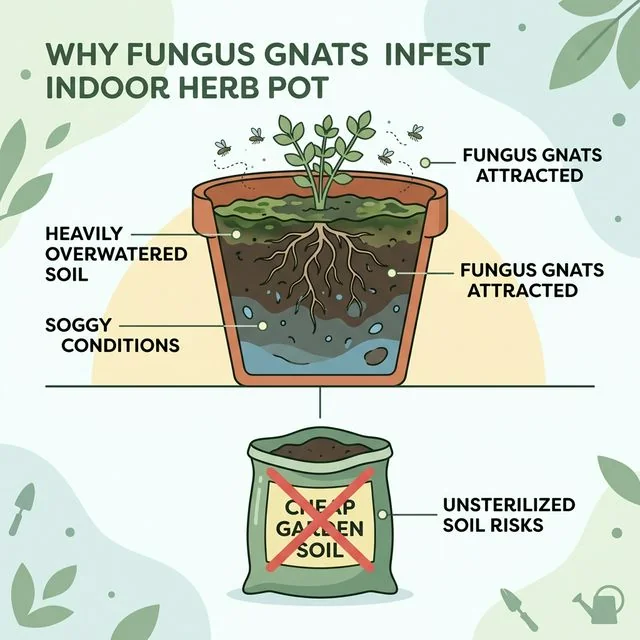
Why fungus gnats keep coming back in herb pots
Fungus gnats are the absolute bane of indoor gardeners. If a cloud of tiny black flies eradicates your peace every time you walk past your basil plant, you are treating the symptom, not the cause.
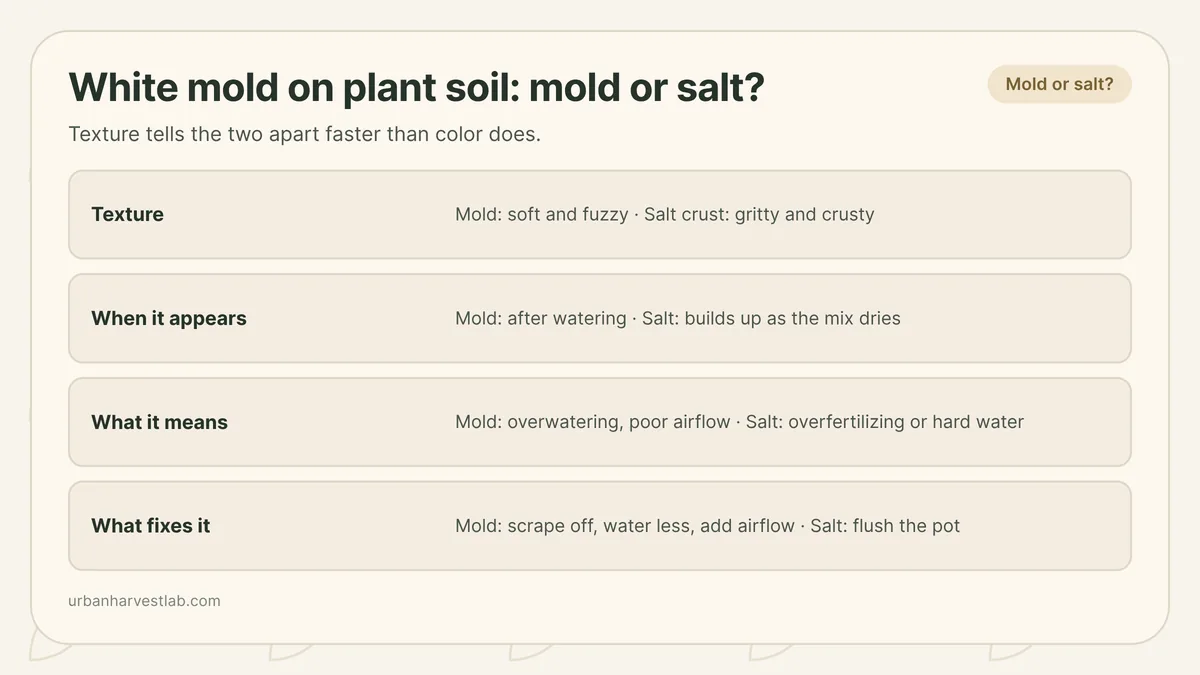
White mold on plant soil: what it means and what to do
A white, fuzzy patch spreading across the soil surface looks alarming, but it is usually a cosmetic fungus feeding on the mix, not the plant.
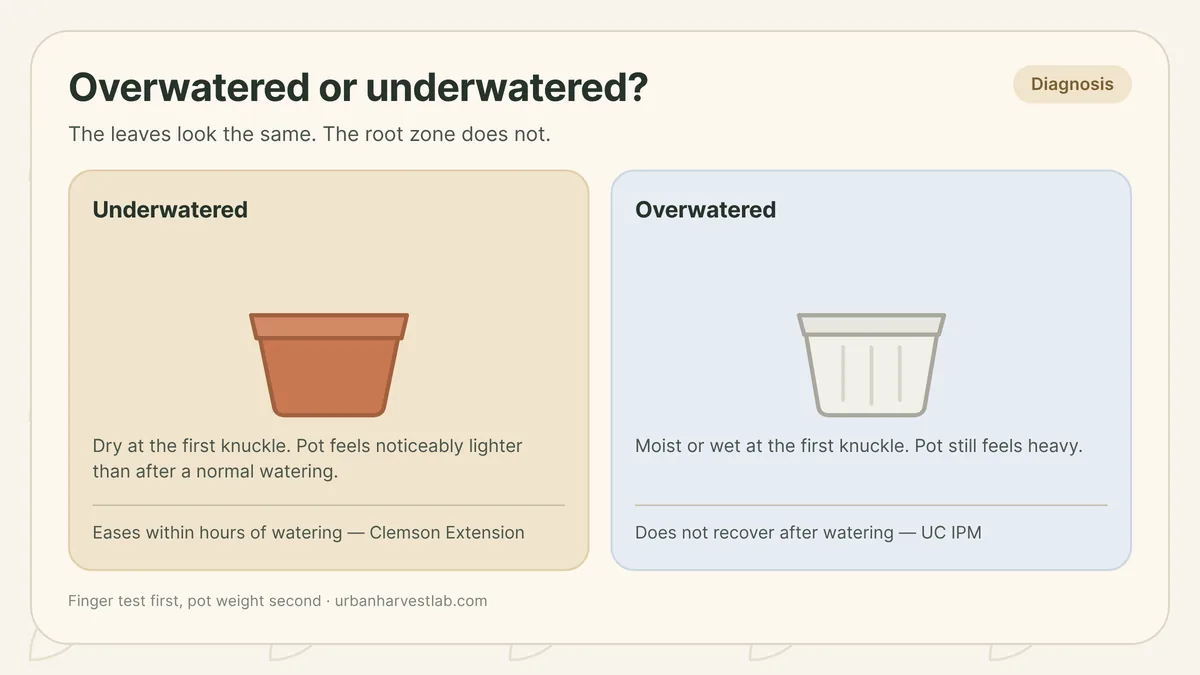
Overwatered vs underwatered: how to tell which one you have
Reading the root zone directly, with a finger test, pot weight, and how the plant responds to being watered, settles what the leaves alone cannot.