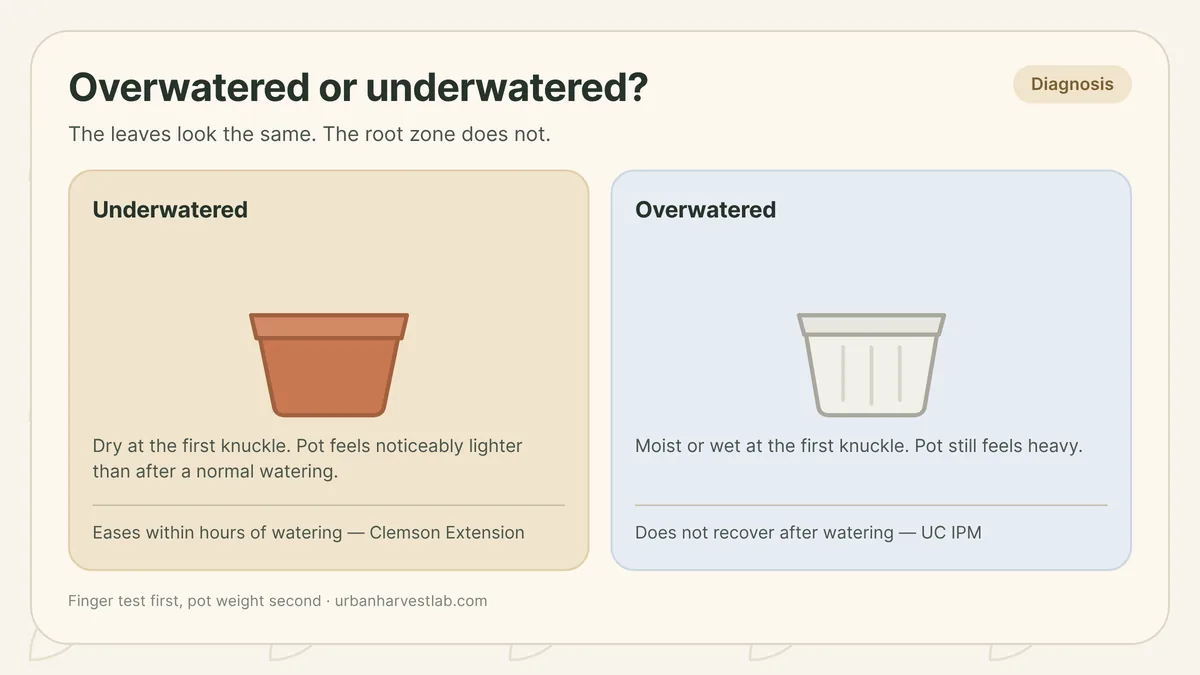
Fast reference: the two clearest signals
| Signal | Points to underwatering | Points to overwatering |
|---|---|---|
| Fingertip at the first knuckle | Dry | Moist or wet |
| Pot weight versus right after watering | Noticeably lighter | Still heavy |
| Response a few hours after watering | Wilting eases | Wilting continues or returns |
Overwatering and underwatering cause nearly the same symptoms — wilting, yellowing leaves, and slowed growth — so the leaves themselves will not tell you which one is happening. The root zone will: a finger pushed into the mix, the pot’s weight, and whether a wilted plant recovers within a few hours of being watered are the tests that actually separate the two. For the broader troubleshooting order across all potted-herb symptoms, start with common potted herb problems, then come back here to sort out which failure mode is actually in front of you.
Why the leaves lie
Clemson Cooperative Extension’s Home & Garden Information Center states the overlap outright: “The symptoms of over-watering and underwatering are similar. Both lead to poor root health, root decline and possibly death of the plant.” That single sentence is why a symptom table built only from leaf appearance cannot do this job. Wilting, yellowing, and slowed growth show up on both lists, and treating any one of them as proof means guessing, because the same symptom appears on both lists.
Missouri Botanical Garden’s own list of overwatering symptoms makes the overlap concrete rather than abstract. It names “stunted slow growth with yellowing leaves,” “leaf scorch or leaf burn,” and “water-soaked spots and blisters” on stems and leaves, a condition called oedema, with the crown eventually rotting. Leaf scorch is also a textbook underwatering complaint, so a scorched leaf margin does not point one way over the other; it only says the root zone is under stress, not which direction that stress came from. Brown tips and margins specifically have four listed causes of their own, covered in brown leaf tips on potted herbs.
Wilting is the most misleading symptom of all. Clemson’s watering guidance is direct about it: “Any injury to the root system decreases a plant’s ability to take up water, including root rot, which is caused by too much water.” A wilted plant is not automatically a thirsty plant. It may be a plant whose roots have already failed and can no longer move water into the stem, no matter how much water is sitting in the pot around them.
Read the root zone, not the canopy
Because the canopy lies, the discriminators that actually work come from the mix and the pot, not the leaves.
The finger test is the first one, and Clemson states it as a literal instruction: “Stick your finger into the mix up to the first joint; if it is dry at your fingertip it needs water.” That single check rules out or rules in thirst faster than staring at the leaves ever will, because it reads the zone where the roots actually are instead of the part of the plant furthest from the problem.
The weight test is the second, and it works because dry potting mix genuinely weighs less. Clemson notes that “as potting mixtures become dry, a definite loss in weight can be observed,” which means a pot that feels noticeably lighter than it did right after a watering has lost real water, not just surface moisture. Two secondary cues back this up: a clay or terracotta pot sounds hollow when it dries out, and the mix itself lightens in colour as it loses moisture, per the same Clemson guidance. Neither cue proves anything on its own, but each one adds weight to a reading that the finger test alone might leave uncertain.
None of these tests require guessing about drainage rate or soil type. They ask the plant directly, at the one point in the system, the root zone, where overwatering and underwatering actually diverge before either one shows up in the leaves.
Check your plant
Run through the signs below for whatever is in front of you right now, not what it looked like last week. Check every box that applies; the result updates as you go, and shows how the dry-side and wet-side signs are stacking up.
Read the root zone, not the leaves
Check every physical sign you can confirm right now: the finger test, the pot's weight, the mix, and how the plant responded the last time it was watered.
Likely diagnosis
Check the boxes that match
Select every physical sign you can confirm on the plant right now.
- Do next
- —
No signs selected yet.
The four tests, side by side
The logic behind the checklist above is short enough to run by hand:
| Test | How to do it | Underwatered reading | Overwatered / root-stress reading |
|---|---|---|---|
| Finger test | Push a finger into the mix to the first knuckle | Dry at the fingertip | Moist or wet at the fingertip |
| Weight test | Lift the pot, or compare to how it felt right after watering | Noticeably lighter | Still heavy |
| Pot and mix look | Tap a clay or terracotta pot; look at the surface colour | Hollow sound, pale mix | Mix stays dark, saucer holds standing water |
| Response to watering | Water it, then check again in a few hours | Wilted leaves ease | Wilting continues or returns |
The first three tests read what is happening in the mix at this moment. The fourth reads how the plant reacts over the next few hours, and it is the one that catches root damage the other three can miss entirely.
The test that matters most: does it recover?
A plant that wilts because it is dry perks up within a few hours of a normal watering. A plant that wilts because its roots are damaged does not, and that non-recovery is the single most reliable sign in this whole comparison, because it does not depend on reading moisture correctly in the first place.
The mechanism behind it is Phytophthora root and crown rot, one of the organisms behind chronic overwatering damage. The University of California’s Statewide Integrated Pest Management Program describes the exact pattern: infected plants “wilt and turn dull green, yellow, red, or purplish,” but critically, “plants don’t recover when irrigated.” Below ground, the same source describes “darkened areas in the bark around the crown and upper roots,” and cutting into an affected stem reveals “reddish brown zones … in the inner bark and outer layer of wood.” Once an infection is established, the prognosis is blunt: “A plant with a substantial Phytophthora infection rarely recovers.”
That organism does not need days to get a foothold. UC IPM states that Phytophthora “can establish in as little as 4 to 8 hours of soil saturation,” which is why a blocked drainage hole or a saucer left full overnight is a genuine risk rather than a tidiness complaint. It is also why the finger test and the weight test matter as prevention, not just diagnosis: catching a saturated pot within that same window is what keeps a simple overwatering mistake from becoming an infection that does not reverse.
What overwatering does to roots
The mechanism is straightforward once you know it. Roots sitting in waterlogged mix cannot get oxygen, and Missouri Botanical Garden states the consequence plainly: “The longer the air is cut off, the greater the root damage.” Roots that have been without oxygen for long enough begin to die, which means they stop supplying water and nutrients to the rest of the plant, and dying tissue becomes an entry point for rot organisms such as Phytophthora.
Clemson’s description of houseplant root rot names what that looks like above and below the soil line: “leaves and stems show noticeable wilt. Stems may be girdled at or near soil level by a ring of brown or black tissue. Infected roots are brown to black and may be soft.” The fungi behind that damage are not one organism but several — Clemson names Rhizoctonia, Pythium, Botrytis, Phytophthora, Alternaria, and Sclerotinia as causal genera behind houseplant root rot, which is one reason a rescue attempt does not always work the same way twice.
What underwatering does, left unchecked
Chronic underwatering has its own end state, and Clemson describes it in three words: it “results in wilting, leaf curling, and death.” The pattern usually starts lower on the plant, since lower leaves yellow first when a plant has been “allowed to become too dry for an extended time.”
The good news for this side of the checklist is that the damage is more often reversible if it is caught with the finger and weight tests before the plant collapses completely. A dry root zone that gets water again generally resumes normal function; a rotted one does not resume the same way, which is the whole reason the response-to-watering test outranks every other sign here.
Fix what the tests actually told you
If the tests point toward underwatering, water thoroughly until it runs from the drainage holes rather than adding a small amount to the surface, then let the finger test, not the calendar, decide when to water again. A by-herb watering chart gives a starting frequency, and potted herb care covers the full routine once watering is dialled in.
If the tests point toward overwatering or root-zone stress, the fix is restraint rather than a new routine. Let the top few inches of mix dry out before watering again, and make sure the container is actually draining rather than trapping water against the roots. A container that is too large for the plant’s light and water use, or one without real drainage, makes this exact failure more likely regardless of how carefully the schedule is followed, which is why container choice belongs in the same conversation; see best containers for herbs for the drainage and sizing details.
Either way, empty a saucer that collects runoff rather than letting the pot sit in it. Clemson’s watering guidance is specific about why: water should run “until it runs out of the bottom of the pot,” which flushes excess salts and wets the lower two-thirds of the root zone, but the plant should not be left sitting in the water that collects afterward.
When it is not simple thirst
If the checklist above keeps landing on “no recovery after watering,” treat that as its own category rather than pushing harder on either the wet or dry side. A plant with a substantial root infection is not waiting on the next watering decision to get better; it needs the roots inspected directly; gently sliding the rootball out of the pot to look for brown, soft tissue is more useful at that point than another round of the finger test. A solid mass of circling, pale roots instead is a different problem with the same watering-frequency symptom — Clemson HGIC’s repotting criterion names “the plant requires frequent watering or wilts shortly after watering” as a root-bound sign in its own right, and signs your potted herb is root bound covers confirming and fixing that instead.
Basil shows this pattern often enough to have its own detailed pages: why is my basil wilting indoors and why are basil leaves turning yellow indoors both walk through the basil-specific versions of the same root-zone logic covered here, including the cases where the cause turns out not to be watering at all.
Common mistakes
- Reading the leaves and skipping the finger test, which is the single most reliable shortcut to the wrong fix.
- Adding water because leaves are wilted, without first checking whether the mix underneath is already wet.
- Letting a saucer hold runoff water “just in case,” which keeps the lower root zone saturated long after the surface looks dry.
- Judging by the calendar instead of by the pot, so a routine that suited last month’s light and temperature keeps running unchanged.
- Giving a non-recovering plant more water on the assumption that the first watering “just wasn’t enough.”
FAQ
What is the fastest way to tell if a plant is overwatered or underwatered?
Clemson Cooperative Extension’s instruction is to push a finger into the mix to the first knuckle. Dry at the fingertip usually means underwatering, and still moist or wet at that depth points toward too much water in the root zone. Pot weight is the second check: a pot that feels noticeably lighter than after a normal watering has lost water, and one that still feels heavy has not.
Can a plant wilt even though the soil is still wet?
Yes. Any damage to the root system, including root rot caused by too much water, reduces how well roots take up water, so a plant can wilt in wet soil the same way it wilts when dry. Wilting by itself does not say which one is happening.
Why did watering not fix the wilting?
If leaves stay wilted more than a few hours after a normal watering, or wilt again within hours of being watered, the roots are usually damaged rather than simply thirsty. UC IPM’s pattern is that a plant that eases within a few hours of being watered was dry; one that does not needs its roots checked directly.
Do yellow leaves tell you which problem you have?
Not on their own. Overwatering and underwatering both produce yellowing, and leaf scorch shows up on both lists too. The finger test, pot weight, and how the plant responds to watering are more reliable than reading the leaves alone.
Sources
Settle the diagnosis, then fix the routine
Once you know which one you have, these guides cover the watering routine, container choice, and herb-specific symptoms that follow.
Common questions
What is the fastest way to tell if a plant is overwatered or underwatered?
Clemson Cooperative Extension's instruction is to push a finger into the mix to the first knuckle. Dry at the fingertip usually means underwatering, and still moist or wet at that depth points toward too much water in the root zone. Pot weight is the second check: a pot that feels noticeably lighter than after a normal watering has lost water, and one that still feels heavy has not.
Can a plant wilt even though the soil is still wet?
Yes. Any damage to the root system, including root rot caused by too much water, reduces how well roots take up water, so a plant can wilt in wet soil the same way it wilts when dry. Wilting by itself does not say which one is happening.
Why did watering not fix the wilting?
If leaves stay wilted more than a few hours after a normal watering, or wilt again within hours of being watered, the roots are usually damaged rather than simply thirsty. UC IPM's pattern is that a plant that eases within a few hours of being watered was dry; one that does not needs its roots checked directly.
Do yellow leaves tell you which problem you have?
Not on their own. Overwatering and underwatering both produce yellowing, and leaf scorch shows up on both lists too. The finger test, pot weight, and how the plant responds to watering are more reliable than reading the leaves alone.
Related guides
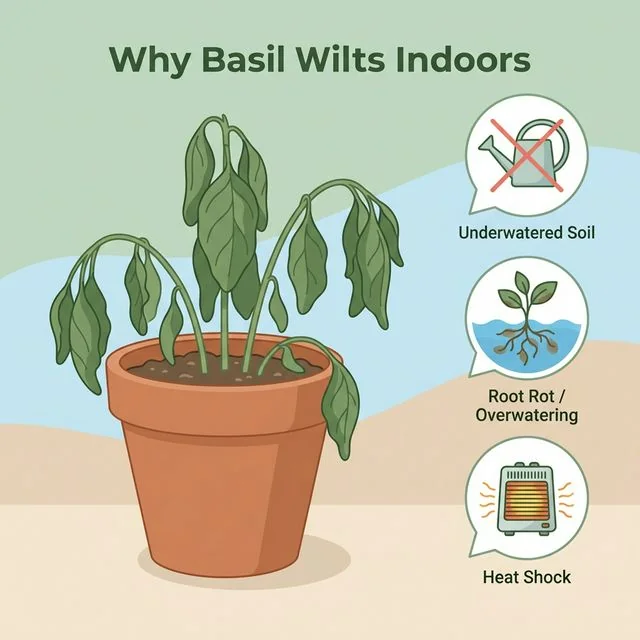
Why is my basil wilting indoors? Stop the droop
Basil is famous for being dramatic. If your plant suddenly wilts into a sad green puddle, don't panic. Here is exactly how to diagnose the droop and revive it.
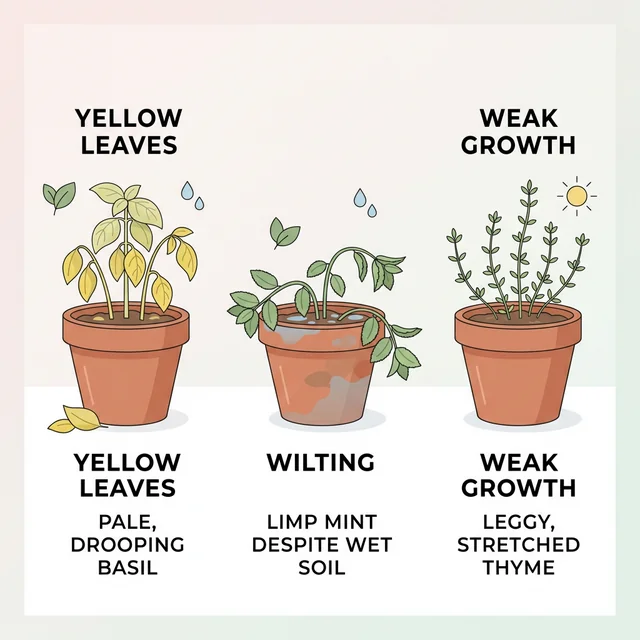
Common potted herb problems: yellow leaves, wilting, and weak growth
Common potted herb problems usually show up as yellow leaves, wilting, or weak growth, but the useful diagnosis starts with light, drainage, and root stress.
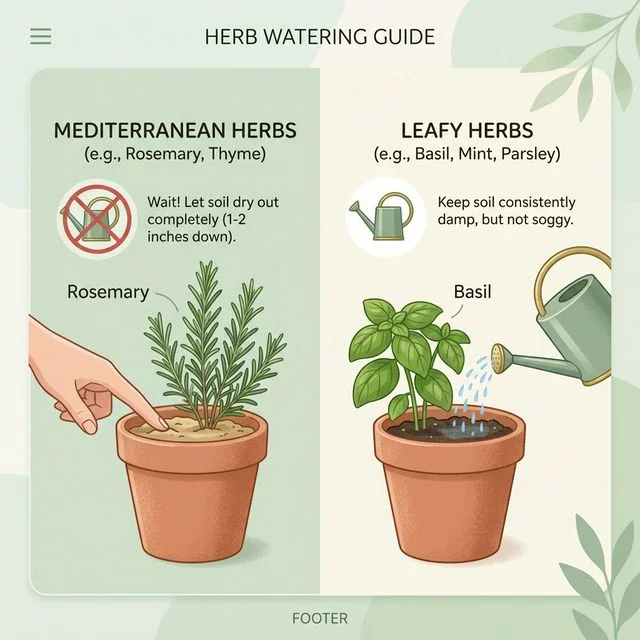
How often to water potted herbs: a by-herb chart
Most potted herbs should be checked often but watered only when the root zone is actually drying. Judge the pot instead of following a rigid calendar.