Troubleshoot the system before you change the inputs.
Symptoms
- A white, grey, or yellowish fuzzy or powdery growth spreading across the surface of the potting soil, usually after watering.
- A gritty white or grey crust on the soil surface or around the pot rim and drainage holes, instead of a soft fuzzy growth.
- White powdery patches on the leaves themselves rather than on the soil.
- Wilting or yellowing on the plant alongside the surface growth, especially if watering does not perk the plant back up.
Possible causes
- A saprophytic soil fungus feeding on organic matter in an overwatered, poorly ventilated mix, which Clemson Cooperative Extension treats as cosmetic.
- Fertilizer salt buildup on the surface and pot rim, a different problem with a different fix.
- Powdery mildew, a foliar disease that grows on leaves and needs no free water to infect, according to UC IPM.
- Root rot from a waterlogged root zone, which can coincide with surface mold but is a separate and more serious problem.
Quick fixes
- Scrape off the visible surface growth and let the top of the mix dry out before watering again.
- Improve airflow around the pot and give it as much light as the plant tolerates.
- Water less often and let the surface dry between waterings rather than keeping it constantly damp.
- Check root color and the plant's recovery after watering if wilting or yellowing is also present.
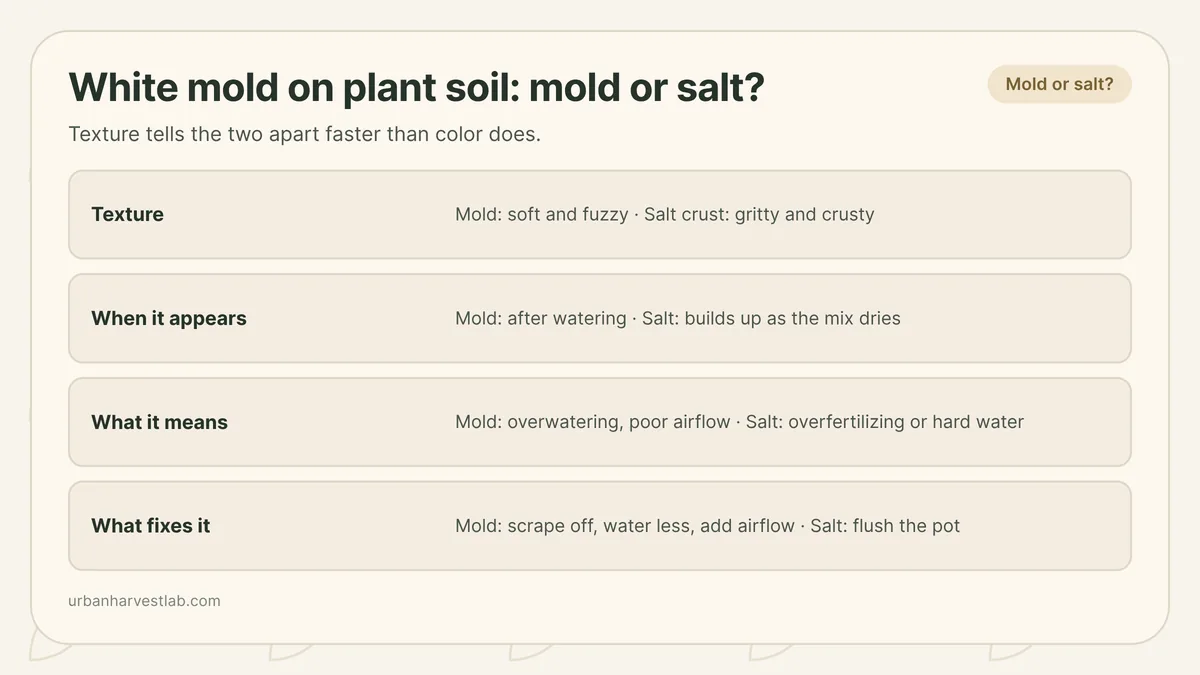
White on the soil: mold or salt?
| Sign | Saprophytic mold | Salt or fertilizer crust |
|---|---|---|
| Texture | Soft, fuzzy, filamentous | Gritty, crusty, crumbly |
| Color | White, grey, or yellowish | White to grey |
| When it appears | After watering, in damp organic-rich mix | Builds up between waterings as the mix dries |
| Where it forms | Across the surface, sometimes in patches | Surface film, or a crust at the pot rim and drainage holes |
| What it means | Overwatering and poor airflow at the surface | Overfertilizing, or mineral buildup from tap water |
| What fixes it | Scrape it off, water less often, improve airflow | Flush the pot until water runs clear from the bottom |
A fuzzy white, grey, or yellowish growth on top of your potting soil is almost always a saprophytic fungus feeding on decaying organic matter in the mix, not a disease attacking the plant. It shows up because the surface is staying damp and airflow is poor, and it clears up when those two things change. The real diagnostic work is ruling out three look-alikes that get called “mold” and are not: a salt crust from fertilizer or hard water, powdery mildew on the leaves, and root rot underneath the soil. If yellowing, wilting, or stunted growth is the bigger complaint and the surface growth is incidental, start with the common potted herb problems guide instead.
What that white fuzz actually is
Clemson Cooperative Extension’s Home and Garden Information Center names it directly: the “white or yellow mold-like growth” on potting soil comes from saprophytic soil fungi, organisms that live on dead organic material rather than on living plant tissue. Peat moss, compost, and bark fines in a potting mix are exactly the kind of organic matter these fungi feed on, and a mix that stays damp and shaded at the surface, the way it does inside a pot that gets watered from the top and sits in low airflow, gives them a steady food source and the moisture they need to fruit visibly.
That is the whole mechanism. The fungus is not parasitizing the herb’s roots or stems. It is decomposing the same organic fraction of the mix that would break down anyway, just doing it somewhere you can see. The growth can look dense enough to worry about, sometimes spreading into a solid mat after a heavy watering, but its presence describes the surface conditions in the pot rather than the health of the plant sitting in it.
Salt crust or fertilizer film: the texture test settles it
The look-alike that causes the most confusion is not a fungus at all. Clemson’s guidance draws the line explicitly: “White to grey crusty deposits on the soil surface or rim of pots is a sign of salt buildup,” and the extension service adds the direct warning not to “confuse this with the white or yellow mold-like growth of saprophytic soil fungi.” Two different problems, described in the same sentence, because growers reliably mix them up.
Texture is the fastest way to tell them apart. A salt crust is gritty and crusty, sometimes crumbly to the touch, and it tends to build up gradually on the surface and at the pot rim or drainage holes as the mix dries between waterings. Saprophytic mold is soft and filamentous, and it appears after watering rather than as the mix dries out.
The salt version usually has a fertilizing cause behind it. Clemson’s fertilizing guidance notes that “soils that have a white film on the surface or pots with a white crust on the rim or drainage hole may indicate that the plant is being overfertilized,” and the same source lists reduced growth, brown leaf tips, dropping of lower leaves, and wilting as what follows if it is not addressed. The fix is also different from anything that helps with mold: flush the pot with plain water until it runs clear from the drainage holes, discard what collects in the saucer, and back off the feeding schedule rather than trying to dry the surface out. The full leaching procedure, and when a flush is not enough, is in salt buildup in herb pots.
It is not powdery mildew
Powdery mildew gets confused with soil mold mostly because both are described as “white” and “powdery.” They are not the same organism, and they do not even occupy the same part of the plant. Powdery mildew is a foliar disease: UC IPM’s pest notes describe a fungus that “can germinate and infect without water on the plant’s surface,” which is the opposite of the damp conditions that grow saprophytic soil fungi. On houseplants specifically, Clemson describes it presenting as “white, powdery growth or dry, brown, papery leaf spots,” and in both descriptions the growth is on the leaf, not the soil.
If the white coating you are looking at is on foliage rather than on the mix, it is a leaf disease with its own treatment path, covered in full in powdery mildew on container herbs. A soil surface growth does not need the fungicide or airflow interventions that page recommends for leaves, and treating the two the same way wastes effort on whichever one you do not actually have.
It is not root rot either, but check anyway
The genuinely serious look-alike is root rot, and the discriminator is not what the soil surface looks like but how the plant is doing. Clemson describes root rot on houseplants as leaves and stems that “show noticeable wilt,” sometimes with stems “girdled at or near soil level by a ring of brown or black tissue,” and roots that turn “brown to black” and soften. Several fungi can cause it, including Rhizoctonia, Pythium, Phytophthora, Botrytis, Alternaria, and Sclerotinia, according to Clemson.
Root rot and surface mold share a root cause, an overwatered pot, so they can turn up in the same container at the same time without one causing the other. UC IPM’s research on Phytophthora root and crown rot gives a figure worth knowing here: this pathogen can establish in as little as 4 to 8 hours of soil saturation, and once a plant has a substantial infection it “rarely recovers.” That combination, a fast-acting pathogen and a poor prognosis once established, is why a surface fungus alone is not the thing to worry about, but a surface fungus plus a wilted plant is.
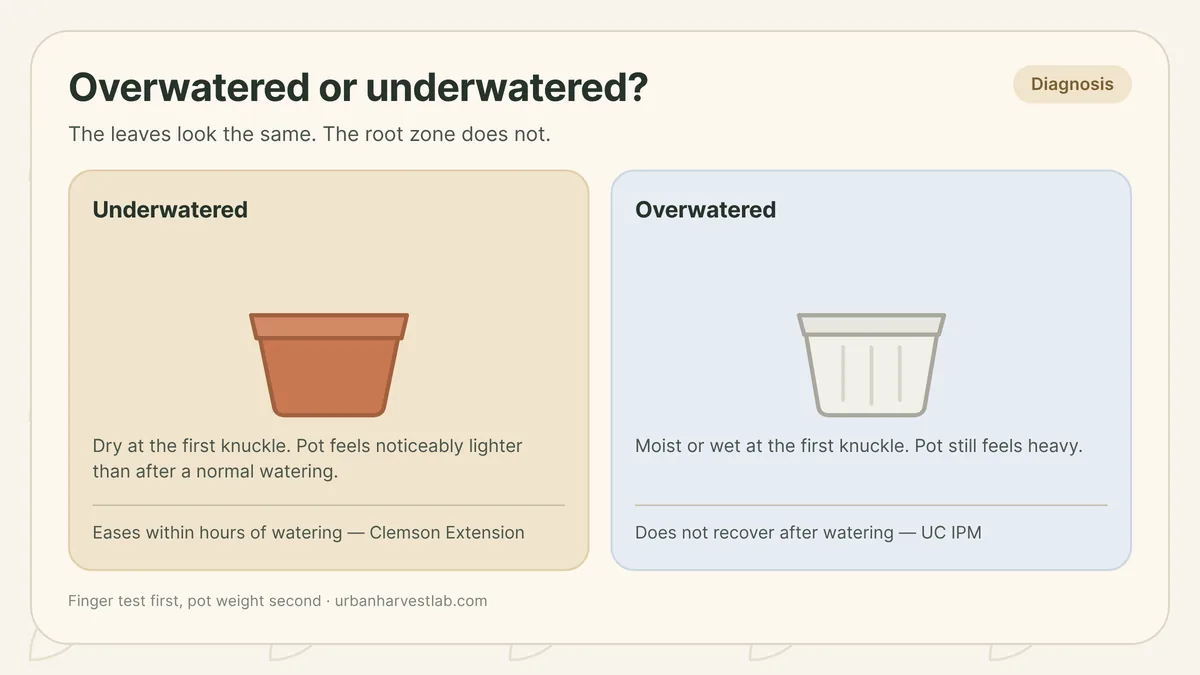
The test that separates the two situations is the same one that separates overwatering from underwatering generally: does the plant recover within a few hours of being watered, or does it stay wilted regardless of how wet the mix is. A full walkthrough of that test, along with the finger-test and pot-weight checks that read the root zone directly, is in overwatered vs underwatered. If wilting does not ease after watering, that page is the next stop, not a fungicide for the soil surface.
Why it shows up in the first place
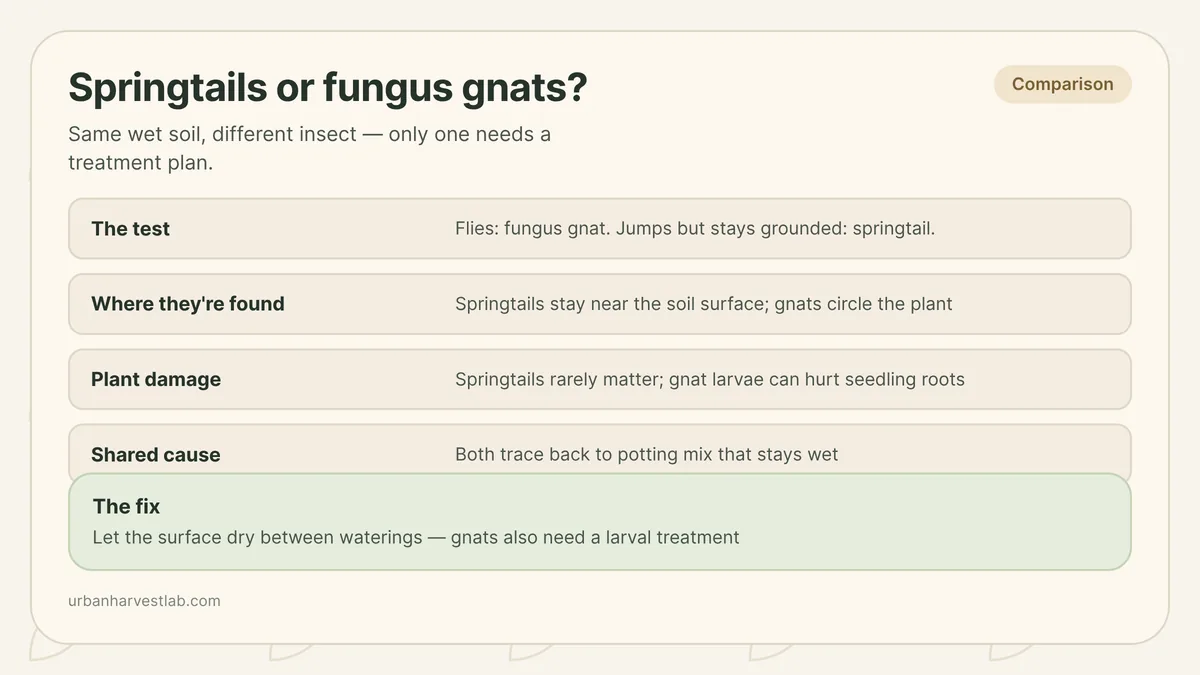
Surface mold, root rot risk, fungus gnats, and springtails all trace back to the same underlying condition: a pot that stays wetter, for longer, than the plant needs. Clemson’s pest guidance lists moisture as the shared signal for two of the most common soil-dwelling nuisances, noting that the “presence indicates overwatering” for both fungus gnats and springtails. Neither of those is the mold itself, and neither one causes it, but all three show up under the same wet, poorly ventilated conditions.
That overlap is worth knowing because a pot can carry more than one of these signals at once without one explaining the other. Small jumping specks in the mix and a white fuzzy patch a few inches away are not the same organism doing two things; they are two separate symptoms of one watering habit. If tiny bugs rather than a fuzzy growth are the main complaint, springtails vs fungus gnats covers how to tell those two apart, and why fungus gnats keep coming back covers the gnat life cycle specifically.
Clearing it and keeping it from coming back
Because the fungus is feeding on surface moisture and organic matter, the fix works on both. Scrape off the visible growth with a spoon or the edge of a plant marker and discard it rather than leaving it to spread. Move the pot somewhere with better air movement, a spot away from a wall or crowded shelf, since still, humid air at the soil surface is exactly what let the fungus establish.
Then change how the pot gets watered rather than just cleaning up after the fact. Let the top of the mix dry out between waterings instead of keeping the surface constantly damp, and water from the bottom or aim the stream at the base of the plant rather than saturating the whole surface every time. UC IPM’s management guidance for a related soil-surface problem, damping-off in seedling mixes, describes the same underlying principle: gentle misting rather than saturating the mix reduces the fungal pressure that thrives there. If the growth returns quickly despite drier watering, the mix itself may be holding too much organic matter and moisture for the pot’s airflow, and repotting into a fresh, well-drained mix breaks the cycle faster than repeated scraping; whether the old mix is worth keeping is a separate check, covered in reusing potting mix.
Common mistakes
- Reaching for a fungicide before checking whether the white deposit is gritty (salt) rather than fuzzy (fungus).
- Treating a leaf coating as soil mold, or the reverse, without checking which part of the plant actually has the growth.
- Assuming any white growth on the soil means the roots are also rotting, without checking whether the plant wilts and fails to recover after watering.
- Scraping off the surface fungus but leaving the watering routine unchanged, so it returns within days.
- Watering more, rather than less, in response to a dry-looking crust that is actually a salt buildup needing a flush, not more water on top of it.
FAQ
Is white mold on soil dangerous to my plant?
Usually not. Clemson Cooperative Extension describes this white or yellow mold-like growth as the work of saprophytic soil fungi, organisms that feed on decaying organic matter in the potting mix rather than on the living plant. It becomes more of a concern only if the overwatering that fed the fungus has also damaged the roots underneath.
How do I tell mold from a salt crust on the soil?
Texture is the test. A gritty, crusty deposit on the surface or around the rim of the pot points to fertilizer salt buildup, according to Clemson Cooperative Extension, while a soft, fuzzy, filamentous growth that shows up after watering is the saprophytic fungus.
Will white mold on the soil spread to my other plants?
Saprophytic soil fungi feed on organic matter in the mix rather than on living plant tissue, so the growth is not the same kind of threat as a foliar disease spreading leaf to leaf. Keeping pots spaced out and improving airflow around the soil surface is still a reasonable precaution.
Should I repot the plant to get rid of it?
Scraping off the top layer of moldy mix and letting the surface dry out is usually enough. Repotting into fresh mix is worth doing if the growth keeps returning quickly, or if you also suspect the roots underneath are affected.
Sources
- Clemson Cooperative Extension HGIC, “Houseplant Diseases & Disorders”
- Clemson Cooperative Extension HGIC, “Indoor Plants – Cleaning, Fertilizing, Containers & Light Requirements”
- UC IPM Pest Notes 7493, “Powdery Mildew on Ornamentals”
- UC IPM Pest Notes 74133, “Phytophthora Root and Crown Rot in the Garden”
- UC IPM Pest Notes 74132, “Damping-Off Diseases in the Garden”
Rule out the other white or fuzzy look-alikes
Salt crust, powdery mildew, and root rot all get reported as "mold." These guides cover the pest and disease specifics for each.
Common questions
Is white mold on soil dangerous to my plant?
Usually not. Clemson Cooperative Extension describes this white or yellow mold-like growth as the work of saprophytic soil fungi, organisms that feed on decaying organic matter in the potting mix rather than on the living plant. It becomes more of a concern only if the overwatering that fed the fungus has also damaged the roots underneath.
How do I tell mold from a salt crust on the soil?
Texture is the test. A gritty, crusty deposit on the surface or around the rim of the pot points to fertilizer salt buildup, according to Clemson Cooperative Extension, while a soft, fuzzy, filamentous growth that shows up after watering is the saprophytic fungus.
Will white mold on the soil spread to my other plants?
Saprophytic soil fungi feed on organic matter in the mix rather than on living plant tissue, so the growth is not the same kind of threat as a foliar disease spreading leaf to leaf. Keeping pots spaced out and improving airflow around the soil surface is still a reasonable precaution.
Should I repot the plant to get rid of it?
Scraping off the top layer of moldy mix and letting the surface dry out is usually enough. Repotting into fresh mix is worth doing if the growth keeps returning quickly, or if you also suspect the roots underneath are affected.
Related guides
Tiny bugs in plant soil: springtails or fungus gnats?
If the bugs in your potting soil jump but stay grounded, they are springtails. If they lift off and buzz around the plant, they are fungus gnats. Both are pointing at the same watering habit.
Common potted herb problems: yellow leaves, wilting, and weak growth
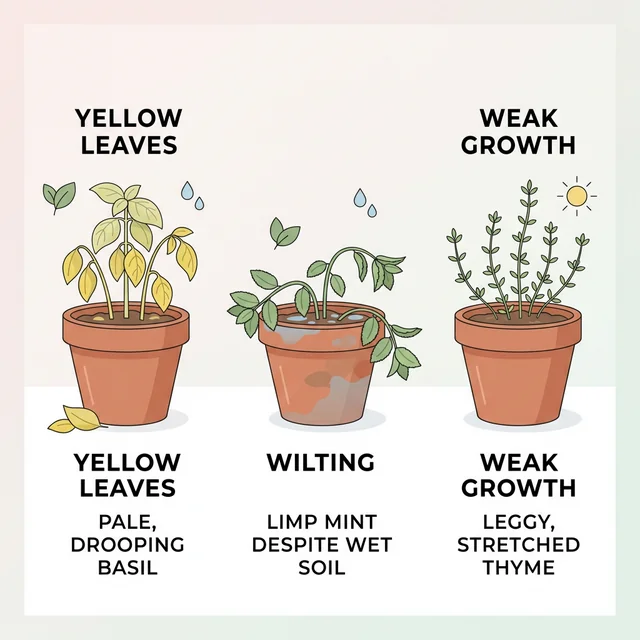
Common potted herb problems usually show up as yellow leaves, wilting, or weak growth, but the useful diagnosis starts with light, drainage, and root stress.
Overwatered vs underwatered: how to tell which one you have
Reading the root zone directly, with a finger test, pot weight, and how the plant responds to being watered, settles what the leaves alone cannot.