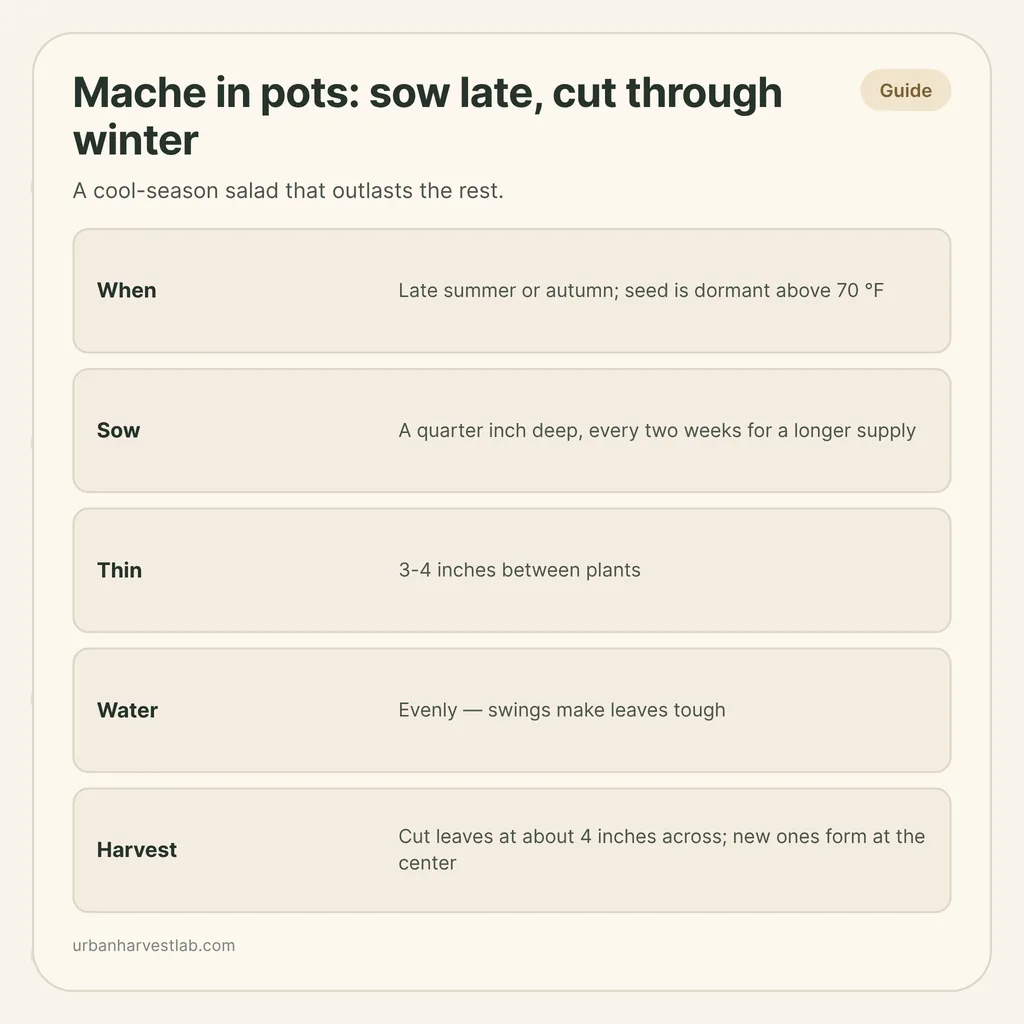
Sow mache (also called corn salad or lamb’s lettuce) in a pot once summer heat has passed, thin it to the 3-4 inches Utah State recommends, keep it evenly moist, and cut it as small rosettes through the cold months. It is a cool-season crop, so it does best in the weather that finishes off most other salad greens.
The ordinary fall mix of lettuce, spinach and arugula is covered in growing salad greens in containers this fall. Mache is the one that keeps going after those slow down.
When to sow
Heat is the thing to avoid. Utah State Extension says mache seed goes dormant and will not germinate above 70 °F, and that it should be direct-seeded when soil is 41-68 °F. It also says high summer temperatures reduce growth, lower quality and make the plants flower, and that the crop grows best when temperatures do not exceed 75 °F.
That sets the calendar:
- Late summer to autumn. The Royal Horticultural Society says mache is normally sown in late summer or autumn for winter salads.
- Utah State’s fall dates. Seed by early September in Utah, or start seeding about 30 days before the first fall frost in your area.
- In a hot spell, wait. Utah State says seed goes dormant above 70 °F, so if seed will not sprout in hot weather, wait until it cools.
Sow seed a quarter inch deep, as Utah State advises. Utah State also says a crop sown now can be harvested two to three weeks after emergence. For a longer supply, it recommends sowing every two weeks; the staggering is explained in succession planting in containers.
Container, spacing and water
The RHS lists mache among plants suited to patio and container growing, in full sun or partial shade. Neither the RHS nor Utah State gives a pot size, only the 3-4 inch spacing between plants. Use fresh potting mix. Utah State warns against garden soil for damping-off, a disease where seedlings collapse shortly after emerging, and adds that wet soil encourages the pathogens.
| Task | What the sources say | Source |
|---|---|---|
| Sowing depth | Quarter inch | Utah State |
| Thin when | Plants have 3-4 true leaves | Utah State |
| Final spacing | 3-4 inches between plants | Utah State |
| Light | Full sun to partial shade | RHS |
| Seed germination | Soil 41-68 °F; dormant above 70 °F | Utah State |
Thin early. The plants you pull can be eaten, or moved to another pot. Utah State notes mache does not compete well with weeds, so pick out any that come up in the mix.
Water evenly. Utah State says moisture fluctuations make leaves tough, slow their development and contribute to off-flavors. In a pot that means checking the mix often and avoiding swings from soaked to dry.
Cold, frost and winter
Utah State reports that temperatures down to 32 °F do not seriously damage young plants, and that mache will easily overwinter in garden beds for an early spring crop, with 4-5 true leaves and heavy mulch. Its hardiness figures are for garden beds, and it gives no figure for plants in pots. Covering on freezing nights is a cautious choice, not a measured need.
Cover option:
- Cloche or cover. The RHS suggests cloches in very harsh weather. Utah State also says row covers protect plants from light frosts in spring and fall.
If you need a cover for freezing nights, browse frost cloth and row cover on Amazon. Materials and fixing options for a balcony are covered in extending the growing season on a balcony.
Harvesting
Mache can be picked at any stage. Utah State says to cut leaves with scissors when they are about 4 inches across, or cut off the entire plant when it is 2-3 inches tall. If you take leaves, new leaves continue to form at the center, so the same rosette feeds you for several cuts. Taking whole plants is a fast way to thin a crowded pot.
Cold-weather growth is slow, so cut a few plants from each pot rather than clearing it. Utah State says harvested leaves keep five to seven days in the refrigerator; wash them before using.
Problems
Utah State describes mache as fast growing and not susceptible to many production problems. Its list includes aphids, flea beetles and slugs, and the RHS notes slugs and snails may eat plants. On a balcony, a quick check of leaf undersides and the pot rim is usually enough. Rotating the location each year helps with most diseases, Utah State says; with pots, start from fresh mix.
Sources
Cool-season salads in pots
Companion reading for fall and winter salad containers.
Common questions
When should I sow mache in pots?
As summer heat fades. The RHS says it is normally sown in late summer or autumn for winter salads. Utah State gives early September for its climate, or about 30 days before the first fall frost, and notes that seed goes dormant above 70 °F.
How cold can mache take on a balcony?
Utah State reports that temperatures down to 32 °F do not seriously damage young plants and that mache overwinters easily in garden beds. The RHS suggests cloches in very harsh weather. Utah State gives no figure for potted plants, so cover the pot if a hard freeze is forecast.
How do I harvest mache without killing the plant?
Utah State says to cut leaves with scissors when they are about 4 inches across; new leaves continue to form at the center. You can also cut the entire plant at 2-3 inches tall.
How far apart should mache plants be?
Utah State recommends 3-4 inches between plants, thinned when they have 3-4 true leaves. Thinnings can be eaten.
Related guides

Extending the growing season on a balcony: row cover, cloche or cold frame
Covers add a few degrees on cold nights and far more heat on sunny days. Here is what each device buys you on a balcony, and how to pick one you can manage.
Growing salad greens in containers this fall
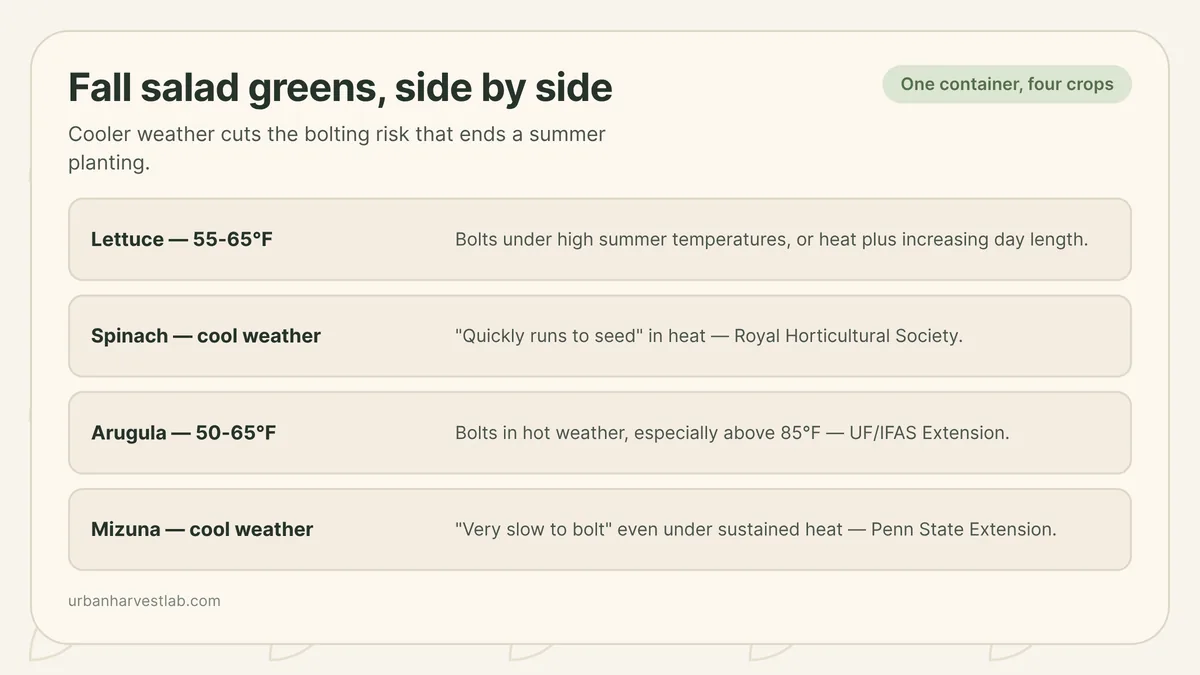
Lettuce, spinach, arugula, and mizuna all share the same summer problem and the same fall fix. Here is how to grow them together once the heat breaks.
Succession planting in containers: how to stagger a harvest from a few pots
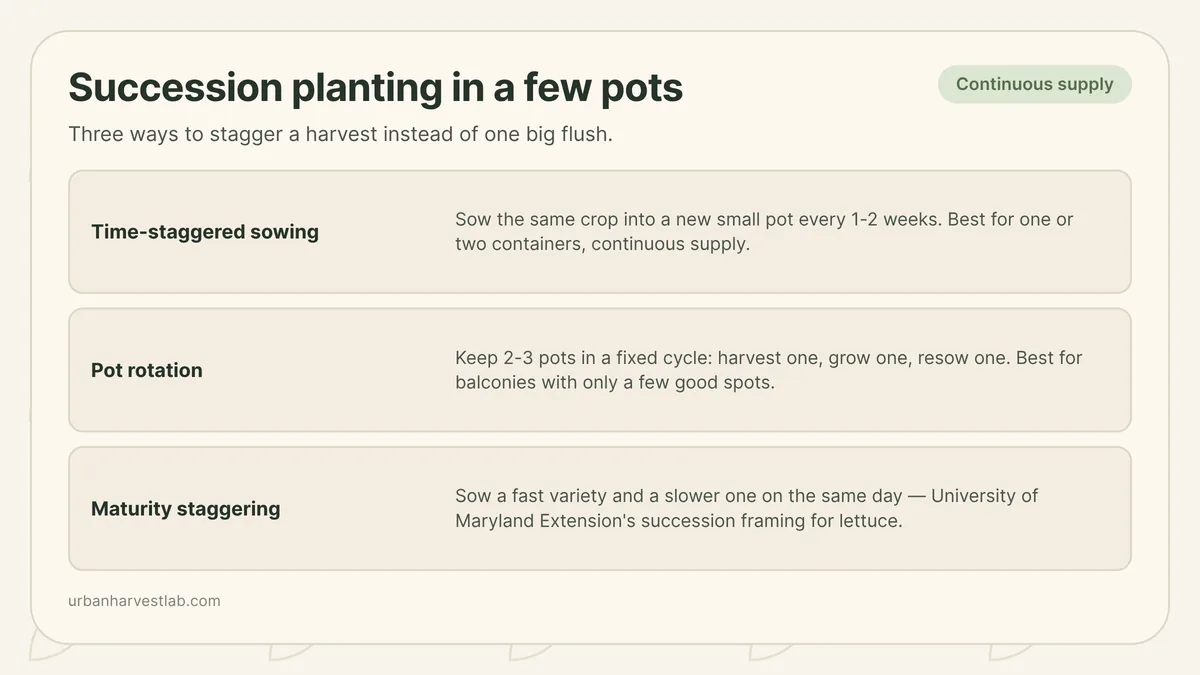
Succession planting in containers is a sowing rhythm: a few pots restarted on a schedule keep producing, where one large planting ripens together and then quits together.