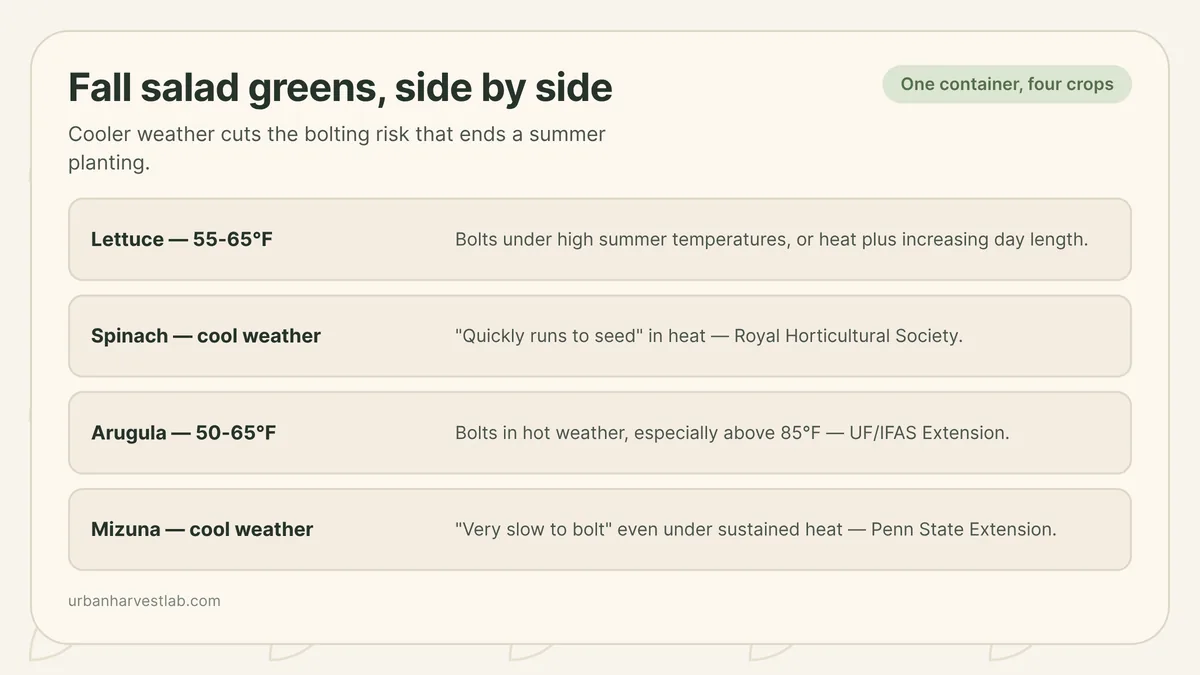
Four fall salad greens, side by side
| Crop | Grows best at | What pushes it to bolt |
|---|---|---|
| Lettuce | 55-65°F | High summer temperatures (Clemson Cooperative Extension); heat plus increasing day length (University of Maryland Extension) |
| Spinach | Cool weather | 'Quickly runs to seed' (Royal Horticultural Society) |
| Arugula | 50-65°F | Hot weather, especially above 85°F (UF/IFAS Extension) |
| Mizuna | Cool weather (55-75°F is Penn State''s germination range, not a growth preference) | Sustained heat, though it is 'very slow to bolt' (Penn State Extension) |
Fall is the easier season for lettuce, spinach, arugula, and mizuna because all four are cool-season crops that shift from making leaves to making a flower stalk once summer heat and long daylight hours arrive, and a fall sowing matures on the other side of that trigger instead of racing against it. Grown together in one container, they cover a longer stretch of the fall calendar than any single green would alone, since they do not all bolt or slow down at the same point as the weather cools further. If this is one piece of a bigger fall setup, a balcony vegetable garden calendar lays out what else to plant and tend through the season.
Why heat ends a summer planting, and fall does not
Lettuce is the clearest case, and the best documented. Clemson Cooperative Extension describes it as a cool-season crop that prefers 55 to 65°F for optimum growth, and states plainly that high summer temperatures cause seed stalk formation, or bolting, along with bitter flavor. The University of Maryland Extension names the same mechanism with one addition: increasing day length and high summer temperatures together cause the seedstalk to form and the leaves to turn bitter. Neither source treats this as something a grower did wrong. It is the plant’s own clock, and a fall sowing simply matures during shortening days and falling temperatures instead of lengthening, warming ones.
Spinach runs on a shorter fuse. The Royal Horticultural Society’s guidance for growing it in containers notes that it “quickly runs to seed” once warm weather arrives, which is why the RHS itself plans to replace a February sowing with a summer crop by June rather than nursing it through the heat. A fall sowing gets the reverse of that timing: temperatures are already falling rather than climbing as the plants mature, so the trigger that ends a spring planting arrives late or not at all before the season closes on its own.
Arugula sits in between. UF/IFAS Extension gives its preferred range as 50 to 65°F and states that it bolts quickly in hot weather, recommending afternoon shade for any planting that has to tolerate temperatures above 85°F. That heat sensitivity is exactly why arugula is usually one of the first greens to give up in a summer container and one of the more reliable performers once fall settles in.
Mizuna is the outlier, in a useful direction. Penn State Extension calls it “very slow to bolt” and names it directly as “an ideal vegetable for early spring or fall planting,” with seed germinating between 55 and 75°F. That slow-bolting habit does not make mizuna immune to summer heat, but it buys more margin than the other three, which is worth knowing if a fall sowing runs later than planned or a warm spell interrupts the season early.
Building one container instead of four
Because all four share a similar cool-season temperature preference and a similarly shallow root system, they can share a single wide, shallow container rather than needing four separate pots. The container-size math for lettuce specifically is covered in growing lettuce in containers, and spinach’s is covered in growing spinach in containers; both settle on a wide, shallow footprint over a deep one for the same reason arugula and mizuna do well in the same shape of pot.
UF/IFAS Extension gives arugula seedlings a 1- to 2-gallon container with drainage holes once true leaves appear — more generous than the roughly half-gallon of mix per plant the lettuce and spinach guides above work out to for a cut-and-come-again stand, so plan arugula’s share of a shared container more generously rather than assuming one density fits all four. Mizuna’s own shallow, fast-growing habit matches that same profile, and Penn State Extension’s harvest method for it, cutting the greens 2 inches or more above the ground for cut-and-come-again regrowth, works the same way in a shared container as it does in a garden bed.
The practical layout is to give each green its own patch of surface area within the container rather than scattering all four seed types together at random. They germinate and mature at slightly different rates, and keeping them in rows or blocks makes it easier to harvest one that is ready without disturbing a neighbor that still needs another week.
Watering follows the same general test Iowa State University Extension gives for any container crop: water once the potting mix is dry to a depth of 1 to 2 inches, checking more often in a hot, sunny, exposed spot and less often once fall weather turns cool and overcast. That test matters more for this mix than for a single deep-rooted crop, since all four greens keep their roots shallow and dry out from the surface down rather than drawing on a deeper reserve.
Succession sowing keeps the container producing
A single fall sowing of any of these four still finishes on its own schedule, cool weather or not — the Alabama Cooperative Extension System puts most lettuce cultivars at 5 to 7 weeks from sowing to picking, which is the interval a fall container is actually working against — so the container that keeps producing longest is the one seeded in stages rather than all at once. The University of Maryland Extension’s general advice for lettuce is to plant it in succession, or in different varieties that mature at different times, rather than sowing the whole crop on one date. UF/IFAS Extension is more specific for arugula, recommending a fresh sowing every two weeks through the cooler months for a continuous supply of young leaves.
Applied across all four greens in a shared container, that means holding back part of the planting area at sowing time and filling it in every one to two weeks rather than using the whole surface on day one. The general timing and spacing math for staggering any container crop this way, not just these four, is covered in succession sowing for containers.
What ends the run, and which green lasts longest
Fall does not remove the eventual end of the season, it just changes what causes it. Instead of bolting, a mixed salad container in fall is more likely to finish when frost or day length gets short enough to stop growth outright. Both the University of Maryland Extension and Penn State Extension describe lettuce and mizuna respectively as able to withstand a light frost. UF/IFAS Extension reports arugula tolerates light freezes and recommends frost cloth, row cover, or a cold frame once temperatures fall below 32°F, so lettuce, mizuna, and arugula all have documented light-frost tolerance. Spinach’s frost tolerance is the one not documented in these sources, so it is safer to treat it as the earlier finisher in a mixed container and plan its last sowing a little ahead of the other three. First and last frost dates for a balcony covers finding the date that last-sowing decision depends on.
A container that is losing light fast, rather than just cooling down, is a different problem from bolting and calls for a different response: moving the whole planting to the brightest remaining spot, or adding supplemental light, does more good at that point than adjusting the sowing schedule further.
Why fall, and not just spring, for a first mixed planting
Cool, bolt-resistant growth is not unique to fall; it is also what a spring sowing gets before summer heat arrives. The University of Maryland Extension notes that leaf lettuce can be grown from March to December, with a break in July and August, which frames fall as the second half of the same cool window spring opens, not a separate season with its own rules. The Alabama Cooperative Extension System states plainly that fall is the best time to plant lettuce, even though spring planting is also workable.
The practical difference for a first attempt at this four-crop mix is margin: a slightly late fall sowing costs some harvest window rather than ending the planting outright, which is not true of a spring sowing running late into the heat.
Sources
- Clemson Cooperative Extension, “Lettuce”
- University of Maryland Extension, “Growing Lettuce in a Home Garden”
- Alabama Cooperative Extension System, “Growing Lettuce in Spring or Fall”
- UF/IFAS Extension (Leon County), “Arugula: Planting and Care”
- Penn State Extension, “Mizuna: an Asian Green”
- Royal Horticultural Society, “Vegetables in containers”
- Iowa State University Extension, “How to Care for Plants Growing in Containers”
Round out a fall container planting
These guides cover the per-crop container sizing, the succession technique, and the fall planning that go with a mixed salad-greens container.
Common questions
Can lettuce, spinach, arugula, and mizuna share one container in fall?
Yes. Clemson Cooperative Extension's 55-65°F for lettuce and UF/IFAS Extension's 50-65°F for arugula overlap enough to share a pot; Penn State Extension's 55-75°F for mizuna is a germination figure rather than a growth preference, and the Royal Horticultural Society gives spinach no temperature range at all, only "cool weather." All four keep most of their roots in the top several inches of soil, so a wide, shallow container that would suit lettuce alone works for the mix. Give each its own patch of surface area rather than scattering seed randomly, since they mature at slightly different rates.
Why do salad greens bolt in summer but not in fall?
Clemson Cooperative Extension and the University of Maryland Extension both point to rising heat as the trigger that pushes lettuce from making leaves to making a flower stalk, and University of Maryland Extension adds lengthening days as part of that trigger. A fall sowing matures during shortening days and falling temperatures instead, so the shift that ends a summer planting simply does not arrive on the same schedule.
How often should you sow a fall salad greens container?
Every one to two weeks for as long as the season allows. The University of Maryland Extension recommends succession sowing lettuce rather than planting it all at once, and UF/IFAS Extension gives arugula specifically a two-week sowing interval for a continuous supply through the cooler months.
Which of the four greens holds up longest as fall turns colder?
Penn State Extension gives mizuna light-frost tolerance, University of Maryland Extension and Clemson Cooperative Extension both give lettuce light-frost tolerance, and UF/IFAS Extension gives arugula tolerance of light freezes — spinach is the one green in the mix with no hardiness figure from these sources.
Related guides
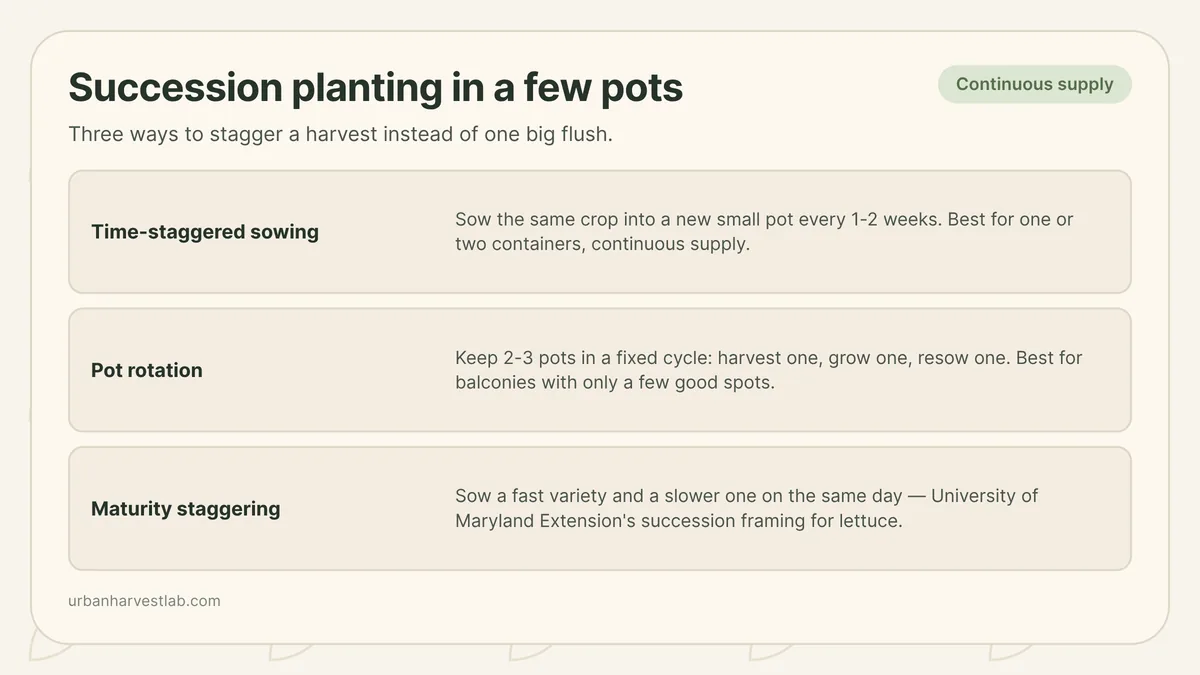
Succession planting in containers: how to stagger a harvest from a few pots
Succession planting in containers is a sowing rhythm: a few pots restarted on a schedule keep producing, where one large planting ripens together and then quits together.
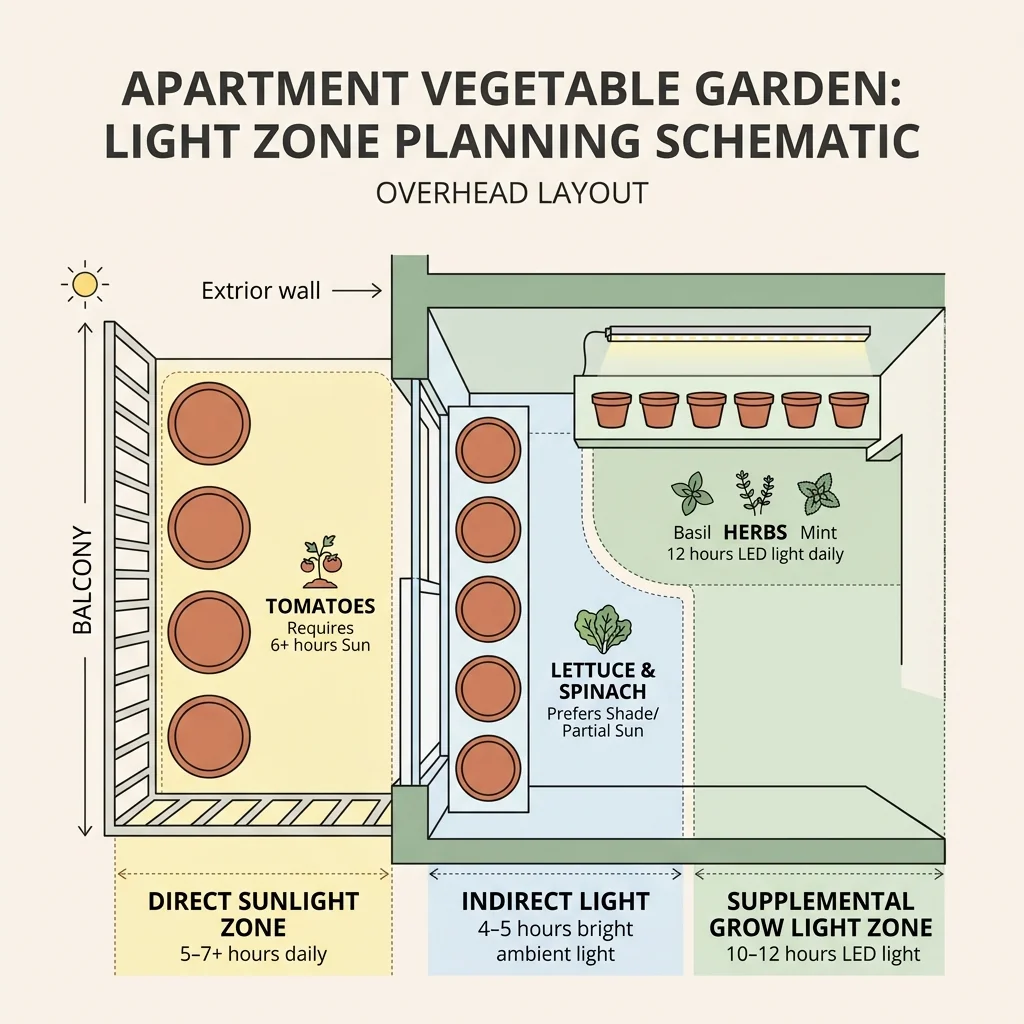
A beginner's apartment vegetable garden plan
Growing food in an apartment works when light, containers, crops, and routine are planned together. This is a simple, step-by-step plan to start from scratch.
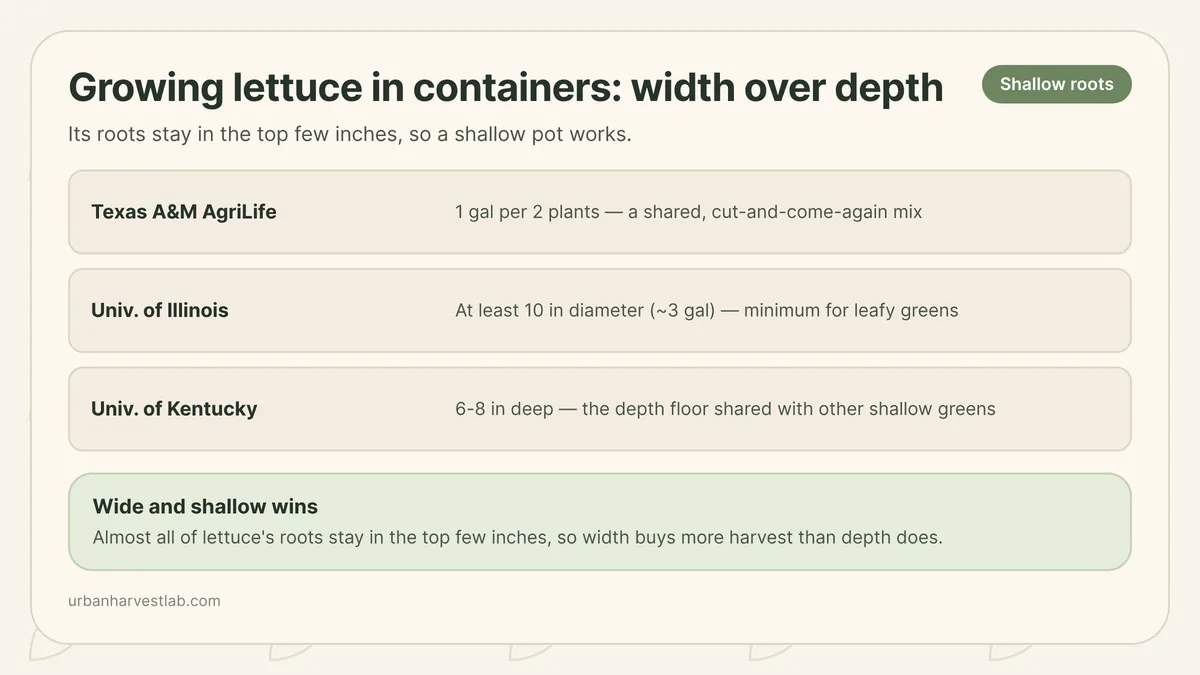
Growing lettuce in containers: pot size and spacing for soil
Lettuce keeps its roots in the top few inches of soil, which changes the whole container math. Here is how wide, how deep, and how far apart to space it.