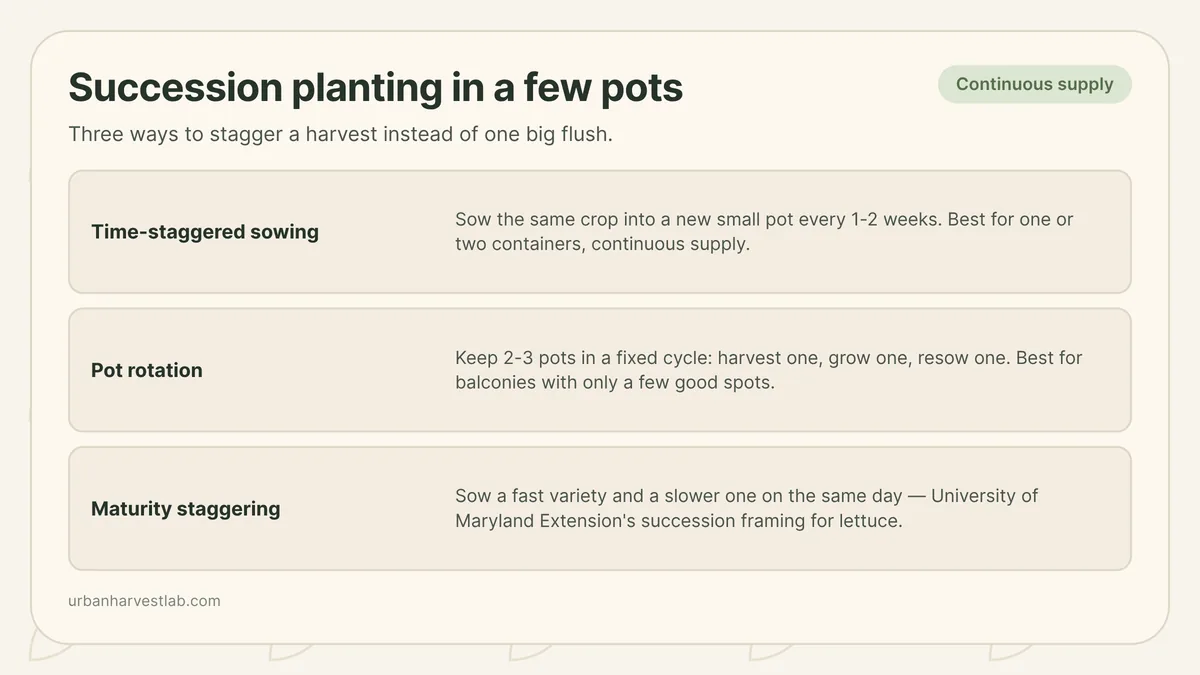
Three ways to stagger a harvest in a small footprint
| Method | How it works | Best for |
|---|---|---|
| Time-staggered sowing | Sow the same crop into a new small pot or cell tray every 1-2 weeks | One or two containers, same crop, continuous supply |
| Pot rotation | Keep 2-3 pots in a fixed cycle: harvest one, grow one, resow one | Balconies with only a few good spots for containers |
| Maturity staggering | Sow a fast variety and a slower one of the same crop on the same day — the University of Maryland Extension's own succession framing for lettuce | Filling a gap without a second sowing date to track |
Succession planting in containers means sowing a fast crop in small batches, a week or two apart, instead of filling every pot on the same day. Instead of one tray of lettuce or radish that all matures together and then leaves you with an empty pot, you keep two or three containers moving through sowing, growing, and harvest at staggered stages, so something is ready most weeks. The balcony vegetable garden calendar covers the seasonal gates that decide when to start and stop; this is the sowing rhythm that runs inside each of those windows.
Why one big sowing leaves you with a glut, then nothing
A single sowing of a fast crop germinates on roughly the same schedule, grows at roughly the same rate, and finishes at roughly the same time. That is fine for a crop you plan to preserve or use in bulk. For a household eating a handful of greens or a few radishes at a time, it means a week of more lettuce than you can use, followed by weeks of an empty pot while you wait for the next round to catch up — if you remembered to start one.
Staggering breaks that pattern by treating the harvest as an ongoing supply rather than a single event. You are not growing more food in total; you are spreading the same amount of food across more of the season, in portions that match how much you actually eat in a week.
The crops this actually works for
Succession sowing is built for fast annuals — crops that complete an entire life cycle in one season and decline on their own timetable regardless of care. Clemson Cooperative Extension’s own herb classification lists basil, cilantro, and dill among the annuals in a home herb bed, alongside borage and marjoram, distinct from the biennials and perennials that behave differently in a pot. The same logic carries over to fast vegetable crops grown the same way: lettuce, arugula, spinach, and radish all mature quickly and bolt or decline once conditions push them. That does not mean one cut ends a pot: Illinois Extension found that annual herbs like basil tolerate cutting back 50 to 75 percent of their growth and recovering, and Iowa State University Extension gives the same annual group a cut “back to within 4 to 6 inches of the ground” without needing to be resown. Growing salad greens in containers for fall gives the per-green cut heights for lettuce, arugula, spinach, and mizuna specifically. Once a pot stops sending up usable new growth after a cut — not after its first harvest — that is the point to count the rotation interval from and resow it.
That is the reason succession planting is a technique for these crops specifically, and not for a pepper plant or a rosemary shrub. A perennial herb or a long-season fruiting crop is not something you restart every couple of weeks — it is something you maintain across a whole season or longer. Staggering a fast annual works with its short lifespan instead of fighting it.
Light matters when you are deciding which pot gets which sowing. Penn State Extension names cilantro, along with lemon balm and chives, as tolerating lower light than most herbs, in the 2 to 6 hour range, while most herbs want closer to 6 hours of direct sun. If your balcony has one bright spot and one marginal one, a low-light-tolerant crop like cilantro can take the dimmer position while a sun-hungry crop occupies the better one — useful when you are running more than one rotation in a limited footprint.
Three ways to stagger a harvest in a small footprint
Time-staggered sowing is the simplest version: sow the same crop into a small pot, cell tray, or section of a larger container every one to two weeks. Each new sowing becomes the next wave of harvest once the earlier one is cut. This works well when you have one or two containers you are willing to dedicate to the same crop for the whole season.
Pot rotation treats a small set of containers, typically two or three, as a cycle rather than a fixed planting. At any point, one pot is being harvested, one is mid-growth, and one has just been resown after the previous crop finished. As soon as a pot is cleared, it goes back into the cycle instead of sitting empty or being repurposed on impulse.
Maturity staggering sows a fast variety and a slower one of the same crop side by side on the same day, so they finish at different times without you needing to remember a second sowing date — this is the University of Maryland Extension’s own succession advice for lettuce, framed as planting different varieties that mature at different times. It is the lowest-maintenance version, at the cost of less control over the exact interval between harvests.
Most balcony setups end up combining the first two: a rotation of two or three pots, with a new sowing timed into whichever pot the previous crop just vacated.
Keeping soil productive across repeat sowings
A container resown every few weeks is doing more work than one planted once and left for a season, and the soil needs attention to match. Iowa State University Extension gives a working baseline for container plants generally: check moisture by feel, watering “when the potting mix is dry at a depth of 1 to 2 inches,” with frequency swinging anywhere from once or twice a day in a small pot in hot, windy weather to once or twice a week in a larger pot in cool conditions. The same source recommends fertilizing container plants “every 1 to 3 weeks throughout the summer” with a 1:2:1 nitrogen-phosphorus-potassium ratio product — a schedule that matters even more in a pot being resown repeatedly, since each new sowing resets that feeding clock. The container has stayed in continuous use, but from the schedule’s point of view, the new batch is starting fresh just like a brand-new pot would; how often to feed container vegetables covers the crop-by-crop intervals that clock should follow.
Between rounds, break up any compacted mix at the surface and top up with fresh potting mix if the level has dropped noticeably. You do not need to empty and replace the whole pot after every sowing, but a container running its third or fourth crop of the season is a different soil situation than the one it started with. Whether that calls for a deeper refresh rather than just fluffing and topping up depends on what the previous crop was and how it finished — crop rotation in containers covers when a mix needs amending or replacing between plantings, not just a surface top-up.
A simple rotation to start with
Pick one fast crop and two or three containers you can dedicate to it. For a crop that takes about three weeks from sowing to first harvest, a three-pot rotation sown a week apart works out like this:
| Week | Pot A | Pot B | Pot C |
|---|---|---|---|
| 1 | Sow | — | — |
| 2 | Growing | Sow | — |
| 3 | Growing | Growing | Sow |
| 4 | Harvest, then resow | Growing | Growing |
| 5 | Growing | Harvest, then resow | Growing |
| 6 | Growing | Growing | Harvest, then resow |
| 7 | Harvest, then resow | Growing | Growing |
| 8 | Growing | Harvest, then resow | Growing |
By week 4, every pot has settled into the same three-step cycle it repeats for the rest of the season: harvest, resow, grow on. A crop that matures faster or slower than three weeks shifts the numbers in this table but not its shape — count from your own crop’s actual time to harvest rather than the three weeks used here.
Sow a fraction of each pot’s surface rather than filling the whole thing at every date, especially in a wider container: a single pot divided into two or three sowing bands can carry more than one stage of the rotation at once, which cuts how many separate containers the same rotation needs. Oregon State University Extension’s own per-crop spacing figures are a useful reference for how tight to sow a band — for cilantro specifically, roughly 10 to 15 seeds per foot of row, thinned to 8 inches apart, covered in full at why does cilantro bolt. For how much surface area a crop needs once it is growing rather than germinating, the per-crop sizing guides such as lettuce container size and spinach in containers cover that separately.
Watch your own results for the first cycle or two rather than committing to a fixed interval from the start. A sunnier or warmer spot moves a fast crop through its stages quicker than a shadier or cooler one, so the gap that works on one balcony may crowd or starve the rotation on another.
Common mistakes
- Sowing every container on the same day, which recreates the glut-then-gap problem the technique is meant to solve.
- Leaving a harvested pot empty “until next weekend” instead of resowing it immediately, which breaks the rotation and creates a gap later.
- Applying the rotation to a slow, long-season crop that only gives one harvest a season regardless of how it is sown.
- Assuming a container’s feeding schedule still runs on whatever interval its very first crop started, instead of restarting the clock each time a new batch is sown, so a pot resown for months on the original reminder quietly runs short.
- Ignoring how light and heat shift through the season — a pace that worked in spring can leave gaps once a fast crop starts bolting in summer heat.
Fall applications of this same rotation, including which greens hold up best as the light and temperature change, are covered in growing salad greens in containers for fall. For the frost and temperature gates that decide when a rotation should start and when to wind it down for the season, see the balcony vegetable garden calendar. Crop choices that fit a small footprint in the first place are in best vegetables for small balconies, container sizing fundamentals are in best containers for herbs, and whether a pot’s mix needs more than a surface refresh between rounds is in crop rotation in containers.
Sources
- Clemson Cooperative Extension HGIC: Herbs
- Penn State Extension: Growing Herbs Indoors
- Iowa State University Extension: How to Care for Plants Growing in Containers
- University of Illinois Extension: Harvesting (Herbs)
- University of Maryland Extension: Growing Lettuce in a Home Garden
- UF/IFAS Extension (Leon County): Arugula: Planting and Care
- Oregon State University Extension: How to grow cilantro for leaves — or coriander seeds
Build the rotation
Pair the staggering technique with the seasonal calendar, the mix-refresh question between crops, and the feeding schedule a resown pot needs.
Common questions
What is succession planting in containers?
It means sowing a fast crop in small batches, spaced a week or two apart, in the same pots or a small rotating set of them, so new plants keep coming on as older ones are harvested instead of one large batch maturing and finishing together.
How often should I sow a new batch?
Every one to two weeks is a practical starting interval for fast greens and radishes: the University of Maryland Extension recommends succession sowing lettuce rather than planting the whole crop at once, and UF/IFAS Extension gives arugula a two-week interval specifically for a continuous supply through the cooler months. Watch how quickly the previous batch matured in your own light and temperature and adjust the gap from there rather than following a fixed number for every balcony.
How many pots do I need to keep a harvest going continuously?
Two or three containers per crop is usually enough. One is being harvested, one is growing on, and one has just been resown, so something is at each stage at any given time.
Do I need to replace the soil between sowings?
Not every time, but each new sowing resets the pot's feeding clock — treat the first few weeks after a resow like a fresh planting rather than assuming it is still on whatever interval its first crop started. Fertilize on the interval Iowa State gives for container plants generally, and refresh or fluff the top few inches of mix once it has compacted.
Related guides
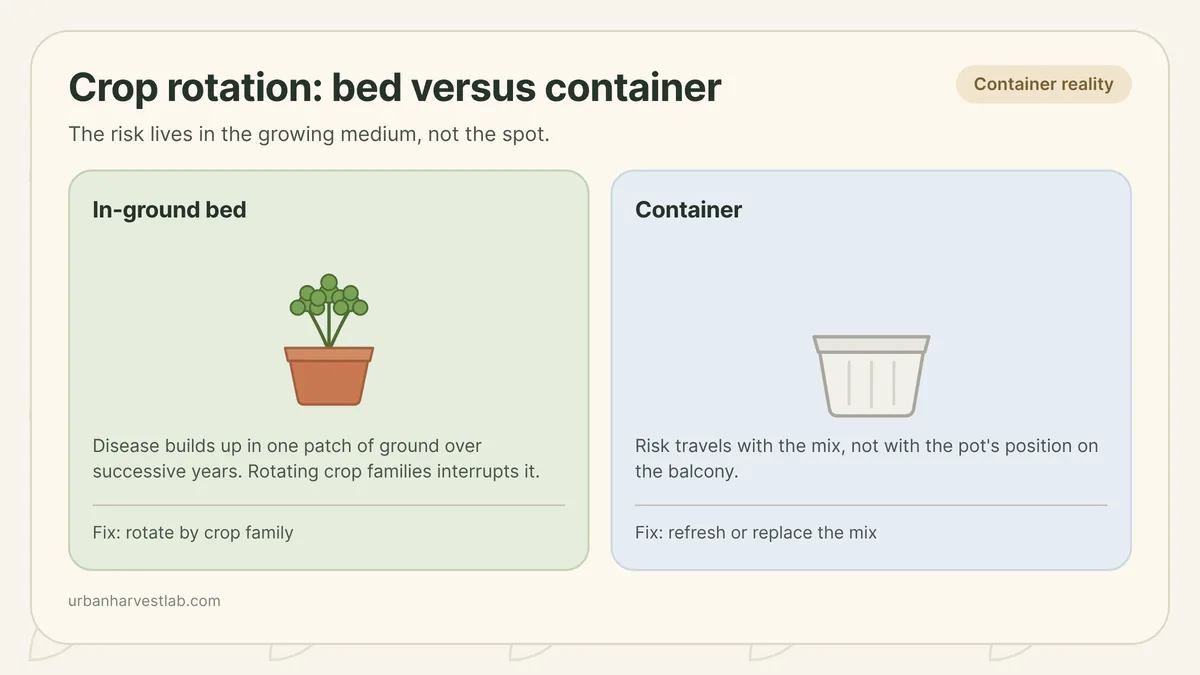
Crop rotation in pots: what actually matters
The rotation habit that protects an in-ground vegetable patch does not transfer cleanly to a pot, because the thing it was protecting against lives in the soil, not the spot.
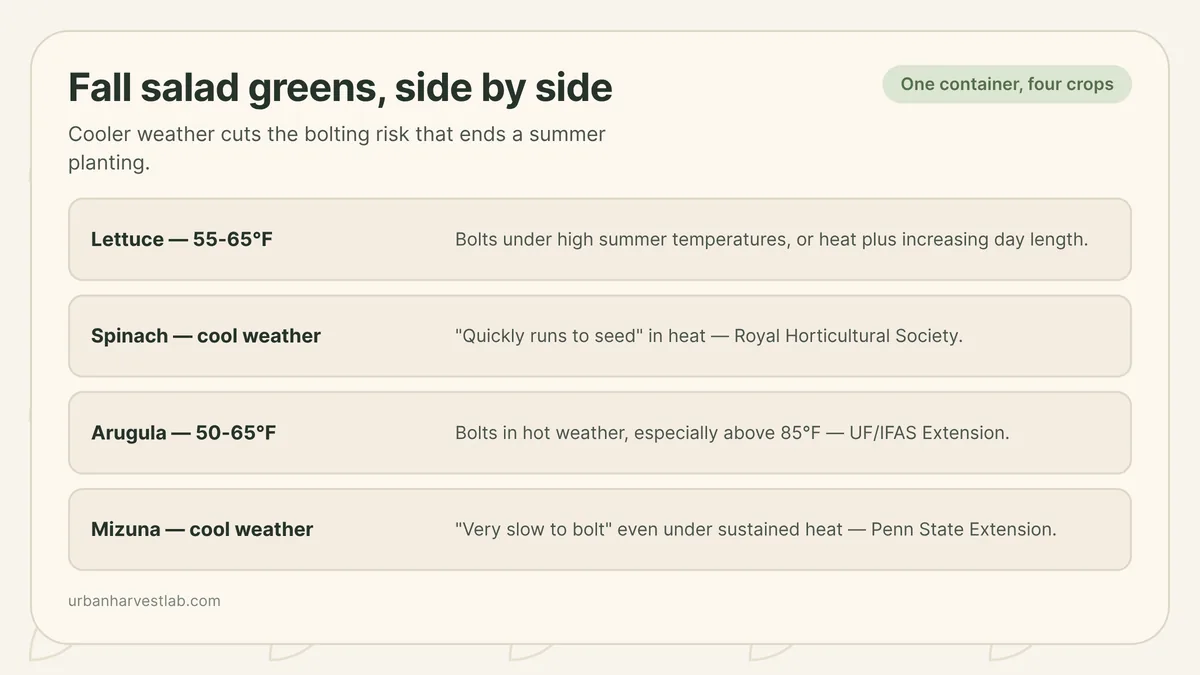
Growing salad greens in containers this fall
Lettuce, spinach, arugula, and mizuna all share the same summer problem and the same fall fix. Here is how to grow them together once the heat breaks.
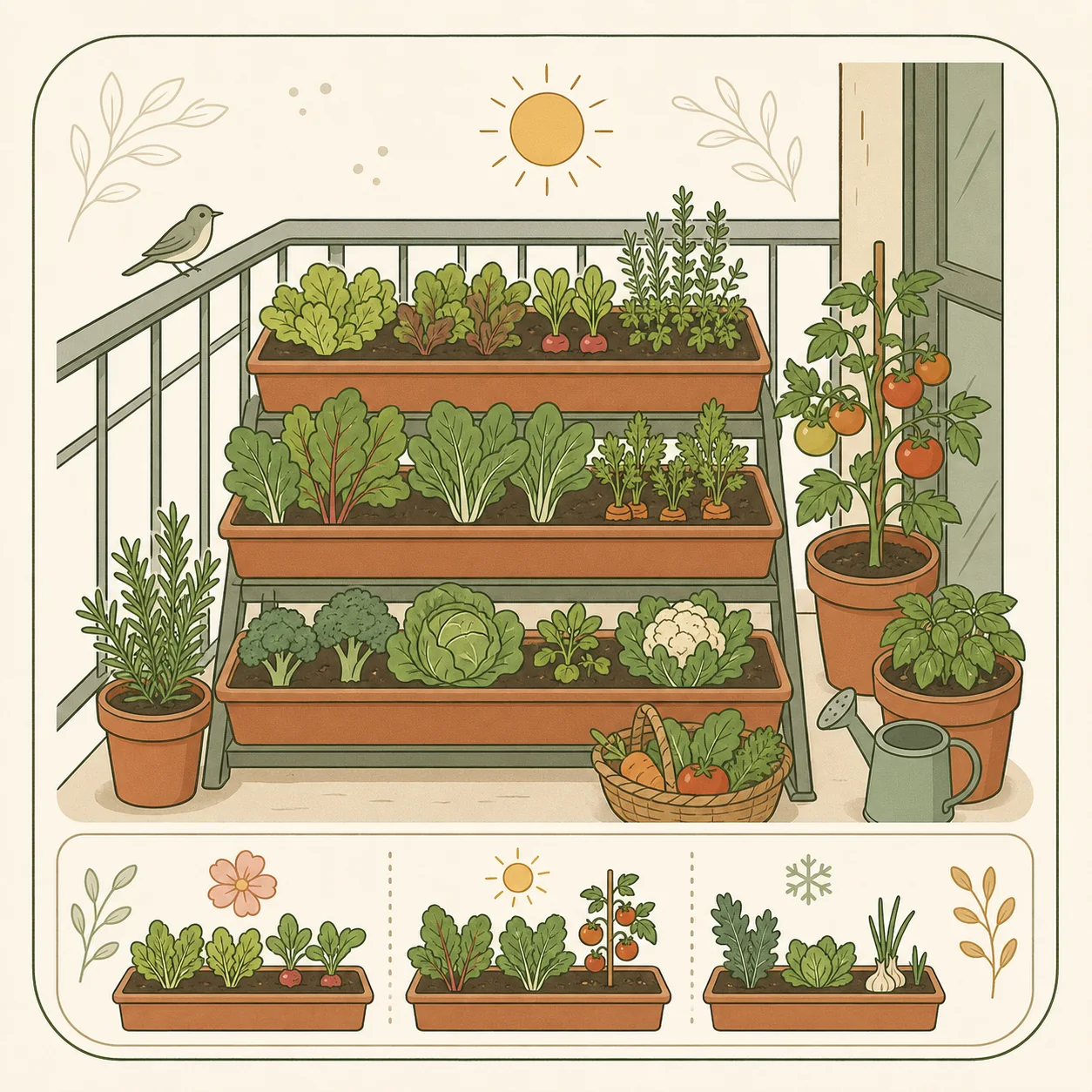
Balcony vegetable garden calendar: what to do each season
A useful balcony calendar is a set of seasonal decisions, not twelve fixed planting lists. Use temperature, light, and container conditions to decide what happens next.